Editor’s note: The current article is authored by Clandestine, threat researcher and threat hunter. You can find Clandestine on X.
Taking down a banking Trojan does not necessarily stop financial fraud. Cybercriminals can switch malware families, reuse existing infrastructure, and exploit legitimate software to keep their operations running. In LATAM, this adaptability creates a persistent challenge for businesses trying to protect financial assets and customer data. Using ANY.RUN, we explore the connections behind Brazilian-linked financial fraud and identify opportunities for earlier detection and more effective response.
Key Takeaways
- Financial fraud operations in LATAM are highly interconnected, combining banking Trojans, infostealers, phishing kits, and legitimate remote access software.
- Vidar and StealC dominate the analyzed Brazilian infostealer submissions, appearing in 73% and 49% of sessions, respectively.
- Attackers exploit legitimate websites and software to evade detection, extend their reach, and maintain unauthorized access.
- Shared infrastructure and execution patterns offer opportunities for broader threat detection without relying solely on malware-specific indicators.
- Behavioral analysis and timely threat intelligence can help SOC teams uncover related threats faster, close detection gaps, and reduce business exposure to financial fraud.
The Business Risks Behind LATAM’s Financial Fraud Ecosystem
For financial institutions and payment providers, the ability to detect threats before they result in fraudulent transactions is critical to protecting revenue and maintaining customer trust. However, as cybercriminals diversify their attack methods, security teams must investigate increasingly complex incidents within increasingly narrow response windows.
This creates several operational and financial challenges:
- Rising cost per incident: Investigating interconnected threats requires more time and security resources, increasing the cost of incident response and remediation.
- Pressure on SOC capacity: Recurring campaigns and evolving attack techniques increase investigation workloads, leaving fewer resources for proactive threat hunting.
- Costly response delays: Every minute spent validating suspicious activity gives attackers more time to compromise accounts, access sensitive information, or initiate fraudulent transactions.
- Inefficient security investments: Relying heavily on malware-specific detection rules requires continuous updates as attackers switch between malware families and infrastructure.
For security leaders, the priority is to build detection and response capabilities that remain effective as attack methods change. Understanding the relationships between threats can help organizations focus their security investments on common attack behaviors, improve SOC productivity, and achieve broader protection with existing resources.
Research Overview
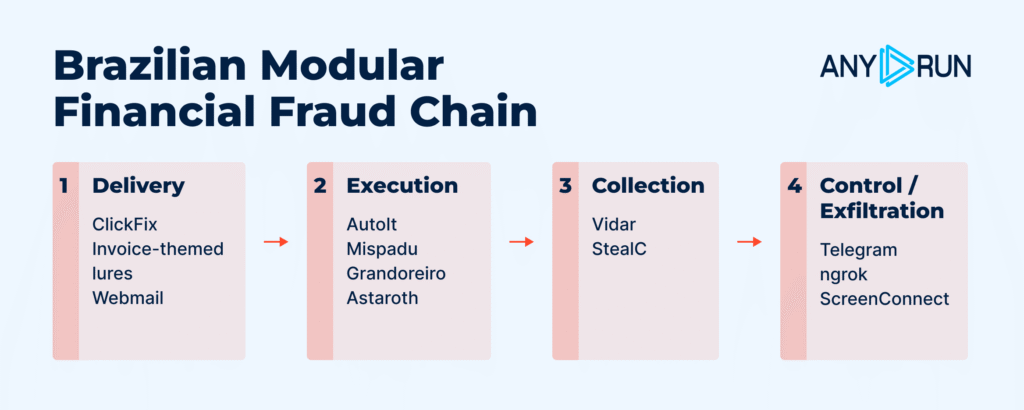
Financial fraud linked to Brazil operates as a modular chain of services rather than being the work of a single threat actor or malware family. Eight queries conducted using ANY.RUN’s Threat Intelligence Lookup (TI Lookup) on October 16, 2026, combined with cross-verification against open sources, reveal four recurring stages: delivery, execution, collection, and control/exfiltration.
The delivery stage is dominated by invoice lures, compromised webmail, and, increasingly, legitimate Brazilian websites compromised to deliver attacks using ClickFix and EtherHiding techniques. Execution centers on LATAM banking Trojans packaged in AutoIt (Mispadu/URSA, Grandoreiro, Astaroth), frequently employing language checks. Collection is performed by widely available infostealers, with Vidar and StealC accounting for the largest share of observed activity following the disruption of Lumma’s infrastructure in May 2025. Control and exfiltration rely on Telegram bots, ngrok tunnels, and the widespread abuse of legitimate remote access software, particularly ScreenConnect.
From a defensive standpoint, the highest immediate priority is the governance of remote monitoring and management (RMM) instances, followed by the detection of AutoIt3.exe execution from temporary directories or IExpress-generated files, which can help identify both banking Trojans and infostealers.
1. Operational and Economic Context
1.1 The Pix System as a Structural Driver
Brazil’s instant payment system, Pix, surpassed one billion registered keys in September 2026 and serves approximately 170 million customers. Monthly transaction volume exceeds seven billion, with values in the trillions of reais. The same characteristics that make the system efficient (real-time settlement, limited reversibility, and widespread adoption) reduce the time available for fraud detection and response while increasing the potential returns for cybercriminals.
Data compiled from Brazil’s Central Bank indicate substantial losses associated with Pix-related scams, with historically low recovery rates through the Special Refund Mechanism. This economic environment sustains a specialized criminal ecosystem capable of operating both at scale, through phishing kits and malware loaders, and through more sophisticated attacks involving banking Trojans with overlay and remote-control capabilities.
For financial institutions, this makes early threat detection particularly important, as delays in identifying malicious activity can translate directly into financial losses.
1.2 Specialization of the Brazilian Financial Fraud Ecosystem
The financial fraud ecosystem originating in or closely linked to Brazil exhibits several distinctive characteristics. These include the development of banking Trojans with overlay and remote-control capabilities, frequently written in Delphi and packaged in AutoIt; systematic use of geofencing based on language (Portuguese or Spanish) and location; and extensive use of legitimate infrastructure and software to evade detection.
Law enforcement operations have had temporary rather than lasting effects. The Brazilian Federal Police operation against Grandoreiro in January 2024 resulted in arrests and infrastructure takedowns. Subsequent campaigns, documented by IBM X-Force, targeted at least 1,500 banking applications across more than 60 countries. Astaroth (also known as Guildma) has been observed using ngrok for command and control (C2) and public repositories to maintain access to its configuration data. These patterns illustrate the ecosystem’s ability to adapt to disruptions.
2. Research Methodology and Scope
The research was conducted using ANY.RUN’s Threat Intelligence Lookup on October 16, 2026. Eight queries were used to identify recurring attack patterns and connections between malware families, infrastructure, and execution techniques.
Geographical and industry data reflect the origin of sample submissions rather than confirmed infection locations or targeted sectors. Search results were reviewed to exclude unrelated activity, taking into account that a single analysis may contain multiple threat labels.
The identified connections provide a foundation for further threat investigations and can be validated through open-source intelligence and behavioral analysis in ANY.RUN’s Interactive Sandbox.
3. The Modular Chain
The evidence indicates that activity is organized into four relatively independent stages. Different operators and services can be combined according to the campaign.
3.1 Delivery
Traditional invoice lures, frequently featuring the pattern .php?tipo=inv, remain in use. Domains such as 2026pdf[.]com, impdocw[.]com, and otxsmart[.]com, hosted within an IP address range in Germany, were observed. Links using share.google with Roundcube parameters suggest delivery through compromised webmail.
Alongside these methods, attackers use compromised legitimate Brazilian websites to deliver malicious content. The ClickFix technique tricks users into copying and executing a command in the Windows Run dialog. In more recent variants, malicious configurations are retrieved from smart contracts (EtherHiding), making the attack infrastructure more resilient.
Websites belonging to small organizations, including healthcare providers, also appear in the query results. This combination allows attackers to expand their reach beyond traditional email campaigns, making it increasingly important for businesses to detect threats originating from seemingly trustworthy websites.
3.2 Execution
The observed LATAM banking Trojans use AutoIt as a packer. The association between a3x and Mispadu is consistent with previously documented attack chains in which malware checks the system language before proceeding.
These language-based evasion techniques highlight the importance of analyzing suspicious samples in environments configured to match the intended targets, including Portuguese or Spanish system locales.
Grandoreiro and Astaroth also appear in this context, although with different volumes and distribution patterns.
3.3 Collection
After the coordinated operation that seized approximately 2,300 domains associated with Lumma in May 2025, some samples labeled as Lumma were observed accessing judicial notification pages and sinkholes. In Brazilian submissions, Vidar and StealC account for the largest share of observed activity.
The pattern of AutoIt3.exe execution from an IExpress-generated temporary directory is common to both infostealers and banking Trojans, enabling partial detection coverage with a single detection rule.
3.4 Control and Exfiltration
Exfiltration via the Telegram Bot API was observed with multiple distinct tokens and a relatively high proportion of submissions from the banking sector. ngrok tunnels are used by banking Trojans for command and control (C2).
ScreenConnect appears across several queries. Recent campaigns documented in open sources confirm the abuse of unauthorized ScreenConnect instances delivered via phishing, including through legitimate services such as Power BI. This layer provides attackers with remote access capabilities that are difficult to distinguish from legitimate IT support activity.
4. Detailed Query Results
4.1 LATAM Banking Trojans in Brazilian Submissions
The query returned 17 analyses. The labels a3x and mispadu appear in 52% of sessions, followed by astaroth (29%) and grandoreiro (17%).
Connections to 1.tcp.us-cal-1.ngrok.io on multiple ports, DNS-over-HTTPS resolution for charlie.stufftoread[.]com, and, in one session, access to web.whatsapp.com/status.json were observed. The IP address and port 13.222.157.107:8138 also appear in other queries.
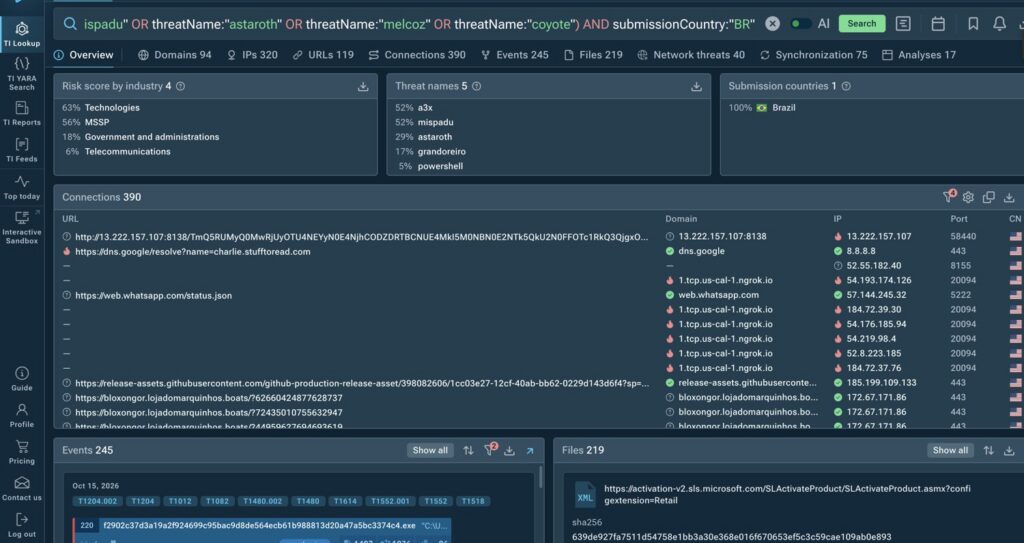
The co-occurrence of a3x and Mispadu is consistent with the documented Mispadu attack chain, which includes a language check. Access to WhatsApp Web may indicate the presence of a propagation module, although this remains unverified.
4.2 Grandoreiro with Run Key Persistence
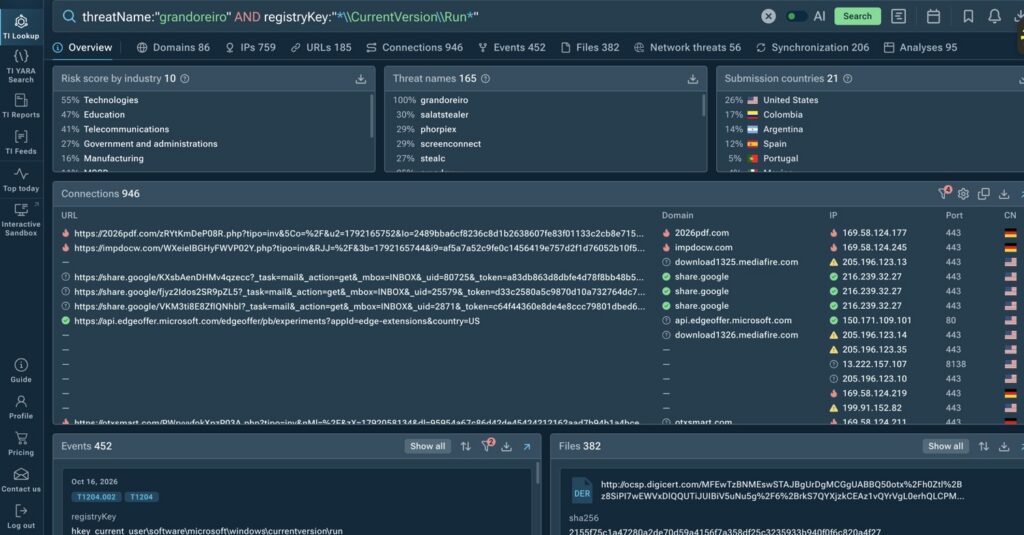
The query returned 95 analyses. The geographical distribution of submissions includes the United States (26%), Colombia (17%), Argentina (14%), Spain (12%), and Portugal (5%). Frequently associated threat labels include salatstealer (30%), phorpiex (29%), screenconnect (29%), and stealc (27%).
Invoice lures featuring the .php?tipo=inv pattern appear on domains hosted within the 169.58.124.0/24 IP address range. Links using share.google with Roundcube parameters suggest delivery through compromised webmail.
The IP address 13.222.157.107 also appears in other queries, providing an investigative pivot to banking Trojan sessions submitted from Brazil. The geographical distribution of submissions is consistent with the international expansion of Grandoreiro campaigns documented by IBM X-Force following the 2024 operation, although it does not establish actual infection locations.
TI query: threatName:”grandoreiro” AND registryKey:”\CurrentVersion\Run”
4.3 Bankers with msiexec Execution
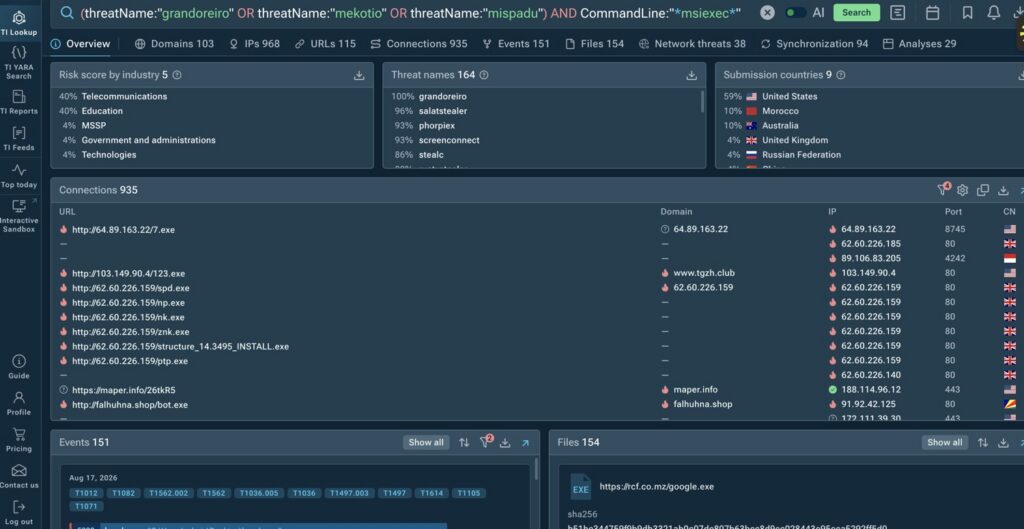
The query returned 29 analyses. Grandoreiro appears in 100% of sessions, with high co-occurrence of salatstealer (96%), phorpiex (93%), screenconnect (93%), and stealc (86%). Geographic distribution (United States 59%, Morocco and Australia 10%) and the absence of Portuguese-language lures and Brazilian submissions among the top countries suggest these are predominantly loader pay-per-install sessions rather than a dedicated Grandoreiro campaign. The server 62.60.226.159 distributes multiple generic executables. This interpretation remains at moderate confidence, as no public source establishes a direct link between Phorpiex and Grandoreiro.
TI query: (threatName:”grandoreiro” OR threatName:”mekotio” OR threatName:”mispadu”) AND CommandLine:”msiexec“
4.4 Infostealers with Brazilian Submission
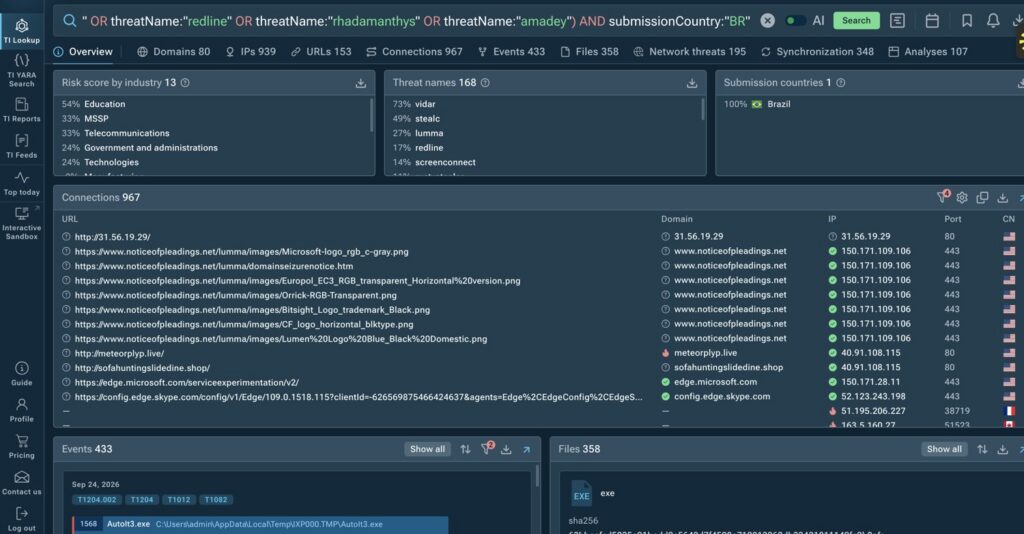
The query returned 107 analyses. Vidar appears in 73% and StealC in 49%. Lumma (27%) and Redline (17%) are present in lower volume. Sessions labeled as Lumma access the judicial notification page at noticeofpleadings.net, corresponding to the May 2025 operation. The AutoIt3.exe pattern from %TEMP%\IXP000.TMP\ is recurrent. Some Lumma samples are legacy with neutralized C2; detection priority falls on Vidar and StealC. AutoIt use is common to both stealers and bankers.
4.5 Exfiltration via Telegram
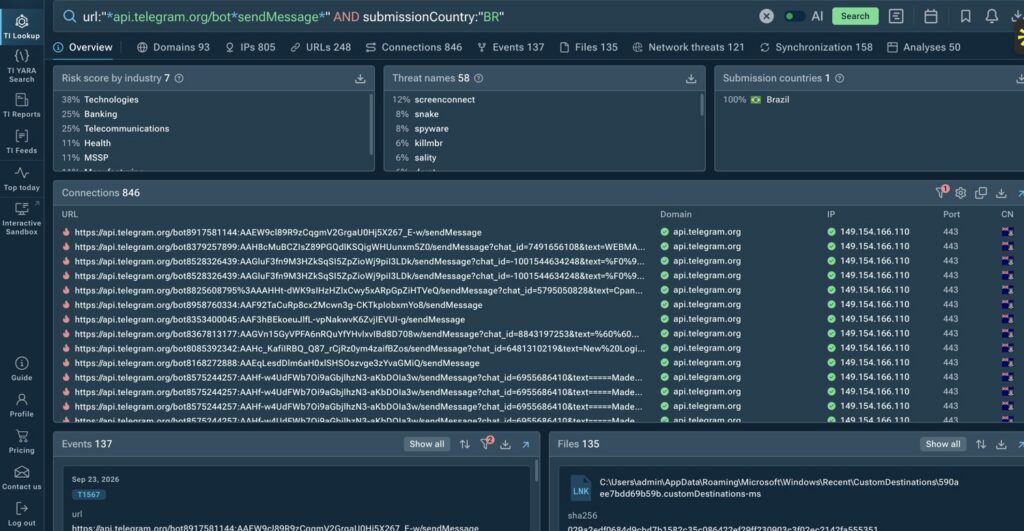
The query returned 50 analyses. Submissions from the banking sector account for 25%, the highest proportion among the malware queries. Multiple distinct bot tokens were identified, with prefixes such as “WEBMA…”, “Cpan…”, and “New Logi…”. The pattern is consistent with credential phishing kits (webmail and cPanel) and lightweight infostealers that exfiltrate data directly to chats. Interaction with the bots is not recommended; the appropriate action is to report them to Telegram and the relevant CSIRT.
TI query: url:”api.telegram.org/botsendMessage*” AND submissionCountry:”BR”
4.6 Phishing with the “Pix” Term and Payment Lures
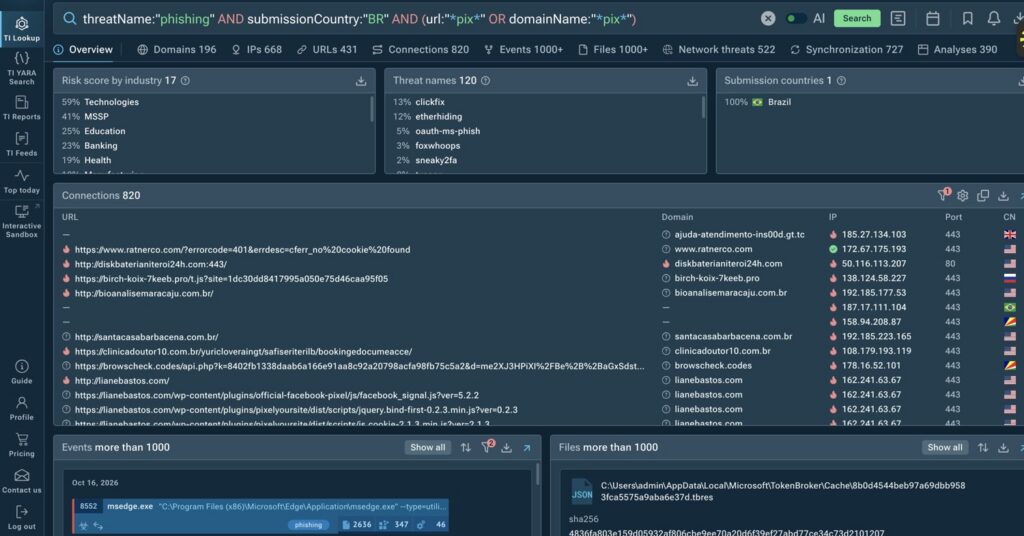
The query using the term “pix” returned 390 analyses. ClickFix appears in 13% and EtherHiding in 12%. Legitimate Brazilian websites (santacasabarbacena[.]com[.]br, clinicadoutor10[.]com[.]br, bioanalisemaracaju[.]com[.]br) appear in network traffic, consistent with WordPress compromise.
TDS scripts and fake browser verification pages were also observed. Results associated with legitimate Facebook pixel implementations were identified as unrelated activity.
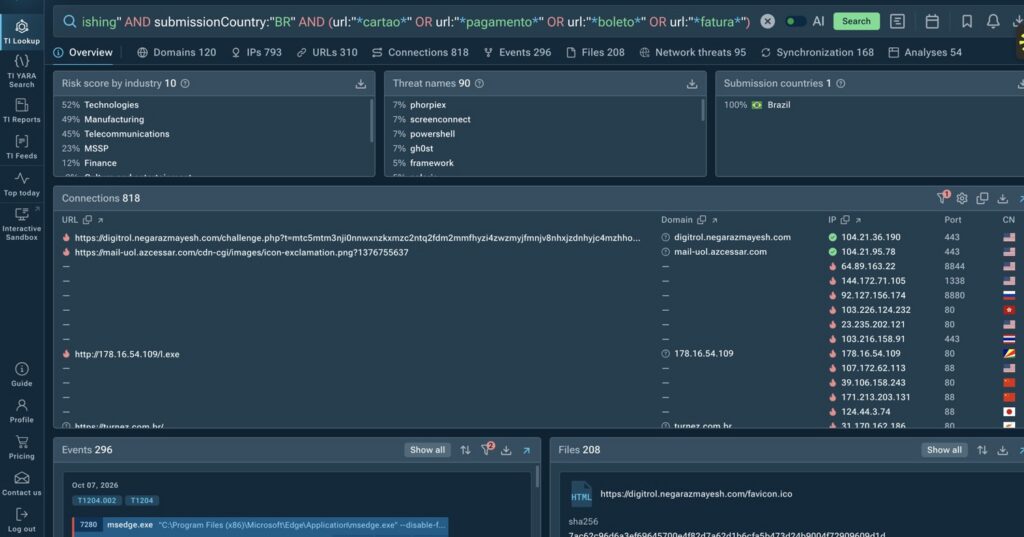
The payment lure query (54 analyses) revealed UOL webmail impersonation and the IP address 64.89.163.22, which also appears in the msiexec query. Addresses on port 88 associated with gh0st and phorpiex were assessed as unrelated botnet activity.
TI query: threatName:”phishing” AND submissionCountry:”BR” AND (url:”pix” OR domainName:”pix”)
5. Pivots, Correlations, and Intelligence Graphs
Several artifacts identified through ANY.RUN’s TI Lookup connect distinct threat clusters. The address 13.222.157.107:8138 appears in queries involving banking Trojans submitted from Brazil and Grandoreiro with persistence. The address 64.89.163.22 connects loader distribution to payment lures. ScreenConnect appears across multiple queries, while AutoIt is a common packer.

While shared threat labels may indicate potential connections, these should be validated through additional analysis. The abuse of RMM software has also been documented in independent campaigns. IP addresses shared across banking Trojan and loader distribution queries provide valuable investigative leads, even where the exact nature of the relationship remains unverified. The role of AutoIt is more strongly supported by both shared threat labels and execution patterns observed directly in the analyses.
For SOC teams, identifying these connections through TI Lookup helps reduce manual threat research, uncover related malicious activity, and expand investigations beyond individual indicators of compromise (IOCs).
6. Key Threat Intelligence Insights for SOC Teams
The research reveals several recurring patterns that can help SOC teams anticipate evolving threats, identify detection gaps, and prioritize defensive measures. The following insights highlight opportunities to strengthen business protection against financial fraud while making better use of existing security resources.
6.1 Modularization and Resilience
Modular organization reduces dependence on any single component. Disruptions targeting one malware family or infrastructure provider tend to shift activity to other parts of the chain. This pattern was observed after operations against Grandoreiro and Lumma infrastructure. Delivery operators do not need to develop banking Trojans; banking Trojan operators can use third-party loaders and RMM software. This specialization increases the resilience of the ecosystem as a whole.
6.2 Geofencing and Malware Evasion
Language checks (Portuguese or Spanish) in families such as Mispadu can prevent malicious behavior from being revealed in analysis environments that do not match the intended target. Re-executing relevant samples with appropriate language and network configurations can help security teams uncover additional malicious behavior and improve detection coverage.
6.3 RMM as a High-Value Control Layer
Abuse of legitimate RMM software provides attackers with remote access capabilities that are difficult to distinguish from legitimate support activity. Instance governance through tenant allowlisting and alerting on unknown instances directly targets this layer. In corporate environments, this control can offer a good balance between implementation effort and risk reduction. Campaigns documented in 2026, including those using legitimate services to deliver unauthorized instances, reinforce the relevance of this control.
6.4 Broader Security and Business Implications
The combination of ClickFix on third-party sites with Telegram exfiltration reduces the adversary’s dependence on its own infrastructure and complicates takedown efforts. The presence of ScreenConnect in stealer and banker sessions suggests that remote access may be used both for additional collection and for lateral movement or hands-on-keyboard operations during financial transactions. In organizations processing high volumes of Pix transactions, correlating sessions with active RMM and suspicious transactions provides a valuable investigative opportunity.
7. MITRE ATT&CK Mapping and Detection Artifacts
The observed techniques map primarily to the MITRE ATT&CK tactics of initial access, execution, evasion, persistence, command and control, and exfiltration.
Mapping these techniques helps SOC teams assess existing detection coverage, identify security gaps, and prioritize detection rules based on observed attacker behavior.
The following table summarizes the technique associations identified during the analysis.
| Tactic | Technique | Evidence | Confidence |
|---|---|---|---|
| Initial Access | T1566.002 / T1189 | tipo=inv lures, Roundcube, .com.br sites | Moderate |
| Execution / Defense Evasion | T1204.004 / T1059.010 / T1218.007 | ClickFix, AutoIt, msiexec | High |
| Persistence | T1547.001 | Run key | High |
| Command and Control | T1219 / T1572 | ScreenConnect, ngrok | High |
| Exfiltration | T1567 | Telegram sendMessage | High |
Priority detection artifacts include:
- AutoIt3.exe execution from %TEMP% or paths containing IXP0.
- Non-browser processes contacting api[.]telegram[.]org.
- Suspicious PowerShell, mshta, or curl execution associated with Explorer\RunMRU entries.
- ScreenConnect instances outside the approved allowlist.
8. Risk Assessment
Understanding the likelihood and potential impact of these threats can help SOC teams prioritize defensive measures, allocate security resources more effectively, and reduce business exposure to financial fraud.
The following table summarizes the risk assessment for the main observed threats and their recommended controls.
| Threat | Likelihood | Impact | Key Control |
|---|---|---|---|
| RMM abuse (ScreenConnect) | Almost certain | High | Tenant allowlisting and alerting |
| AutoIt banking Trojans with geofencing | Likely | High | Block unauthorized AutoIt3 execution |
| ClickFix on .com.br sites | Likely | High | Group Policy restrictions on the Run dialog and alerting |
| Telegram exfiltration | Almost certain | Medium to high | Phishing-resistant MFA, outbound traffic monitoring, and bot takedown |
9. Recommended Actions for SOC Teams
Based on the research findings, SOC teams can prioritize the following actions to strengthen detection, reduce investigation time, and minimize exposure to financial fraud.
Short-term actions (0–72 hours)
- Hunt for unauthorized ScreenConnect instances and AutoIt3 execution in temporary directories.
- Use ANY.RUN’s Threat Intelligence Lookup to investigate suspicious IOCs, identify related malicious activity, and validate indicators before implementing blocking rules.
- Temporarily block, after validation, addresses 13[.]222[.]157[.]107, 64[.]89[.]163[.]22, 62[.]60[.]226[.]159, and the 169[.]58[.]124[.]0/24 range. Restrict unauthorized outbound ngrok TCP traffic.
- Notify CERT[.]br regarding compromised Brazilian websites and Telegram regarding identified bots.
Medium-term actions (30 days)
- Implement an RMM policy with instance and tenant allowlisting.
- Restrict non-corporate DNS-over-HTTPS and implement Group Policy limiting use of the Run dialog.
- Analyze relevant banking Trojan samples in ANY.RUN’s Interactive Sandbox using appropriate system language and network configurations to uncover behavior hidden by geofencing.
Long-term actions
- Correlate sessions with active RMM and suspicious Pix transactions.
- Continuously monitor small Brazilian websites for ClickFix compromise.
- Integrate ANY.RUN’s Threat Intelligence Feeds into existing security systems. ANY.RUN’s internal research found that up to 30% of unique malicious IOCs discovered during studied Sandbox investigations were already available in TI Feeds, enabling earlier threat detection and reducing the need for manual IOC research.
10. Research Gaps and Indicators to Monitor
Several areas require further investigation. The actual target sectors were not directly observed, while the WhatsApp propagation module and the reliablelifecure[.]com panel remain unverified. Mobile banking and brand typosquatting were outside the main scope of the research. The Brazilian geolocation of certain addresses requires further corroboration.
Key indicators for SOC teams to monitor include:
- The emergence of new AutoIt-based malware families with language checks.
- New IP addresses shared across threat clusters.
- An increase in submissions from the banking sector.
- ClickFix attacks using Pix or social benefit lures.
Further investigation of representative samples from each threat cluster using ANY.RUN’s Interactive Sandbox and other solutions, alongside corroboration with CERT[.]br and the financial ISAC, can help clarify the role of ScreenConnect across the observed attack chains.
11. Conclusion
The research conducted using ANY.RUN reveals the modular structure of Brazilian-linked financial fraud and identifies common elements across multiple attack chains. AutoIt functions as a common packer. Legitimate RMM software, particularly ScreenConnect, provides attackers with remote access capabilities. Delivery via compromised websites using ClickFix expands their reach beyond traditional email campaigns, while Telegram-based exfiltration reduces their dependence on their own infrastructure.
For organizations operating in Brazil, especially in the financial and payments sectors, the short-term priorities are RMM governance and the detection of AutoIt execution from temporary directories. These controls address behaviors common to multiple attack chains, reducing dependence on malware-specific detections.
The modular nature of the financial fraud ecosystem means that individual takedowns tend to displace rather than eliminate malicious activity. By combining behavioral malware analysis with timely threat intelligence, businesses can strengthen detection coverage, accelerate investigations, and reduce the financial and operational risks associated with evolving threats.
About ANY.RUN
ANY.RUN provides interactive malware analysis and threat intelligence solutions trusted by 700,000+ security professionals across 16,000+ organizations worldwide. The company helps SOC teams, MSSPs, and enterprise security teams accelerate threat investigations and make more informed response decisions.
Its Interactive Sandbox combines automated malware and phishing analysis with real-time behavioral visibility and AI-powered reporting. Threat Intelligence Lookup helps security teams uncover connections between malware families, investigate malicious infrastructure, and identify related threats. Threat Intelligence Feeds deliver fresh IOCs directly into existing security systems, supporting earlier threat detection.
Together, these capabilities help businesses reduce investigation costs, expand detection coverage, minimize exposure to emerging threats, and improve SOC efficiency without increasing headcount.