
Thank you to Przemysław Wcisło (SO5DZ) for writing and sharing rxx_lora, a command-line LoRa receiver for RTL-SDR and SDRplay RSP devices. Przemysław notes that it was designed in the spirit of rtl_fm, so there are no GNU Radio flowgraphs to build or maintain. Instead, it is a single small C binary (rtl_lora or rsp_lora, plus file_lora for saved I/Q captures). Decoded packets are printed as JSONL to stdout, so you can pipe them into other programs.
Przemysław writes:
- It's fast. The entire receive chain (detection, sync, demodulation, FEC) runs from dozens to hundreds times real-time, depending on the PHY parameters and hardware, of course.
- It's sensitive. I've benchmarked the binary end-to-end over AWGN, and it comes within ~1-2 dB of ideal theoretical LoRa performance. It can easily demodulate Meshtastic's MediumFast preset at -14 dB SNR. I can also vouch for this based on real-world observations. Valid decodes regularly pop up at -12 to -14 dB. I even saw a frame at -17 dB SNR, although it had a bad CRC :)
- It's stable. It's never crashed on me, apart from when I accidentally wiggled the dongle out of the USB port ;) It should also be stable from a software quality perspective. I've put together an extensive suite of quality gates and tests, including noise tests, tests against previously recorded over-the-air captures... This should make it quite unlikely that an upcoming change will accidentally introduce a major regression.
- It doesn't require much: librtlsdr, FFTW, a C compiler, and make. Most who have dabbled with RTL-SDRs probably won't need to install a single package on top of what they already have. Python and a few libraries are used for the tests and extra tools, but they're not required for normal operation.
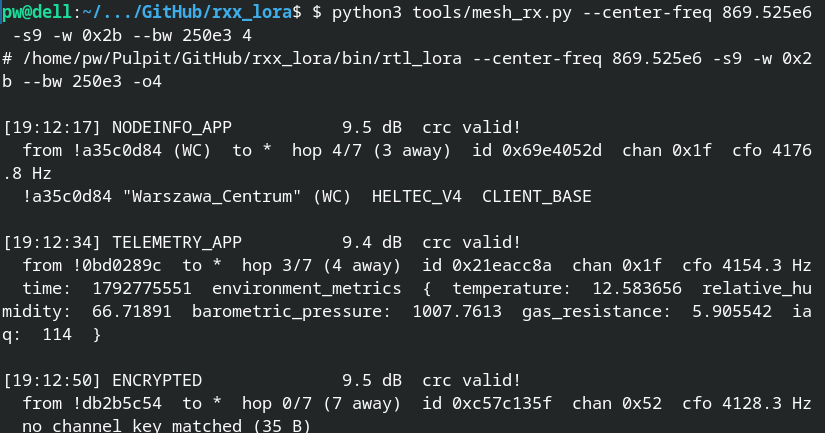
The receiver implements the standard LoRa PHY, so it can be used for Meshtastic, LoRaWAN, MeshCore, APRS-over-LoRa and other LoRa signals. An included Python script also decrypts Meshtastic packets with the default or configured channel keys and prints them in a readable form.
The demodulation core is derived from the gr-lora and gr-lora_sdr GNU Radio projects. The code is open source under GPLv3 and available on GitHub. It runs on Linux, and the README says macOS "probably" works too. The SDRplay version also requires the SDRplay API. For Meshtastic reception, it covers similar ground to the GNU Radio-based Meshtastic_SDR project, which we previously posted about, but with a much smaller footprint.
AI Disclaimer: Przemysław notes that the sensitivity improvements came from "patient and deliberate use of strong AI tools", and the README states that the project made heavy use of AI for both coding and theoretical exploration.