
On day eleven of our influencer campaign, I opened the spreadsheet and did the math. Five creators p 2026-10-13 16:59:56 Author: hackernoon.com(查看原文) 阅读量:12 收藏
On day eleven of our influencer campaign, I opened the spreadsheet and did the math. Five creators paid. $900 gone. In return: 30 to 40 leads who regarded our product the way people regard a timeshare pitch, politely and mostly for the snacks.
I'm Barbara Nekrasova, CEO of the international marketing agency Erste Advertising. Less than three months later, the Discord server we built for our FinTech client had more than 3,500 members, and after that first test we didn't spend another cent on ads.
This is the unvarnished version of how: the failure, the manual grind, and the parts where AI helped and the parts where it very much didn't.
Key takeaways
- A $900 test with five paid influencers produced only 30 to 40 low-intent leads, so we stopped after 10 to 11 days.
- We built the Discord community by hand: 20 members in 3 to 4 days, 100 by the end of week two, 3,500+ in 2 months and 3 weeks.
- AI supported decisions (audience research, post angles, draft critique, an in-server persona) but humans chose where to go and ran the community.
- Discord's own benchmark for a healthy server is 15% of members active; we used it as a minimum bar.
Why did influencer marketing fail for our FinTech project?
When you launch a FinTech or Web3 project, the default reflex is to buy attention. So we did.
We spent about a week combing influencer exchange platforms and hunting for creators by hand in Facebook groups and on Reddit. We shortlisted 50 candidates. Ten replied. We closed deals with five, paying between $50 and $400 per publication ($100, $200, $50, $150 and $400, to be exact). Negotiating and publishing ate another three to four days.
The result: 30 to 40 low-intent leads who barely touched the product.
We killed the campaign after 10 to 11 days. To be fair, this was one small test, not a verdict on influencer marketing. But it taught us something we've seen repeated since: in financial products, trust is the product, and you can't rent trust by the post. An influencer's audience trusts the influencer, not the unfamiliar app they're being paid to mention.
So we moved the budget, and our attention, to building a community from zero.
How do you get the first 100 members on a new Discord server?
There is no growth hack for an empty server. An empty Discord is a very quiet room.
The first 20 members took three to four days of pure manual work. We sent personal invitations and seeded engagement-first posts (questions, not ads) in the Reddit communities and Facebook groups where our target audience already hung out.
Members 20 to 50-ish: we launched a "bring a friend" giveaway, which brought in another 30 to 40 people. That was the moment the server stopped being a room of strangers and became a group with an active core.
By the end of week two, we hit 100. Another 50 members arrived through targeted invites and better posts (more on those below), and something shifted. The core started feeding itself: members answered each other, newcomers got welcomed by people who weren't on our payroll, and conversations kept going when we stepped away.
A caveat: 50, 100 and 500 are not universal laws of community science. They are the milestones we used and the points where we noticed changes in our server. Your thresholds may differ. Track your own.
Let me be clear about what AI did not do: it didn't pick our audience, and it didn't run the community. People did that. Here is what it did do.
1. Finding the right people. We used web scrapers, including Apify, to pull unstructured text (complaints, recurring questions, arguments) from niche subreddits and competitor Facebook groups. Then we went through the Reddit communities by hand to spot the especially active and valuable ones. Humans chose where to go.
2. Choosing the hook. We fed large batches of that text through AI to find the post "bait" most likely to pull people onto the server. The same pain points kept surfacing: hidden fees, platform security and cross-border settlement speed. Those became the angles of our invite posts, and we pointed them at the specific audience the scrapers had helped us find, instead of blasting generic invitations at everyone.
3. Making two AIs argue. ChatGPT wrote the first drafts of our invite posts and in-server content. We then gave those drafts to Claude and made the two models critique each other. It sounds theatrical, but it worked: the debate stripped out generic corporate phrasing and left us with the points that actually mattered to readers. Both the posts for outside communities and the content for the server itself went through this loop.
4. Building a character. To keep the server alive during quiet hours, we created an AI persona. We used Gemini to write its personality, tone and behavioral prompts. The character took part in conversations, welcomed newcomers and nudged the chat along so nobody walked into an empty room. Members knew it was a bot. It fit our needs fully, which is more than I can say for some of the other tools we tried.
What else didn't work, and what did we change?
Influencers weren't our only miss. We also tried several bots from Discord's app directory, and some simply didn't fit what we needed. We kept testing until we settled on the premium version of MEE6. Two things sold us: its analytics, which gave us a clear picture of what members were actually doing, and its moderation and engagement mechanics, which we could lean on as the server grew.
The pattern in both failures was the same: we tested cheaply, noticed quickly when something wasn't working, and moved on instead of defending the original plan.
What was the road from 100 to 3,500 members?
Our next target was 500 members, because that's when Discord's native Server Insights becomes available, and we wanted real data instead of impressions. Until then, MEE6 Premium analytics filled the gap.
In two months and three weeks, the server grew from zero to more than 3,500 members. At its peak, the community produced 24,000 to 28,000 messages a week.
The number we watched most closely was the one Discord itself uses to judge whether a server is alive. By Discord's standard, a server is developing healthily when at least 15% of its members are active: writing at least three messages a day and visiting at least three channels. It's not a FinTech benchmark, it's a Discord one, and it works as a minimum bar. Fall below it and you know something needs fixing. Stay above it and you can leave things alone. Our share of active members stayed comfortably above that line.
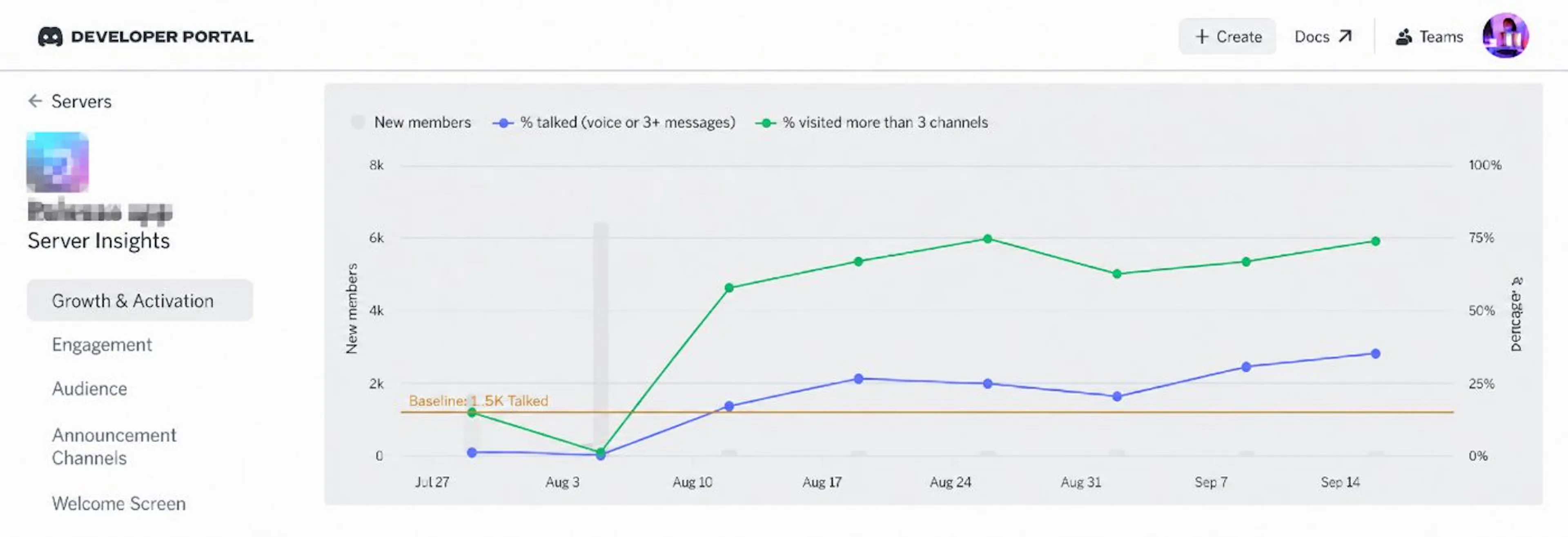 Community Growth & Activation
What would I repeat, and what would I skip?
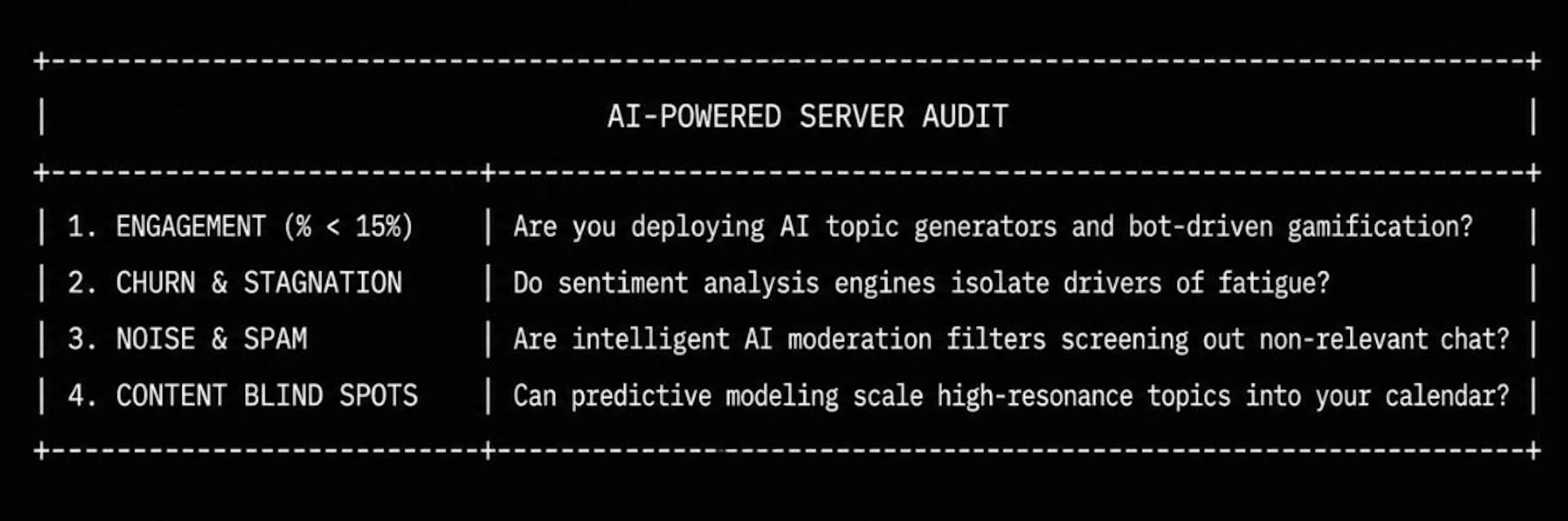
If your community feels stuck, here is the checklist we'd run on our own server:
- Fewer than 15% of members active (3+ messages a day across 3+ channels)? Stop posting announcements. Seed questions people can't resist answering, and let AI help you draft them.
- Growth stalled or people leaving? Feed your chat history into an AI sentiment tool and look for the moment people got bored or annoyed.
- Running out of topics? Use AI to cluster what your members keep asking about, then build your content calendar around it.
- Tempted by influencers? Test small, set a kill date, and measure leads that actually do something.
- Choosing bots? Test several, keep the one whose analytics you actually use.
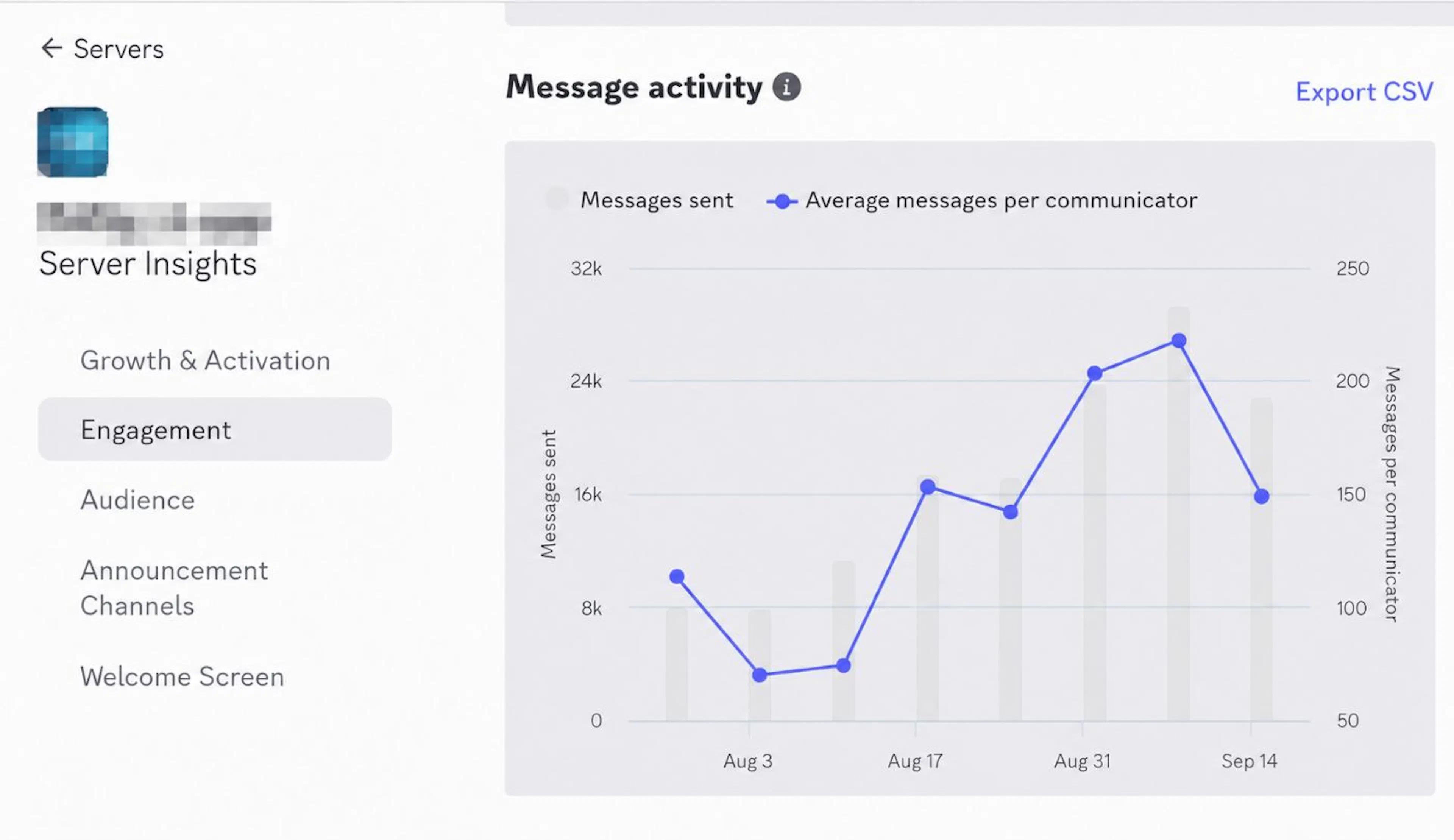 Message Activity & Engagement
FAQ
How long did it take to grow the Discord server to 3,500 members? Two months and three weeks, starting from zero, with no paid ads after our initial influencer test.
How much did the failed influencer campaign cost? About $900 across five creators, paid $100, $200, $50, $150 and $400. It produced only 30 to 40 low-intent leads.
What is a healthy active-member rate on a Discord server? According to Discord's own benchmark, at least 15% of members should be active, meaning they write three or more messages a day and visit three or more channels.
At what size does Discord Server Insights become available? At 500 members.
Which AI tools did you use? Apify for scraping audience discussions, ChatGPT for first drafts, Claude for critique, and Gemini to design the server's AI persona.
Your turn
We got lucky in one sense: our influencer test failed cheaply and early. So here's my question for you. What's the most expensive marketing lesson you've learned, and what did it teach you? Tell me in the comments. I promise not to send a bot to argue with you about it. (Though we do have one, if you're curious.)
如有侵权请联系:admin#unsafe.sh