It hasn’t been long since Large Language Models (LLMs) entered our daily lives. Yet, they remain an 2026-10-4 15:0:4 Author: hackernoon.com(查看原文) 阅读量:8 收藏
It hasn’t been long since Large Language Models (LLMs) entered our daily lives. Yet, they remain an elusive technology—treated almost as old news by AI experts, casually overlooked by newcomers eager to specialize, and still largely misunderstood by the general public.
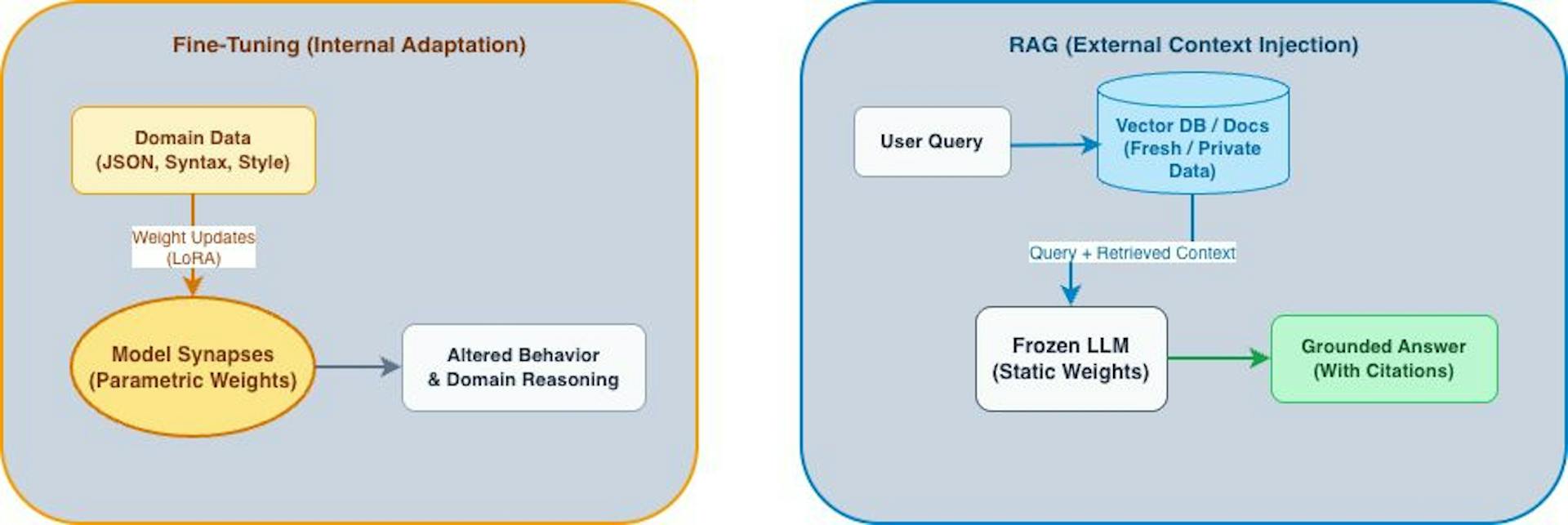
In this post, we’ll not only demystify LLMs but also break down the most common model adaptation techniques: Fine-Tuning and RAG architectures. Planned as a comprehensive series, this journey will take you from the fundamentals to gaining a solid grasp of technical AI concepts.
Demystifying LLMs: From Raw Data to Statistical Engines
Scientists working in the field of artificial intelligence have spent years experimenting with NLP-based models. However, they have not been able to achieve the desired level of original generation. This is because NLP-based models strictly adhere to the rules defined for them and respond based on those rules. These findings led researchers toward deep learning-based models capable of making decisions using statistical methods and probability calculations.
Initially, they succeeded in capturing short-term dependencies by utilizing LSTM and RNN architectures; however, hardware limitations became apparent when dealing with long-term dependencies.
The primary task of large language models is to understand human language and respond to it in a manner similar to how humans do. So, simply understanding the information is not enough. "Encoder-only" models capable of this were developed; BERT is a prime example of this architecture, which excels at tasks such as classification, sentiment analysis, and text categorization. Over time, models capable of both understanding user queries and generating appropriate responses were also created. These predominantly utilize a "decoder-only" architecture.
Modern models such as GPT, Claude, Llama, and Qwen are built upon this architectural approach. Encoder-only models interpret input text by viewing it in its entirety. In contrast, decoder-only models operate unidirectionally (autoregressively) to generate content, producing text from left to right. Both of these architectures originate from the Transformer architecture.
Modern LLMs are capable of performing many creative tasks such as code generation, translation, information extraction, reasoning, and question-and-answer operations. While traditional ML or NLP models are designed to handle specific, specialized tasks, LLMs clearly distinguish themselves from these traditional models in tasks that demand creativity and versatility.
This creative feature is provided by the transformer architecture and self-attention mechanism that Vaswani and his team developed as a result of their important research in 2017. The fundamental architecture underlying LLMs was unveiled in the paper "Attention Is All You Need."
Encoders, Decoders, and Attention: How Transformers Actually Process Context
Modern LLM models rely on the "transformer" architecture. When we briefly examine this architecture, we see that it consists of encoder and decoder modules. However, the structure that truly powers these large language models is the "attention" mechanism found within the transformer architecture. Through this mechanism, models establish relationships and contexts between words in a sentence. They decipher relationships between words or objects.
Depending on the specific task, LLMs assign higher weights (scores) to elements deemed important and lower weights to less significant words; the aforementioned encoder and decoder components are responsible for performing this function.
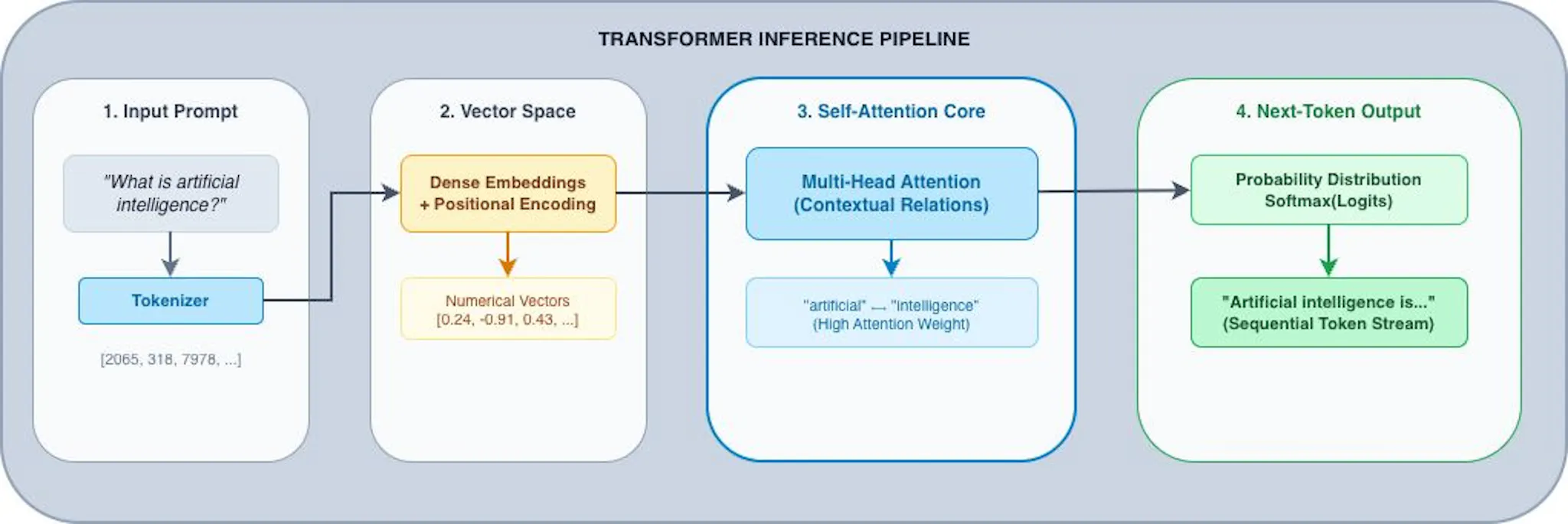 Figure 1: The end-to-end Transformer flow—from tokenizing input prompts to self-attention context mapping and auto-regressive next-token generation.
The encoder component reads the input text and converts its meaning into numerical data—a process known as vectorization. The aim is to make it easier to represent the text as a mathematical vector space. The decoder, meanwhile, uses the vectorized representations from the encoder to generate new information. Let us illustrate this theoretical concept to make it easier to remember. When a model based on the full Transformer architecture is asked, "What is artificial intelligence?", the encoder breaks the query down into small units called tokens. It resolves the relationships between these tokens and establishes context using the self-attention mechanism.
After creating a semantic representation, it forwards the encoded data to the decoder. The decoder’s task is to generate a response based on the incoming data. It first focuses on predicting the initial token based on this representation. Subsequently, it begins generating new tokens in sequence by referencing both the previously generated tokens and the encoder's context.
In this way, it produces a response that is both relevant to the question and original—such as: "Artificial intelligence (AI) is a field of technology that enables computer systems to exhibit capabilities such as learning, problem-solving, decision-making, and human-like reasoning." Its selective attention mechanism allows it to concentrate solely on the meaningful parts of the input text.
One of the greatest advantages offered by the Transformer architecture is its ability to enable parallel training on large datasets. The ability to process multiple data points simultaneously using a parallel training mechanism has significantly shortened training times. This feature has played a pivotal role in the development of the general-purpose models used today.
The New Paradigm: Moving Beyond Task-Specific Microservices
Before the advent of Large Language Models (LLMs), we had to train separate models for every specific task. This was both a very time-consuming task and required engineers to consider many criteria, such as being careful in model selection. For instance, anyone venturing into NLP almost certainly worked on a sentiment analysis project, while those working with BERT models surely undertook a Named Entity Recognition (NER) project.
As you can see, accomplishing a single task requires a great deal of effort. It's essentially like managing multiple microservices, where we can think of each model as a different service. The management, data collection processes, and associated costs of these massive structures began to pose a huge challenge for developers and companies alike.
This was the status quo of the "old world"—a state of affairs that existed until quite recently. The emergence of LLMs ushered in a "new world order." Instead of training separate models for each task as before, the approach shifted to specializing a single LLM for various tasks. This helped reduce workloads, personnel expenses, time investment, and overall costs. Here, we can think of LLMs as operating systems: just as an operating system hosts programs that perform various tasks, LLMs possess the capability to execute a wide range of functions.
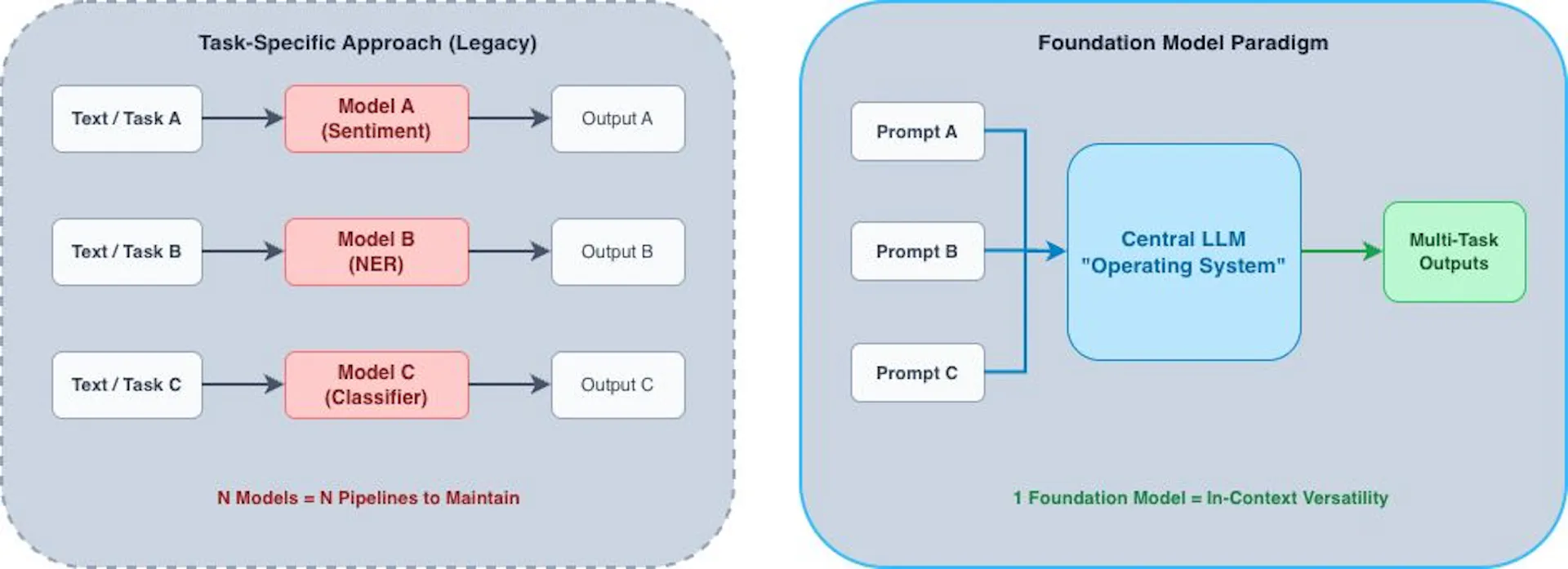 Figure 2: Architectural shift from fragmented, task-specific models to a unified foundation model acting as a central runtime.
If we treat LLMs as the underlying runtime for modern AI applications, their ability to pull this off rests on three main pillars. Here is how they work in practice:
1. Generalization: Handling Unseen Tasks by Default
One of the most significant characteristics of these models is their ability to generalize. While earlier generations of models were typically designed to focus on a single task, LLMs demonstrate the capability to perform tasks they have never encountered during training.
For instance, because they have learned the grammar of a language, they can interpret structures like JSON blocks or SQL code—which also possess linguistic structures—as languages due to their structured syntax. This capability significantly enhances the efficiency of model training processes that follow the pre-training phase.
2. In-Context Learning: The Runtime Configuration of AI
This feature is a favorite among developers because it cuts down development time drastically. Instead of retraining the model—updating its underlying weights—we simply supply a prompt. This prompt outlines task instructions and can include a few reference examples—a technique known as few-shot prompting.
Through this setup, models parse the context on the fly and execute the task immediately. The real edge of in-context learning is how fast it lets models pivot between distinct jobs, all guided through plain human language. Prompt engineering is often treated as simple, but I believe anyone who hasn't actually fine-tuned a model struggles to write truly effective prompts. To put in-context learning into perspective, it works much like the runtime configuration you are familiar with from software engineering.
3. Transfer Learning: The Foundation for Specialization
Training large language models is a resource-intensive process that demands massive engineering effort. Let's think about it this way: you train a model using trillions of tokens, and in the end, you have a model with a massive pool of information. If you then want to specialize that model in a specific field, do you spend millions of dollars and days of computing time training it from scratch, or do you simply impart specialized expertise to it? In other words, do you want to create a brain from scratch, or take an existing brain and equip it with specialized skills?
For those seeking answers to these questions, LLMs offer a solution. Processes such as fine-tuning have emerged as the bridge enabling us to adapt general-purpose conversational models for specialized fields like medicine, law, or finance. Engineers have revolutionized the modern AI landscape by specializing existing models for specific domains using only a fraction of the compute and data.
The Cracks in the Armor: The Real-World Limits of General-Purpose Models
We have discussed the structure and effects of LLM models so far. On the other hand, general-purpose models also have various limitations. They cannot fully meet the needs of the industry. They are knowledgeable in every field, but they are not experts in any field. Let's clarify this concept, which is referred to as "domain-specific knowledge" in the literature. Here, large language models are like a person who specializes in general knowledge.
They have superficial knowledge of every subject. However, when necessary, we need a software developer to write code, a doctor to perform surgery, or a judge to make decisions. Using general-purpose models for such domain-specific information is both dangerous and a waste of time.
Another problem is known as “private/proprietary knowledge”. Even if you choose the model with the most comprehensive knowledge, the model's knowledge is limited to what has been taught to it. The model does not even have internal information about the company that developed it.
In today's world, most information in enterprises is confidential internal data. Of course, a general-purpose model cannot be expected to have access to such information. We can describe this situation as trying to join an online meeting in a place where there is no internet connection. Since the goal is undefined from the beginning, it would be meaningless to expect to achieve the result.
Perhaps the most significant problem in the emergence of the RAG architecture is the issue of "knowledge freshness," meaning outdated information. In fact, this is a common problem for all LLM models. No matter which model it is, it is limited to the days, hours, minutes, and even seconds on which it was trained. For example, imagine that we pre-train a model using the most up-to-date data in the medical field today.
We have a doctor's assistant who has the most up-to-date information. What would happen if a new article on the treatment of a disease were published tomorrow, completely changing the treatment method? My answer is, your model would still be based on outdated information and continue to endanger human health. Without retraining, your model will be limited by what it has learned. In order to avoid such problems, the RAG architecture comes to the fore. This allows the model to search external sources and access the most up-to-date information.
I saved the biggest limitation for last. This problem is valid for all LLM models and RAG systems. This problem, called "Hallucination", has still not been resolved. However, research is ongoing to reduce the incidence of hallucinations. Models inherently work based on probability calculations. They're always trying to predict the next token.
The statistical distribution in the training data determines what predictions they will make. It is very difficult to teach a model to say “I don't know.” Those who do fine-tuning know very well that if you leave the model unconstrained, it will feed you a lot of misinformation based on fabricated data. If you set rules that are too strict, it will respond with an "I don't know" approach even to questions it knows the answers to, much like a completely introverted child. We can compare the hallucination problem to people we describe as know-it-alls. Some people have an opinion on everything.
They may even offer a few made-up claims on a subject they actually know nothing about. LLM models also have such problems. In fact, even if the intent is benign, the results endanger users and developers alike. For example, a model that allows a suspect to be sentenced to prison based on a fabricated law could lead to disaster.
I think hallucination is the biggest problem. But even if we cannot solve it completely, there are various ways to reduce it. Just like the claims of self-proclaimed "AI experts" who have never actually built anything in this field, the idea that independent researchers cannot solve problems that even big tech cannot solve is completely irrational.
If these challenges had not been tackled head-on, we would never have reached this stage today. Anyone who does real research knows that, historically, the most impactful breakthroughs have come from those working under the tightest constraints. I believe it's far better for people to claim expertise only in fields where they've actually invested effort and built real things. Otherwise, instead of contributing to progress, they end up doing nothing but adding to the noise.
Bridging the Gap: The Engineering Need for Adaptation
As we have seen so far, LLM models have opened a new door, but they inevitably require adaptation. General-purpose LLMs undergo extensive pre-training and end up with broad yet superficial knowledge across most subjects. They are simply not domain experts.
However, real-world problems—and the rapid advancement of fields like robotics—demand specialized artificial intelligence models. Two main types of challenges arise here, and specific solutions have emerged to adapt models for these problems. In modern AI workflows, these solutions are known as "Fine-Tuning" and "RAG".
Problem 1: Changing Model Behavior — Fine-Tuning at the Neuron Level
In this problem, engineers want to change the character and capabilities of the model. This should be done so that the model specializes in a particular area. To give the model a response format, teach it a new domain language, and make it an expert in a field by enabling it to reason from a different perspective, you need to tap into its internal parameters. In other words, you have to go down to the neuron level and give it a new character with surgical precision.
The most effective way to do this is to do “fine-tuning”. Using the fine-tuning method, you touch the artificial neurons, that is, the weights, of the model and make changes there. Thus, by eliminating the need for pre-training from scratch and providing training on a ready-made model to acquire domain-specific knowledge, you can achieve a hassle-free solution.
Problem 2: The Freshness and Privacy Bottleneck — The Case for RAG
Another challenge is that the large language model needs to remain constantly updated and have access to predefined resources. We already have a pre-trained model that has a certain level of knowledge on every subject. Fine-tuning this model isn't always enough.
The RAG architecture should be used at such times instead of constantly updating static weights. By opening the model to the outside world, you can enable it to keep up with current developments and access proprietary domains.
For example, by implementing a RAG system, you can access internal company documents, academic literature, private databases, or the most up-to-date information in your domain and avoid the overhead of fine-tuning. So, if you want an LLM to do a literature review before making a decision, this solution is just for you.
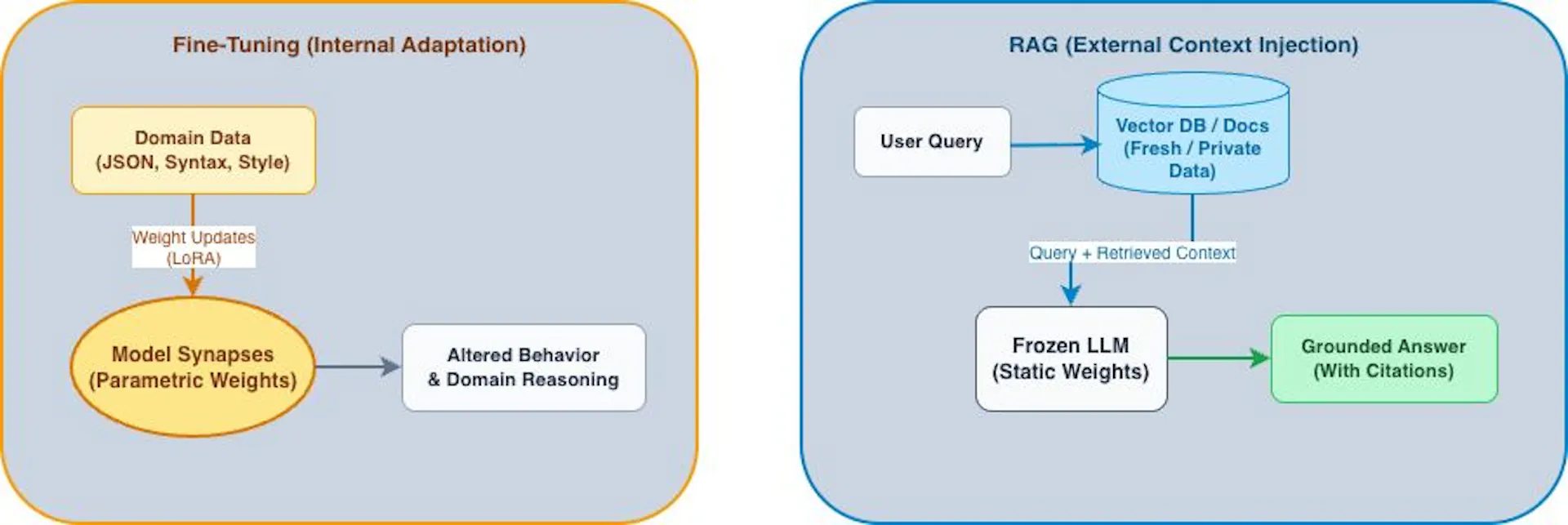 Figure 3: Adapting LLMs via parametric weight updates (Fine-Tuning) versus non-parametric external context injection (RAG).
Of course, it varies from problem to problem, but for some challenges, you can use these two methods together. For example, for a model to be used in healthcare, it must first undergo specialized medical training—just like a doctor—and then continue its research throughout its lifecycle.
Because this work directly impacts human health, you must be extremely careful and ensure safe interactions. That's why I recommend using fine-tuning first, and then pairing it with a RAG system in these kinds of scenarios.
Looking Ahead: The Evolution Doesn't Stop Here
In conclusion, although LLMs have driven significant changes in today's artificial intelligence landscape, they also have clear limitations. Various solutions have been developed—and will continue to be developed—to address these challenges. The AI field will never stop evolving.
The world of artificial intelligence neither began with LLMs nor will it end with them. If you want to find your place in this space, you need a solid grasp of LLMs and their underlying architecture. In this series, I will explore the world of AI through the eyes of an engineer.
Hope to see you in the next article.
Metin YURDUSEVEN
Artificial Intelligence Engineer
如有侵权请联系:admin#unsafe.sh