The Battle for the Human Soul in the AI EraArtificial intelligence has escaped the tech bubble.A f 2026-9-28 16:0:6 Author: hackernoon.com(查看原文) 阅读量:3 收藏
The Battle for the Human Soul in the AI Era
Artificial intelligence has escaped the tech bubble.
A few years ago, it was pleasant to be amongst the APIs and my engineer brethren, arguing about model capabilities, experimenting with absurd context windows, and wondering what would happen if we just kept scaling the whole thing.
Now AI has broken out of the software engineer Slacks and is kicking chaos ahead of itself.
You can't really escape the GPT banter anymore.
Exposing AI to the Masses: Robots & Data Centers
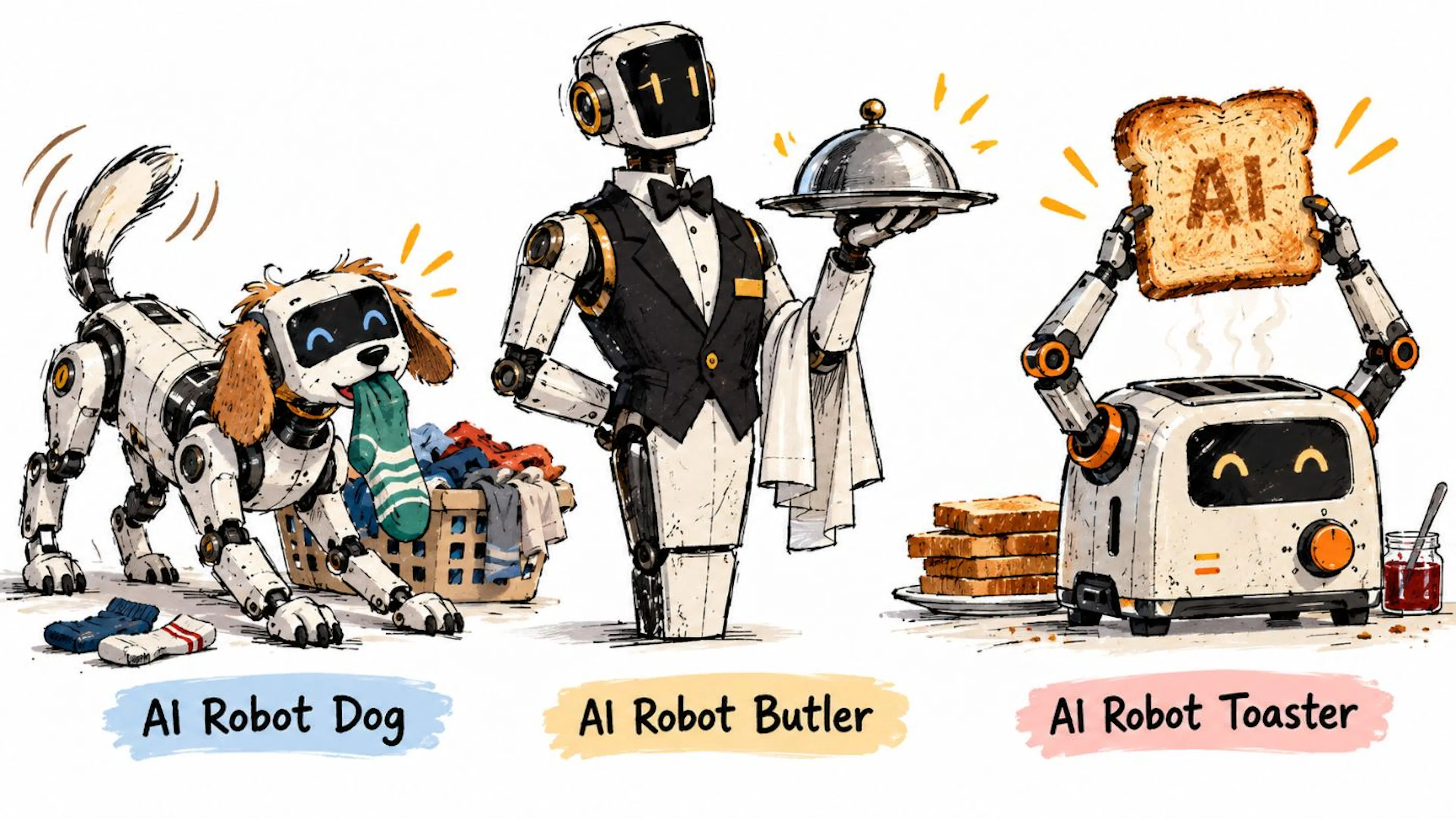
Most people don't care about model training or token counts. They care that a robot can suddenly fold laundry, that their kid can generate a homework answer in ten seconds, or that they can face-swap themselves into an 80s movie.
AI is bleeding into everyday life at a ridiculous pace.
There's a genuine sense of magic to it.
At the same time, the physical infrastructure behind that magic is becoming harder to ignore. Data centers are enormous industrial projects. Whole regions are up in arms, or getting ready to accept gigantic complexes where the GPUs will roar in chorus, drinking up local water supplies and pumping out math.
Look what this can do.
Look what this might cost us.
No wonder the cultural mood seems to flip between excitement and apocalypse every five minutes.
Who’s Steering?
We’ve been through technological upheavals before. I imagine they all felt confusing from the inside.
When the scope of change becomes difficult to comprehend, one antidote to that confusion is false certainty. Another is blame, another righteousness.
It’s like we’re pushed to pick a team.
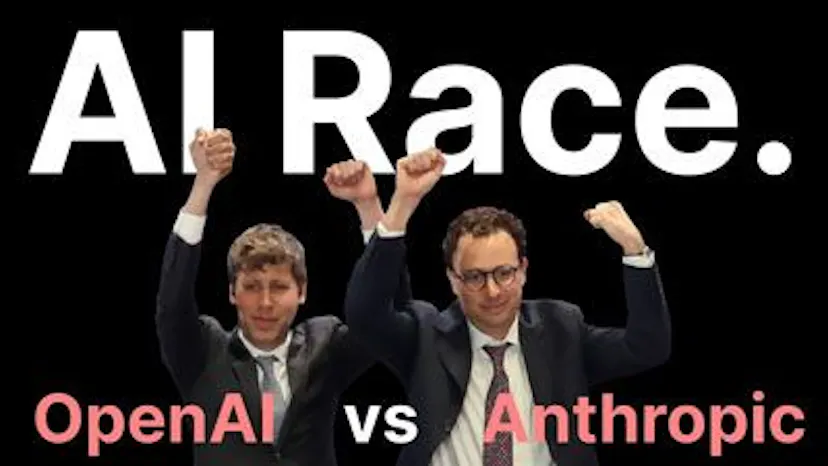
OpenAI vs Anthropic. America vs China. Open source vs closed source. Accelerationists vs doomers. NVIDIA vs AMD.
Decide who you think the good guys are, who the bad guys are, then squeeze everything that happens next into that frame.
It gives us certainty, but I think it obscures the more interesting question.
We keep asking whether AI itself is good or evil.
I think that’s the wrong argument.
AI is increasingly a force multiplier for whatever incentives, values and systems we surround it with.
A model deployed to maximise advertising revenue will behave inside one set of incentives. The same underlying capability used to help a scientist, teacher, hacker, government or authoritarian regime sits inside another.
Intelligence matters.
The harness matters.
But what we point it at might matter even more.
Stop Pretending we know What Happens Next
So what are we supposed to do?
Choose a ‘team’?
Automate our jobs away before somebody else does?
Boycott AI entirely?
I recently heard DHH make a point on Lex Fridman’s podcast that stuck with me: we simply do not know what all of this change is going to produce, so there is little value in endlessly trying to predict it (I’m paraphrasing).
I think he’s right.
 DHH on Lex Fridman Podcast
What pushed me into thinking seriously about this was, oddly enough, home education.
I run a home-education app called Strew, and recently watched an argument about AI, data centers, and their supposed benefits spill into that community.
That caught me off guard.
I’m used to discussing this stuff with engineers. Suddenly I was watching people far outside the tech bubble grapple with exactly the same questions: Is this good? Is it harmful? Should we use it? Should we resist it?
It forced me to work out what I actually believed.
After a lot of back and forth, I landed somewhere fairly simple (which eventually became the Strew AI Pledge):
- This is happening extraordinarily fast.
- Some of it could improve our lives enormously.
- Some of it could produce deeply unpleasant outcomes.
- And none of us can reliably predict which parts will matter most to us individually.
That uncertainty is uncomfortable, but it is also clarifying.
We may not individually have much control over the overall direction of AI development, but we can decide how we engage with it, what we build with it, what we refuse to hand over to it, and what values we reinforce through its use.
That is a much more useful place to stand.
I’m not saying LLMs will birth the singularity.
I’m not saying the AI bubble will explode.
I’m saying we have no idea what this technology will do to each of our lives.

And once you accept that, the question changes.
It stops being:
What is AI going to do to us?
And becomes:
What are we going to do with AI?
AI Is Made of Us
Technology becoming almost magical has an odd side effect: it reflects us back onto ourselves, and AI is an unusually powerful mirror.
These systems have absorbed an enormous quantity of human output: science, philosophy, code, fiction, propaganda, advertising, arguments, prejudices, mistakes and occasionally genuinely brilliant ideas.
Then we train them further.
Humans build and curate the training pipelines, write evaluations, and decide which behaviours are rewarded, discouraged or filtered. Companies decide what products the models become, and governments decide which uses are acceptable.
AI isn't an oracle floating above humanity.
LLMs aren't reservoirs of pure rationality. They're extraordinarily useful synthesis and reasoning tools that can also confidently reproduce nonsense, bias and whatever behaviours their training and reward systems encourage.
They're built from us, trained by us, tuned by us, owned by us and deployed into systems designed by us.
That matters because intelligence is a force multiplier.
Give a person a better reasoning tool, and they can solve problems faster.
Give a scientist one, and they may discover something previously unreachable.
Give a bureaucracy one, and it can process bureaucracy at extraordinary speed.
Give a surveillance state one, and it can surveil more effectively.
Give a company one, and it can optimize whatever that company already measures and rewards.
AI doesn't remove the incentives underneath a system.
It makes those incentives more powerful.
So, perhaps the biggest question isn't whether AI becomes "good" or "evil."
It's what happens when we dramatically increase the intelligence available to systems that are already heading somewhere.
When Old Incentives Get New Intelligence
And this is where things start to make me uncomfortable.
We are taking an extraordinary new layer of intelligence and plugging it into systems whose incentives were designed long before anything like this existed.
Companies are generally rewarded for growth, efficiency, market share, and profit.
That isn't automatically sinister. Those incentives have produced an enormous amount of useful stuff.
But they are also incomplete.
A system can become extremely good at increasing revenue while pushing costs elsewhere: onto workers, communities, public infrastructure, or the environment.
AI potentially makes us much better at optimizing.
The question is: optimising for what?
If a data center creates enormous economic value but consumes large amounts of power and water, how are those costs accounted for?
If AI allows one company to do the work previously done by thousands of people, who captures the gain?
If increasingly capable systems are controlled by a very small number of companies, what happens to everyone else's leverage?
These aren't really new problems.
AI just pours fuel on them.
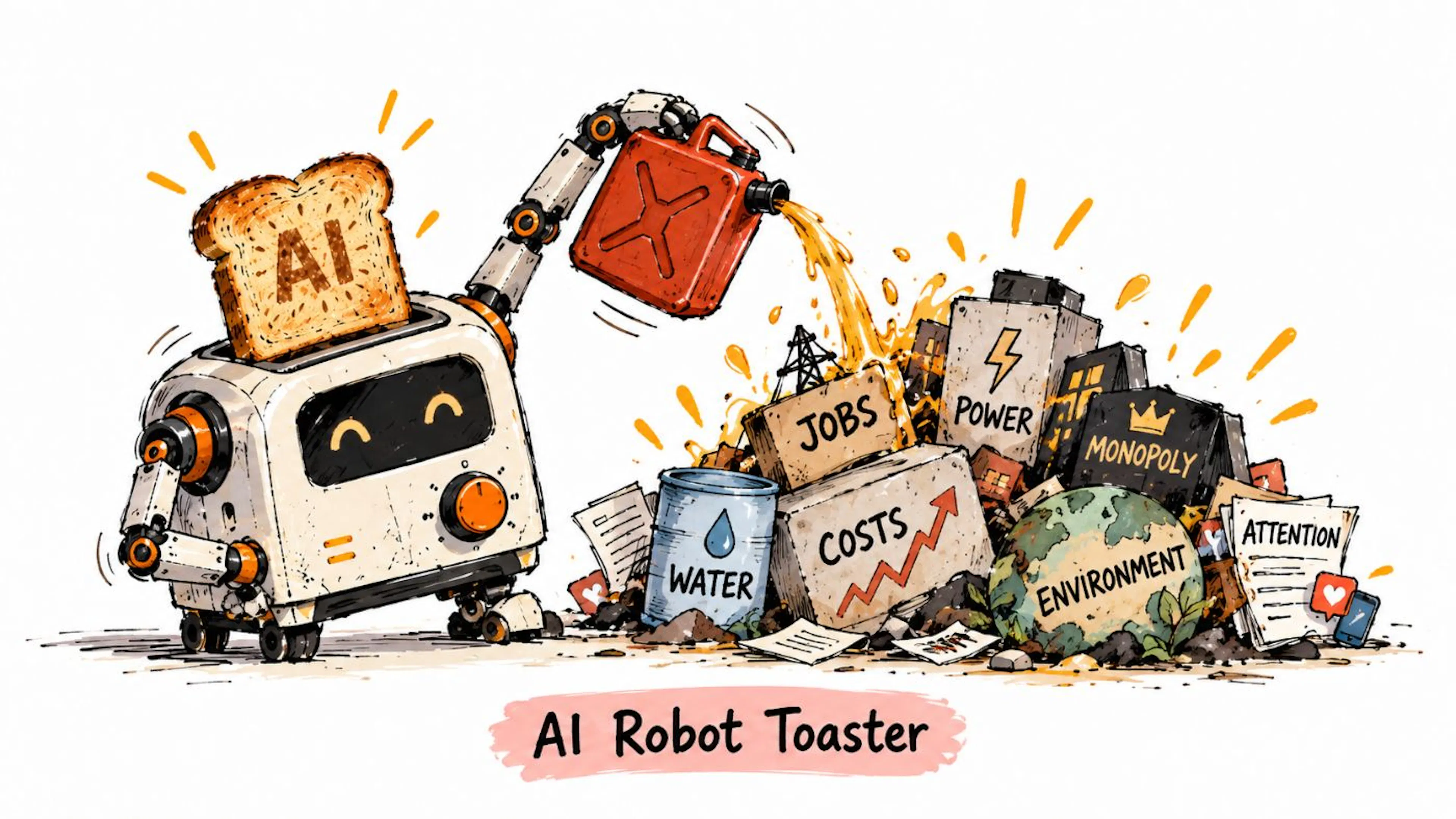
For years, we've tolerated systems that optimise one variable while treating everything outside it as somebody else's problem. More growth. More consumption. More engagement. More assets. More efficiency.
That becomes a lot more consequential when the optimisation machinery gets dramatically better.
This is why parts of our current economic model suddenly feel strangely old to me.
Not because AI has somehow discovered a better political system, and not because capitalism can simply be switched off.
Because we're applying twenty-first-century intelligence to incentive structures that can still reward short-term extraction over long-term resilience.
Maybe the opportunity isn't simply to use AI to make the existing machine run faster.
Maybe we can use it to ask whether we're running the right machine at all.
Better Questions: Permaculture & Solarpunk
If we're going to question the machine, we need some idea of what better might look like.
This is where my thinking drifts away from software and towards something I've spent a lot of time with in the physical world: permaculture.
In my twenties, I read a lot of Noam Chomsky and became increasingly uncomfortable with the systems around me. That kicked off a depression and a much longer period of questioning how I actually wanted to live.
Eventually, some of the answers became surprisingly literal.

More recently, I planted a 14,000-tree native woodland.
There is something reassuring about trees. You can argue endlessly about economic systems and political ideology, but planting a diverse woodland is relatively easy to reason about. Given enough time, it creates habitat, stores carbon, protects soil, slows and retains water, and becomes more valuable as an ecosystem precisely because it is alive.
Permaculture takes that kind of thinking and turns it into a design philosophy.
Instead of asking only:
How do I extract more output from this system?
you start asking:
Can the system replenish what it consumes?
Can one part's waste become another part's input?
Does increasing productivity make the whole thing stronger or more fragile?
Will this still work in twenty years?
Those questions feel increasingly relevant to technology.
AI gives us extraordinary new capacity to optimise systems. Perhaps we should use some of that capacity to optimise for resilience, regeneration and long-term human wellbeing, rather than simply making existing extraction more efficient.
This is also why I find solarpunk interesting.
At its best, solarpunk isn't just an aesthetic of plants growing over futuristic buildings. It's an attempt to imagine technologically advanced futures that are actually pleasant to live in: abundant without being relentlessly extractive, decentralised where possible, and designed around human and ecological wellbeing.
AI could fit remarkably well into that future.
But only if we ask it to help build one.
Using AI for Good
So this is where I land.
I don't think the important battle is humans versus AI, or Red vs Blue.
I think it's a battle over what we choose to amplify.
AI can make extractive systems more efficient, centralize power further, and encourage us to outsource more and more of our judgement.
Or it can give ordinary people access to capabilities that previously belonged to large companies, specialists and institutions.
Both can be true at the same time.
That's why simply boycotting AI doesn't feel like much of an answer to me.
AI is going to be embedded in more and more of the world around us. The more useful question is how we use it without allowing it to quietly reshape us in ways we never consciously chose.
For me, that means a few principles.
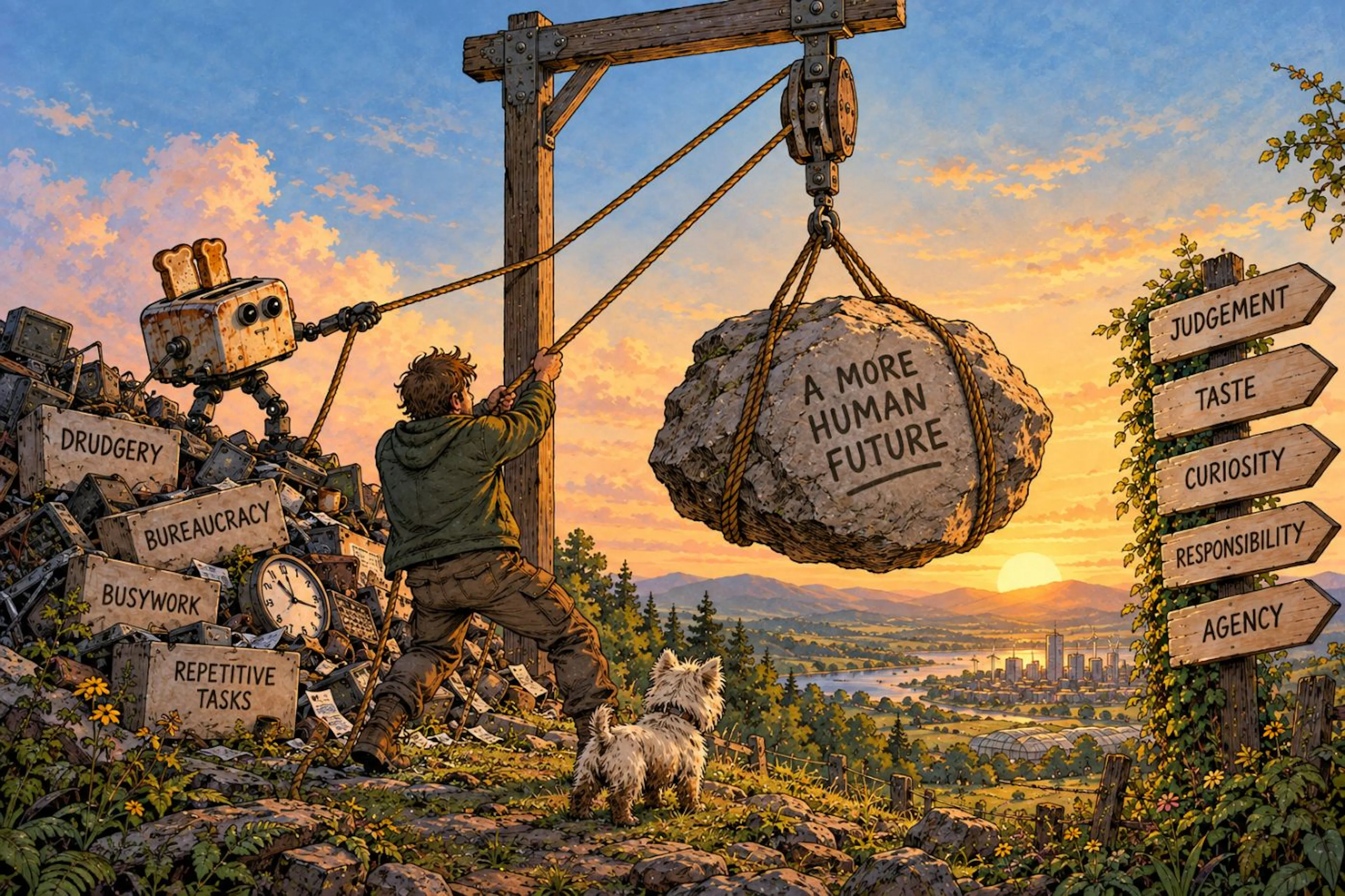
- Automate the soulless stuff. Use AI to remove drudgery, bureaucracy and repetitive work before using it to replace the things that give life meaning.
- Keep your taste. Let AI increase your capability, but don't outsource your judgement, curiosity or personality to it.
- Reject zero-sum optimisation. When AI makes a previously impossible solution possible, look for outcomes where the user, the wider community and the environment can all benefit.
- Use it to question legacy systems. Debt, contracts, bureaucracy, healthcare, food, education, government: intelligence that was once expensive is becoming cheap. That gives us new opportunities to interrogate systems we previously had little choice but to accept.
- Dream bigger. A surprising number of ideas that would once have required a team, large amounts of capital or years of specialist knowledge are becoming achievable by individuals and small groups.
- Decide your principles before the machine decides them for you. If long-term resilience, environmental impact, personal freedom or human wellbeing matter to you, make them explicit constraints in the things you build and the decisions you make.
That last point matters most.
AI is already good at making things easier.
Easier isn't always better.
The danger isn't only that AI becomes powerful. It's that we gradually stop exercising the parts of ourselves that decide what power should be used for.
Judgement.
Taste.
Curiosity.
Responsibility.
Agency.
That, to me, is the real battle for the human soul.
The technology is a force multiplier.
We still get to decide what we multiply.
如有侵权请联系:admin#unsafe.sh