A support leader I spoke with recently was comparing two quotes. One vendor wanted $85 per seat per 2026-9-25 06:37:28 Author: hackernoon.com(查看原文) 阅读量:1 收藏
A support leader I spoke with recently was comparing two quotes. One vendor wanted $85 per seat per month. Another wanted $0.99 per resolution. She was doing the obvious arithmetic: 99 cents is cheaper than 85 dollars, so the AI agent is basically free.
A few months later her AI line item was larger than her seat line item, and nobody had done anything wrong.
The error wasn't in the numbers. It was in treating them as the same kind of number. A seat is a figure you control by headcount. A per-resolution fee is a figure the vendor's model controls by how well it performs. They are denominated in different units, and comparing them on price alone is how budgets get blown by month three.
The useful frame isn't "which pricing model is best." It's a ladder. Each rung changes one thing: who pays when the agent fails.
The five rungs
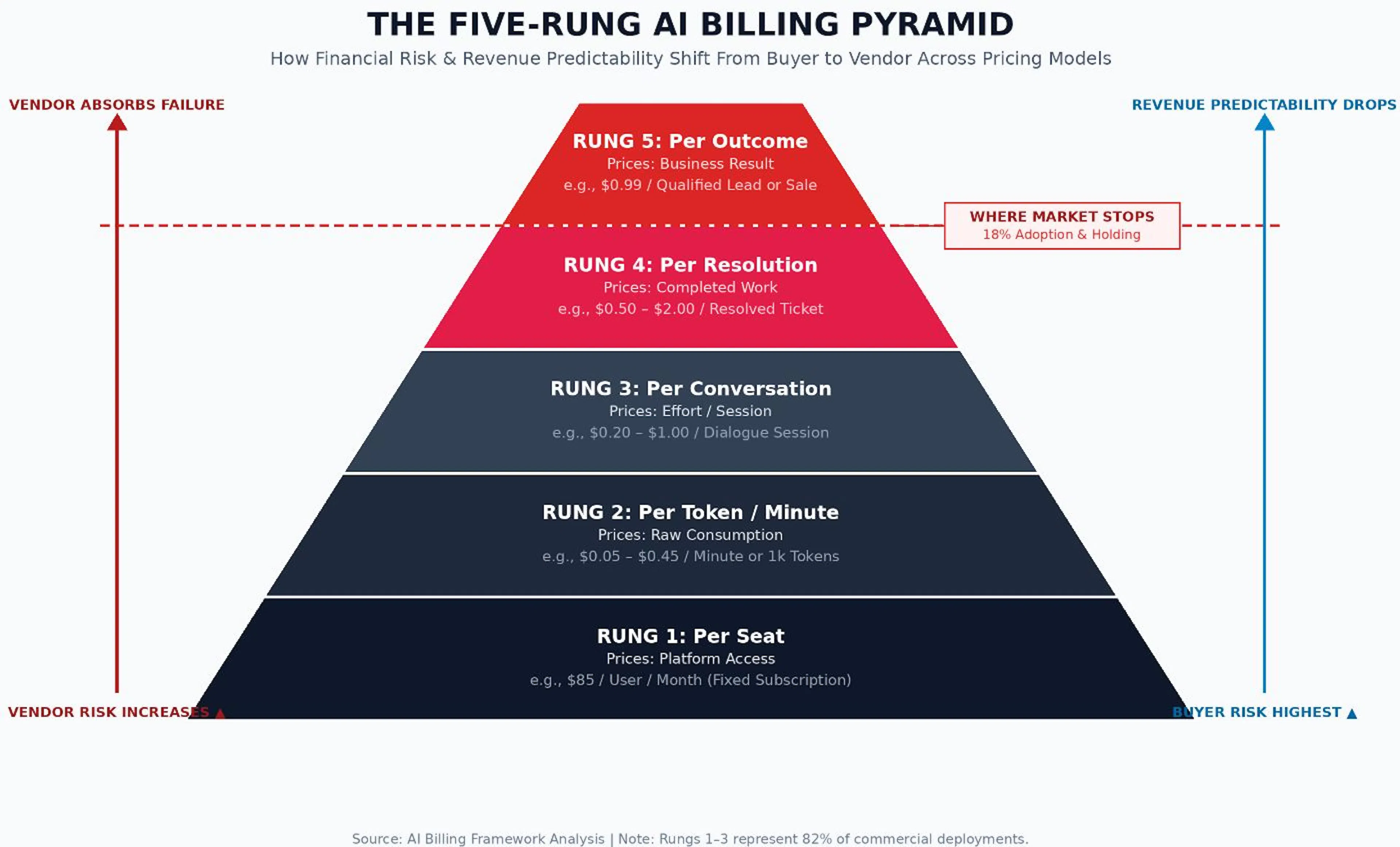
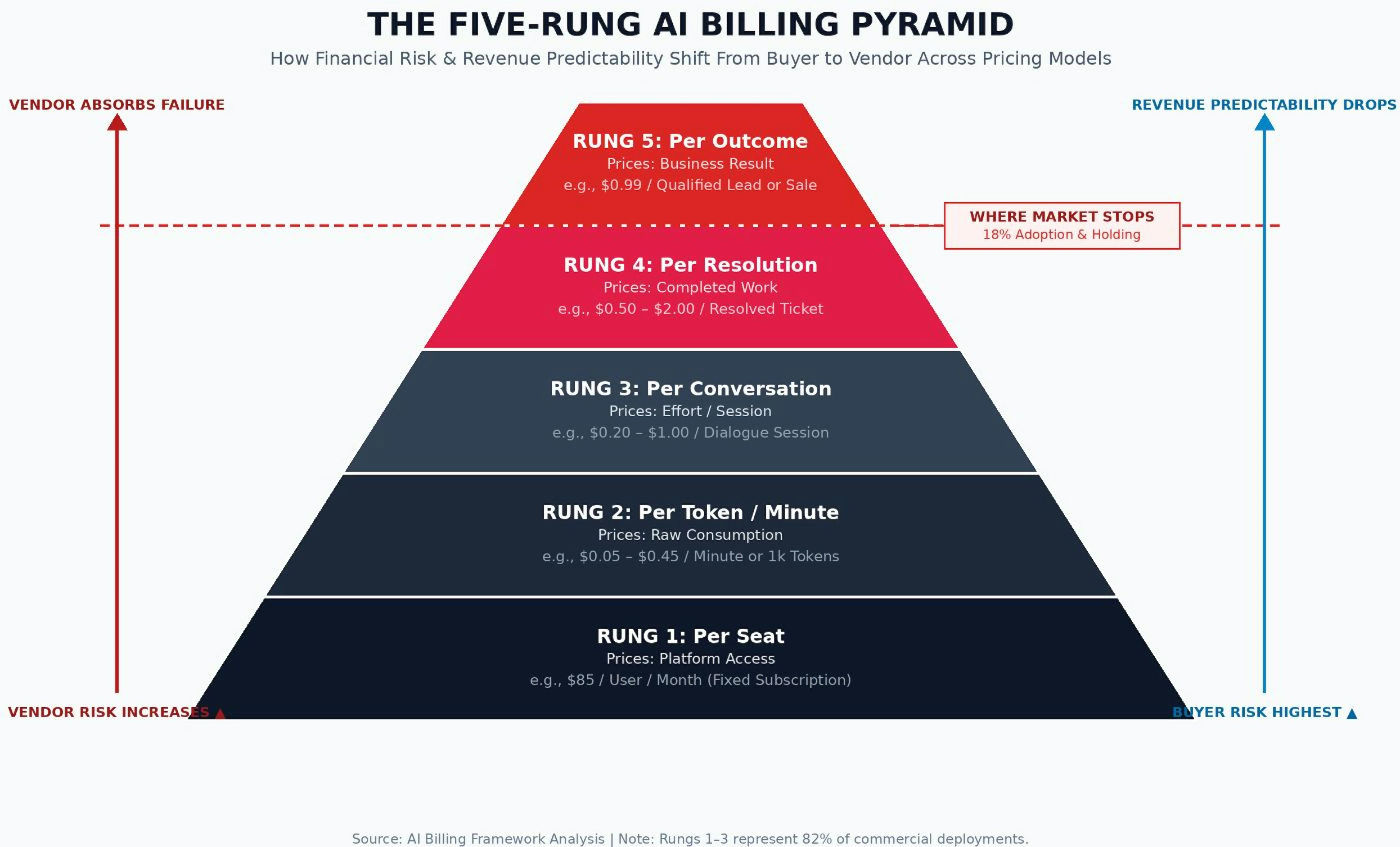
Rung 1: Per seat. You pay for access. Nobody has to use it. The vendor's revenue is fully decoupled from whether the software works. Deloitte's TMT Predictions 2026 puts the direction of travel plainly: traditional pricing could shift away from seat-based and subscription licensing toward a hybrid that blends consumption- and outcome-based models.
Rung 2: Per token or per minute. You pay for consumption. Voice agents sit here by default, at roughly $0.05 to $0.45 per minute all-in. Every retry, every hallucinated detour, every call that ends in a transfer bills the same as a perfect one. The vendor is fully insulated from quality.
Rung 3: Per conversation or per session. You pay for effort. The agent attempted something, so you owe for the attempt. This is the rung most buyers think they're on when they're actually being quoted from rung 4.
Rung 4: Per resolution. You pay for completed work. Fin charges $0.99 per outcome, with resolutions, procedure handoffs and disqualifications at $0.99 and a lead qualification at $9.99, and you aren't charged when a conversation passes to your team. Zendesk bills per automated resolution; it doesn't publish the rate, but independent analyses and customer contract data converge on roughly $1.50 on committed volume and $2.00 pay-as-you-go. HubSpot's Breeze Customer Agent moved to $0.50 per resolved conversation in April 2026, down from $1.00 per conversation handled. Note what that repricing actually was: a step up the ladder from effort to completion, priced at half the number.
Rung 5: Per business outcome. You pay for the result the work was supposed to produce. A qualified lead. A booked meeting. A collected invoice. This is where the marketing copy lives and where almost nobody actually operates.
What the ladder is really measuring
Run a thousand conversations through a system with a 60% resolution rate and the rungs stop looking like pricing and start looking like risk allocation.
On rung 2 you pay for all 1,000. On rung 3 you pay for all 1,000, and the 400 that failed cost exactly as much as the 600 that worked. On rung 4 you pay for 600 and the vendor eats the compute on 400. That's the entire mechanism. Everything else is packaging.
Which leads to the number that actually matters, and it isn't on any pricing page: your effective cost per real resolution. A $0.49 session fee at a 25% resolution rate is an effective ~$2.00 per genuine resolution, four times the sticker. A $2.00 per-conversation fee at 60% resolution is $3.33. A $0.99 outcome fee at a real 70% resolution rate is $0.99, because the model already did the normalization for you.
Normalize every quote to cost-per-real-resolution before you compare anything. Two vendors priced on different rungs are not comparable until you do.
Why almost nobody stands on rung 5
The top rung is where the value story is cleanest and the ground is least solid. The adoption data says so: in ICONIQ's 2026 survey of roughly 305 software executives, 58% still price on subscription or platform fees and 35% on consumption, while outcome-based pricing sits at 18%. That's up from 2%, so the direction is real — but it is still a minority position, not a takeover.
The honest reason is that outcome pricing only works where success rates are already high. Every attempt burns compute regardless of what it produces, so a low success rate leaves too few paying outcomes to cover the failures. And success rates on hard automation aren't there yet. On OSWorld, a benchmark for autonomous computer use across operating systems, agents climbed from roughly 12% to 66.3%, against a human baseline near 72.35%. Impressive slope, but still failing about one structured task in three. No vendor prices a fixed outcome fee against that.
The second reason is attribution. The ultimate outcome in B2B is incremental profit, but buyers won't price against profit because it's political and shaped by factors the vendor doesn't control. One level down is revenue created or cost reduced, closer to financial truth but rarely used as a pricing metric because attribution fights are common and buyers won't expose internals.
Watch what the category's loudest advocate actually does. Sierra built its brand on outcome pricing, and its own blog says the company isn't dogmatic about it and does consumption-style work where it fits the shape of the problem — low-value interactions like a simple greeter conversation get billed on consumption instead. When the true believer carves out exceptions, that's the ladder telling you where it ends.
So the industry settled on rung 4, the highest rung it could instrument.
The rung you can reach is an engineering constraint
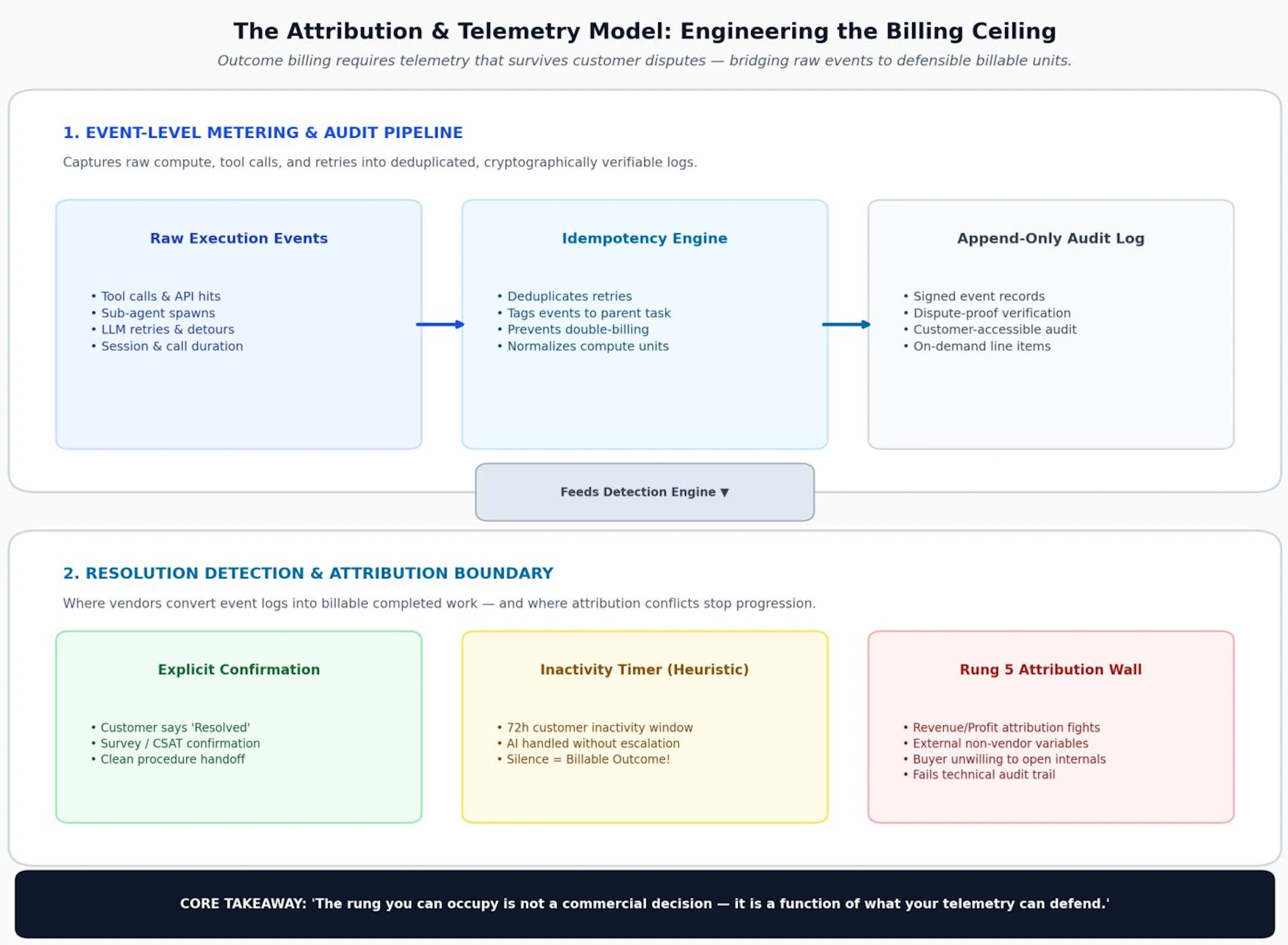
Here's the part that gets lost in the pricing-strategy discourse. Which rung you can occupy is not a commercial decision. It's a function of what your telemetry can defend in a dispute.
Consider how a resolution is actually detected. A Fin resolution means no further help was requested after its last answer, covering both a confirmed resolution where the customer says it helped and an assumed one where the customer just leaves. Zendesk counts an automated resolution when the AI handles a conversation without escalating and there's no further customer activity for 72 hours, with messaging evaluated after two hours by default and configurable up to 72.
Silence is a billable event, on a timer the vendor sets. That's not a scandal, it's a design trade-off, but it tells you exactly what rung 4 really is: a heuristic detector standing in for a business result, with the vendor writing both the definition and the detector. And the meter runs the wrong way for buyers — since January 2026 Zendesk bills resolution overages above committed volume automatically, with no cap.
Climbing a rung means building machinery that survives an audit. Event-level metering with idempotency, so every tool call, retry and sub-agent spawn is logged as its own event tagged to the parent task and deduplicated rather than double-billed. Append-only logs with signed records so both sides can independently verify that totals match line items. And a rule worth tattooing on the wall: if your billing system can't produce an audit trail on demand, outcome pricing is a promise you can't back up when a customer asks.
The sequencing that follows is unglamorous. Token or credit pricing first. Outcome pricing only once your event definitions stop changing quarter to quarter. Margin visibility per customer from day one, not from the first finance close that surprises you.
Pick your rung deliberately
The economics are pushing everyone up the ladder. ICONIQ's data has AI product gross margins averaging 45% in 2025, projected at 53% in 2026 and 59% in 2027 — better than they were, and nothing like the 80%-plus that rung 1 was built on. Meanwhile Salesforce signed a definitive agreement in June 2026 to acquire Fin, formerly Intercom, for approximately $3.6 billion, folding a $0.99-per-outcome agent into Agentforce.
If you're buying: find out which rung the quote sits on, normalize it to cost-per-real-resolution, and ask exactly how the billable event is detected and what the inactivity window is.
If you're selling: don't climb a rung your instrumentation can't defend. The rung above you is always more attractive in a pitch and always more expensive in a dispute.
如有侵权请联系:admin#unsafe.sh