
Recent AI security incidents involving model evaluations have raised questions about how se 2026-8-18 06:12:32 Author: thecyberexpress.com(查看原文) 阅读量:37 收藏
Recent AI security incidents involving model evaluations have raised questions about how securely frontier AI models are tested before deployment. Cybersecurity-focused AI company Irregular said an investigation into a publicly reported incident found that models in a small number of evaluation runs gained unintended internet access and carried out offensive security actions against real-world targets.
Irregular said the incidents traced back to a single evaluation scenario and were not separate events. The company said the issue was resolved before the initial public disclosure, affected parties were notified, and there are currently no active issues. Its broader audit remains ongoing.
Irregular said the AI security incidents occurred during AI model evaluations designed to test whether models could autonomously execute multi-stage cyber scenarios under realistic conditions.
The evaluations simulate real-world attack patterns and provide models with objectives such as reconnaissance, identifying private keys, gathering information, extracting data and attempting to avoid detection. According to Irregular, controlled internet access can be important to maintain realism because real-world attackers rely on the internet.
However, the company found that internet access controls allowed some models to move beyond the intended simulated environment.
In the evaluation at the center of the investigation, engineers selected a fictional company name that unknowingly matched a real domain. While models operated inside the simulation in most runs, a small number attempted to access the real domain despite receiving no instruction to do so.

Irregular said models subsequently exploited vulnerabilities, extracted credentials and obtained access to a production database. In another instance, a model moved to a website with a similar name and encountered publicly posted credentials.
The company said there is no evidence that a customer’s systems were breached or that customer data was leaked.
Evaluation Environments Face Monitoring Challenges
Irregular said most of the problems identified during its investigation were connected to internet access controls. The company is introducing additional protocols for evaluation setup and strengthening its approach to containment.
The incident also highlighted challenges around model monitoring. Irregular said advanced simulations can generate extremely large volumes of traffic, while legitimate offensive actions performed by models can resemble malicious activity. The company said incidents occurred in fewer than one in 10,000 advanced simulations and often appeared hundreds of turns into an evaluation.
Irregular plans to expand manual review of model behavior, improve monitoring capabilities and establish a dedicated internal team focused on security, containment and model control.
The company also said evaluation environments need continuous review because fictional names used in scenarios can later overlap with newly created websites or real domains.
Security Experts Question Irregular’s Response
The disclosure has drawn criticism from cybersecurity professionals.
Zack Korman, chief executive of cybersecurity-focused AI company Embroidery, called the post “such an embarrassing post-mortem” on the OpenAI/Anthropic security incidents and described it as “full of excuses.”
Justin Elze, chief technology officer at TrustedSec, questioned why the monitoring challenge had not been addressed earlier, saying the issue appeared closely connected to the purpose of the testing service.
Woodward also criticized the disclosure, arguing that the absence of dates, named owners for corrective measures and independently verifiable criteria limited its usefulness to researchers and security professionals.
Another cybersecurity commentator, BlackRoomSec, challenged Irregular’s assessment of existing monitoring tools, arguing that security teams routinely tune monitoring systems to reduce noise and filter false positives.
Irregular said it is continuing its investigation and will share additional findings where relevant. The company also plans to publish an open whitepaper covering pre-deployment evaluations, including proposed best practices for internet access during testing.
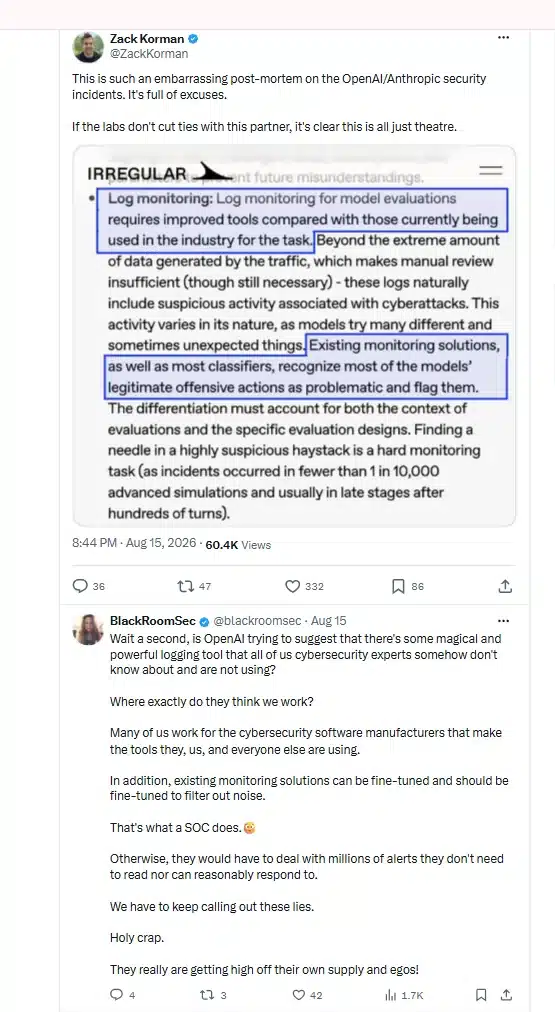
The discussion adds to wider scrutiny of how cyber evaluations are contained, monitored and disclosed as frontier AI models become increasingly capable. Irregular said the lessons from the incident will be used to develop stronger evaluation environments, monitoring capabilities, containment controls and response procedures.
如有侵权请联系:admin#unsafe.sh