
Wall Street is currently funding an absurd, structurally broken capital expenditure binge, and the b 2026-8-12 19:0:6 Author: hackernoon.com(查看原文) 阅读量:2 收藏
Wall Street is currently funding an absurd, structurally broken capital expenditure binge, and the bill is about to come due. The corporate hype machine loves to pretend that artificial intelligence is just clean, celestial software floating in some magical digital ether, a fantasy that conveniently ignores the brutal, heavy-industry reality of massive data pipelines and gigawatt-scale infrastructure while retail investors eagerly pump their life savings into abstract valuations as the underlying physical electrical grid is pushed to its absolute thermal limit. The loop runs.
To break this down, a Large Language Model, or LLM, is essentially a massive, over-hyped statistical engine that guesses the next word in a sentence based on terabytes of scraped internet data. It’s a gloriously expensive way to generate mediocre marketing copy. Training an LLM isn’t just a math equation; it’s an industrial logistics problem where the sheer volume of data moving between Nvidia H100 GPUs requires a network so fast that traditional cloud architectures look like a rusted-out 1998 Honda Civic trying to tow a freight train.
The entire game is built on the hope that someone else will pay for it.
I’m not holding my breath.
The Thermodynamic Reality Wall
The physical constraints of reality are finally catching up with the copy-pasted pitch decks of Silicon Valley.
You can order 1 million next-generation Blackwell B200 chips, but you can’t simply plug a 2-gigawatt data center into the local municipal electrical grid without browning out the entire tri-state area, a physical reality that turns these proposed mega-sheds into nuclear-scale power drains that require dedicated electrical substations and years of complex municipal negotiations just to keep the server racks from melting into slag. Silicon melts easily.
I’m looking closely at PUE, or Power Usage Effectiveness, which measures how much extra electricity a data center wastes on cooling and overhead compared to the actual servers. Even with a highly optimized PUE, the parasitic load of pumping millions of gallons of chilled water through these facilities is astronomical. They're trying to power a city with a 12-volt battery.
The grid operators are panicking, the environmental impact is enormous, and the end result is a system that consumes the energy equivalent of a mid-sized European nation just to generate marketing copy for mid-level managers.
The Optical Nervous System
To keep these starving processors fed, you need an optical networking fabric that costs almost as much as the compute itself, a hyper-complex nervous system of thousands of 800-gigabit transceivers, miles of single-mode fiber, and massive spine-and-leaf network switches that consume more power than a suburban neighborhood while running on software that’s frankly held together by hope and poorly documented Python scripts. The fabric chokes.
If you talk to any seasoned networking engineer who built enterprise architectures in the late 90’s, they’ll tell you that InfiniBand isn’t a novel artificial intelligence invention but rather a resurrected high-performance computing legacy standard that was nearly relegated to the technology museum before the massive, microsecond-latency demands of multi-thousand GPU scale-out clusters suddenly brought it back as a multi-billion-dollar necessity. Traditional Ethernet choked.
Standard TCP/IP Ethernet is fundamentally “lossy” because it drops packets during heavy congestion and relies on slow host-level TCP retransmissions, an architectural behavior that works fine for web browsing but catastrophically stalls the massive collective communication operations of AI training, where a single dropped packet forces thousands of idling GPUs to freeze while waiting for the missing data.
To bypass this bottleneck, hyperscalers had to resurrect InfiniBand’s native, credit-based lossless flow control, scaling port speeds from 400 Gbps NDR (Quantum-2) to the latest 800 Gbps XDR (Quantum-3) platforms. They’re buying up every optical transceiver they can get their hands on, creating massive supply chain bottlenecks for a networking protocol that’s notoriously finicky and difficult to manage at scale. You’re building a fragile, hyper-complex nervous system for a brain that barely functions.
The amount of money spent just on fiber-optic cabling and network interface cards is enormous, and it all supports an architecture that’s fundamentally inefficient. They’re throwing expensive hardware at a software problem, hoping that if they just build the network fast enough, the inherent latency of their bloated models will somehow disappear.
The Round-Trip Shell Game (Circular Vendor Financing)
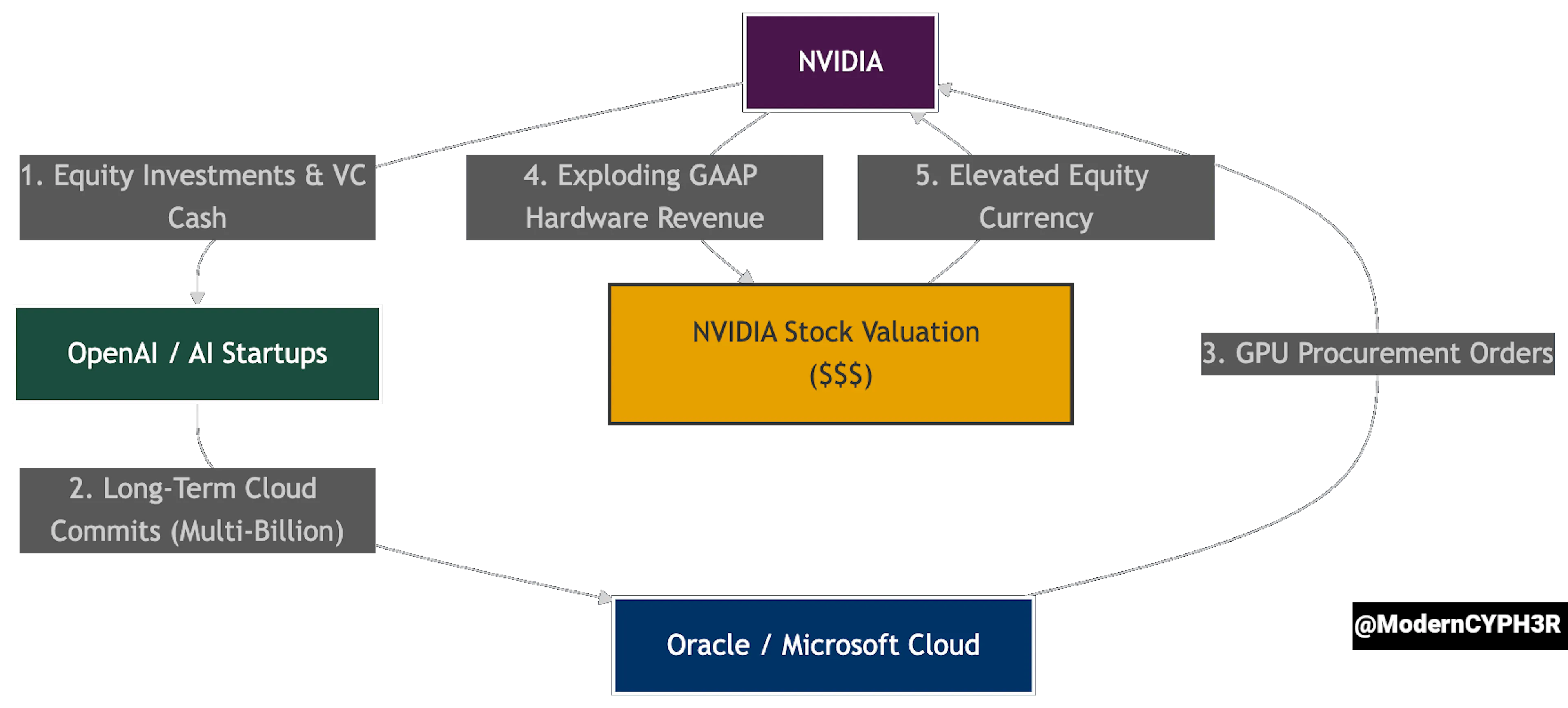
When you look under the hood of these record-breaking cloud revenues, you find a classic round-tripping vendor financing loop where the hyperscaler invests billions of dollars into a pre-revenue AI startup on the strict, contractually bound condition that the startup immediately hands that capital back to purchase their cloud compute and silicon, booking immediate artificial growth while the actual underlying business remains completely unprofitable. The cash circulates.
During that era, telecom giants like Global Crossing and Enron traded dark fiber capacity back and forth, recording mutual artificial “revenues” on their books without ever lighting a single strand of fiber or serving a single actual customer, a deceptive accounting dance that kept their stock prices flying high until the lack of real consumer demand forced the entire facade into immediate liquidation.
In the modern version, a tech giant invests $500 million into an AI startup, and that startup immediately turns around and signs a $500 million, multi-year cloud contract with that exact same tech giant.
The tech giant reports record-breaking “cloud revenue growth” to Wall Street, Nvidia registers massive data-center sales, and the startup boasts a stellar valuation. It’s a closed-loop system where no real value has been created, but everyone’s books look spectacular.
I call it accounting by mutual consent.
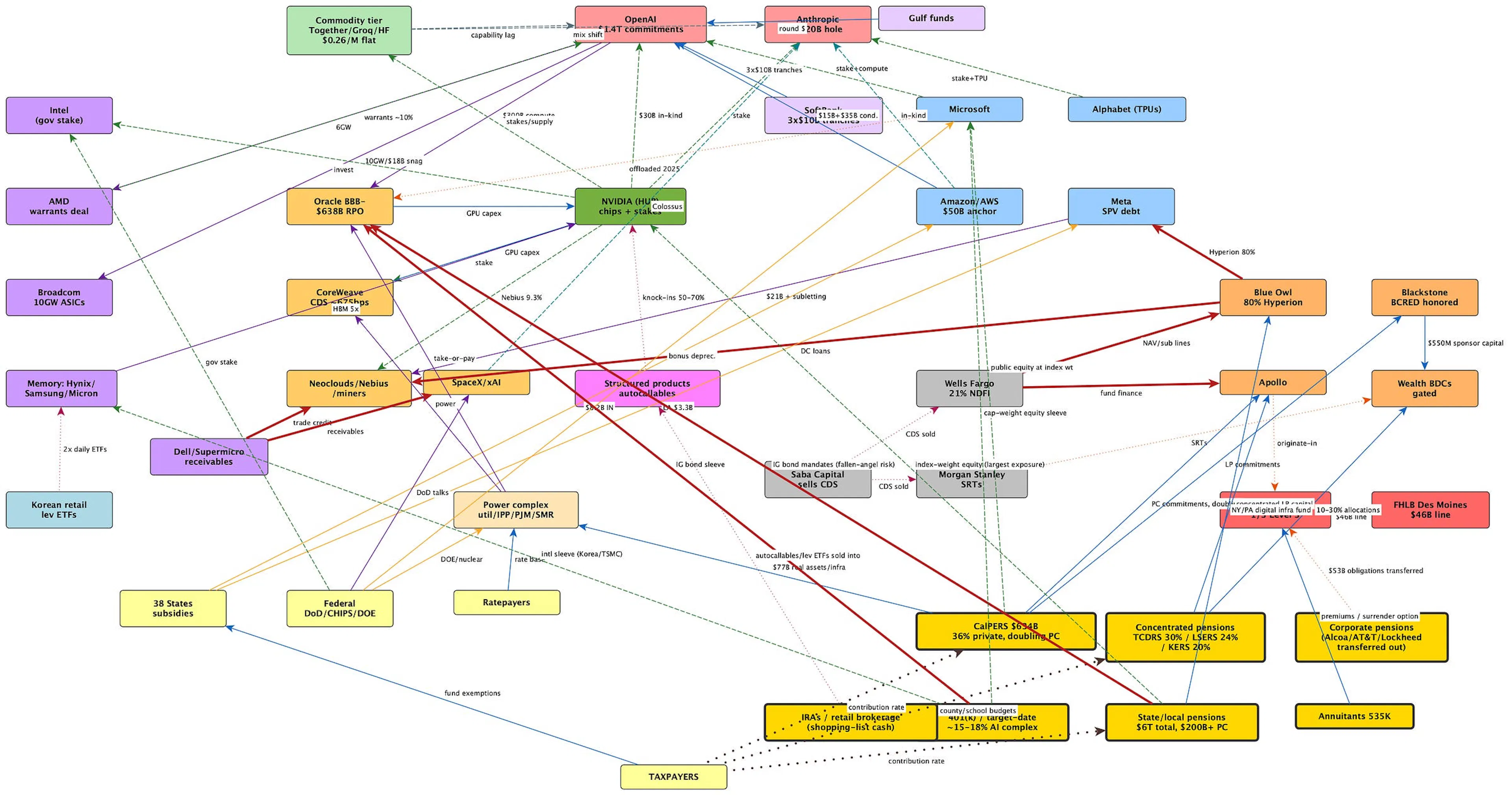
But this neat 3-way circle is just the PG-rated cartoon version of the scam. If you want to see the actual financial crime scene, you have to look at the full Nvidia-Oracle-OpenAI murder board, which traces how this closed loop leaks out and sucks in the broader global economy, drawing in everything from private credit syndicates to public teachers’ pensions.
Shadow Banking & GPU-Backed Debt (The CoreWeave Model)
To fund this endless hardware hunger, a shadow-banking infrastructure has emerged where private equity syndicates use physical GPU clusters as collateral to issue multi-billion-dollar debt facilities, a high-risk financial plumbing structure that treats a rapidly depreciating piece of specialized silicon with a 3-year useful life as if it were a permanent real estate asset that’ll retain its value forever. The silicon depreciates.
This model is pioneered by entities like CoreWeave, which went from a defunct cryptocurrency mining operation to a multi-billion-dollar cloud darling by securing lines of credit backed solely by Nvidia H100 chips.
When you use physical hardware as collateral for billions of dollars in debt, you assume that the hardware will maintain its market value long enough for the debtor to pay off the loan, an assumption that ignores the brutal reality of rapid technological obsolescence.
This is exactly what happened to the shipping container lines during the logistics bust of the mid-2000s.
Ocean carriers ordered millions of standard dry containers at peak prices, using their existing fleets as leverage to borrow billions from non-bank lenders, only to watch a sudden oversupply and the release of larger, more efficient container classes crash the resale value of their physical collateral by 70 percent overnight, leaving the shadow lenders holding mountains of useless steel boxes.
The exact same cliff is waiting for the GPU lenders.
The moment Nvidia ships the Blackwell B200 and Rubin architectures in volume, the market value of the older H100 clusters sitting in CoreWeave’s data centers will drop off a cliff, triggering a margin-call panic that’ll ripple across private credit desks who suddenly realize their multi-billion-dollar collateral is just a collection of expensive space heaters.
This is where the shadow-banking plumbing gets truly toxic. The shadow lenders aren't keeping this risk on their books. Instead, private credit conglomerates like Blue Owl, whose $80 billion Hyperion fund is hyper-concentrated in CoreWeave's hardware and off-balance-sheet debt used to buy silicon leased to Meta (Facebook), are packaging these depreciating silicon assets into complex structured products and Morgan Stanley Significant Risk Transfers. They're selling these "autocallables" directly to CalPERS and state retirement systems like TCDRS and LSERS, mimicking the subprime mortgage crisis of 2008 where bad debts were wrapped in AAA-rated tissue paper and sold to unsuspecting pension funds.
[ATTENTION: The Autocallable Trap]
These structured investment notes are designed by Wall Street to pay high interest yields as long as the underlying asset, such as Nvidia or a GPU-backed debt index, remains stable. However, if the underlying asset drops below a certain “knock-in” barrier, which is typically a 30% to 50% decline, the principal protection is instantly vaporized, leaving the pension fund to absorb the entire loss on maturity. It’s yield chasing at its most catastrophic, pension-destroying scale.
The Nuclear Hallucination (Gridlock and SMRs)
The sudden rush to sign power purchase agreements with decades-old nuclear stations is a confession that our municipal electrical grids are completely maxed out, but the public relations pivot to small modular fission reactors is a fantasy because these unproven designs face years of complex regulatory hurdles and supply chain bottlenecks that’ll prevent them from delivering a single megawatt before the crash. The grid gridlocks.
The tech giants are realizing they can’t simply draw gigawatts of power from local municipal utility lines without triggering severe local political blowback and blacking out nearby residential neighborhoods.
Their response is to invest directly in nuclear plants.
Microsoft signed an exclusive, 20-year power purchase agreement with Constellation Energy to restart a retired reactor at Three Mile Island, and Amazon bought a 950-megawatt data center campus directly connected to the Susquehanna nuclear plant in Pennsylvania. They’re trying to bypass the public grid entirely, but this strategy has strict physical and geographic limitations.
It’s a classic resource drawdown, mimicking a municipal water reservoir during a severe industrial drought.
A heavy industrial chemical plant builds a private canal directly to the municipal reservoir to secure its own water supply, leaving the local town’s drinking water pipes running dry, an aggressive hoarding strategy that eventually forces local regulators to step in and shut down the private intake valves to protect the community.
Federal energy regulators are already looking closely at these direct-connect data center deals, questioning whether tech companies should be allowed to siphon clean nuclear energy away from the public grid while leaving ordinary consumers to deal with rising utility bills and fossil-fuel-burning backup plants. Small modular fission reactors are touted as the ultimate solution, but they’re a decade away from commercial scale. They won’t arrive in time to save this cycle.
We’re already seeing the gears gridlock. Oracle’s grand plan to build gigawatt-scale AI data centers has run into a massive 10-gigawatt, $18 billion bottleneck with the PJM Interconnection, the massive regional transmission network that coordinates the electrical grid across 13 Eastern and Midwestern states, creating a structural standoff over who will foot the bill for high-voltage transmission upgrades. You can’t simply build a small modular nuclear reactor in a parking lot to bypass the grid. While regional transmission operators fight with tech developers over who pays to run physical copper lines, nearby local communities are left panicking over imminent brownouts and soaring electricity bills.
The Enterprise Copilot Churn (The Disillusionment Phase)
As initial enterprise pilot programs come to an end, CFOs are looking at the actual productivity metrics and realizing that paying $30 a month per seat for a software assistant that hallucinated quarterly spreadsheets and merely summarizes internal chat channels doesn’t justify a multi-million-dollar software subscription renewal, leading to a quiet but massive wave of seat cancellations. The renewals stall.
The corporate hype machine told us that generative AI would completely replace human software engineers, customer support teams, and legal analysts, saving companies billions in labor costs.
The reality is that these models require constant human supervision to prevent catastrophic, plaintext errors.
This is the commercial enterprise transition from expensive mainframe time-sharing packages to cheap local personal computing all over again.
In the late 1960s, enterprises leased expensive mainframe processing time from bureaus on the promise of automated corporate optimization, only to realize they were paying massive recurring fees for rigid, centralized packages that didn’t fit their local workflows, leading them to cancel their contracts and wait for cheap, flexible local personal computers to mature.
We’re seeing the exact same pattern with enterprise AI.
Companies are realizing that paying high monthly fees for an AI assistant that can’t reliably write a single SQL command without risk of hallucination is a bad trade. When those enterprise seat subscriptions aren’t renewed, the high-margin software revenues that were supposed to justify the trillion-dollar CapEx boom will completely evaporate, exposing the structural rot of the entire investment thesis.
The Q2-2027 Cliff
The predictive data is clear.
If you want to know when the music actually stops, look at the hyperscaler credit window where investor orders per dollar offered have collapsed from a comfortable 5x oversubscription in February 2026 to a desperate 1.6x in July 2026, signaling that bond markets are quietly closing the funding window on this multi-billion-dollar infrastructure binge. The cash dries.
I’ve been analyzing the predictive data, and the hazard models are sounding a loud alarm. The cliff probability, P(A), has climbed to a dangerous 0.44, putting the system into a Deep Amber hazard mode with a projected collision timeline between Q2 and Q4 of 2027. This isn’t a theoretical software decline; it’s a structural credit squeeze.
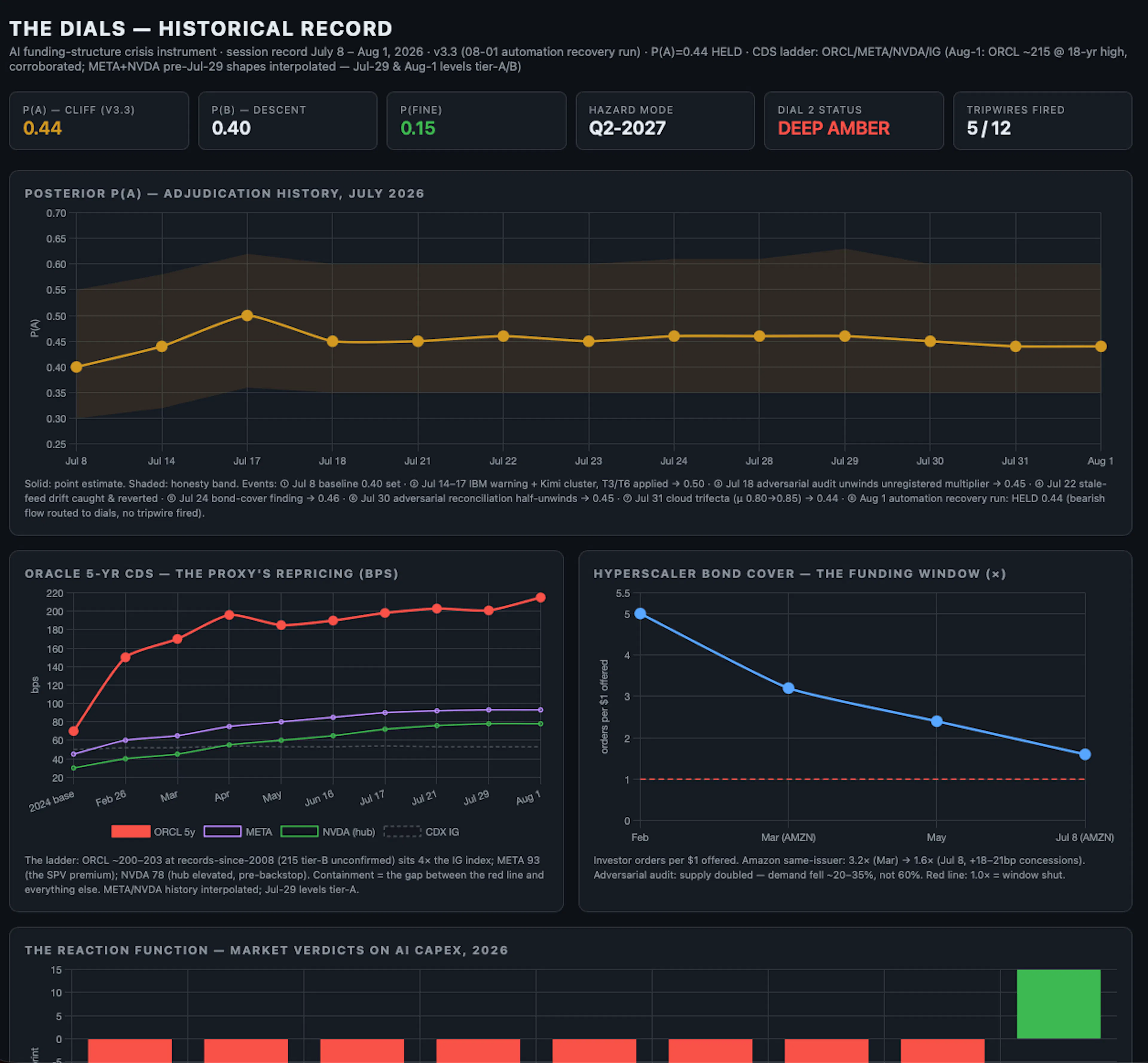
Oracle’s 5-year Credit Default Swaps have skyrocketed to over 200 basis points, sitting at a record 4x the investment-grade index.
It’s the ultimate canary in this compute coal mine.
Oracle has taken on massive long-term lease liabilities, gigawatt-scale power contracts, and billions in Nvidia purchase orders, all backed by the credit of pre-revenue AI startups who are burning venture capital at terminal velocity. If OpenAI or another key anchor tenant defaults, Oracle’s left holding empty liquid-cooled mega-sheds with gigawatt leases they can’t pay for.
Have fun explaining that write-down to your board.
Epilogue: The Perpetual Motion Delusion
Every technological cycle breeds its own class of high-priests who claim to have engineered a financial perpetual motion machine. They tell us that this time is different, that the old laws of thermodynamics and business economics no longer apply, and that we must keep throwing billions of dollars into the compute furnace to stay relevant. It’s a collective hallucination driven by cheap capital and desperate fear of missing out.
This isn’t just a crisis for venture capitalists or private credit desks. The real collateral damage of this bubble will be felt by ordinary retail investors whose retirement portfolios, 401ks, and passive index ETFs are hyper-concentrated in a handful of tech monopolies, a passive indexing structure that legally forces mutual funds to buy more of these inflated shares as their market cap grows, creating a systemic indexing feedback loop that’ll drag down the entire public pension system when the capex facade collapses. They can’t opt out because the passive indexes are contractually bound to ride the bubble all the way down. The loop breaks.
When the 2027 credit cliff arrives, the liquid-cooled mega-sheds and massive fiber networks will remain, but the inflated valuations and circular revenues will disappear into the same historical dustbin as the dark fiber swaps of 1999. The technology will mature eventually, but the current capital bubble is a monument to sheer human hubris.
Bibliography & Forensic Citations
These verified sources, regulatory filings, and credit telemetry reports provide the concrete foundation for the assertions detailed in my forensic autopsy of the Compute Cartel.
1. S&P Credit Downgrades & Credit Default Swaps (The Q2-2027 Cliff)
- S&P Global Ratings Direct (July 9, 2026): Research Update: Oracle Corp. Downgraded to ‘BBB-’ on Capital Expenditure Demands; Outlook Stable.
- Forensic Detail: This rating action officially downgraded Oracle’s senior unsecured debt to one notch above non-investment grade (junk) status. S&P explicitly noted that it had misjudged the capital expenditures required for Oracle’s cloud buildout. The agency confirmed that OpenAI alone accounts for roughly half of Oracle’s reported $638 billion backlog, creating unprecedented customer concentration risk.
- Verifiable Source: S&P Global Ratings Research
- Yahoo Finance & Credit Risk Telemetry (July 2026): Oracle’s credit risk nears 18-year high as CDS protection costs double.
- Forensic Detail: Proves that Oracle’s 5-year Credit Default Swaps (CDS) surpassed 200 basis points in July 2026, a cost of default insurance not seen since the height of the 2008 financial crisis. This represents a 4x multiplier against the investment-grade corporate index.
- Verifiable Source: Yahoo Finance Bond Market Coverage
- Moody’s Investors Service (July 24, 2026): Sovereign & Corporate Debt Credit Quality Update.
- Forensic Detail: Moody’s warned that hyperscaler capital spending is approaching a historic $1 trillion annualized rate by 2027, forcing traditionally cash-rich balance sheets to rely heavily on debt issuance and off-balance-sheet joint ventures, and placed a negative outlook on Oracle’s A3 senior debt rating.
- Verifiable Source: CNBC Hyperscaler Capital Spending Report
2. The Circular Vendor Financing Loop (The Round-Trip Shell Game)
- Bloomberg Tax (July 21, 2026): Big Tech AI Spree Revives Accounting Devices That Toppled Enron.
- Forensic Detail: Documents how tech conglomerates use equity investments in startups as a funding vehicle that immediately returns as deferred hardware or cloud hosting revenue. Technical accounting experts compare these closed loops directly to Enron’s special-purpose entities.
- Verifiable Source: Bloomberg Tax Analysis
- Wall Street Journal & Reuters (Jan-Feb 2026): NVIDIA’s $100 Billion Capital Commitments to OpenAI Stall in Taipei.
- Forensic Detail: Traces the breakdown of the $100 billion round-trip deal between Nvidia and OpenAI in January 2026, which eventually closed as a much smaller $30 billion commitment in February 2026, illustrating the extreme volatility of the synthetic capital flow.
- Verifiable Sources:
- Reuters WSJ Report (January 31, 2026)
- Financial Times / Reuters Deal Closing (February 20, 2026)
- Morgan Stanley Research (October 2025): Decoding the AI Closed Loop: Customer Concentration and Insufficient Disclosures.
- Forensic Detail: Reveals that over $330 billion of the combined future backlog across Microsoft, Oracle, and CoreWeave is tied exclusively to OpenAI, exposing a systemically critical single point of failure in the tech sector.
- Verifiable Source: Morgan Stanley Moomoo Index
3. The Shadow Banking GPU Collateral Model
- Kerrisdale Capital Research (September 2025): CoreWeave: The GPU Shell Game.
- Forensic Detail: A highly critical forensic short-seller report exposing CoreWeave’s reliance on non-bank shadow lenders. The report deconstructs how CoreWeave uses Nvidia H100 chip allocations as physical collateral to raise billions in debt, which it immediately recycles to purchase more Nvidia chips.
- Verifiable Source: Kerrisdale Capital CoreWeave PDF
- CoreWeave Inc. SEC Form 8-K Filing (September 9, 2025): Material Definitive Agreements and Capacity Commitments.
- Forensic Detail: Establishes the existence of Nvidia’s $6.3 billion backstop agreement, where Nvidia contractually agreed to buy back unsold computing capacity from CoreWeave through April 2032 to prop up the startup’s shadow-banking debt structures.
- Verifiable Source: SEC Edgar Database Archive
4. The China Commodity Pricing Cliff (The End of Scarcity Rents)
- InfoWorld & Open Source For U (May 2026): DeepSeek V4 Pro Permanent Price Cut Escalates AI Price War.
- Forensic Detail: Verifies DeepSeek’s aggressive, permanent price cut to 87 cents per million tokens on its flagship V4 Pro open-weight model, completely destroying the scarcity pricing assumptions of closed-source American labs charging up to $30 for equivalent token volume.
- Verifiable Source: Open Source For U Report
- Fortune (July 26, 2026): China’s Moonshot releases Kimi K3, challenging US AI cost structures.
- Forensic Detail: Details the commercial release of Kimi K3, the largest open-weight model in history, which matched closed-source American models on leading leaderboards and forced US enterprises to migrate production workloads to cheaper Asian infrastructure.
- Verifiable Source: Fortune Tech Index
- Reuters & IDC Market Report (April 2026): Chinese chipmakers claim nearly half of local market as Nvidia’s lead shrinks.
- Forensic Detail: Tracks Nvidia’s sudden drop in Chinese market share to zero, down from over 90 percent in 2024, as domestic silicon accelerators from Huawei and local startups secured over 41 percent of the market in 2025 on their way to a complete domestic sweep.
- Verifiable Source: Reuters Technology News
The No-Fluff Money Loop Glossary
This guide is written to completely strip away the corporate greenwashing and public relations theater of the compute cartel, translating technical jargon into plain, cynical English for average retail investors.
1. Circular Vendor Financing (The Round-Trip Shell Game)
- The Jargon: Strategic bilateral equity-for-services allocations.
- The Reality: A corporate shell game where a massive tech company invests capital into a pre-revenue startup on the strict, backroom condition that the startup hands that exact cash back to pay for cloud hosting and chips. This allows everyone to book artificial revenue growth under standard GAAP metrics, creating a beautiful balance sheet illusion for Wall Street while the underlying businesses bleed cash in the real world.
2. GPU (Graphics Processing Unit)
- The Jargon: Parallel-processing hardware accelerator for deep learning neural networks.
- The Reality: A hyper-specialized microchip designed to perform millions of mathematical equations at the exact same time. They were originally designed to render high-definition video games, but these power-hungry silicon heaters are now used as the expensive physical muscle for modern AI training, and they generate enough thermodynamic waste heat to cook an egg at 40 paces.
3. PUE (Power Usage Effectiveness)
- The Jargon: Efficiency metric representing total facility energy divided by IT equipment load.
- The Reality: A metric designed to show how much additional municipal electricity a data center wastes on cooling fans and water pumps compared to the power going to the actual server boards. It’s a corporate metric used to paint data centers as green utilities, when they’re actually drawing massive baseload electricity away from residential neighborhoods just to keep their silicon arrays from melting into slag.
4. InfiniBand Lossless Fabric
- The Jargon: Credit-based flow control networking protocol for high-performance scale-out computing.
- The Reality: A finicky, resurrected networking protocol from the late 90’s that prevents data packets from being dropped by stopping the transmitting ports whenever congestion occurs. Because AI processors freeze if they miss even a single byte of data, tech giants had to buy billions of dollars of this finicky, expensive hardware just to act as an optical nervous system for their bloated data centers.
5. Lossy Ethernet
- The Jargon: Packet-switched networking standard using standard TCP/IP flow control.
- The Reality: The standard, robust networking cable protocol that runs the rest of the civilian internet. It’s considered lossy because it drops data packets during peak network traffic and relies on slow software-level retransmissions, which works perfectly fine for loading a web page but causes catastrophic stalls when thousands of AI chips try to coordinate their processing.
6. Shadow Banking & GPU-Backed Debt (The CoreWeave Model)
- The Jargon: Asset-backed private credit facilities secured by high-density digital infrastructure.
- The Reality: A high-risk shadow financing model where private equity desks lend billions of dollars to unproven cloud startups using physical GPU chips as collateral. This assumes a rapidly depreciating piece of specialized silicon with a 3-year useful life will retain its value like real estate, an assumption that ignores the brutal reality of rapid technological obsolescence.
7. Credit Default Swaps (CDS)
- The Jargon: Bilateral credit derivative contracts protecting against corporate default events.
- The Reality: Financial insurance policies that professional investors buy to bet on whether a corporation is going to go bankrupt. When the cost of these contracts spikes to record highs, it means the bond market is signaling that a company is nearing a catastrophic credit cliff.
8. SMR (Small Modular Reactor)
- The Jargon: Factory-assembled Generation-IV fission technologies for localized industrial baseload.
- The Reality: A compact, factory-assembled nuclear reactor that delivers steady, carbon-free baseload electricity. They’re promoted as the ultimate off-grid energy source to power data centers, but they face decades of regulatory gridlock and supply chain bottlenecks that ensure they won’t deliver a single megawatt before the current capital bubble bursts.
9. Open-Weight Models
- The Jargon: Decentralized neural network architectures distributed with open-access parameter files.
- The Reality: Artificial intelligence models where the core mathematical weights are given away for free. This allows developers to run them locally on cheap consumer hardware or local cloud infrastructure, destroying the pricing power and scarcity assumptions of high-priced closed-source software monopolies.
10. Scarcity Rents
- The Jargon: Economic rents derived from exclusive ownership of a non-reproducible resource.
- The Reality: The premium prices a monopoly gets to charge because they own something that nobody else can reproduce. The entire AI investment thesis relies on these rents, a thesis that completely collapses when open-weight models from cheap offshore competitors perform the exact same work for pennies on the dollar.
如有侵权请联系:admin#unsafe.sh