Trust has become one of the most valuable currencies in the proprietary trading industry. With prop 2026-8-12 14:0:32 Author: hackernoon.com(查看原文) 阅读量:1 收藏
Trust has become one of the most valuable currencies in the proprietary trading industry. With prop firms promising left and right how trustworthy they are, traders look for more signals to determine which firm they can truly trust, such as Trustpilot reviews.
A Trustpilot rating can change how a prop firm is perceived long before a trader opens an account.
But how trustworthy are Trustpilot reviews, to be exact?
Online reviews have become more than customer feedback. They're part of how firms present themselves to the market. Some customers decide on their own to share an experience. However, not every review starts with the customer; some begin with the firm.
A review invitation can be sent after a positive interaction, giving businesses some control over when they're asking customers for feedback. That timing doesn't change what a customer writes, but it can influence which experiences are more likely to be reviewed.
The timing isn't always random, and that makes review collection a business decision rather than simply a customer decision. This doesn't mean invited reviews are misleading or that firms are manipulating their ratings. Business invitations are a legitimate part of Trustpilot's review system. The question is whether the way invitations are used can influence the overall picture that prospective customers see.
To explore that question, we analyzed 14,277 Trustpilot reviews collected from 52 active proprietary trading firms over a twelve-month period. By comparing business-invited reviews with customer-initiated reviews, this analysis examines whether different review collection methods produce different patterns in public ratings, and what those patterns mean for anyone relying on Trustpilot when evaluating a prop firm.
The Invitation Model
Business invitations are a standard part of
The invitation itself isn't the focus of this analysis. The more important question is when that invitation is sent. Unlike a customer who independently decides to leave a review, an invited review begins with a decision made by the business.
That means companies have control over the timing of the request. The key decision isn't whether a customer can leave a review. It's when the business chooses to ask for one. That timing sits at the center of this analysis.
That distinction is central to this study. If review invitations are consistently sent after positive interactions, invited reviews may reflect a different set of customer experiences than reviews left voluntarily. The purpose of this analysis is not to question the legitimacy of invited reviews, but to examine whether invitation timing influences the overall picture presented by public ratings.
How We Analyzed the Data
This
The dataset was then analyzed to compare how the two review groups differed.
The analysis focused on three questions:
- How many reviews came from business invitations versus customers who reviewed on their own?
- Did invited and organic reviews receive different average star ratings?
- Were low-rated reviews distributed differently across the two groups?
The purpose of the analysis was not to determine whether invited reviews are valid or invalid. Both review types are recognized by Trustpilot and contribute to a company's overall rating. Instead, the objective was to examine whether the method of review collection produced measurable differences in the public ratings traders rely on when comparing prop firms.
What the Data Shows
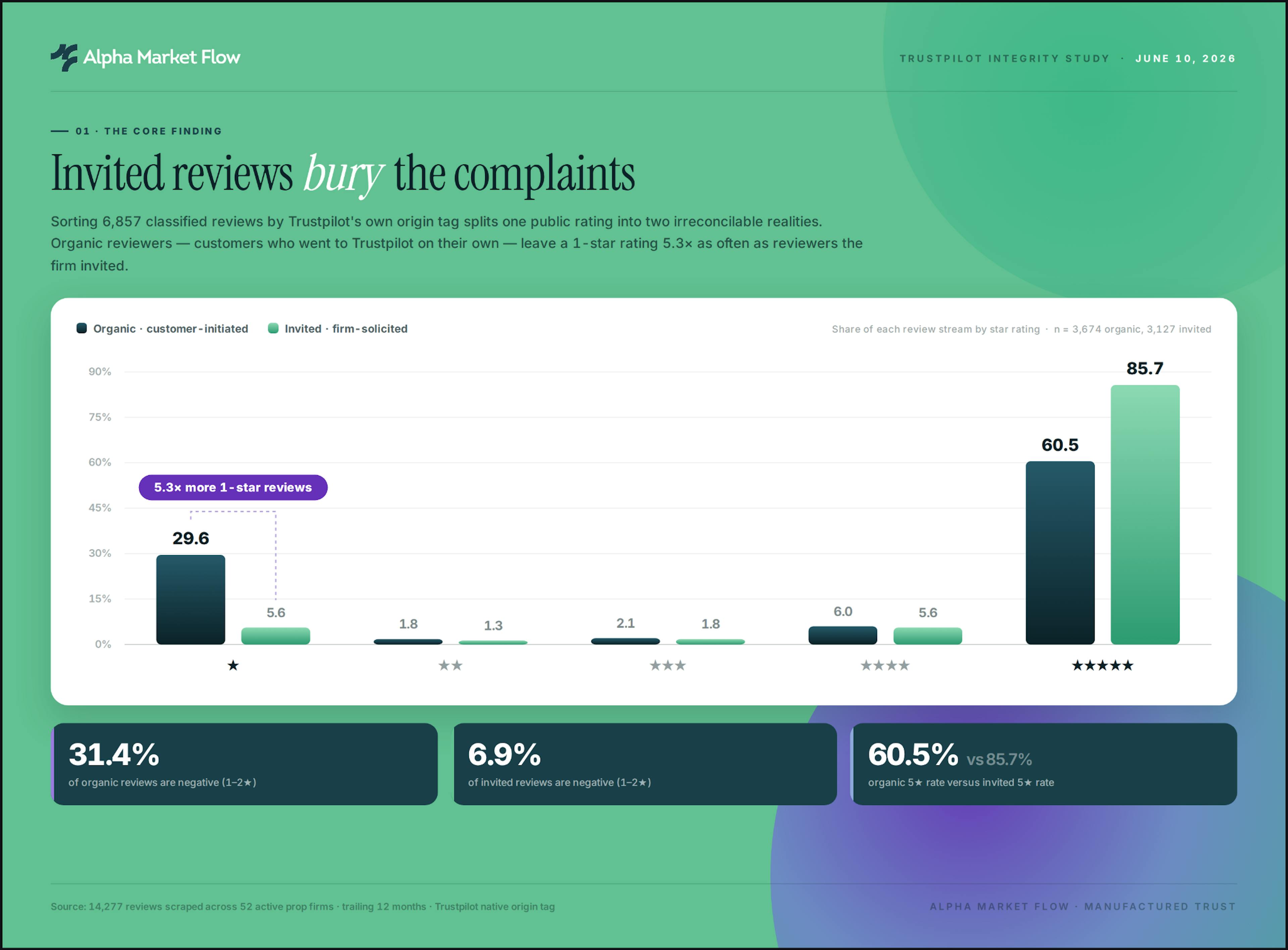
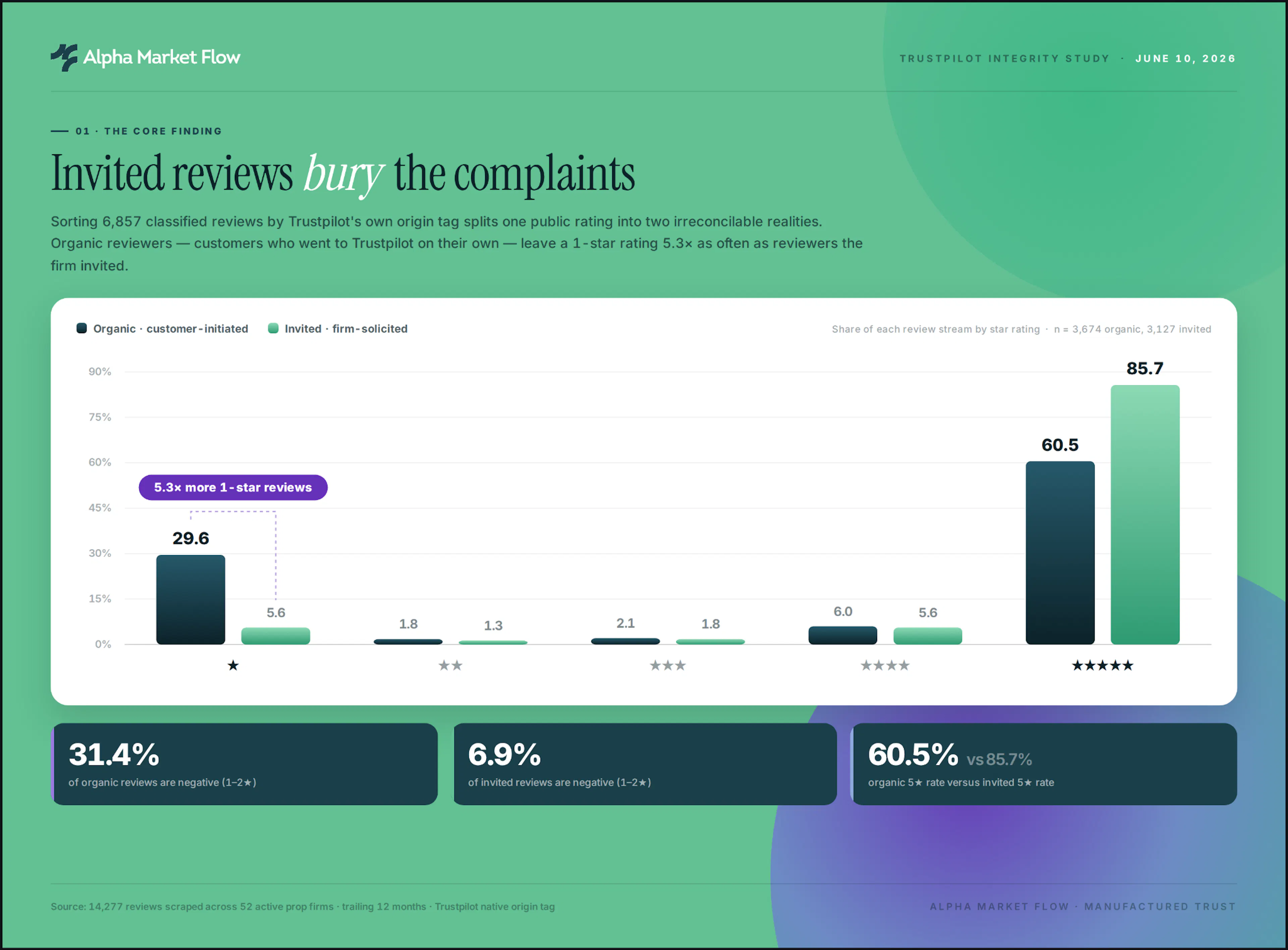
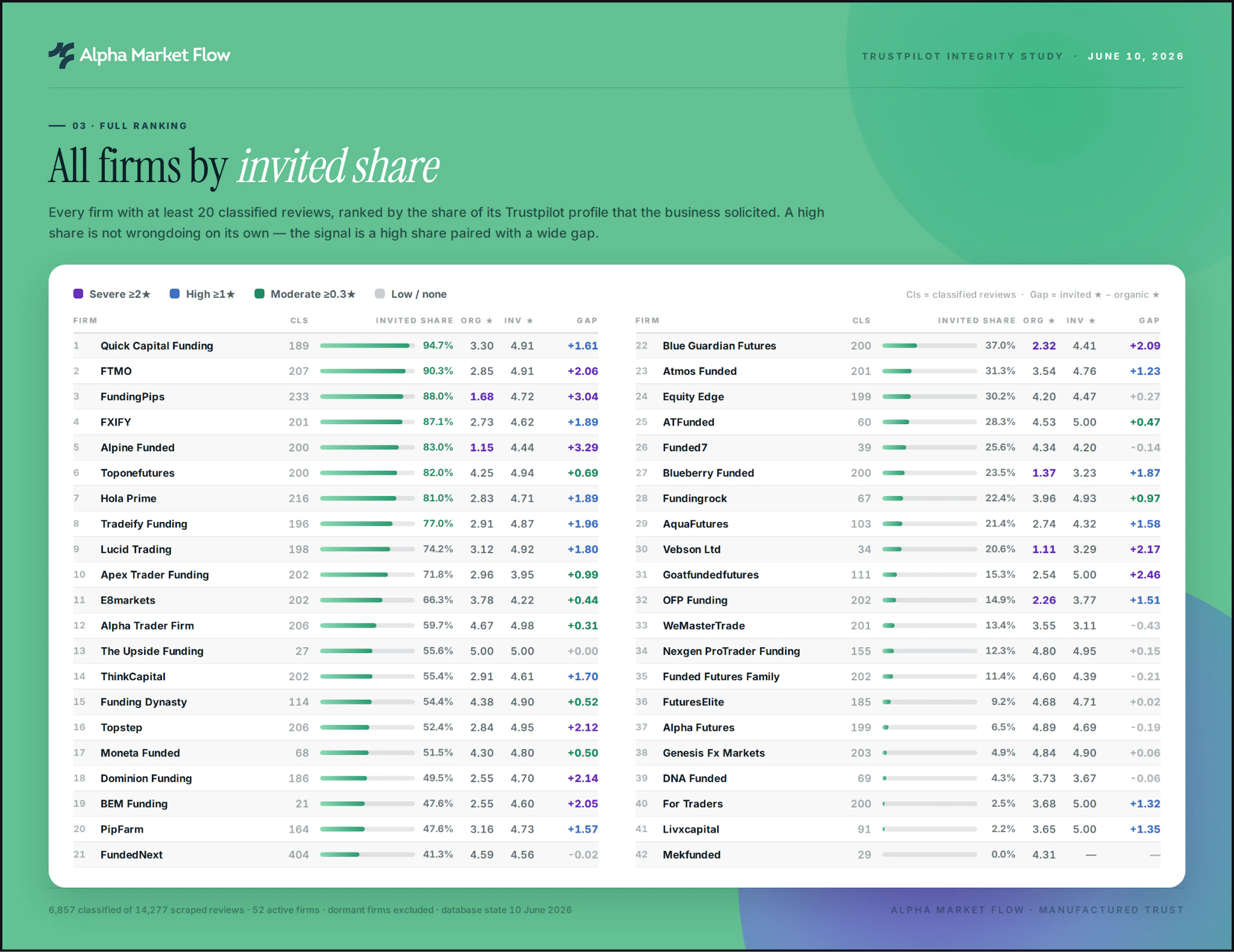
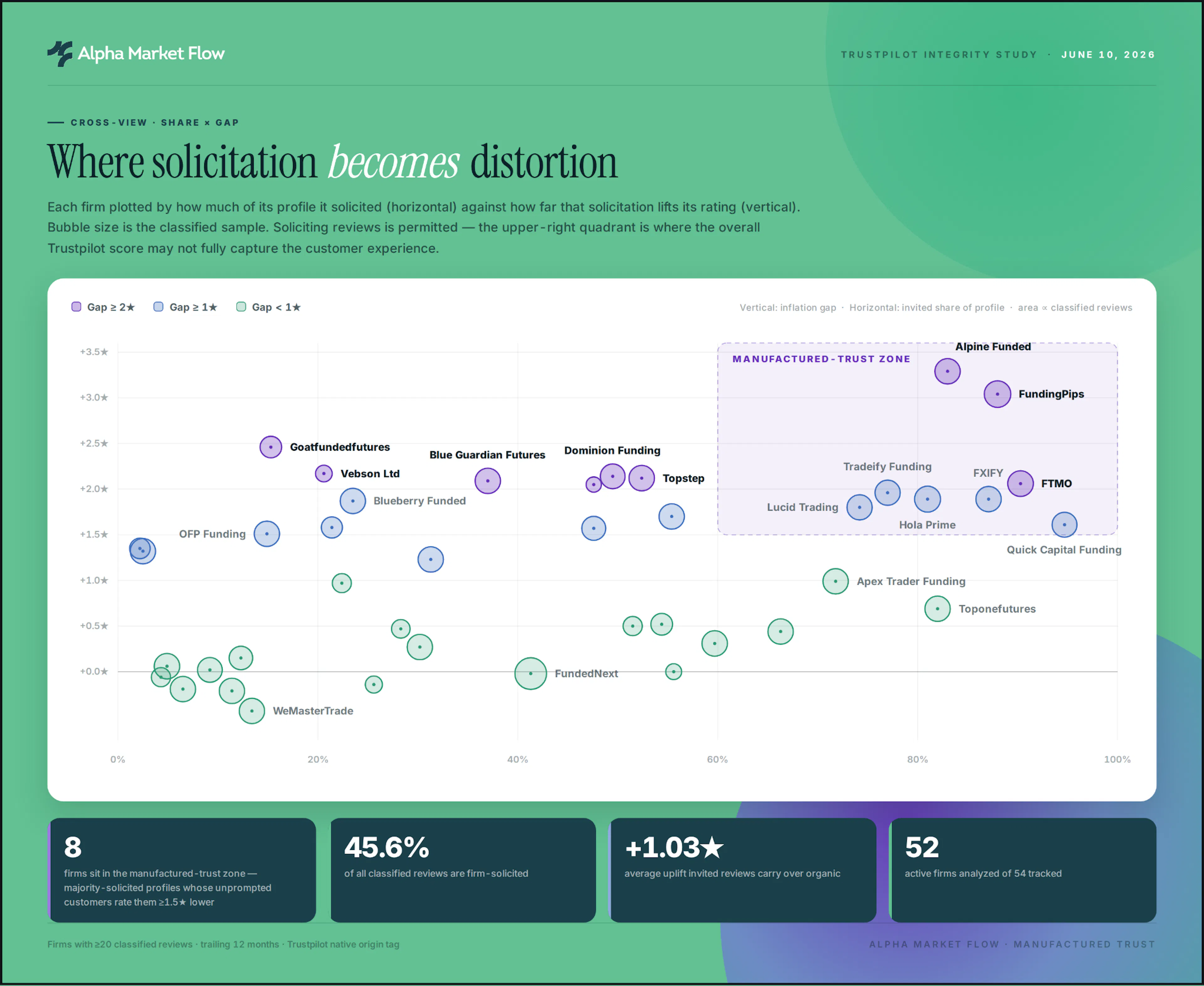
The dataset contained 14,277 reviews, of which 6,857 were classified by Trustpilot as business-invited. Across the firms analyzed, invited reviews accounted for 45.6% of all reviews in the sample.
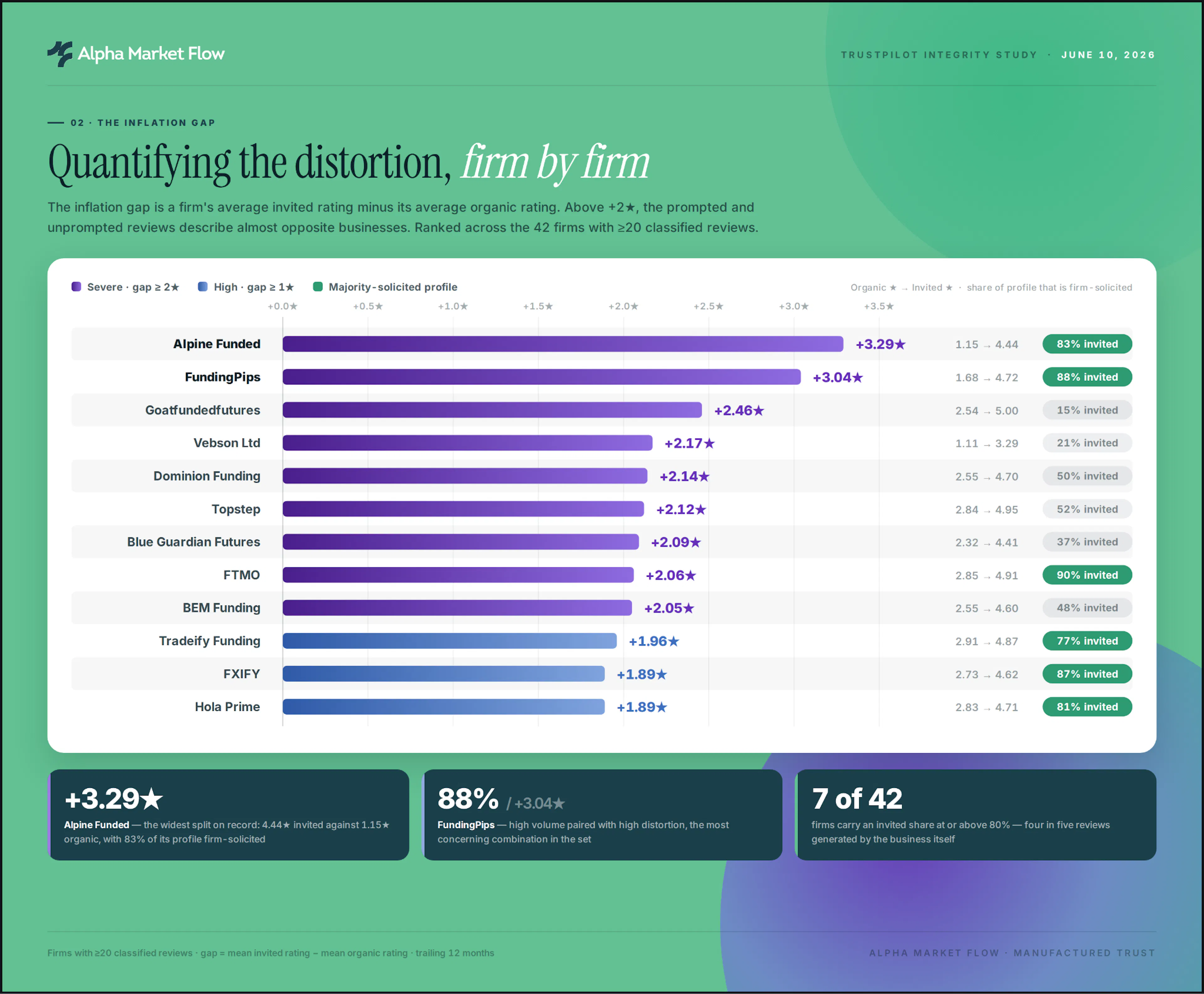
The difference between invited and organic reviews became more apparent when the ratings were compared. On average, invited reviews received 1.03 more stars than reviews customers submitted on their own. That gap appeared consistently across the dataset and was one of the strongest patterns identified in the analysis.
The contrast was even clearer at the lowest end of the rating scale. Among organic reviews, 29.6% were one-star ratings. For invited reviews, that figure dropped to 5.6%.
These findings do not suggest that invited reviews are inaccurate or that firms are manipulating customer feedback. They do show that invited and organic reviews produce noticeably different rating patterns. That difference becomes important when both review types are combined into a single public score used by traders to compare firms.
What the Findings Suggest
This analysis doesn't attempt to determine intent or misconduct. It examines whether review invitation practices produce different public rating patterns.
One possible explanation is selection. The findings don't suggest that invited reviews are dishonest or that firms are manipulating Trustpilot. They point to something more practical.
Trustpilot itself has addressed a related practice. The platform discourages businesses from soliciting reviews through channels like email or live chat, on the reasoning that a direct request is more likely to follow a positive interaction, and that pattern can be read as selective. Firms that have asked why organic positive reviews are subject to
The invitation data in this analysis suggests a parallel pattern operating through a different channel. If invitations sent through the API cluster around positive outcomes in the same way organic solicitation through email or chat does, the mechanism Trustpilot has flagged as a risk in one context may be occurring, at scale, in another.
Businesses decide when review invitations are sent. If those invitations are concentrated around positive customer experiences, the public rating may reflect a different picture than one built entirely from customers who chose to leave a review on their own. Business invitations are a legitimate feature of the platform, and customers remain free to leave positive or negative feedback regardless of how they arrived at the review page.
The findings instead highlight a question of interpretation. When invited and organic reviews produce different rating patterns, a single overall score may not fully represent the range of customer experiences behind it. For traders comparing prop firms, understanding how reviews are collected can be just as important as the rating itself.
Viewed in that context, the issue isn't whether invited reviews should count. It's whether the method used to collect reviews provides enough context for readers to understand what the final rating actually represents.
Conclusion
Trustpilot ratings remain a useful signal, but no rating exists in isolation. Every score is built from individual reviews, and every review has its own path to publication. Understanding that process doesn't make the ratings less valuable; it makes them easier to interpret. For that reason, consumers and firms may also find it wise to consider multifaceted audit systems, such as Alpha Market Flow’s
Editor’s note: This article is paid content. HackerNoon’s editorial team has reviewed it for clarity and quality standards, but the research, methodology, findings, claims, and conclusions expressed are solely those of the sponsor. HackerNoon assumes no responsibility for third-party assertions contained in sponsored content
如有侵权请联系:admin#unsafe.sh