Robotics sells machines that work around the clock and quietly employs some of the best engineers al 2026-8-11 20:2:48 Author: hackernoon.com(查看原文) 阅读量:3 收藏
Robotics sells machines that work around the clock and quietly employs some of the best engineers alive to work out why they stopped. When a robot fails in the field, the investigation can consume days and sometimes weeks inside log files, dashboards and custom scripts, and the bitter part is how often the fault turns out to be one the team has already diagnosed, because the more robots a company runs, the more its failures rhyme.
Joe Harris, who founded Alloy Robotics after scaling Eucalyptus as chief commercial officer through to its $1 billion acquisition, puts the problem plainly: the answer is in the data, just buried, =and the more robots you run, the more often it happens.
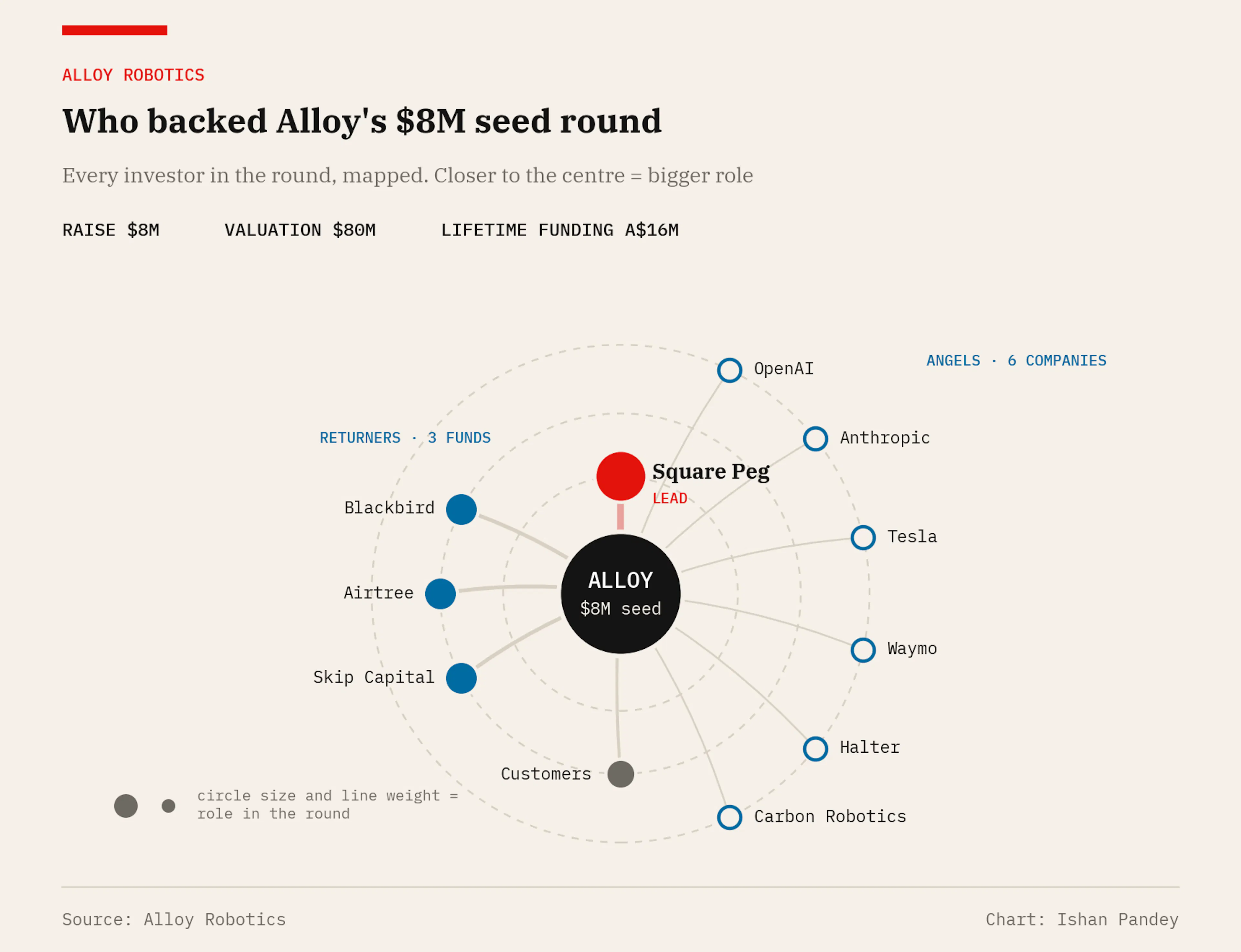
Alloy has now raised $8 million at an $80 million valuation, just over a year after its founding in Sydney, to build the layer that digs the answer out. Square Peg led the round, all three pre-seed backers, Blackbird, Airtree and Skip Capital, returned and the rest of the cap table reads like a staff directory of the fleets Alloy wants to serve with leaders and engineers from OpenAI, Anthropic, Tesla, Waymo, Halter and Carbon Robotics investing personally alongside several of Alloy's own customers. The company has raised A$16 million to date and is opening a San Francisco office with Harris relocating to lead the US push.
The Most Expensive Hour in Robotics Belongs to an Engineer Reading Logs
What Alloy sells is the execution layer of fleet learning. Its agents ingest everything a robot fleet records, logs, telemetry, video and sensor data, and cross-reference it with the engineering context already sitting in Slack, Jira and the other systems teams actually use, scanning continuously for anomalies, regressions and recurring patterns while letting engineers interrogate known problems in natural language. Every finding links back to the missions, timestamps and signals behind it, which matters because the product is not an answer but an answer with the evidence attached. Through a native Model Context Protocol server the same context is exposed to coding agents such as Codex and Claude Code, so the investigation can increasingly be run by an engineer's own agents without anyone assembling raw files by hand, a design decision that positions Alloy less as a dashboard and more as a data layer that other software consumes.
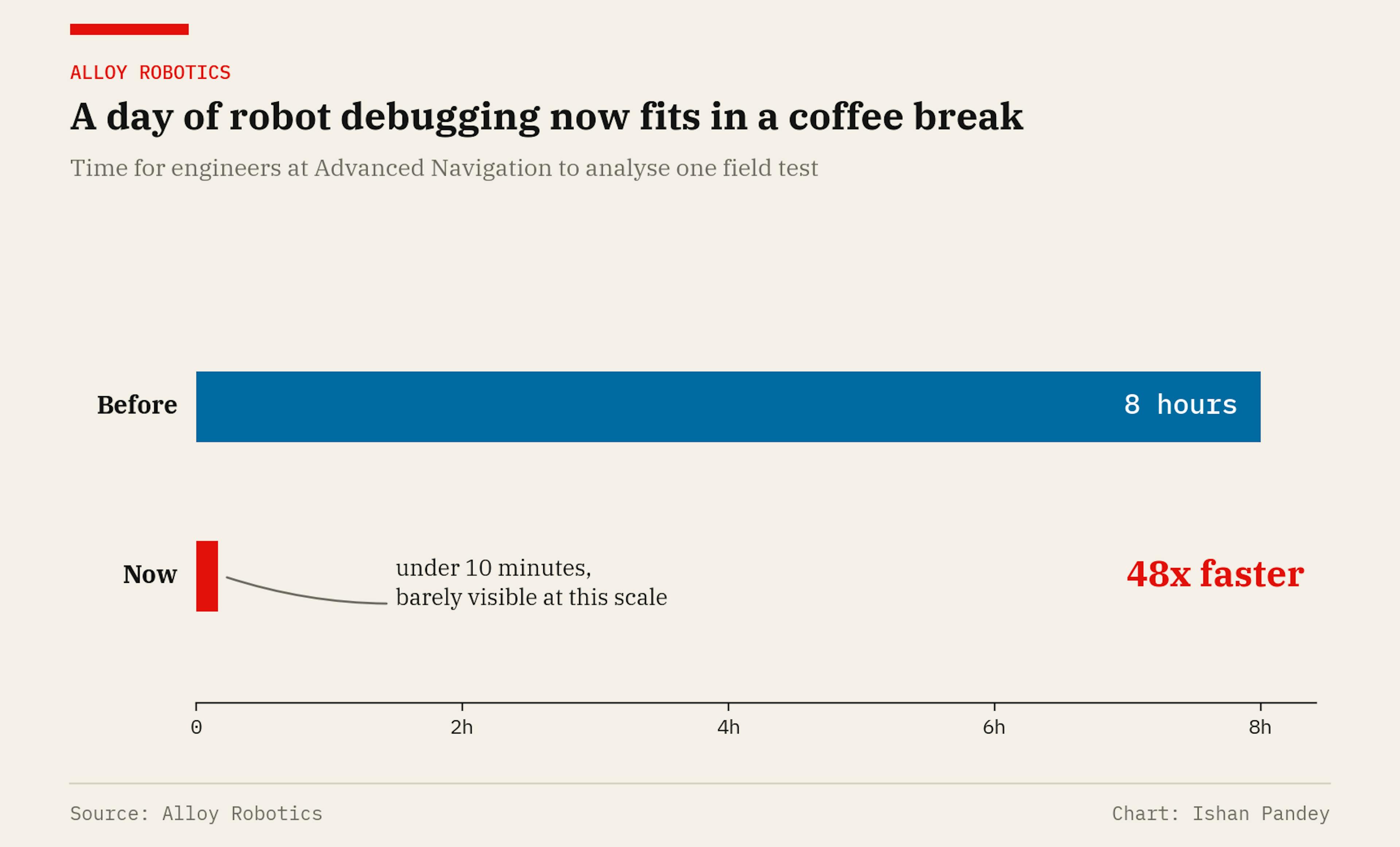
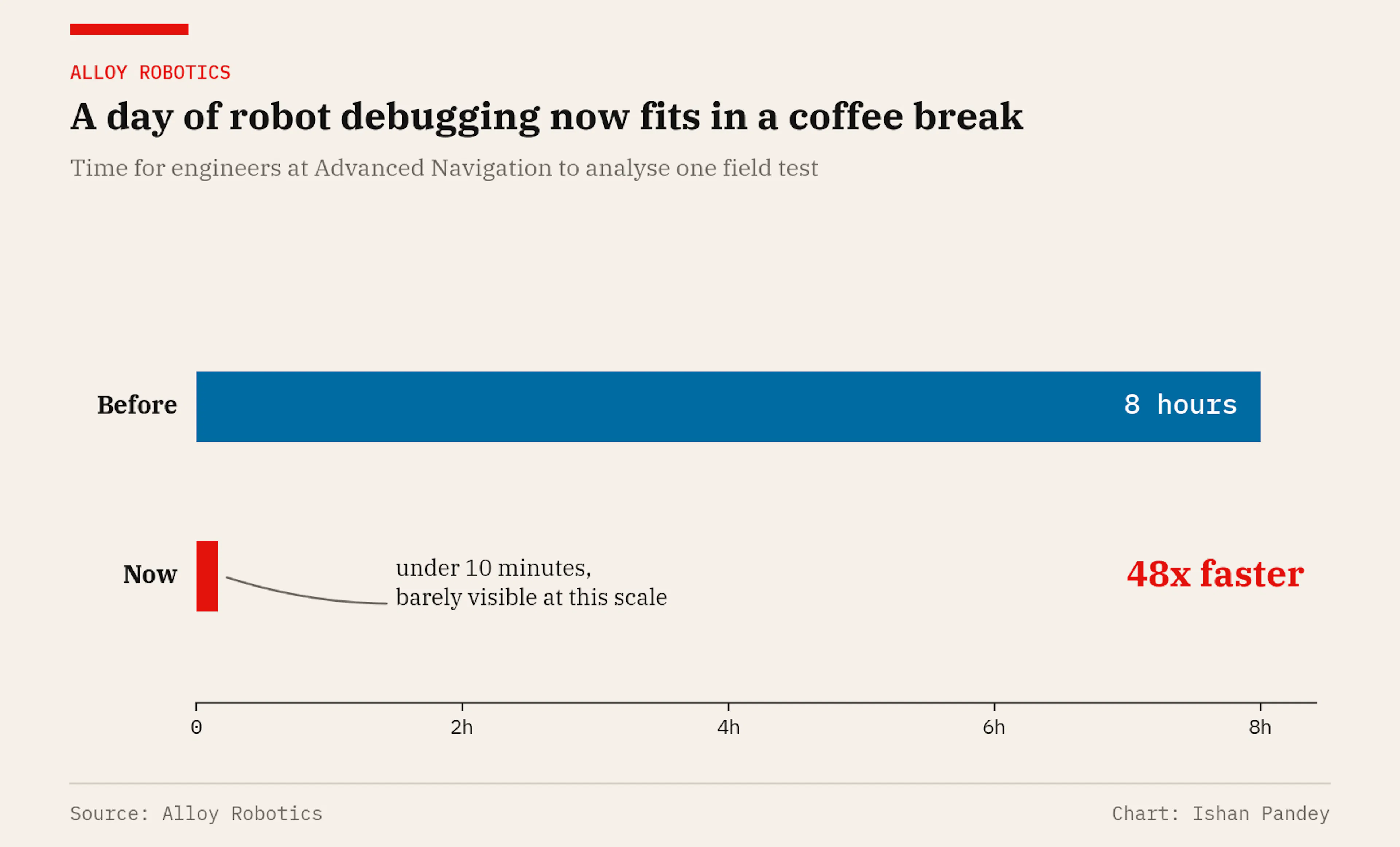
The customer accounts supply the numbers that make the proposition concrete. At Advanced Navigation, field-test analysis that consumed a full working day now completes in under ten minutes, and the company's product validation manager, Jai Castle, describes the change as a shift in the conversation itself, from whether the analysis can be finished in time to what else the team can go after. At the US autonomous-drone startup DroneForge, engineer David Crabtree suspected the wrong component entirely until Alloy showed both state estimators functioning normally and pointed to the actual fault, and his observation that every misdiagnosis compounds is the economics of fleet reliability in a sentence. The customer base now spans navigation, defence, drones, agriculture, maritime, humanoids, construction and medical robotics, including Advanced Navigation, DroneForge, Breaker Industries and Puralink, with some teams running entire fleets through the platform and others designing their next robots around it from the outset.
 A day of robot debugging now fits in a coffee break
The Economics That Keep Robots More Expensive Than People
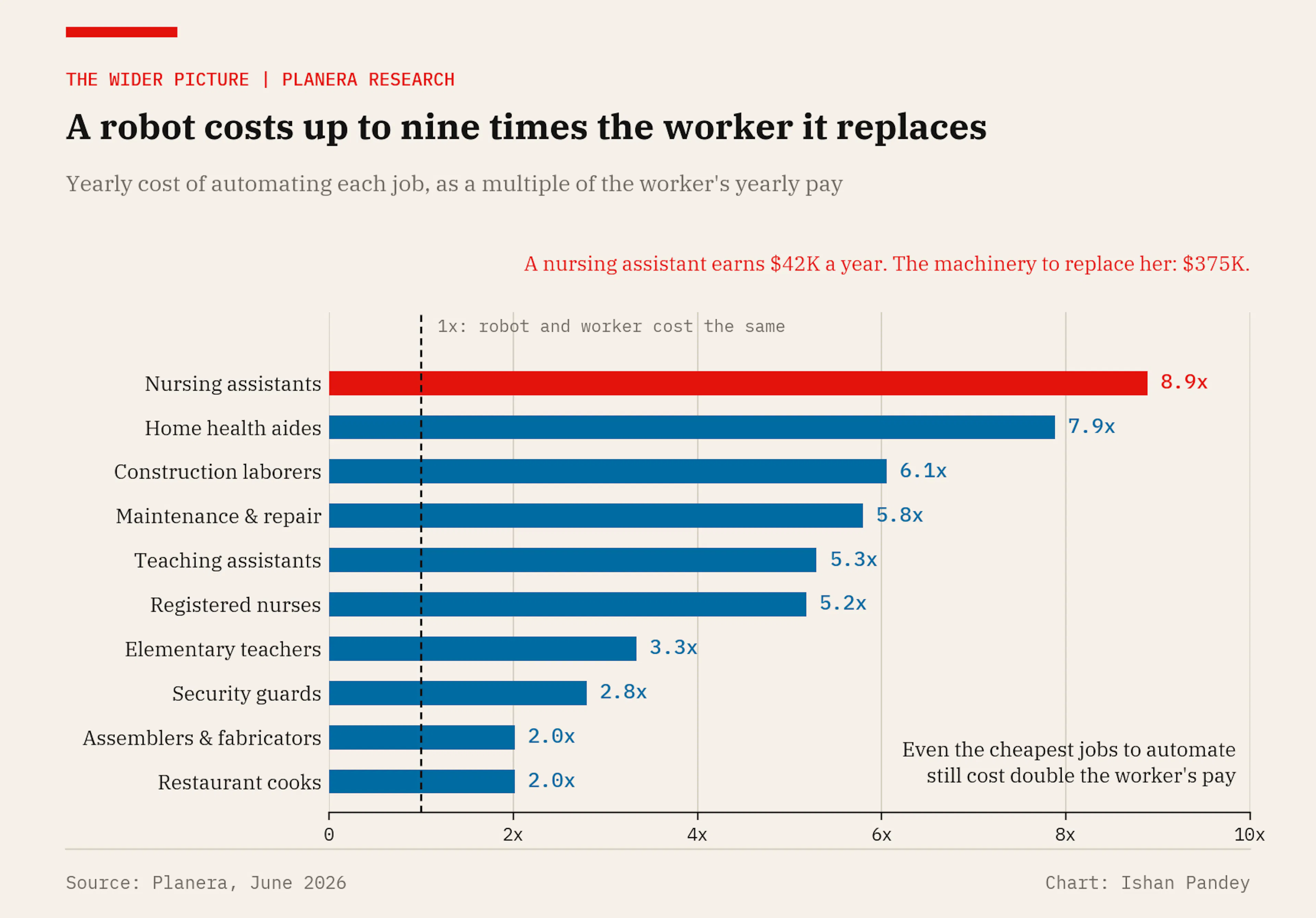
The wider market context explains why a debugging layer is a venture-scale idea rather than a tooling niche. Research from the construction scheduling platform Planera examined 30 of the most common jobs in America and priced what replacing one worker with a machine actually costs for a year, counting the hardware, the integration, the upkeep and the human supervisors still required after deployment, and the results are brutal for the automation-replaces-labour thesis. Replacing a nursing assistant runs $375,000 a year against a $42,200 wage, nearly nine times over. Home health aides cost roughly eight times their pay to automate, construction laborers, one of Alloy's own verticals, around six times, and even restaurant cooks and assemblers, the cheapest physical-world jobs in the study, still cost double. Of everything examined, only cashiering flips the equation, where self-checkout undercuts the worker at about $24,000 a year.
 A robot costs up to nine times the worker it replaces
The industry-shaping detail sits in the methodology rather than the ranking, because a meaningful share of those costs is not the robot at all but everything around it, the integration, the maintenance and the engineers who diagnose it when it breaks, which is to say automation fails on the recurring human cost of keeping machines trustworthy long before it fails on hardware economics. Tesla and Waymo answered that problem by spending years building fleet-data infrastructure internally, because learning from every mission is what separates fleets that improve from fleets that merely operate, and most robotics companies cannot afford the same build. Alloy is betting the capability becomes shared infrastructure for everyone else, the way observability in software became a purchase rather than an internal project.
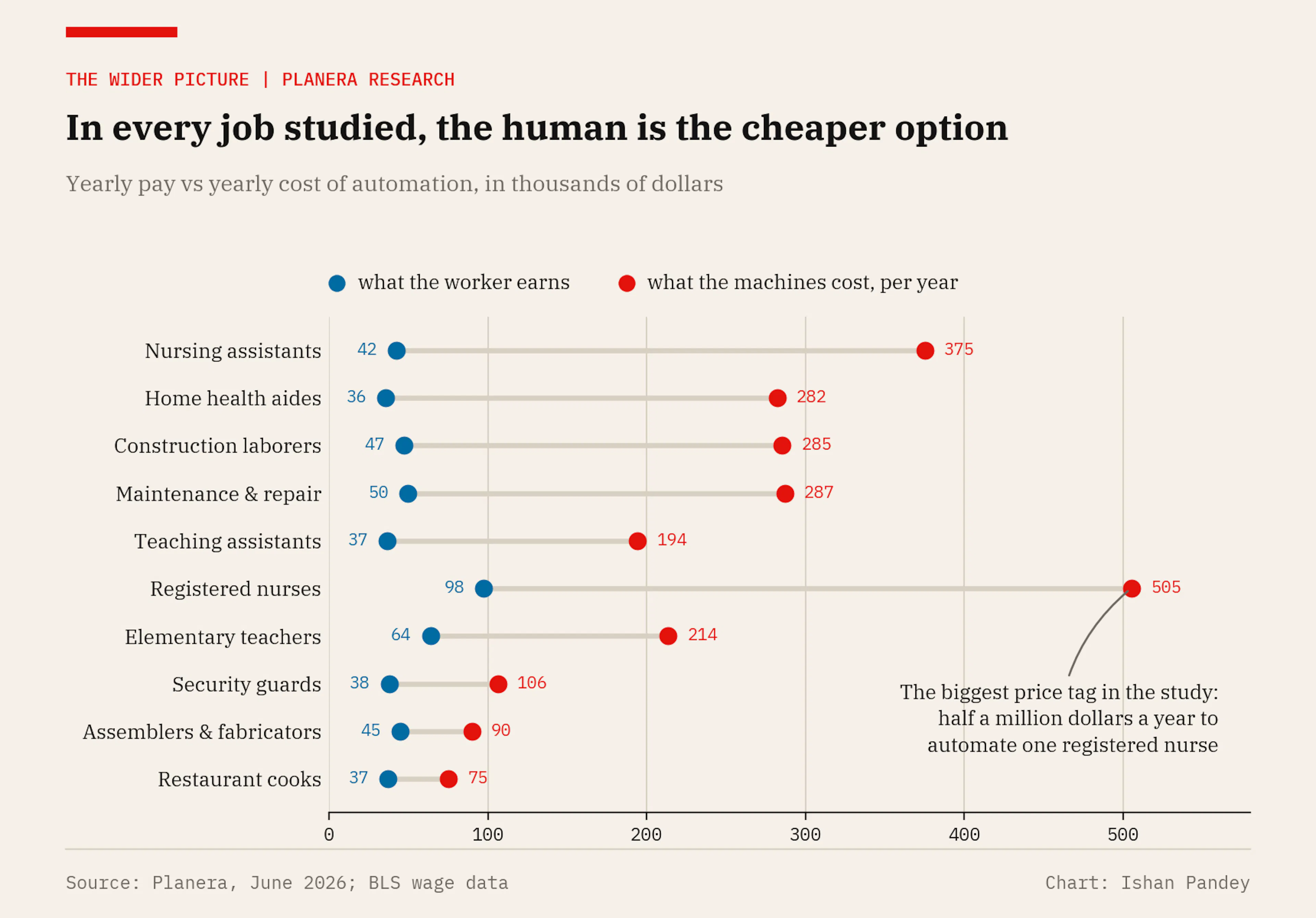 In every job studied, the human is the cheaper option
The Investor Thesis: A Cap Table Full of the Hardest Audience to Fool
Square Peg's reasoning, articulated by principal Jethro Cohen, goes to operating leverage rather than novelty, framing robotics as one of the hardest industries to build in and arguing that the winners will be the teams that learn fastest from their own data, with Alloy giving each engineer the leverage to support far larger fleets. The returning pre-seed trio is a different kind of signal, capital re-underwriting a team it has already watched execute for a year, which is the private-market equivalent of a reference that cannot be faked.
The angel list is the most telling attribute of the round, because the people who run real fleets at Tesla, Waymo, Halter and Carbon Robotics, and the people building the agent models at OpenAI and Anthropic, are precisely the audience hardest to impress with a demo, and they invested personally, joined by customers buying equity in a product they already pay for. A valuation at ten times the raise, one year in, is a price set against working deployments and named metrics rather than narrative, and in a funding environment that has rewarded robotics companies for burning toward promises, that is a quietly disciplined document.
What Has to Go Right
Honest analysis requires naming the hard parts, and Alloy has four worth naming.
The first is the window. The largest insights the release offers, that Tesla and Waymo built this internally, cuts both ways, because it proves the need and names the ceiling: observability incumbents can move down into robotics, robotics platforms can move up into analytics, and the biggest fleets have already shown they will build rather than buy. Alloy's defence is speed and the context that accumulates with every mission analysed, and the history of startups supplying capabilities the giants built in-house suggests the window in which that defence must become a moat is a couple of years, not many.
The second is capital against ambition. A$16 million of lifetime funding is thin for a company relocating its founder into the most expensive engineering talent market on earth while developing models, agents and a data platform simultaneously, which means the real function of this round is to convert the current deployments into retention and expansion evidence for a much larger financing, and the metric that will price that round is how many pilot customers become fleet-wide customers.
The third is integration gravity. The product is only as good as the data piped into it, logs, telemetry, video, Slack and Jira together, and the same depth of integration that makes Alloy sticky once installed makes it heavy to install, so sales cycles and onboarding cost are the quiet variables in the growth story. If onboarding compresses, Alloy compounds like infrastructure; if it stays heavy, the company grows like an enterprise services vendor.
The fourth is the agent bet. Exposing fleet context to Codex and Claude Code through MCP positions Alloy for a world where engineering work is increasingly agent-mediated, and that world is arriving, but the wedge assumes the platforms that own the coding agents do not bundle fleet-data context themselves. Betting on becoming the data layer other agents consume is a strong position exactly until a platform owner decides the layer belongs to them.
Final Thoughts
Every industry that runs on watching eventually meets software that does the watching, and robotics has resisted because its failures are physical, contextual and expensive to misread, which is why the debugging engineer has survived every previous wave of tooling. What makes Alloy's attempt interesting is that it does not ask teams to trust a summary, it hands them conclusions with the missions, timestamps and signals attached, and the earliest verdicts have come from the least forgiving jury available, the engineers who live inside these fleets, several of whom liked the product enough to buy the company's equity.
Funding stories are easy to tell and hard to interpret, but this one carries a clean test, and the test is expansion. Either the pilot deployments become fleet-wide deployments over the next eighteen months, with new robots designed around the platform from day one as some customers already claim to be doing, in which case this round will look like the cheapest entry anyone got into the data layer of physical-world automation, or the incumbents and platform owners rebuild the layer themselves and the window closes. A company whose entire pitch is that fleets should learn faster has, at least, chosen a test that will not take long to grade.
如有侵权请联系:admin#unsafe.sh