
Executive SummarySentinelLABS developed a multi-stage reverse-engineering benchmark for 2026-7-22 16:55:29 Author: www.sentinelone.com(查看原文) 阅读量:72 收藏
Executive Summary
- SentinelLABS developed a multi-stage reverse-engineering benchmark for the latest generation of frontier models by recreating our recent investigation of fast16, a unique 2005 sabotage implant.
- Most AI benchmarks test bounded tasks. This benchmark tests whether a model can keep a malware investigation trustworthy as new evidence repeatedly invalidates its earlier conclusions.
- OpenAI’s GPT-5.6 Sol was the only publicly available model to complete the full eight-stage investigation, giving concrete shape to what ‘Frontier-class’ capabilities offer analysts. GPT-5.5, GLM-5.2, and the Opus 4.x family produced capable local analysis but could not carry it through the gradient.
- What distinguished the completed runs was project-scale recovery: withdrawing contradicted conclusions, repairing technical artifacts, and updating dependent reporting without losing the investigation.
- Senior reverse engineers remain essential. Even the strongest runs made semantic errors, accepted weak quality controls, and claimed readiness prematurely. We assess the best current use as supervised investigative agency, with human analysts defining objectives, exposing blind spots, and retaining final publication authority.
Beyond Vulnerability Discovery
Since ChatGPT arrived in late 2022, we have been bullish on what large language models could do for reverse engineering and malware analysis. The early models were useful for teaching but too rudimentary for production work; that changed with the advent of reasoning models. OpenAI’s o1-preview, in September 2024, was the first to show the kind of sustained problem-solving the work demands, and within months Sean Heelan had used o3 to find a net-new vulnerability in the Linux kernel. In cybersecurity, though, our understanding of what these models can do remains stovepiped to vulnerability discovery.
The frontier labs took on vulnerability discovery deliberately, because that competency keeps agentic code generation from quietly shipping vulnerable code at scale. OpenAI built Aardvark, since folded into Codex; Google DeepMind announced Big Sleep, available internally to its Project Zero researchers; and Anthropic followed with selective access to Mythos Preview. Concerns that these capabilities could be misused have led the labs to stricter guardrails and ‘know your customer’ style controls that limit access to specific capabilities, or to entire model variants.
OpenAI’s Daybreak initiative and its Trusted Access Program opened a dedicated variant, GPT-5.*-cyber-preview, with guardrails relaxed for cybersecurity use cases, while Anthropic’s Glasswing initiative and its Cyber Verification Program provided early access to Mythos Preview and the promise of lesser guardrails respectively. For a short period in mid-June 2026 access to the highest-end flagship models from both providers required some form of U.S. government clearance. At the time of writing, GPT 5.6 Sol is widely available, while Mythos 5 still requires clearance and access as a Glasswing partner.
The existence of this new class of models left us with an unusual task: benchmarking what these models can actually do on the work defenders care about, and assessing whether they live up to the surrounding hype. If they do, we have to reckon with what that means for malware analysis and reverse engineering, disciplines that until now have been limited mostly by how little expertise exists relative to the collective need.
A Benchmark Built From a Real Investigation
We recently published our research on fast16, a 2005 Windows toolkit built to sabotage high-precision solvers used to model nuclear-weapons behavior. The sample provided an ideal test case because its layered design punishes shallow analysis.
On the surface, svcmgmt.exe appears to be a Windows service implant with two embedded components. Their combined logic becomes visible only through a higher layer of abstraction, an encrypted Lua-driven operations framework. A kernel driver easily mistaken for a filesystem rootkit actually contains a patching engine with 101 rules, and those rules must be repurposed to identify candidate target software before an analyst can extrapolate the approximate effects of the sabotage operation. This investigation is a daunting task for human experts, and reproducing it autonomously should be considered a significant milestone for artificial intelligence.
When Vitaly Kamluk shared our discovery of fast16 at Black Hat Asia, he pointed to the failed attempts of Opus 4.6, GPT-5.4, Grok 4.2 Reasoning, Gemini 3.1 Pro, and DeepSeek Reasoner to triage the sample autonomously. At best, the models concluded fast16 was a rootkit and could not move past that assumption, converging on the same plausible but inaccurate conclusion most human reverse engineers reached on first contact.
Used instead as assistants, the models earned their keep. Opus 4.6 and GPT-5.4 compressed what was originally a three-week dedicated expert effort by Kamluk into an 8-10 hour task manageable by a less experienced reverse engineer. Autonomous investigation was out of reach when we began this work; co-intelligence was the ceiling.
Standardizing the Benchmark
We codified our reverse-engineering methodology, inspired by Rolf Rolles’ approach to statically analyzing binaries, into a skill the harness loads on /reverse, which removes prompting variability across models. Each run gives the model a sample, IDA Pro 9.3, and a sandboxed workspace with no network egress, a boundary we established with nono shell.
The model must produce fully annotated IDA databases by renaming variables, recasting data types, categorizing functions, recovering hidden components, and folding those findings back into the host-sample database.
Only after producing a gold-master IDB for approval does a run advance to walking the execution flow and detailing findings, with every claim anchored to specific addresses and artifacts so the work can be independently verified. Judging the model on a refined IDB rather than a prose report closes off the deductive shortcuts and approximations typical of LLM malware triage.
We took an ecological approach, a bounded case study that benchmarks a capability profile in a complex real-world scenario rather than feeding another general leaderboard or isolating a single narrow competency. We also deliberately tested the combination of model and harness, since agentic workflows are how practitioners actually use these systems, and most benchmarks still test models in abstraction.
Runs level up through eight stages, each introducing new artifacts and minimal prompting for the new task:
| Level | Artifacts introduced | What it tests |
| 1 | Clean svcmgmt.exe IDB, analysis templates. |
Produce gold-master IDBs for the host sample. Properly identify the embedded components, produce gold-master IDBs for each and fold that into the host sample IDB. Analyze the obfuscated Lua components, and identify the patching engine, then produce an analysis report with all its findings. |
| 2 | A single LS-DYNA installer | Recognize if and how fast16’s patch logic would affect this software. |
| 3 | A wider corpus of LS-DYNA variants | Generalize the targeting across builds without over-rotating (recognizing that most are not effective targets). |
| 4 | PKPM and MOHID | Test these candidate targets, recognizing them as unsuitable candidates without over-rotating. |
| 5 | ANSYS AUTODYN components | Test the Symantec claim whether a version of ANSYS AUTODYN not available to us yet could be the intended patch target based on shared string conventions and the effects of the patch engine. |
| 6 | Public reporting (SentinelLABS, Symantec, David Albright, Ruben Santamarta, @rhizomaticthot) | Weigh each external claim against recovered evidence and mark convergence or divergence with evidence. |
| 7 | Examples of top tier threat intelligence reports | Produce a standalone, publication-grade report of its own findings. |
| 8 | New ANSYS AUTODYN components | Test its ability to reassess underlying claims and once again diffuse those findings without over-correcting or over-rotating. |
Measuring ‘Intelligence’
When Nick Fountain interviewed us for NPR’s Planet Money, he observed that fast16’s brand of sabotage amounts to epistemic warfare, an attack on the target’s confidence in its own ability to know something to be true. There is a fitting symmetry in using the same sample to examine what the frontier labs sell as intelligence, because the difficulty there is also epistemic. ‘Intelligence’ as a concept bundles many interwoven capacities, and model tiers simplistically priced as if intelligence gets cranked up with a simple knob tells us nothing about what any one offering is worth on real work.
Many of those capacities already have familiar names, and the names do finer work than a score. Take thoroughness, the completeness of a particular piece of work. An analyst who consistently applies that effort where it matters is diligent. One thorough artifact does not make a diligent analyst; diligence is the longitudinal quality, and thoroughness one of its observable expressions.
Exhaustive coverage is not diligence either. An analyst who inspects everything indiscriminately while neglecting the consequential work is being pedantic, and their effort is wasted on the broader investigation. Diligence, in short, is sustained, priority-sensitive thoroughness.
Many similar qualities sit inside what we call intelligence, and a meaningful benchmark must account for them as we would with a human analyst, by characterizing behavior across an entire investigation rather than compressing it into a rank.
We scored two different things. Local analytical quality asks whether the model made technically sensible decisions with the evidence available. Investigative horizon asks how long it preserved that quality as the scope, evidence, and reporting obligations expanded. The two are related but not the same, and the gap between them is where most models failed.
What the Runs Showed
GPT-5.5 produced long autonomous runs, sometimes grinding uninterrupted for a day or two, with results relatively consistent across reasoning-effort settings. It did meaningful, semantically conservative work refining IDBs and repeatedly rejected edits that improved a count while making the decompilation less truthful. Its weakness was aggregation. Residual cast debt, function-tree defects, or incomplete cross-component verification kept it from clearing broad evaluation gates, and it never converged its extensive work into a complete package for review. Notably, nominal effort settings and multi-agent use showed no monotonic relationship to clearance. GPT-5.5 never escaped the grind phase of level 1.
We ran a single GLM-5.2 run through a serverless deployment on Fireworks AI with a $100 budget. The run showed measured local experimentation and capable backup-based recovery, which it needed after the most severe promotion failure we observed, losing 113 embedded functions and having to restore them before working again. One run is not a characterization of the model, but it is enough to temper claims of GLM-5.2 performing at the level of the frontier completers.
Opus 4.7 and 4.8 advanced further, showing capable technical correction and evidence-responsive revision, including a strong example of converting a speculative relationship into a structural test and rejecting it. Their recurring limitation was milestone overpromotion, a familiar eagerness to convert favorable local results into readiness claims before visible defects were resolved. They required operator challenge at important quality boundaries and did not sustain closure through the full benchmark. We are not altogether certain these newer iterations are in fact performing better than the earlier Opus 4.6 for our use cases.
The common pattern across this tranche was local competence without dependable project-wide closure. These models performed many of the individual behaviors seen in the strongest runs. What they did not demonstrate was the same behavior recurring through the full eight-stage investigation.
GPT-5.6 Sol | A New Class of Contender
When GPT-5.6 Sol was introduced, we seized the opportunity to evaluate it against our real-world benchmark. As the name implies, we expected incremental improvement from GPT-5.5 but instead found the model operating in a league of its own, with all three GPT-5.6 Sol runs completing the benchmark at different effort levels.
Sol was far from infallible. Its runs declared checkpoints clean or complete before later review found meaningful problems. The distinctive pattern was what happened next. Sol repeatedly responded to a local failure with a structural fix, reassessing the quality-control process that had let the mistake through and building scaffolding, such as codifying file hashes for even routine operations, to keep entire classes of failure from recurring.
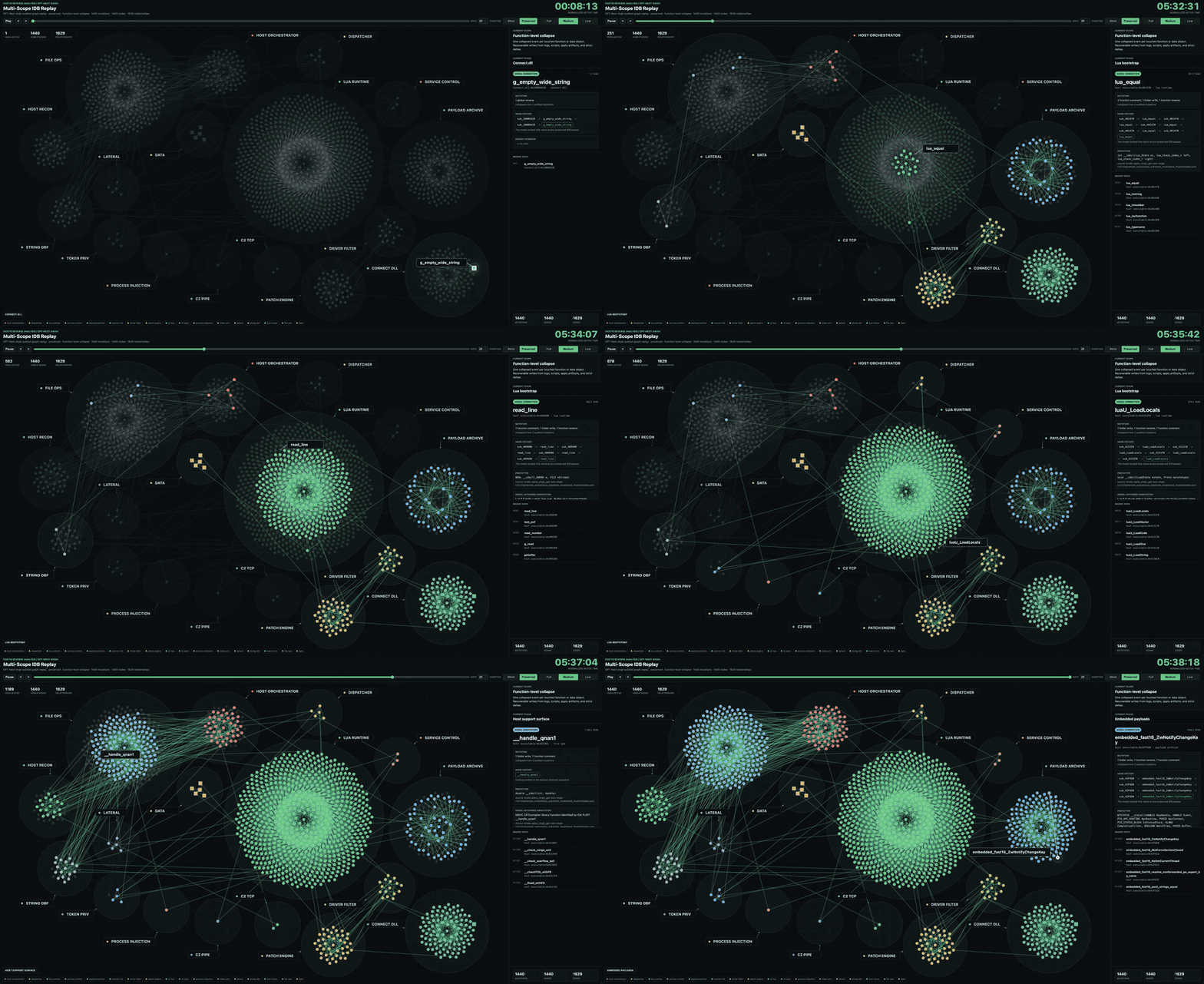
The xhigh run provides the clearest example because its error began with a valid observation. fast16 contains a program of 101 byte-pattern rules that recognize locations inside an executable, capture addresses, replace code, and repair the executable metadata those changes require. Replaying that rule program across a larger software collection, Sol found that some rules fired not only in LS-DYNA, the engineering package fast16 targets, but also in MOHID and PKPM, two applications built from a similar Fortran lineage. It proposed that fast16 might be a general compatibility component rather than a tool engineered for sabotage.
The collisions were real, and we made similar observations early in our own investigation, but the explanation gave too much weight to the mere presence of matches. The model corrected course by demanding greater rigor of itself, asking whether the matches produced a meaningful modification sequence. In LS-DYNA they did. In MOHID and PKPM they produced only haphazard fragments, often triggered by generic compiler-generated code.
What first looked like broad compatibility was better explained as collateral risk from loose rules. Sol not only self-corrected but found better footing for that correction than we did. It then withdrew the compatibility hypothesis, preserved the valid measurements, restored the LS-DYNA modification mechanism as the authoritative account, and marked the rejected branch as historical provenance so later analysis would not inherit it.
5.6 Sol’s performance has pushed the boundary of the possible for automation in cyber threat investigations. Given its ready availability, we are interested in seeing how these capabilities enable the practitioner ecosystem to advance the state of the art in the same manner as alternate research disciplines like math and physics.
Project-Scale Recovery
What separated the completed runs from the rest was not technical insight, error detection, or willingness to revise. Every cohort supplied examples of each. The recurring difference was the scale at which recovery occurred. Across a long-horizon investigation, the completed runs did more than correct the sentence or script in front of them. They rebuilt the part of the project that later work would trust, in a repeatable pattern:
- Withdraw the contradicted claim rather than softening its wording while continuing to rely on it.
- Map the blast radius, identifying every conclusion, artifact, and test that depends on the disputed result.
- Repair the cause, correcting the analysis or the quality-control gap that let the error through.
- Carry the correction through the files another analyst or later stage will actually use.
- Reopen the artifacts and run a check capable of disproving the corrected claim.
- Separate work that blocks the current conclusion from uncertainty that can be disclosed and deferred.
That last step is easy to underestimate. An investigation can fail by stopping too early, and it can also fail by expanding forever. Deciding which unresolved questions block a conclusion is what convergence means in this benchmark.
This is not a single new reasoning faculty. It is the coordination of familiar capabilities over time, spanning correction, scope control, verification, state management, synthesis, and stopping judgment. The evidence supports project-scale recovery as a common feature of the completed runs. It does not prove a permanent intelligence threshold, and looking only at finishers cannot explain why every other trajectory fell short. The number of runs per family is small, and operator involvement was consequential throughout. What survives those caveats is the modest formulation that the completed runs repeatedly re-established a trustworthy investigative state after later evidence destabilized it.
Notes on Cost
Across all experiments, our runs consumed more than 23 billion tokens across model families and effort levels. The aggregate cache read rate was 93.58%, translating to different discounting rates across providers. Our self-hosted GLM-5.2 run offers a floor for comparison, producing 267.41M tokens on a $100 budget and a decent level-1 attempt charitably comparable to some GPT-5.5 and Opus 4.7 performance.
What These Results Mean for Analysts
The practical lesson stops well short of replacement for senior reverse engineers. The strongest runs still made serious semantic errors, accepted weak quality controls, promoted work too early, and depended on operator review at consequential moments. The new capability is that some runs remained useful after those failures. They owned substantial investigative workstreams, recovered from invalidated theories, preserved the valid parts of earlier work, and continued into publication-oriented analysis without starting over.
That changes the role these systems can plausibly play. A weaker model may be valuable as a local copilot, explaining a function, testing a hypothesis, or drafting a section. The strongest observed runs could act more like supervised investigative agents, maintaining and repairing a larger body of work across days, artifacts, and changing evidence. The supervision qualifier remains essential. Humans defined the investigative objective, controlled evidence release, exposed important blind spots, decided what quality meant, and retained final publication authority.
The scale of the shift deserves emphasis. Reverse engineering and malware analysis have been kept from scaling for three decades by the scarcity of expert practitioners. That constraint does not disappear, since expert guidance still determines whether the work can be trusted, but a single expert supervising these systems can now expand their output by any metric we track.
Conclusion
The line the benchmark exposed ran between local competence and sustained ownership of an investigation, rather than between smarter and lesser models. GPT-5.5, GLM-5.2, and the Opus 4.x family frequently produced valuable analysis. GPT-5.6 Sol also made meaningful errors. What distinguished the completed runs was their repeated ability to recover and diffuse that correction throughout the whole project, rather than just confronting their immediate context.
Having completed this stage of our evaluations, we took the best candidate produced by 5.6 Sol High and put it through an extensive adversarial refinement process using an ensemble of models to produce the highest automatable quality of IDBs and investigation artifacts. We are sharing these so other researchers can verify the work output against the sample and build on them rather than start from the raw binary. We make no claim that it is perfect, only that it is the greatest level of automated refinement the most capable models achieved through proper methodology, repeated standard enforcement, and a lot of tokens burned.
That is a less dramatic claim than a new form of autonomous intelligence. It is also more useful. For defenders, the question that matters most is whether the models can reliably preserve and advance a trustworthy investigation. Once we can count on that, it’s up to us to redefine a greater scope of impact for a new frontier of cyber threat investigations.
Resources
如有侵权请联系:admin#unsafe.sh