
Abbott Laboratories, one of the world’s largest healthcare and medical device companies, is investigating two apparently unrelated cyber incidents after confirming unauthorized access to internal systems. While Abbott says there has been no impact on manufacturing, laboratory operations, or patient care, cybercriminal groups ShinyHunters and ShadowByt3$ claim the breaches were far more extensive. Those claims remain unverified at the time of writing and, so far, unsupported by publicly leaked data.
The incidents reportedly involve Abbott’s Cancer Diagnostics business and its LabCentral customer portal for core laboratory diagnostics.
Several news outlets point to an official statement by Abbott, which has since been removed:
“Unauthorized access was limited to internal systems of the Cancer Diagnostics business only, with no impact to other Abbott businesses, sites, systems, product availability, manufacturing, or lab operations.”
Regarding LabCentral, Abbott told reporters that it is an externally hosted portal and that there has been “no known exposure of sensitive customer or business information.”
ShinyHunters told BleepingComputer it stole internal documents, contracts, customer information, more than 22 million doctor‑patient notes, over 20 million medical orders, and more than one million US Social Security numbers, along with personally identifiable information (PII) such as names, addresses, dates of birth, emails, and phone numbers.
On July 18, ShinyHunters gave Abbott until July 21 to respond before leaking the alleged data:
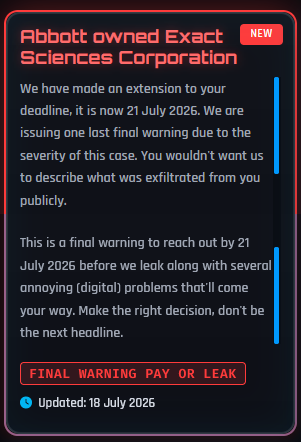
“This is a final warning to reach out by 21 July 2026 before we leak along with several annoying (digital) problems that’ll come your way. Make the right decision, don’t be the next headline”
The threat of “digital problems” is a familiar one from ShinyHunters. During the Canvas attacks, the group defaced school login pages and the Canvas app with an on‑screen ransom message.
Separately, ShadowByt3$ claims it accessed the LabCentral portal on July 4, using compromised customer credentials plus a “weak point” in the environment, allegedly exfiltrating technical documentation, manufacturing certificates, operating manuals, technical specs, and regulatory docs for Abbott lab systems.
If the attackers’ claims prove accurate, the breach could affect healthcare providers that use Abbott’s diagnostic systems and potentially expose sensitive patient and healthcare data. Abbott, however, says it has found no evidence that sensitive customer or business information was exposed through the LabCentral incident and has not confirmed any patient data was compromised.
What we can reasonably assume to be true
- There was a genuine compromise affecting Cancer Diagnostics systems. Abbott has publicly acknowledged unauthorized access and engaged incident response and law enforcement. This doesn’t appear to be a purely “fake” extortion attempt.
- There was also a separate cyber incident involving the LabCentral portal. Abbott says the portal primarily hosts public reference material and that it has found no evidence that sensitive customer or business information was exposed.
- Both ShinyHunters and ShadowByt3$ have listed Abbott on their extortion sites and have provided narrative details to media outlets, so this is not just generic name‑dropping.
- As of the latest reporting, neither group has publicly released samples of the data they claim to have stolen.
What Abbott customers can do
There are some actions you can take if you are, or suspect you may have been, the victim of a data breach.
- Check the vendor’s advice. Every breach is different, so check with the vendor to find out what’s happened and follow any specific advice they offer.
- Change your password. You can make a stolen password useless to thieves by changing it. Choose a strong password that you don’t use for anything else. Better yet, let a password manager choose and store one for you.
- Enable two-factor authentication (2FA). If you can, use a FIDO2-compliant hardware key, laptop, or phone as your second factor. Some forms of 2FA can be phished just as easily as a password. 2FA that relies on a FIDO2 device can’t be phished.
- Watch out for impersonation scams. Criminals may contact you pretending to be the company. Check the company’s website to see how it is contacting affected customers, and verify anyone who contacts you using a different communication channel.
- Take your time. Phishing attacks often impersonate people or brands you know, and create a false sense of urgency with messages about missed deliveries, suspended accounts, or security alerts.
- Consider not storing your card details. It’s definitely more convenient to get sites to remember your card details for you, but we highly recommend not storing that information on websites.
- Set up identity monitoring. Identity monitoring alerts you if your personal information is found being traded illegally online and helps you recover if your identity is stolen.
What do cybercriminals know about you?
Use Malwarebytes’ free Digital Footprint scan to see whether your personal information has been exposed online.