
The moment I realized my analytics were incomplete.I run a small bilingual technology website calle 2026-7-18 14:0:53 Author: hackernoon.com(查看原文) 阅读量:4 收藏
The moment I realized my analytics were incomplete.
I run a small bilingual technology website called TechNovice.
Like most publishers, I used to measure its performance through familiar metrics:
- Human sessions
- Organic clicks
- Search impressions
- Referral traffic
- Conversions
Bot traffic was mostly background noise.
Search crawlers visited the site, SEO tools scanned pages, and various unknown bots appeared in the logs. I knew they existed, but I did not consider them part of the audience.
That changed when I opened my platform’s bot-traffic report and noticed an unexpected pattern.
User-associated AI bots, led by the category labelled OpenAI - user bot, were fetching hundreds of pages per day.
Not occasionally.
Every day.
During some recent periods, the site was receiving more of these AI-related requests than conventional human sessions.
My first reaction was not excitement. It was confusion.
If AI systems were accessing the site this frequently, why was I seeing almost no corresponding referral traffic from ChatGPT and other assistants?
Either the bot data was meaningless, or my normal analytics were no longer showing the full journey.
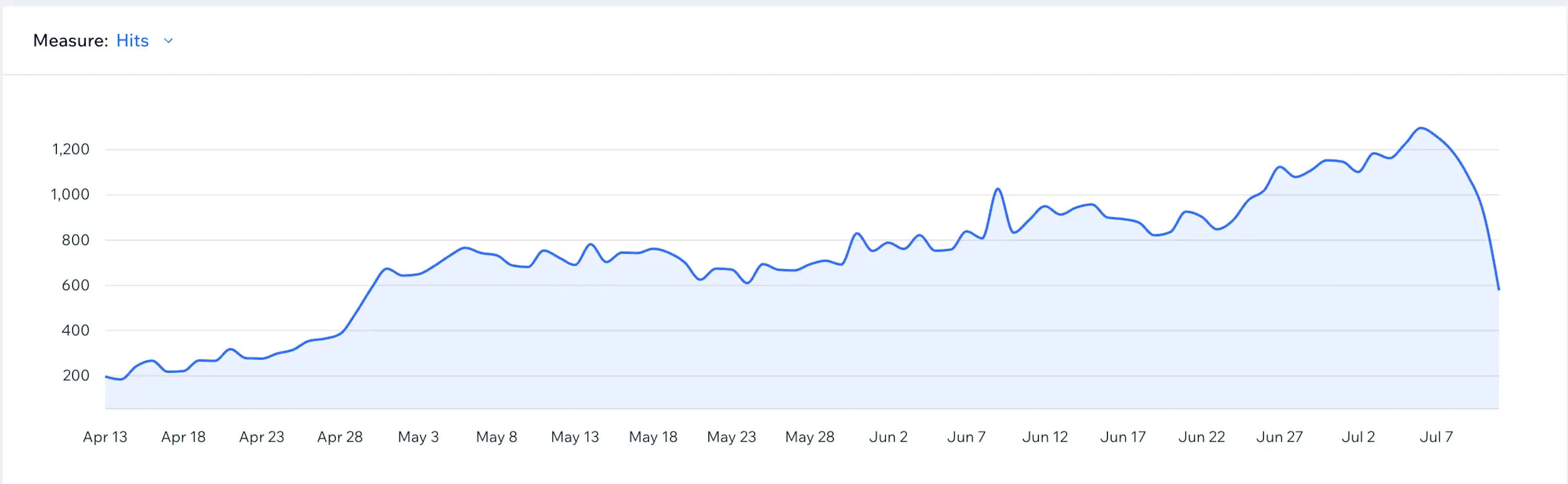 Figure 1. Daily AI user-bot retrieval activity recorded by Wix Analytics during the 89-day observation period. Rather than showing a one-off spike, the data illustrates a sustained increase in AI retrieval over time. The final day's decline reflects an incomplete reporting day.
A necessary clarification about the headline.
Strictly speaking, a crawler hit and a human session are not equivalent metrics.
A human session can include several page views. A single AI interaction can also produce multiple requests, fetch several URLs, or retrieve the same resource more than once.
The numbers should therefore not be interpreted as:
More AI bots than individual human readers.
I cannot identify one unique person behind each request.
What I can say is this:
My website now handles more requests from user-associated AI retrieval than it records conventional human browsing sessions.
The comparison is imperfect, but the scale is still meaningful.
AI-mediated use of the content is no longer a rounding error.
What the data showed.
I exported the bot activity for April 13 to July 10, 2026, covering 89 complete days.
Across the 89-day observation period, the website recorded 95,394 AI bot hits across the user-triggered AI crawler categories monitored by Wix Analytics.
The daily volume averaged approximately 1,072 hits per day. The quietest day recorded 396 hits, while the busiest reached 1,751.
The traffic was dominated by user-associated AI retrieval rather than conventional training crawlers. The distribution was not even close.
The figures reported here are calculated directly from raw Wix Analytics bot-traffic exports and Microsoft Clarity AI visibility reports. I am not publishing the full underlying dashboards because they contain commercially sensitive information.
This was not a conventional search crawler.
The distinction between bot categories matters.
A normal search engine crawler explores the web to maintain an index.
A model-training crawler may collect information for future model development.
A user-associated fetcher is different. Its activity is connected more closely to current interactions in which an AI system needs information to answer a user.
My analytics platform classified the dominant traffic source as an OpenAI user bot rather than an OpenAI training or search bot.
That does not mean every hit represents one unique person or one unique prompt. An individual interaction may generate multiple HTTP requests.
But it does make the traffic more interesting than a scheduled crawl.
It suggests that the website’s content is being retrieved in response to active information needs.
Someone asks a question.
The system decides it needs external information.
My page is one of the resources it retrieves.
The user may never visit the site.
The Referral Paradox
The crawler data showed tens of thousands of successful AI-related requests.
The referral data showed almost nothing.
Between May 13 and July 11, 2026, Microsoft Clarity’s AI visibility dashboard reported:
- 5,108 page citations
- 21.36% Share of Authority
- Less than 0.1% AI referral traffic
The site was being retrieved.
It was being cited.
But the users were rarely clicking through.
Under the traditional analytics model, that looks like failure.
A publisher creates the content, another interface displays the answer, and the website receives almost no sessions.
From a traffic perspective, that is uncomfortable.
From a distribution perspective, however, something more complicated is happening.
The content is reaching people.
It is simply reaching them without requiring them to open the website.
The web page is becoming a data source.
For most of the web’s history, publishers designed pages for human consumption.
Search engines helped users discover those pages, but the expected destination was still the website.
AI assistants change that relationship.
The page can now serve two audiences:
- The human who opens and reads it
- The machine that extracts information and uses it to construct an answer elsewhere
That second audience does not care about the page in the same way.
It does not admire the layout.
It does not scroll through the introduction.
It does not necessarily click the call to action.
It looks for useful information that can be retrieved, interpreted, and incorporated into an answer.
This changes the role of the website.
A page is no longer only a destination.
It is also a structured source that other interfaces can query.
From content extraction to controlled distribution.
For publishers, the instinctive reaction to AI retrieval is often defensive.
An AI system fetches the page, extracts the useful information, gives the user an answer, and sends little or no traffic back to the original source.
It can feel as though the content is being taken while the publisher is left with the hosting costs.
I understand that reaction. I had it myself.
But I eventually arrived at a more pragmatic conclusion:
If AI systems are going to use my content anyway, I want them to use content that still carries my expertise, my evidence and my recommendations into the answer.
That does not mean giving away an entire business strategy or publishing every commercially valuable insight.
It means creating information that remains useful even after it has been separated from the original webpage.
A generic article can be summarized without leaving much behind.
A well-supported source can carry more with it:
- A recognizable publisher or author
- Original measurements
- A clear conclusion
- Transparent testing conditions
- A specific recommendation
- A reason to trust that recommendation
- A logical next step for the reader
This changed the way I think about content.
I am no longer only asking:
How do I get the user to click this page?
I am also asking:
If an AI assistant extracts one part of this page, what information will survive inside the answer?
That is a fundamentally different publishing problem.
The goal is not simply to produce text that an AI can read. Almost every modern webpage can be read.
The goal is to produce information that an AI system can confidently use, attribute, and carry forward without stripping away everything that makes the source commercially and editorially valuable.
In that sense, AI retrieval is not only a traffic-loss problem.
It can also become a distribution channel.
The publisher may lose control over the interface, but not necessarily over the information being distributed.
The strategic question is whether the extracted answer still contains the parts that matter:
- Who established the information
- Why the information is credible
- What conclusion follows from it
- Which option the source recommends
- What the user should do next
I do not publish every detail of how I approach that problem.
Some of the implementation is part of the competitive advantage.
But the underlying principle is simple:
Do not create content that becomes anonymous the moment it is summarised. Create evidence and recommendations that remain connected to their source.
Why this might be a good thing.
At first glance, receiving more AI-bot requests than human sessions sounds terrible.
The bots use server resources. Humans produce revenue.
But that interpretation assumes the two groups are unrelated.
They may instead represent different stages of the same information ecosystem.
AI retrieval can indicate real demand.
A user-associated fetch is not the same as a random scheduled crawl.
It can be a sign that people are actively asking questions related to the site’s subject matter.
The user may receive the answer inside an assistant, remember the publisher’s name, search for the brand later, or purchase a recommended product without ever generating an attributable AI referral.
The website influences the decision even though standard analytics cannot see the complete path.
Citations create distributed visibility.
A citation inside an AI response is not identical to a visit.
But it still places the publisher’s name, research, or conclusion in front of the user.
Repeated citations can create familiarity.
Familiarity can later produce:
- Branded searches
- Direct visits
- Newsletter subscriptions
- Commercial enquiries
- Product purchases
- Links and mentions from other publishers
Attribution becomes indirect, but the visibility is real.
Small publishers can compete through evidence.
Large media organizations have stronger brands, larger teams, and more backlinks.
Small publishers have one advantage: they can be unusually specific.
They can test products personally, document edge cases, collect original measurements, and answer questions that larger publishers overlook.
My own site contains more than 100 logged real-world mobile speed tests, collected across different countries and locations.
That evidence gives AI systems something concrete to retrieve.
A small website may not win through scale.
It can win by being the most useful source for a specific question.
Machine usage can precede visible outcomes.
Traditional analytics begin when the user arrives on the website.
AI retrieval can happen earlier.
It may represent the research stage before a later search, direct visit, or purchase.
That makes crawler activity potentially useful as an upstream signal, even when it cannot be attributed to individual users.
I would not treat every crawler spike as a guaranteed business event.
But I no longer treat the data as irrelevant technical noise.
The Wrong Conclusion: Traffic no longer matters.
Human visits still matter.
A visitor on your own website can:
- Explore additional pages
- Join an email list
- See your branding
- Click an affiliate link
- Contact your business
- Become part of a measurable audience
Publishers should not celebrate losing direct traffic.
The more realistic conclusion is that traffic alone no longer measures the full influence of a website.
A page can contribute to thousands of external answers while receiving only a handful of identifiable referrals.
If publishers evaluate that page only through sessions, it may appear unsuccessful even while it is becoming an important source inside AI systems.
The Other Wrong Conclusion: Every bot is valuable.
Most bot traffic is still not inherently valuable.
My logs also contain:
- SEO crawlers
- Search-engine bots
- Training crawlers
- Social-media preview bots
- Unknown automated agents
- Scrapers
- Broken or misidentified bots
Adding all of them together into one impressive number would be meaningless.
The important step is segmentation.
I now distinguish between three broad groups.
Search and indexing bots
These crawl pages to maintain traditional search indexes.
Training and data-collection bots
These access content for model development or broader datasets.
User-associated retrieval bots
These are the most interesting categories because their activity is closer to a current user interaction.
Even here, caution is necessary.
A bot label is not perfect user attribution. User-agent strings can be spoofed, platform classifications may be imperfect, and several requests can belong to one interaction.
The data is a proxy, not a census.
What I measure now.
I still monitor human traffic, rankings, and conversions.
But I have added a second measurement layer for AI-mediated discovery.
Retrieval Activity
How frequently are AI-related bots accessing the site?
I analyze this by bot category, date, and page.
Successful responses
Are the bots receiving the content successfully, or are they encountering errors and blocked resources?
Citation visibility
Does the website appear in AI-generated answers across relevant queries?
Referral traffic
How often do users actually click from an AI platform to the site?
Downstream business outcomes
Do branded searches, direct traffic, leads, or commercial results change as AI visibility grows?
No single metric provides the answer.
The goal is to observe the system as a funnel:
Retrieval → interpretation → citation → influence → measurable outcome
Traditional analytics mainly capture the final stages.
Server logs help reveal what happens earlier.
A simple way to analyse the logs.
The basic aggregation does not require complex infrastructure.
A daily bot export can be analysed with a few lines of Python:
import pandas as pd

bots = pd.read_csv("bot-traffic.csv")

bots["date"] = pd.to_datetime(
    bots["date"],
    errors="coerce"
)

daily = (
    bots.groupby("date", as_index=False)["hits"]
    .sum()
)

print(daily.tail())
print(f"Total hits: {daily['hits'].sum():,}")
print(f"Average per day: {daily['hits'].mean():.1f}")
The difficult part is interpretation.
A request does not equal a user.
A citation does not equal a visit.
A visit does not equal a conversion.
And a conversion cannot automatically be attributed to the crawler activity that happened before it.
The measurements become useful only when those limitations are kept visible.
What I am not publishing.
I am deliberately not sharing:
- Which individual pages produce the strongest commercial results
- Which questions are most valuable
- Which content structures are retrieved most frequently
- How pages are prioritized and updated
- Internal-linking logic
- Conversion rates by page
- Absolute revenue
- Commercial partner terms
Those details belong to the implementation.
The broader observation is still worth sharing:
A growing part of a publisher’s audience may no longer appear as an audience inside conventional analytics.
What publishers should do now.
The first step is not to redesign every page for AI.
It is to understand what is already happening.
Check whether your hosting platform, CDN, or analytics system exposes bot activity. Separate user-associated retrieval from training, search, and generic crawler traffic.
Then compare the data with other signals:
- Which sections are retrieved most often?
- Are those pages also being cited?
- Does branded search increase?
- Are direct visits growing?
- Do commercial outcomes move even when referral traffic remains flat?
Do not judge the strategy using crawler volume alone.
But do not ignore tens of thousands of successful requests simply because the requests came from machines.
The bigger measurement problem.
The web’s analytics systems were built around a simple assumption:
Influence begins when a person loads your page.
That assumption is breaking.
A person can now receive information extracted from your website without opening it, accepting its cookies, or appearing in its session analytics.
The website may still shape the answer.
It may still influence the decision.
It may still generate economic value later.
But the causal path becomes harder to observe.
This creates a frustrating situation for publishers: their content can become more useful to the wider information ecosystem while becoming less visible inside their own dashboards.
We need better measurements for that middle layer.
Not just clicks.
Not just citations.
Not just bot hits.
We need methods that connect machine retrieval with later human behavior without pretending that every interaction can be attributed perfectly.
Final Thought
My website was receiving more AI user-bot requests than human sessions, which initially looked like an analytics anomaly.
I now think it may be an early sign of how publishing is changing.
The site is still a place people visit.
But it is increasingly also a source that machines consult on their behalf.
That creates obvious risks. Publishers can lose traffic, attribution, and control over how their work is presented.
It also creates an opportunity.
A small, specialised website can influence thousands of answers without having the audience, backlink profile, or brand recognition of a major publication.
The challenge is learning how to measure that influence.
Because if we only count the humans who reach our pages, we may be ignoring the much larger number of people who encounter our work somewhere else.
如有侵权请联系:admin#unsafe.sh