
Warning: Includes graphic descriptions of animal harm and images of animal parts fro 2026-6-24 12:5:0 Author: www.bellingcat.com(查看原文) 阅读量:40 收藏
Warning: Includes graphic descriptions of animal harm and images of animal parts from the outset.
A Bellingcat investigation has uncovered a Myanmar-based wildlife trafficker who has operated openly across social media for at least six years, claiming to have sold tiger bones, rhino horn, elephant skin and other products from protected and endangered species to customers in Myanmar, China and Thailand.
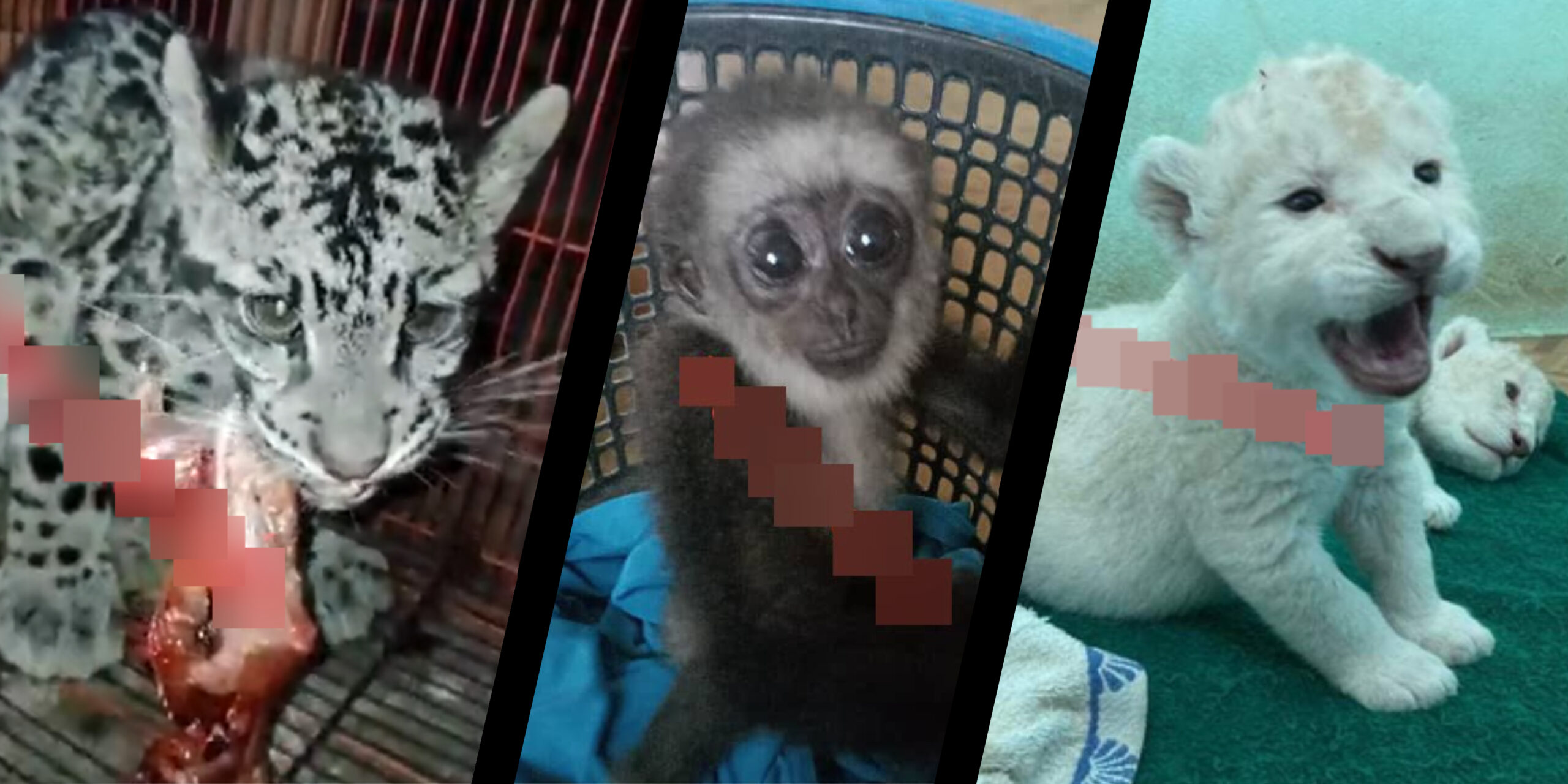
By analysing hundreds of adverts and customer conversations, Bellingcat traced more than US$21,000 in sales, identified cross-border shipments linked to multiple payment accounts, and geolocated the dealer’s home address. The seller frequently used graphic images to convince buyers that his wildlife products were genuine, sharing footage of animals before and after they were killed as proof of authenticity.
Following this investigation, Meta removed 10 Facebook accounts, WeChat suspended three accounts and revoked their payment functions, TikTok and YouTube each removed one account, and authorities in Myanmar and Thailand said they would examine the findings further.
On December 21 2022, a Facebook account shared a reel of a tiger cub lying unconscious beneath the caption: “Time for winemaking”, followed by several laughing face emojis. Four days later, the same account shared another reel, this time of an adult tiger lying motionless on an orange plastic sheet as a man approaches with a knife.
Two separate videos posted to Facebook by the account known as MB.
The account behind both videos belongs to Mei Ba (hereafter MB), a self-described Traditional Chinese Medicine (TCM) doctor based in Myanmar. In TCM, plants and animal products are used to prepare remedies based on established medicinal formulas. These remedies can take many forms, including herbal teas, simmered concoctions, ingredients steeped in wine, and pills. TCM is also sometimes associated with pseudoscientific beliefs, such as the idea that consuming an animal’s organ can nourish the corresponding organ in the human body.
A Bellingcat investigation has found that MB frequently advertises the trafficked parts of critically endangered and vulnerable species to customers in Myanmar, Thailand and China. An analysis of social media posts published by MB over six years found references to sales involving parts of bears, elephants, leopards, musk deer, otters, pangolins, rhinos, seahorses and tigers, all of which are protected species.

Profiting from Protected Species
For at least six years, MB has used ten different Facebook accounts under versions of his name to advertise animal parts and products for sale, including those derived from vulnerable and protected species.
Related articles by Bellingcat

MB has advertised tiger body parts and products, including skins and wine made from bones. Myanmar’s wild tiger population was last estimated at a minimum of 22 animals (in a 2019 study published before the civil war). Licensed tiger farms, described as being similar to zoos, also operate in the country. However, Myanmar law prohibits the killing of any tiger, wild or captive.
Bellingcat has also identified adverts offering leopard body parts, including skin, bones and gallbladders, as well as a product described as a “whip”, a euphemism for a penis. Many of the adverts explicitly stated that the body parts came from wild animals. The Indochinese leopard is classified as critically endangered, with fewer than 800 mature individuals believed to remain in the wild across mainland South-East Asia.

MB has advertised body parts and other products derived from Asian elephants, an endangered species, including skin sold in pieces and powdered form, as well as their genitals.
One of MB’s more graphic posts showed a recently killed and butchered moon bear – a type of Asian black bear which is classified as a vulnerable species. MB has also advertised various bear body parts for sale, including paws, heads, gallbladders, bile and fat.
Whole rhino horns, as well as bracelets and medicinal products made from rhino horn, have been advertised by MB. Although rhinos have been extinct in Myanmar since the 1980s, the country remains a known transit route for rhino products moving from India to China and elsewhere in South-East Asia, suggesting the items advertised by MB originated outside Myanmar.

Under Myanmar law, anyone convicted of killing, possessing or trading a “completely protected species,” or its parts, faces a minimum prison sentence of three years and a fine under a conservation law introduced in 2018. Completely protected species advertised by MB include Asiatic black bears, elephants, leopards and rhinos.
Bellingcat contacted multiple Myanmar government authorities for comment regarding MB’s wildlife trade. The Myanmar embassy in London confirmed receipt of Bellingcat’s request and said it would consult the relevant authorities in Myanmar.
Convincing Customers
Counterfeits are common in the illegal wildlife trade. Buffalo horn is often carved to resemble rhino horn, while cattle penises are passed off as tiger parts. Much of MB’s promotional strategy therefore focuses on persuading buyers that his products are genuine.
To market rhino horn, MB has posted images of the items on scales or held up against a light, which he claims demonstrates the texture of genuine horn. For tiger bones, in one post he said that a patch of skin would be left attached to demonstrate their authenticity.
MB has also posted videos of recent leopard and tiger kills. He has shared footage of live tigers in cages followed by images of the same animals being butchered for their skins, bones, skulls, claws and fangs.

Bellingcat only analysed open source evidence, including social posts, customer conversations, visible transactions and shipping receipts. Therefore, the authenticity and composition of the wildlife products advertised or sold could not be independently verified.
Nevertheless, given the volume and graphic nature of these posts, MB’s ability to operate on Facebook for at least six years raises questions about why his accounts remained active up until Bellingcat contacted Meta.
Evading Platform Moderation
For years, MB has openly advertised his business on Facebook, posting hundreds of adverts across ten profiles and various groups. He often uses coded language, including Chinese-language euphemisms in his comments.
For example, he uses “eraser” (橡皮) to refer to “elephant skin” (象皮), a Mandarin homophone with characters that are also visually similar, shown below.

MB also uses pinyin, the phonetic system for spelling Mandarin Chinese words using Latin letters. For example, in one post, he abbreviates the pinyin word for “rhino” (xīniú) as “X”, advertising “X horn powder”, and uses “Y” (pinyin: yào) as shorthand for “medicine”. He also frequently uses animal emojis, including tiger, elephant, rhino, deer and bear, to refer to products derived from those animals without naming them directly.

Asked why MB had been able to operate for so long without being banned and how it detects common evasion tactics such as coded language, Meta responded: “Bad actors constantly evolve their tactics to avoid enforcement, which is why we partner with groups and invest in tools and technology to detect and remove violating content.”
Cross-Border Trade
To map the scale of MB’s business, Bellingcat analysed more than 500 screenshots of customer conversations spanning May 2021 to May 2026. Originally taking place on Facebook, Viber and WeChat, these exchanges were later reposted by MB on Facebook.
Often blurred or cropped, the material appears to have been shared as part of a strategy to present MB as a trusted seller who reliably delivers to customers. However, given the content frequently included shipping labels with names and addresses, product descriptions, and price discussions, Bellingcat was able to trace part of MB’s customer base and income. Notably, only content MB chose to repost was available for analysis, meaning the findings represent only a sample of his overall activity.
Across the dataset, Bellingcat identified more than 150 transactions totalling US$21,000. The United Nations estimated Myanmar’s annual per capita income at between $300 and $430 in 2023.
Bellingcat analysis of MB’s digital footprint showing revenue earned per species by MB. Currency in US$. Trade values are estimated based on yearly average black market exchange rates.
Based on delivery records, Bellingcat identified 119 deliveries within Myanmar, 27 to mainland China, and nine to Thailand. Within Myanmar, shipments were most often sent to shared pickup points in cities or towns, whereas those to China were more frequently sent directly to individual addresses.
Shipments within Myanmar most often involved small quantities of powders or medicines, such as 3 to 7 g of rhino horn powder or 5 g of bear gall bladder. By contrast, deliveries to China more often included whole animal parts such as rhino horn or tiger bones, or larger quantities of products, including 500 g to 1 kg of elephant skin powder or 10 to 40 bottles of medicine.

MB’s highest-value recorded transaction was to a customer in Yiyang, Hunan Province, China and involved two tiger femur bones weighing just over 2.5 kg. Sold in July 2022, the bones fetched 23,500 Chinese Yuan (US$3,494). The customer was asked to provide a screenshot as proof of payment. MB later reposted this on Facebook, alongside a photograph of the bones wrapped in cling film and a shipping label for Deppon Logistics attached.
Bellingcat contacted Deppon Logistics for comment, sharing the image and tracking number shown below, but received no response at the time of publication.

Under Chinese law, buying, transporting, or selling protected or endangered species can, in the most serious cases, carry prison sentences of more than 10 years. Asian elephants and wild tigers are listed as “Class 1” protected animals. A permit system does exist for the use of captive-bred tigers, although it remains controversial.
Under the Convention on International Trade in Endangered Species of Wild Fauna and Flora (CITES) Appendix I, international trade in any endangered species, including Asian elephants and tigers, as well as their derivatives such as skin powder, scales and bones, is prohibited. China, Myanmar and Thailand are all parties to the treaty.
Bellingcat contacted the General Administration of Customs of China for comment on MB’s wildlife sales to China but did not receive a response at the time of publication.
Related articles by Bellingcat
Bellingcat also found evidence of nine deliveries to Thailand, including a tiger penis and several TCM powders said to contain dog, yak and seahorse, all species regulated by Thai law and protected under CITES.
The Thai Natural Resources and Environmental Crime Division told Bellingcat that it already monitors packages falsely declared as traditional medicine but found to contain protected wildlife parts or ingredients derived from them. Following Bellingcat’s findings on MB’s activities, the division said it would investigate further.
A large proportion of MB’s exports to all three countries were bottles of TCM powders or tablets. For example, a “kidney replenishing medicine” was purported to contain deer, dog, gecko, praying mantis, seahorse and yak, while a “prostate medicine” was said to include deer, seahorse and dog.
Under Chinese law, all packaged TCMs must carry labels clearly displaying the manufacturer’s name, full ingredient list, production and expiry dates, and information on side effects and safety. None of these details were present on MB’s labels.

Multiple banks accounts
Over six years of reposted conversations with customers, Bellingcat observed MB requesting payments to at least 15 different accounts, including seven via WeChat Pay, two via Alipay and six via third-party bank accounts, which MB described as belonging to friends or family.
For example, in May 2022, a customer purchased 1kg of elephant skin powder to be shipped to Chiuchow, Guangdong Province, China. MB told the customer his WeChat account could not currently receive the payment and instructed them to send the funds to his “sis” [female associate], shown below.

Both WeChat Pay and Alipay’s terms and conditions prohibit the use of their services to receive payments for illegal activities.
After being contacted by Bellingcat, WeChat suspended three accounts, revoking all payment functions and removing associated content.
Alipay did not respond to Bellingcat’s request for comment.
Identifying MB
MB’s brazen online activities include operating at least ten Facebook profiles, two TikTok accounts, one WeChat account and one YouTube channel. He is the sole administrator of a Facebook group with nearly 1,000 members. Across these platforms, he has amassed some 12,000 followers.
While using variations of “Mei Ba” (MB) across most of these accounts, he also uses the Chinese name “Mei Xiangfu” on his personal WeChat account. The name “May Kyin Phu” also appears alongside payment QR codes when customers are asked to transfer funds. Below is a QR code for Myanmar’s largest bank, KBZ, which includes what appears to be MB’s legal name: U May Kyin Phu, with “U” used as an honorific equivalent to Mr.

Since 2019, MB has used the same ID photo as his profile picture across multiple platforms, as well as his wedding photo as his TikTok profile picture and Facebook banner image. His wife, identified in the wedding photo and in other images posted by MB, has also been found advertising vulnerable and protected species via her Facebook account.
With more than 3,100 followers, she frequently reposts MB’s adverts while also sharing screenshots of conversations with customers. For example, in one WeChat exchange later reposted to Facebook, she discusses the cash sale of five “real” tiger penises.
From MB’s posts, Bellingcat geolocated a house in Lashio, eastern Myanmar, used to photograph animal parts for sale in his advertisements. MB has posted content from this property since 2020.
In the images below, what MB describes as “leopard gallbladders” can be seen hanging from a balcony, revealing the layout of the property’s backyard and the rooftops of adjacent buildings. Although Lashio is not covered by Street View, the distinctive roof visible in MB’s images matched with user-uploaded photographs on Google Maps.

Bellingcat contacted both MB and his wife for comment on the findings of this report. Both were reached via WeChat and appear to have received the request, but did not reply at the time of publication.
Data visuals by Galen Reich, Graphics by Merel Zoet, Editor, Claire Press.
Bellingcat is a non-profit and the ability to carry out our work is dependent on the kind support of individual donors. If you would like to support our work, you can do so here. You can also subscribe to our Patreon channel here. Subscribe to our Newsletter and follow us on Bluesky here, Instagram here, Reddit here and YouTube here.
如有侵权请联系:admin#unsafe.sh