
IntroductionSecurity is still treated as a split problem of prevention and response, when in realit 2026-6-23 07:36:13 Author: www.group-ib.com(查看原文) 阅读量:40 收藏
Introduction
Security is still treated as a split problem of prevention and response, when in reality the two are inseparable.
Also often, different agreements govern these two functions – one focused on day-to-day work of hardening defenses, another activates only after something goes wrong. But attackers do not operate in phases anymore, and increasingly, neither do regulators, insurers, or boards.
The Group-IB Services Retainer is built on the premise that this separation no longer works.
It is a single flexible agreement that gives organizations direct access to Group-IB expertise across incident response, proactive security services, and long-term security development. Incident response remains at the core, backed by strict SLAs, while preemptive and strategic support helps organizations reduce exposure before a crisis begins.
The need for this model is no longer theoretical.
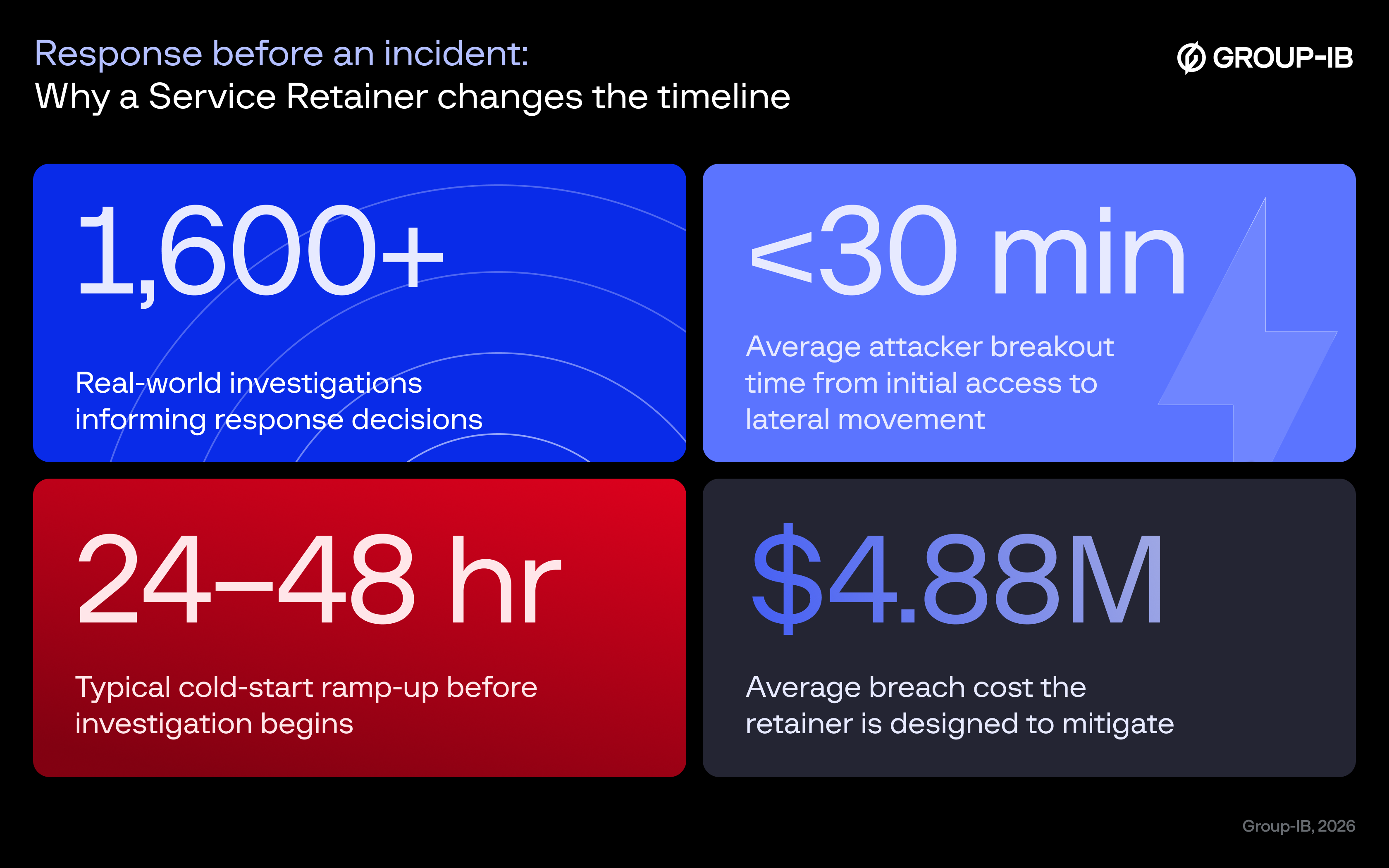
The average attacker breakout time (the window between initial access and lateral movement) is now measured in minutes. Response mobilization without a pre-positioned team is still measured in hours. Regulators increasingly expect evidence of operational readiness, not just documented plans. Insurers are evaluating preparedness as closely as risk exposure itself. An emergency response initiated from a cold start often comes at significantly higher operational and financial cost.
At the same time, many organizations face a broader operational gap: maintaining the internal expertise, continuity, and readiness required to keep pace with an increasingly adaptive threat landscape.
What is needed is not a standalone incident response contract, but a continuous security partnership that spans preparation, response, recovery, and long-term resilience. These seven signals below indicate when an organization has reached that point and how the Group-IB Services Retainer addresses each of them.
1. Attackers return to environments they’ve already broken (and the response window isn’t keeping pace)
Frequent incidents and near misses aren’t random; they’re signals. Ransomware groups like Hunters International, Qilin don’t abandon environments after a first intrusion. The playbook is tested, access paths are known, and without root cause remediation, the next attempt follows the same route.
These operators now exfiltrate sensitive data before deploying the encryptor, creating a second pressure track that runs regardless of whether backups are intact. Pay the ransom — the data may still surface. Don’t pay the same – dedicated leak sites, buyer negotiations, and timed disclosures are now standard operating procedure, not exceptions. Near misses create a different risk: they don’t trigger the same level of review as confirmed breaches, leaving vulnerabilities open. Most organisations have detection. What they lack is a response that activates immediately, not hours later, after vendor selection, negotiation, and onboarding.
For example: This is how modern attacks actually unfold — often before an organization even realizes it’s compromised.
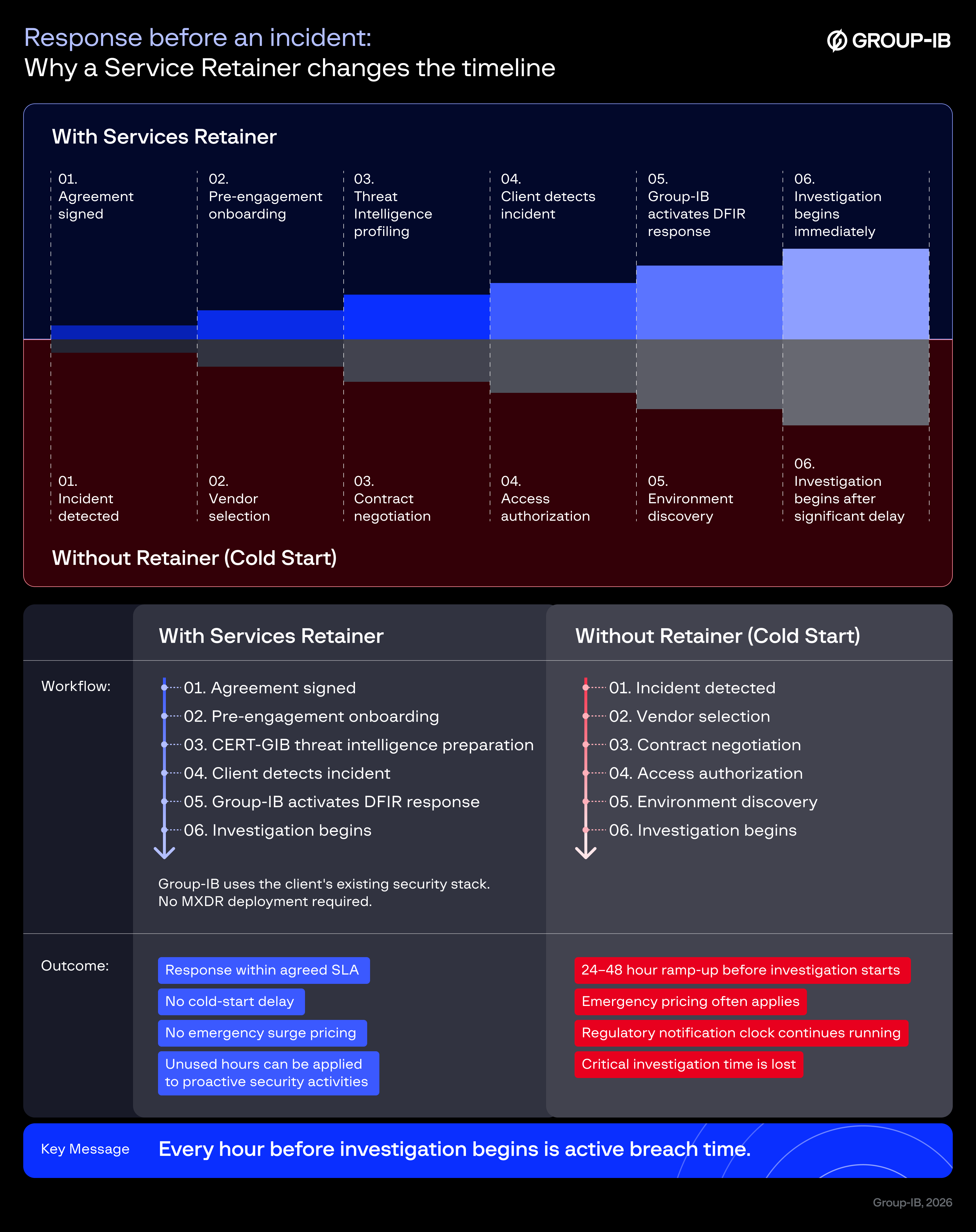
In environments where response is pre-positioned (such as retainer models with integrated monitoring and intelligence), early-stage activity like credential exposure or lateral movement can be detected and contained before detonation.
How Group-IB addresses this?
Group-IB’s Service Retainer is structured as a single flexible agreement that pre-positions the response before an incident occurs. The SLA defines exactly how fast Group-IB activates when an incident hits: no emergency vendor selection, no contract negotiation, no onboarding delay. The DFIR team works across the customer’s existing security stack with full environmental context already in place from pre-engagement onboarding.
Within the same agreement, prepaid hours can be directed into proactive work that addresses root causes before they escalate: compromise assessments, threat hunting, and tabletop exercises scoped to the threat actors targeting the environment.
2. The security team is stretched, and sophisticated attacks will find the ceiling
More than 50% of breached organisations face severe staffing challenges during a cyber crisis. The gap is most acute in digital forensics, malware reverse engineering, and threat actor negotiation. Attacks are also timed for nights, weekends, and holidays (when coverage is lowest).
The undermined reality
Internal teams can handle routine alerts and maintain controls. What they are not built for is parallel response at scale: forensic investigation, legal coordination, executive communication, regulatory reporting, and negotiation. Every team has a ceiling. The only variables are where it sits and what happens when an incident exceeds it.
That ceiling gets harder to defend as the environment grows. Cloud adoption, IoT proliferation, and distributed architectures have dissolved the defined network perimeter that most IR planning was built around. Each layer adds new logging complexity, new investigation workflows, and new blind spots that attackers are faster to exploit than internal teams are to cover.
How Group-IB addresses this?
Group-IB’s Cybersecurity Service Retainer extends capacity where internal teams fall short: 24/7 DFIR coverage, deep forensic expertise, malware analysis, and threat actor negotiation — drawn from 1,600+ real-world investigations. Cloud coverage is built into pre-engagement onboarding: Group-IB’s DFIR team maps the client’s cloud architecture, establishes telemetry access, and documents investigation workflows before an incident requires it. The longer-term fix is also built in: SOC assessments, technical training, and SOC development engagements that build internal capability from the same prepaid hours.
3. Regulators have stopped accepting plans. They want evidence
Various regulations, for example, NIS2 requires early warning within 24 hours, detailed notification within 72 hours, full report within one month
DORA requires proof of tested response capability. Failure results in fines and, in some cases, extended business liability.
The Capital One breach is the case study regulators reference in private: an incident response plan existed, had been documented, and had been approved. It had never been simulated. When a cloud breach hit, the team was running a plan that had never been stress-tested against a cloud environment. 100 million records were exposed. The regulatory consequences were severe, not because there was no plan, but because the plan had never been proven.
Regulators have absorbed that lesson. The benchmark has shifted from “do you have documentation?” to “can you demonstrate the capability works under pressure?”
How Group-IB addresses this?
Group-IB’s Cybersecurity Service Retainer includes the proactive component that creates the regulatory evidence trail: tabletop exercises scoped to the client’s environment, IR plan reviews against current threat actor TTPs, and readiness assessments that produce documentation in the format regulators ask for.
For organisations operating under DORA and NIS2, the retainer’s pre-agreed SLA can make tight notification timelines achievable. When an incident hits, Group-IB activates immediately; no contract negotiation, no procurement delay, no time lost to paperwork. The response is already authorised, scoped, and ready to start.
4. Threats are meshed into cyber and fraud vectors, and neither team has the full picture
An infostealer harvests credentials. Those credentials enable account takeover. The account takeover funds fraudulent transactions. The fraud team flags it. The security team investigates the malware. Two investigations, one incident, and neither team has the full picture.
This is the convergence most response programs weren’t designed for, and most organizational structures actively prevent it from being investigated as a single event.
The attacker sees one operation. The defender sees two separate incidents. That asymmetry is the liability. Digital Forensics tells you how they got in. Fraud analytics tells you what they took and where it went. Both are required to understand the full scope, the full liability, and the full remediation path. A response capability that covers only one domain leaves the other investigation incomplete and leaves the organization exposed to consequences it didn’t see coming.
How Group-IB addresses this?
Group-IB’s retainer accommodates both cyber and fraud risks. DFIR handles the technical investigation. Threat Intelligence monitors underground markets. A single engagement covers the full chain: from infection to fraud, without fragmentation.
The attacker doesn’t separate cyber from fraud. The response capability can’t either.
5. Multiple vendors are creating a coordination problem, not solving one
Most mature security programmes are built from multiple specialist vendors: one for incident response, another for red teaming, a third for penetration testing, and separate contracts for training and assessments. Each vendor is credible in its lane. The problem is that the lanes don’t connect.
Looking at the procurement reality
When an incident hits at 3am, you activate your IR contract. But the team arriving has never seen your environment. The last pen test was done by a different vendor, whose findings were documented in a report that IR has never read. The tabletop exercise was run by a third vendor, against a scenario that’s now 18 months out of date. The red team engagement finished six weeks ago; those findings are sitting in a deck that no one on the response team has seen.
Three vendors. Three partial pictures of the environment. No shared context, no common baseline, no single team accountable for synthesising them while the clock on regulatory notification is already running.
Each contract was procured separately, negotiated separately, and scoped separately. None of them were designed to hand off to the others. That’s not a vendor quality problem. It’s a structural one, built into the procurement model itself.
How Group-IB addresses this?
Group-IB’s Cybersecurity Service Retainer consolidates 20+ services into a single agreement with one point of access and consistent terms. Incident response, red teaming, penetration testing, compromise assessments, SOC assessments, training, and threat intelligence, all under one framework and drawn from the same prepaid hours.
The same team that stress-tests the environment before an incident is the one that responds when one hits. No cold handoffs. No context lost between vendors. No renegotiation under pressure.
6. When the breach hits, the first hours and the budget are already lost
When an organisation without a retainer detects a breach at 2am on a Saturday, the clock starts on two problems simultaneously.
The first is time. The first response hours aren’t lost to the attack; they’re lost to locating available breach counsel, negotiating emergency contracts, identifying who has authority to approve external access, and walking an unfamiliar team through a network topology they have never seen. External responders arriving without pre-engagement context spend 24 to 48 hours on environment orientation before investigation actually begins. For sophisticated attacks that move fast, that window is where the damage is determined.
The second is cost. Every hour of cold-start response runs at emergency rates, forensic teams billing at 2x to 3x standard pricing, scope undefined, timeline unknown. The result is a cost that wasn’t in the budget, isn’t in the risk model, and can’t be absorbed cleanly into quarterly reporting.
CFOs and risk teams have started asking the question that security leaders have been quietly answering for years: is the annual retainer cost less than the probability-weighted cost of a breach without one? With millions in average cost of a breach, and with forensic rates that triple in an emergency, the math tends to resolve in one direction.
There’s a legal dimension too. Critical decisions made in the first hours of a breach about what to preserve, what to report, what to communicate carry lasting legal and regulatory implications. Without breach counsel engaged and attorney-client privilege established before those decisions are made, organisations create liability that the incident response team can’t resolve after the fact.
How Group-IB addresses this?
Group-IB’s pre-engagement onboarding eliminates the ramp-up delay. Before an incident occurs, the DFIR team conducts a deep-dive assessment: network topology documented, critical assets profiled, log sources mapped, secure communication protocols established, and pre-authorised containment actions agreed. When the breach fires, the team activates with full context — no orientation phase, no environment discovery, no renegotiation.
For risk and finance teams that want to model the cost comparison formally, Group-IB’s pre-engagement assessment produces the baseline data ( environment complexity, incident likelihood by threat vector, expected response timeline) that makes the calculation concrete rather than directional.
Group-IB’s Cybersecurity Service Retainer cost is a predictable operating expense. Emergency surge pricing is off the table. And the pre-negotiated, pre-positioned response reduces the downtime that drives the majority of breach costs.
The attackers are planning ahead, are you?
Most organizations reach a point where detection is working, intelligence is flowing, and controls are in place, but response still has a ceiling. When an incident is fast enough, complex enough, or cross-domain enough, the gap between what internal teams can handle and what the situation demands becomes the defining risk.
That gap is closed by pre-positioning/proactive experience, the kind built through hundreds of real-world investigations. This is where a cybersecurity service retainer shifts from optional to structural. Group-IB supports organizations when responses need to move as fast as the attacker and across the full scope of the incident. Across 1,600+ investigations, the consistent differentiator hasn’t been just tailored intelligence and detection accuracy; its 24/7 emergency response capability was already in place when the incident began.
If you’re evaluating what that looks like in practice, it’s worth having the conversation early, not during the incident. Learn more about Group-IB and how our experts offer complete support for proactive and reactive cybersecurity services here.
如有侵权请联系:admin#unsafe.sh