Splunk Enterprise PostgreSQL Sidecar Service Arbitrary File Write VulnerabilitySplunk has 2026-6-16 15:23:54 Author: horizon3.ai(查看原文) 阅读量:52 收藏
Splunk Enterprise PostgreSQL Sidecar Service Arbitrary File Write Vulnerability
Splunk has disclosed CVE-2026-20253, a critical unauthenticated arbitrary file write vulnerability affecting Splunk Enterprise. The flaw exists in a PostgreSQL sidecar service endpoint that lacks authentication controls, allowing a network-reachable attacker to create or truncate arbitrary files on the underlying host without credentials. The vulnerability carries a CVSS v3.1 score of 9.8 and could lead to denial of service, loss of log integrity, or, under certain conditions, remote code execution.
Technical Details
CVE-2026-20253 is caused by missing authentication on PostgreSQL sidecar service endpoints within affected Splunk Enterprise deployments. An attacker who can reach the service over the network can invoke file operations without supplying valid credentials.
Key facts:
- CVSS v3.1: 9.8 (Critical)
- CWE-306: Missing Authentication for Critical Function
- No authentication required
- Network exploitable
- User interaction not required
- Successful exploitation allows arbitrary file creation or truncation on the host system
Researchers have demonstrated that the file write primitive may be chained into remote code execution by overwriting files that are later executed by Splunk services.
Organizations relying on Splunk for SIEM, threat detection, compliance reporting, and log retention should treat this vulnerability as high priority because compromise of the logging platform can directly impact detection, investigation, and audit capabilities.
Stop Guessing, Start Proving
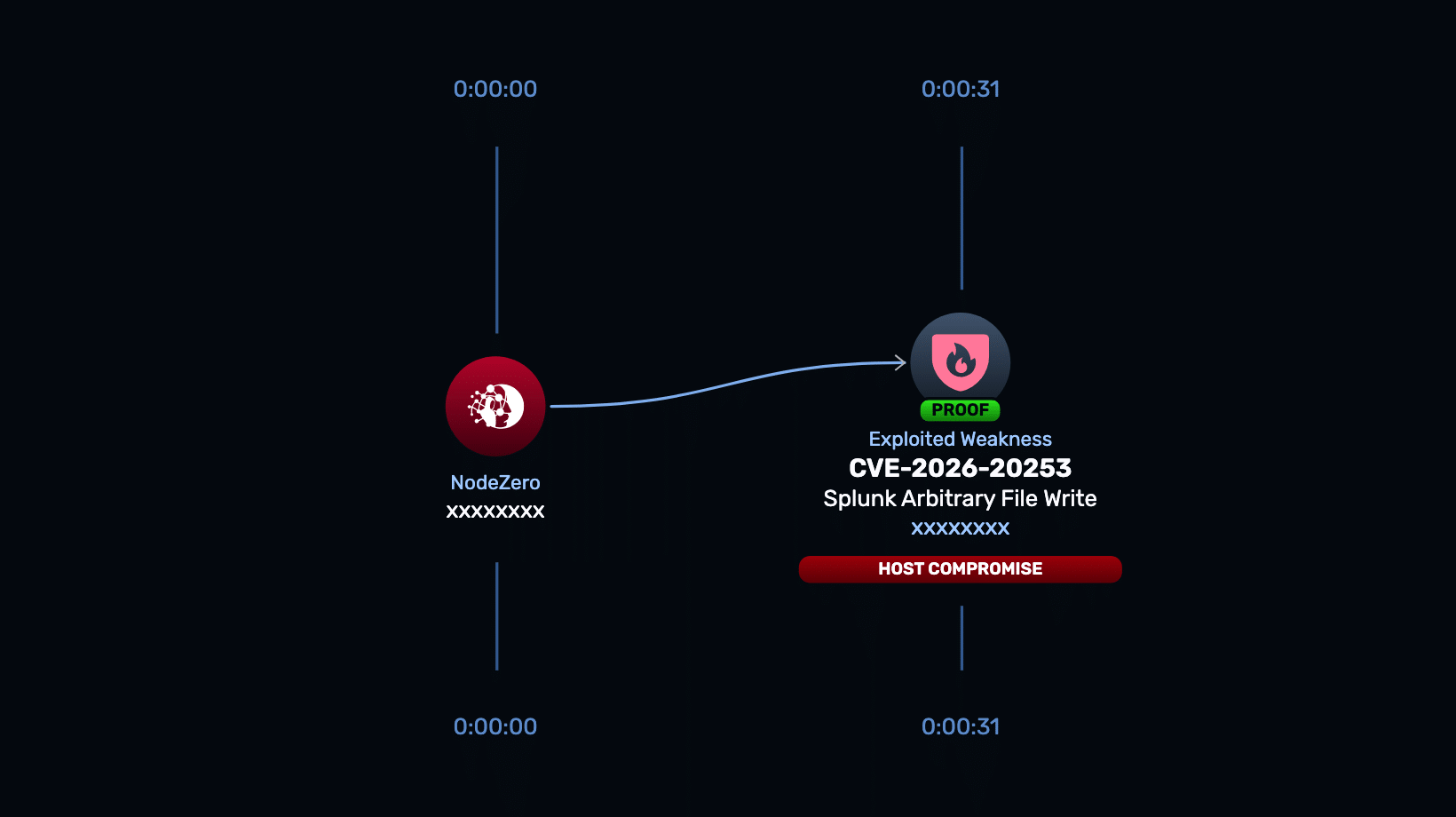
NodeZero® Proactive Security Platform — Rapid Response
A NodeZero Rapid Response test has been developed to safely validate whether this arbitrary file write vulnerability can be exploited in your environment. The test executes real attack techniques without causing damage, giving teams immediate clarity on exposure.
- Run the Rapid Response test: Launch from the NodeZero platform to determine whether the PostgreSQL sidecar service can be abused by an unauthenticated attacker
- Patch immediately: Upgrade to a fixed version of Splunk Enterprise
- Re-run the test: Confirm the vulnerability is no longer exploitable after remediation
Affected versions & patch
Affected
- Splunk Enterprise 10.0.0 through 10.0.6
- Splunk Enterprise 10.2.0 through 10.2.3
Not Affected
- Splunk Enterprise 10.4.x
- Splunk Cloud Platform (Splunk later clarified that PostgreSQL sidecars are not used in Splunk Cloud)
Patch
Upgrade to one of the following versions:
- Splunk Enterprise 10.0.7 or later
- Splunk Enterprise 10.2.4 or later
- Splunk Enterprise 10.4.x
If immediate patching is not possible:
- Restrict network access to the PostgreSQL sidecar service
- Ensure the service is not reachable from untrusted networks or user segments
Splunk has not published an alternative workaround beyond upgrading and limiting exposure.
Timeline
- June 10, 2026 – Splunk published advisory SVD-2026-0603 and disclosed CVE-2026-20253.
- June 13, 2026 – Public technical analysis and exploit details were released.
- June 15, 2026 – Horizon3.ai released a Rapid Response test.
References
Read about other CVEs
NodeZero® Platform
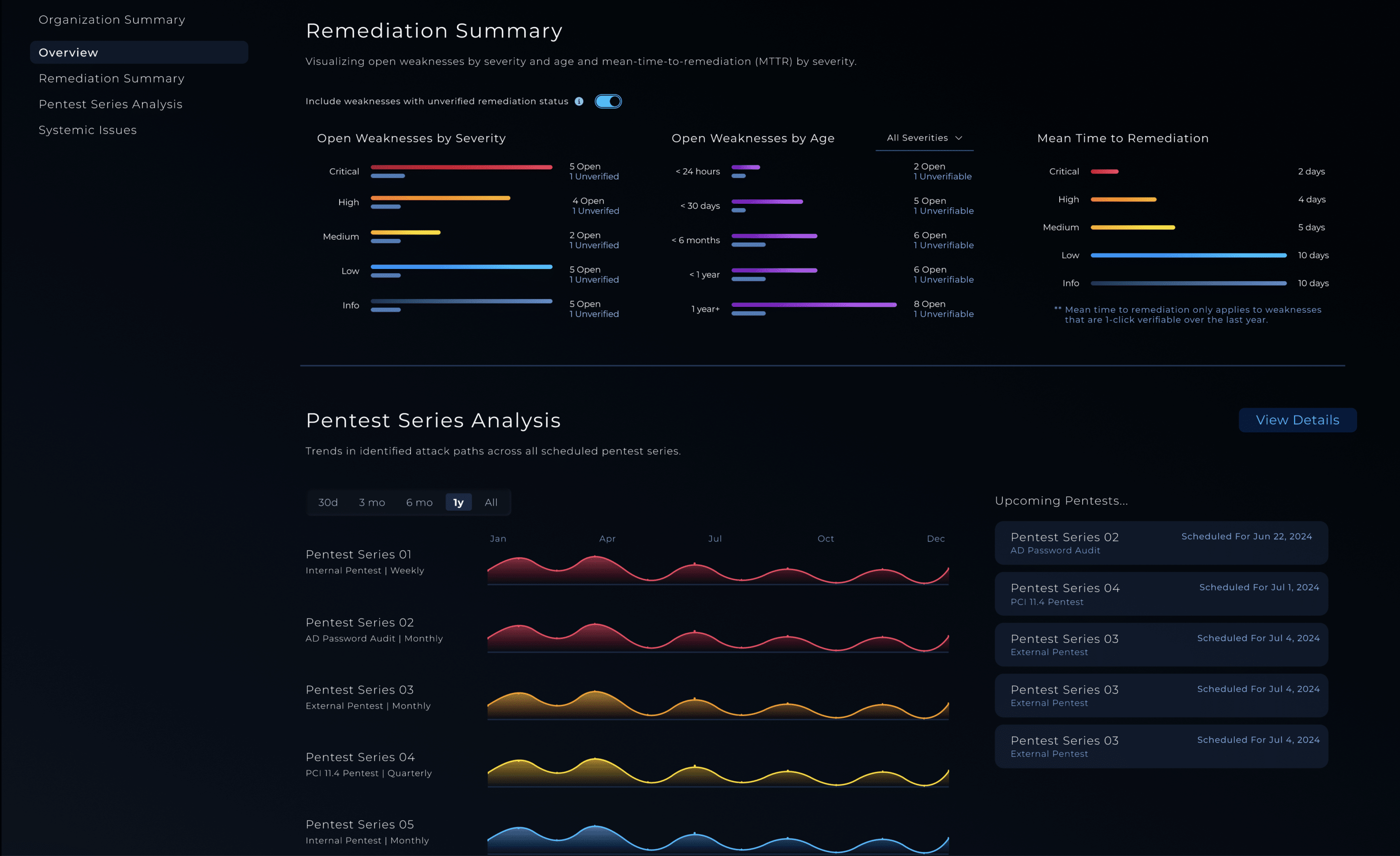
Implement a continuous find, fix, and verify loop with NodeZero
The NodeZero® platform empowers your organization to reduce your security risks by autonomously finding exploitable weaknesses in your network, giving you detailed guidance around how to priortize and fix them, and having you immediately verify that your fixes are effective.
Recognized By
如有侵权请联系:admin#unsafe.sh