Security operations are entering a new phase. As attack techniques grow faster and more complex, 2026-5-6 16:0:0 Author: www.microsoft.com(查看原文) 阅读量:92 收藏
Security operations are entering a new phase. As attack techniques grow faster and more complex, the effectiveness of a SOC depends less on collecting more data and more on how well platforms can turn context into action at scale.
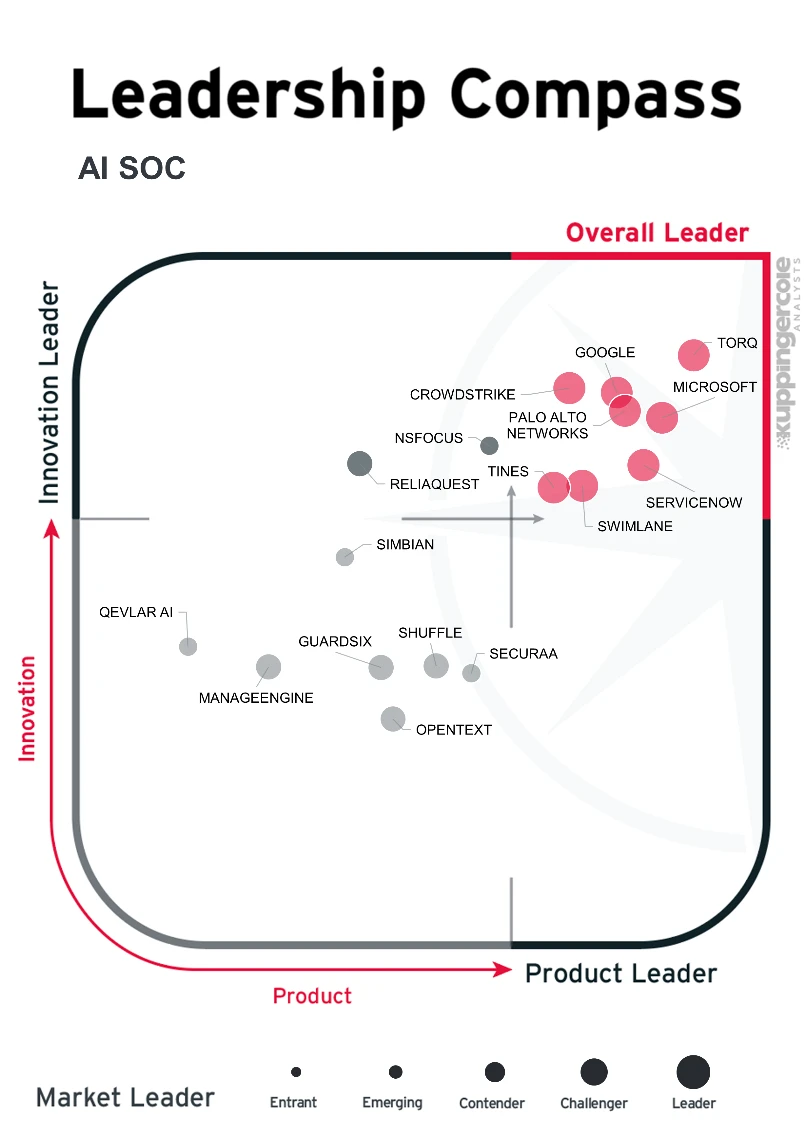
KuppingerCole Analysts’ 2026 Emerging AI Security Operations Center (SOC) reflects this shift clearly: the future of security automation is not defined by static rules or isolated workflows, but by intelligence‑driven automation that supports analyst decision‑making across the full security lifecycle. This evolution mirrors what many security leaders already experience day to day, that the limiting factor is no longer alert volume, but human capacity.
Microsoft is excited to be named an Overall Leader, and the Market Leader, in this report, as we see automation as a core component of the future of cybersecurity.

From playbook‑driven SOAR to intelligence‑led automation
Traditional security orchestration, automation, and response (SOAR) solutions were built to automate predictable, repeatable tasks: enrichment steps, ticket creation, notifications, and predefined containment actions. These capabilities remain valuable, but they were designed for an era when incidents followed more deterministic patterns.
This is a critical change. In many SOCs today, analysts still spend significant time:
- Stitching together context across alerts and data sources.
- Manually triaging incidents that turn out to be benign.
- Following repetitive investigation and response steps.
The result is slower response times and analyst burnout—at exactly the moment attackers are moving faster and operating more quietly.
Automation built into the analyst experience
Microsoft has evolved the way these common challenges can be addressed, leveraging machine learning, large language models (LLMs), and agents, including releases such as:
- Automatic attack disruption: An always-on capability that limits lateral attackers and reduces the overall impact of an attack, from associated costs to loss of productivity, leaving security operations teams in complete control of investigating, remediating, and bringing assets back online.
- Phishing triage agent: An agent that runs sophisticated assessments—including semantic evaluation of email content, URL and file inspection, and intent detection—to determine whether a submission is a true phishing threat or a false alarm.
- AI powered incident prioritization: A machine learning prioritization model to surface the incidents that matter most, assigning each incident a priority score from 0–100 and explaining the key factors behind the ranking.
- Playbook generator: An experience that allows users to create python-code playbooks using natural language for flexible workflow automation.
These capabilities are just the beginning of how we are introducing agents and automation to help users move faster, freeing analysts to focus on higher‑value tasks like proactive hunting and threat analysis.
The next evolution: The agentic SOC
The KuppingerCole report reinforces a broader industry trend, that security platforms must do more than automate pre‑defined workflows. They must support adaptive, intelligence‑driven operations that can respond to novel and fast‑moving threats.
This is where Microsoft is making its next set of investments: agentic security operations.
With innovations such as the Microsoft Sentinel MCP (Model Context Protocol) Server, shared security data and graph context, and deep integration with Microsoft Security Copilot, Sentinel is evolving into a platform where AI agents can:
- Reason across identity, endpoint, cloud, and network signals.
- Summarize incidents and investigations in natural language.
- Assist with decision‑making by correlating weak signals over time.
- Take action—with human oversight—when confidence thresholds are met.
These agents are designed to work alongside analysts, augmenting expertise and dramatically accelerating time to response.
Why this matters for security teams
The direction highlighted by KuppingerCole, and reflected in Microsoft’s roadmap, isn’t about chasing AI for its own sake. It’s about addressing real SOC pain points:
- Scale: Human‑only operations don’t scale with modern attack surfaces.
- Consistency: Automated and agent‑assisted workflows reduce variance and errors.
- Speed: Faster reasoning and response directly reduce attacker dwell time.
By combining automation, rich context, and intelligent agents, Microsoft Sentinel helps SOC teams move from reactive alert handling to proactive, intelligence‑led defense without forcing teams to re‑architect their operations overnight.
Looking ahead
Security automation is no longer a bolt‑on capability. As KuppingerCole’s research makes clear, it is becoming a foundational element of modern security operations. The evolution of SOAR reflects the reality of a shift from static playbooks to adaptive, context‑aware assistance that scales human expertise.
Microsoft is investing accordingly, advancing an AI‑first approach to security analytics that helps SOC teams operate with greater speed, confidence, and resilience as threats continue to evolve. Read the Emerging AI Security Operations Center (SOC) report to learn more.
To learn more about Microsoft Security solutions, visit our website. Bookmark the Security blog to keep up with our expert coverage on security matters. Also, follow us on LinkedIn (Microsoft Security) and X (@MSFTSecurity) for the latest news and updates on cybersecurity.
如有侵权请联系:admin#unsafe.sh