嗯,用户让我用中文总结一下这篇文章的内容,控制在100字以内,而且不需要特定的开头。好的,我先快速浏览一下文章。 文章主要讨论了企业在2026年采用AI时遇到的常见问题和风险,以及应对策略。提到的挑战包括与旧系统的整合困难、数据质量差、员工抵触、过度依赖通用AI解决方案,以及缺乏准备评估。企业如果处理不当,可能会面临项目延迟、预算超支、低回报和运营中断等问题。 应对策略包括进行AI准备评估、分阶段实施、加强数据治理、规划旧系统整合、定制AI解决方案以及设计可扩展的架构。ISHIR公司提供了一些帮助企业降低风险的方法,比如使用数据和AI加速器,现代化旧系统等。 现在需要把这些内容浓缩到100字以内。要抓住关键点:AI在2026年的挑战和策略,包括整合旧系统、数据治理、员工抵触等,并提到ISHIR的帮助。 可能的总结:“文章探讨了企业在2026年采用AI时面临的挑战与风险,如旧系统整合困难、数据质量低及员工抵触,并提出通过准备评估、分阶段实施和加强数据治理等策略来应对。ISHIR提供定制化解决方案和现代化服务,助力企业成功落地AI。” 这样刚好在100字左右。 </think> 文章探讨了企业在2026年采用AI时面临的挑战与风险,如旧系统整合困难、数据质量低及员工抵触,并提出通过准备评估、分阶段实施和加强数据治理等策略来应对。ISHIR提供定制化解决方案和现代化服务,助力企业成功落地AI。 2026-4-28 12:15:37 Author: securityboulevard.com(查看原文) 阅读量:45 收藏
AI is everywhere in boardroom conversations, strategy decks, and product roadmaps. Yet behind the buzz, a quieter reality is unfolding. Many enterprises are investing heavily in AI but struggling to turn that investment into real, measurable impact.
The gap is not about ambition. It is about execution.
Organizations are discovering that AI adoption is less about deploying models and more about navigating complexity. Legacy systems refuse to cooperate. Data turns out to be messy and unreliable. Teams hesitate, unsure how AI fits into their workflows. What looked like a straightforward transformation quickly becomes a tangled web of technical and organizational challenges.
As 2026 approaches, the stakes are rising. AI is no longer a side initiative. It is becoming central to competitiveness, efficiency, and innovation. But without a clear understanding of the risks, enterprises risk moving fast in the wrong direction.
This is where most AI journeys either stall or succeed.
Common AI Adoption Challenges Enterprises Face
1. Legacy System Integration Challenges
One of the most cited challenges in enterprise AI adoption is integrating AI solutions with outdated systems. Many enterprises still operate on legacy infrastructure that was not designed for real time data processing or AI workloads.
“Integration with outdated legacy systems is a common roadblock, often causing project delays and financial losses”
These limitations create bottlenecks, increase complexity, and slow down deployment timelines.
2. Poor Data Quality and Governance Gaps
AI systems depend on high quality data. However, many organizations struggle with fragmented, inconsistent, or unstructured datasets.
“Many organizations struggle with the quality of unstructured data, critical for successful AI implementation”
Without strong data governance frameworks, AI models produce unreliable outputs, leading to mistrust and low adoption.
3. Resistance to Change
AI adoption is not just a technical shift. It is a cultural transformation. Employees may fear job displacement, lack trust in AI systems, or resist new workflows.
This resistance slows down adoption and reduces the effectiveness of AI initiatives.
4. Overreliance on Generic AI Solutions
Many enterprises attempt to deploy off the shelf AI tools without customization. This often leads to poor alignment with business processes.
Generic solutions fail because enterprise environments are complex and unique.
5. Lack of AI Readiness Assessment
Jumping into AI without assessing organizational readiness is a common mistake. Enterprises often underestimate dependencies such as data maturity, infrastructure readiness, and stakeholder alignment.
The Cost of Getting AI Adoption Wrong
- Delayed projects: Integration challenges and unclear requirements often slow down implementation timelines. What starts as a quick pilot can stretch into months of rework and missed milestones.
- Budget overruns: Poor planning, repeated fixes, and inefficient execution drive costs beyond initial estimates. Organizations end up spending more just to stabilize underperforming systems.
- Low ROI: AI models built on poor data or misaligned goals fail to deliver meaningful outcomes. This leads to limited business value despite significant investment.
- Operational disruption: Improperly integrated AI systems can interrupt existing workflows and create confusion. Instead of improving efficiency, they introduce friction across teams.
Enterprise AI Adoption Strategy for 2026: Proactive Frameworks to Reduce Risk and Maximize ROI
AI Readiness Assessment
Impact: Reduced Risk and Clear Execution Path
Conducting an AI readiness assessment helps identify gaps in data, infrastructure, and organizational alignment before implementation begins. This minimizes uncertainty and ensures that AI initiatives start with a strong, well-informed foundation.
Phased AI Implementation Roadmap
Impact: Faster Time to Value
Breaking AI adoption into smaller, manageable phases allows enterprises to test, learn, and scale incrementally. This approach delivers quicker wins, reduces failure risk, and accelerates measurable business outcomes.
Strong Data Governance Framework
Impact: Reliable Insights and Better Model Performance
Establishing data governance policies ensures data quality, consistency, and compliance. High-quality data leads to more accurate AI models and builds trust in AI-driven decisions across the organization.
Legacy System Integration Planning
Impact: Seamless Implementation and Reduced Disruption
Addressing integration challenges early through APIs, middleware, or modernization strategies ensures AI systems work smoothly with existing infrastructure. This prevents delays and avoids operational disruptions.
Tailored AI Solution Design
Impact: Higher Adoption and Scalability
Customizing AI solutions to fit specific business processes improves relevance and usability. Tailored approaches lead to better adoption rates and enable scalable AI deployments across the enterprise.
Scalable AI Architecture and Infrastructure
Impact: Future-Ready and Sustainable AI Growth
Designing flexible and scalable AI systems ensures that solutions can evolve with changing business needs. This prevents rework and supports long-term growth and innovation.
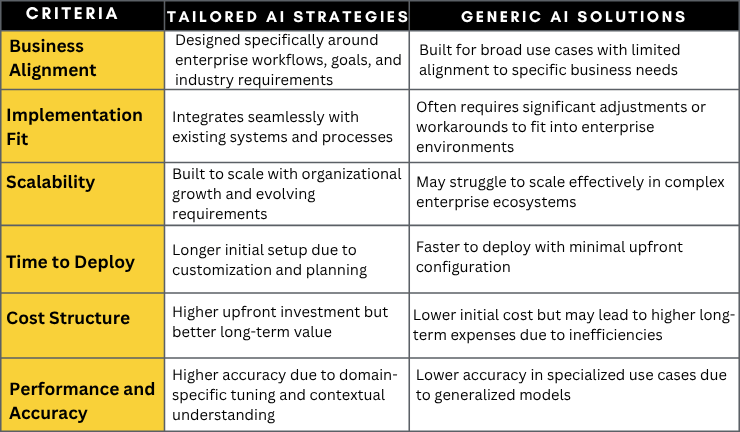
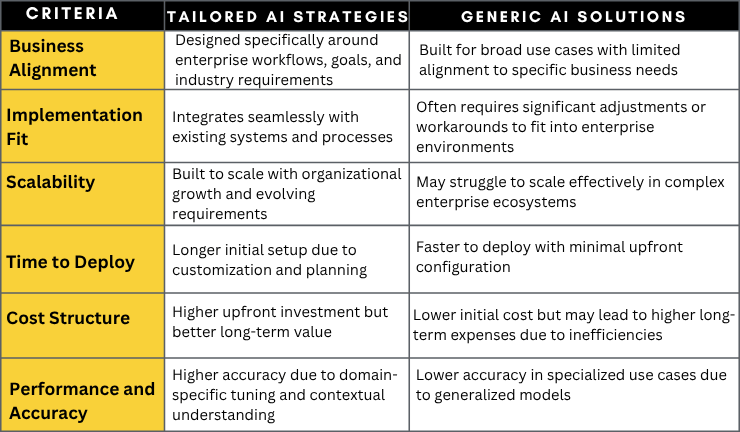
Tailored AI Strategies vs Generic AI Solutions
Data Governance and Data Quality Best Practices Checklist
- Define clear data ownership: Assign accountability for data accuracy, security, and lifecycle management across teams.
- Establish a data governance framework: Implement policies for data access, compliance, and standardization to ensure consistency.
- Standardize data formats and definitions: Create uniform data structures and naming conventions to eliminate inconsistencies.
- Ensure data quality monitoring: Continuously track data accuracy, completeness, and anomalies using automated tools.
- Build reliable data pipelines: Design scalable pipelines that clean, transform, and deliver high-quality data for AI models.
- Manage unstructured data effectively: Organize and preprocess text, images, and other unstructured data to make it AI-ready.
- Enable secure and controlled data access: Implement role-based access controls to protect sensitive data while ensuring usability.
How ISHIR Helps Mitigate AI Adoption Risks
ISHIR enables enterprises to de-risk AI adoption through a structured, outcome-driven approach that combines strategy, engineering, and execution. With its Data and AI accelerators, organizations can fast-track readiness by accessing data maturity, identifying high-impact use cases, and building scalable AI pipelines. This reduces experimentation cycles and helps enterprises move from pilot to production with confidence and measurable ROI.
A key challenge in enterprise AI adoption is integrating with legacy systems. ISHIR addresses this through modernization strategies powered by Gen AI, enabling intelligent transformation of outdated architectures into API-driven, AI-ready ecosystems. Instead of costly system replacements, ISHIR leverages automation, code transformation, and middleware integration to bridge legacy gaps while ensuring business continuity.
By combining strong data governance frameworks with AI engineering expertise, ISHIR ensures that enterprises build on a reliable data foundation. From improving data quality to enabling real-time insights, ISHIR helps organizations unlock the full potential of AI while minimizing risks related to poor data, integration failures, and low adoption.
Struggling to turn AI investments into real business impact?
Accelerate success with ISHIR’s tailored AI strategies, data accelerators, and legacy modernization expertise.
FAQs
Q. How should enterprises choose between generic AI tools and tailored AI solutions?
Generic AI tools are useful for quick experimentation, productivity support, and broad use cases. However, tailored AI solutions are usually better for enterprise workflows that require domain context, integration, governance, and measurable business outcomes. Product platforms show rapid growth in AI tools, but enterprise adoption requires more than tool selection. Companies should evaluate whether the solution fits their data environment, compliance needs, user workflows, and long-term scalability.
Q. Are AI agents ready for enterprise use?
AI agents are becoming more relevant for enterprise workflows, but they need strong controls before they can operate at scale. Recent enterprise AI agent discussions focus on governance, observability, secure tool access, human approvals, and process context. Agents can help with automation, research, customer service, coding, and operations, but they can also introduce risk if they act without clear guardrails. Enterprises should begin with constrained autonomy, role-based permissions, and human-in-the-loop approvals for high-impact actions.
Q. Why is legacy system integration a major AI adoption barrier?
Legacy systems often lack modern APIs, real-time data access, clean documentation, and scalable infrastructure. This makes it difficult to connect AI models with the systems where business work actually happens. For AI to create value, it must integrate with ERP, CRM, data warehouses, customer support tools, and operational platforms. Enterprises can reduce this risk through API modernization, middleware, data integration layers, and Gen AI-assisted legacy modernization.
Q. What role does data governance play in AI adoption?
Data governance is one of the most important foundations for enterprise AI success. AI models depend on accurate, consistent, accessible, and secure data to generate reliable outputs. Research shows that data reliability, data quality, and retrieval are still major barriers for generative AI and agentic AI adoption. Without governance, enterprises risk inaccurate recommendations, compliance issues, security exposure, and low trust in AI-driven decisions.
Q. How can enterprises measure ROI from AI tools and AI models?
Enterprises should measure AI ROI using business metrics, not just productivity claims. Useful metrics include cost savings, cycle-time reduction, revenue impact, customer satisfaction, risk reduction, and employee productivity gains. Reports show that many organizations are using AI widely, but only a smaller share are seeing significant ROI from generative AI. The best approach is to define ROI before implementation, assign business ownership, and track impact at the use-case level.
Q. Why do employees resist AI adoption in enterprises?
Employees may resist AI because they fear job displacement, do not trust model outputs, lack training, or feel AI is being forced into workflows without context. Recent workplace AI coverage shows that adoption depends heavily on people practices, communication, and trust. Developers and knowledge workers are using AI tools widely, but trust can decline when tools produce unreliable or unexplained results. Enterprises need change management, role-specific training, and transparent communication to improve adoption.
The post Enterprise AI Adoption in 2026: Common Pitfalls, Risks, and Proven Strategies for Success appeared first on ISHIR | Custom AI Software Development Dallas Fort-Worth Texas.
*** This is a Security Bloggers Network syndicated blog from ISHIR | Custom AI Software Development Dallas Fort-Worth Texas authored by Praveen Kumar. Read the original post at: https://www.ishir.com/blog/321254/enterprise-ai-adoption-in-2026-common-pitfalls-risks-and-proven-strategies-for-success.htm
如有侵权请联系:admin#unsafe.sh