
嗯,用户让我总结一篇文章的内容,控制在100字以内,而且不需要特定的开头。首先,我需要通读整篇文章,抓住主要点。 文章讲的是Credential stuffing,也就是凭证填充攻击。这是一种网络攻击方式,攻击者利用从数据泄露或暗网上获取的用户名和密码,试图登录其他平台的账户。这种攻击之所以常见,是因为很多用户重复使用密码。文章提到64%的用户这样做,导致攻击成功率高。 接下来,文章分析了这种攻击为何会越来越严重。原因包括持续的数据泄露提供了大量被盗凭证、密码复用现象普遍、自动化工具的普及以及数字足迹的扩大。此外,即使成功率低,攻击者也能通过大量尝试获得收益。 然后,文章讨论了防御措施,比如密码哈希、检测泄露密码和异常检测等方法。最后强调了这种攻击难以检测的原因在于其行为看似正常。 现在需要把这些要点浓缩到100字以内。要确保涵盖攻击方式、原因、影响和防御措施。 </think> 凭证填充攻击利用被盗用户名和密码尝试登录其他平台账户,因用户常重复使用密码而高发。此威胁因数据泄露、密码复用及自动化工具而加剧。企业需通过密码哈希、检测泄露密码及异常监测等措施防范此类攻击。 2026-4-21 06:33:3 Author: securityboulevard.com(查看原文) 阅读量:9 收藏
Credential stuffing is a cyberattack where attackers use stolen usernames and passwords, often obtained from data breaches or bought on the dark web, to gain unauthorized access to accounts on other platforms. These attacks are highly prevalent and a major contributor to data breaches, largely because 64% of users reuse passwords across multiple accounts. On platforms like Auth0, credential stuffing activities account for nearly half of daily login attempts. The risk continues to grow as billions of compromised credentials circulate online, giving attackers endless opportunities to exploit reused passwords.
The good news is that this can be mitigated with the right cybersecurity strategies. Understanding how these attacks work and taking proactive steps can significantly reduce the chances of your organization becoming a target.
Why Credential Stuffing Is a Growing Threat?
This isn’t rising due to advanced attackers; it’s scaling because the internet enables it. A steady stream of leaked credentials, widespread password reuse, and easy access to automation tools make these attacks highly effective. At the same time, users are juggling more online accounts than ever, which significantly expands the attack surface.
Recent insights from the Verizon Data Breach Investigations Report 2025 highlight the magnitude of the issue:
- Compromised credentials were responsible for initiating 22% of analyzed breaches.
- Only 49% of passwords were unique, meaning more than half were reused across platforms.
- Credential stuffing made up a median of 19% of daily authentication attempts, rising to 25% in enterprise environments.
Here’s why this threat continues to grow:
- A Constant Supply of Stolen Credentials:
Frequent data breaches expose billions of usernames and passwords, providing attackers with a steady stream of data to reuse. In 2025, the threat intelligence firm Synthient compiled around 2 billion unique email addresses from credential-stuffing lists circulating online.
- Password Reuse Across Platforms:
When users rely on the same credentials for multiple accounts, whether email, e-commerce, social media, or banking, a single breach can open the door to several services at once.
- Sophisticated Automation at Scale:
Modern tools automate attacks end-to-end. Bots can rotate IP addresses, imitate real user behavior, and even bypass basic defenses like CAPTCHA, enabling attackers to test massive credential sets while staying under the radar.
- Expanding Digital Footprint:
With work, finance, communication, and entertainment increasingly moving online, both individuals and organizations manage more accounts than ever, creating a larger attack surface.
- Profitable even with low success rates:
Credential stuffing doesn’t need high success rates to be effective. Even a small fraction of successful logins from millions of attempts can result in valuable account access, leading to fraud, identity theft, or resale of verified credentials on underground markets.
Book Your Free Cybersecurity Consultation Today!

How Credential Stuffing Attacks Operate?
Attackers carry out credential stuffing attacks by feeding stolen username and password combinations into a botnet, which automates login attempts across multiple websites simultaneously. At scale, these bot-driven attacks can overwhelm IT infrastructure, with some organizations experiencing traffic spikes of up to 180 times their normal levels during an attack.
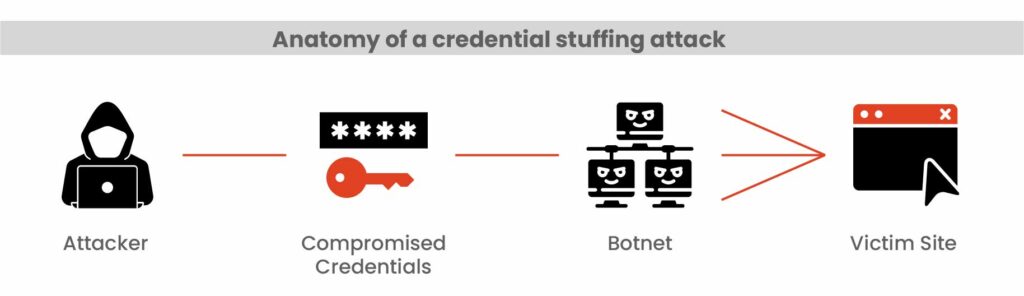
When attackers successfully use stolen credentials on a website, they gain unauthorized access to user accounts and sensitive data, which they exploit in multiple ways. This often includes selling access to compromised accounts, commonly seen with streaming services like Netflix or Spotify, conducting e-commerce fraud by impersonating users to purchase high-value goods, and carrying out corporate or institutional espionage. In severe cases, attackers hijack employee or admin accounts to access sensitive data, causing major business and reputational damage.
Cyber Incidents Triggered by Credential Stuffing
This threat is far from theoretical; it impacts both everyday users and large enterprises. The attacks have compromised even well-resourced organizations, exposing sensitive data and causing reputational damage, regulatory penalties, and legal action.
23andMe
In 2023, 23andMe experienced a credential stuffing attack in which threat actors reused login credentials obtained from unrelated data breaches to gain access to user accounts. By exploiting features such as “DNA Relatives,” attackers were able to harvest sensitive profile data, including ancestry and health-related information, impacting approximately 7 million users.
The incident drew regulatory scrutiny, resulting in a £2.31 million fine for failing to adequately safeguard the genetic data of UK users. It also highlighted how credential stuffing can expose highly sensitive personal information, even when an organization’s core infrastructure remains uncompromised.
Uber
A major data breach exposed information belonging to 57 million riders and 7 million drivers. The incident occurred after developers inadvertently uploaded credentials to a GitHub repository, which attackers discovered and used to gain access to internal systems. Uber later acknowledged that it paid $100,000 to the attackers to delete the stolen data instead of promptly disclosing the breach.
Business Impact of Credential Stuffing
For businesses, the consequences of a data breach can be significant. When customer accounts are compromised, they can be misused for fraud and unauthorized transactions, posing serious risks, especially for financial services and e-commerce organizations.
The financial impact is substantial, with companies incurring high remediation costs such as customer refunds, incident response efforts, and internal security investigations. Operational disruptions also follow, including forced password resets and urgent security enhancements. According to the IBM Cost of a Data Breach Report 2025, the global average cost of a data breach stands at $4.4 million.
Beyond direct financial losses, organizations also face reputational, operational, and regulatory challenges. Publicized incidents can erode customer trust, drive higher churn rates, and weaken long-term brand value. At the same time, large-scale automated login attempts can overload systems, impacting performance and disrupting access for legitimate users and employees.
Join our weekly newsletter and stay updated
Mitigating the Risk of Credential Stuffing Attacks
Although users know password reuse is risky, many still do it due to the difficulty of managing numerous passwords, and password manager adoption remains low. As a result, organizations must take the lead in preventing credential stuffing by implementing stronger controls or even eliminating passwords, so stolen credentials can’t be misused. Based on guidance from OWASP, several effective measures can help achieve this.
Credential Hashing
Credential hashing is a foundational step in safeguarding user credentials. It transforms passwords into unreadable strings before storing them in a database, so even if data is compromised, attackers can’t easily use the stolen information. However, not all hashing methods offer the same level of protection. While hashing alone won’t stop credential stuffing attacks, it significantly reduces the value of stolen credentials and limits the damage attackers can cause.
Protection Against Breached Passwords
Breached password protection works by checking user login credentials against known databases of compromised passwords, such as Have I Been Pwned, to identify and block risky logins in real time.
For instance, Auth0 offers breached password detection that can alert users, prevent login attempts, or trigger additional verification steps like multi-factor authentication (MFA) when credentials are linked to known breaches or when suspicious activity, such as logins from unusual IP addresses, is detected.
Anomaly Detection
Continuous monitoring is essential for detecting and stopping attacks at an early stage. With clear visibility into traffic, organizations can quickly identify suspicious activity and take action to mitigate threats. Using Auth0, Log Streams enable near real-time tracking of events. Once configured, logs are sent to your monitoring platform to analyze events and detect threats in real time.
Conclusion
Credential stuffing has become a persistent and scalable threat, driven not by highly advanced techniques but by widespread password reuse, continuous data breaches, and automated attack tools. As users and organizations manage more digital accounts, the attack surface continues to expand, making it easier for attackers to exploit compromised credentials across platforms. These attacks are particularly challenging to detect because they often mimic legitimate login behavior, allowing them to bypass basic security controls. The real challenge lies in the fact that these attacks often mimic legitimate user behavior, making them difficult to detect without the right visibility and controls in place.
FAQs
- How is credential stuffing different from brute force attacks?
Unlike brute force attacks that guess passwords, credential stuffing uses already stolen credentials, making it faster and more effective.
- How can businesses detect credential stuffing attacks?
By monitoring login patterns, identifying unusual traffic spikes, and using anomaly detection tools to flag suspicious behavior.
- Where do attackers get credentials for credential stuffing?
From previous data breaches, leaked databases, and underground marketplaces on the dark web.
- Can CAPTCHA stop credential stuffing attacks?
It can slow attackers down, but advanced bots can bypass basic CAPTCHA mechanisms.
The post What Makes Credential Stuffing Difficult to Detect? appeared first on Kratikal Blogs.
*** This is a Security Bloggers Network syndicated blog from Kratikal Blogs authored by Shikha Dhingra. Read the original post at: https://kratikal.com/blog/what-makes-credential-stuffing-difficult-to-detect/
如有侵权请联系:admin#unsafe.sh