
好的,我现在需要帮用户总结一篇文章,控制在100字以内。用户的要求很明确,不需要特定的开头,直接写文章描述。 首先,我快速浏览文章内容。文章主要比较了传统风险管理和AI驱动的风险管理。传统方法使用静态表格,手动更新,效率低且容易过时。AI方法则通过实时数据和机器学习,提供动态风险评估和自动化工作流程。 接下来,我需要提取关键点:传统方法的缺点、AI的优势、以及AI如何提升GRC效率。还要注意保持简洁,不超过100字。 然后,组织语言,确保信息全面且简洁。比如提到AI如何持续更新、动态评分、结合业务背景等。 最后,检查字数是否符合要求,并确保没有遗漏重要信息。 </think> 文章比较了传统风险管理和AI驱动的风险管理方法。传统风险登记表依赖手动更新和静态数据,存在效率低下和盲点问题。AI驱动的风险登记表通过实时数据和机器学习实现动态风险评估和自动化工作流程,提升组织的风险应对能力和战略决策能力。 2026-4-20 23:32:31 Author: securityboulevard.com(查看原文) 阅读量:9 收藏
Key Takeaways
- Traditional registers create manual bottlenecks that blind teams to live threats between review cycles.
- AI automation transforms static spreadsheets into continuously updated, evidence-driven risk intelligence.
- Dynamic scoring and business context mapping turn technical findings into executive-ready insights.
- Hybrid AI-human workflows amplify GRC expertise rather than replace it.
It’s surprising that traditional risk registers (spreadsheets or basic databases) persist in a world racing toward AI-infused technology. But the states speak for themselves: 59% of GRC practitioners use no commercial tool, with 52% spending 30-50% of time on admin tasks like data entry.
Although reliable for basic checklists, traditional risk registers are obsolete for live risk management. AI-powered risk registers transform this static domain into dynamic, intelligent systems delivering real-time insights.
Risk Register Fundamentals
Risk registers serve as the foundational tool in GRC. They systematically catalog all identified risks across an organization. Each entry typically captures the risk description, likelihood, impact, owner, mitigation status, and residual score, enabling prioritized decision-making during audits, board reviews, or incident response. Historically, these lived in Excel spreadsheets or basic databases, maintained through manual updates during quarterly cycles, a reliable but labor-intensive approach that worked well for stable environments.
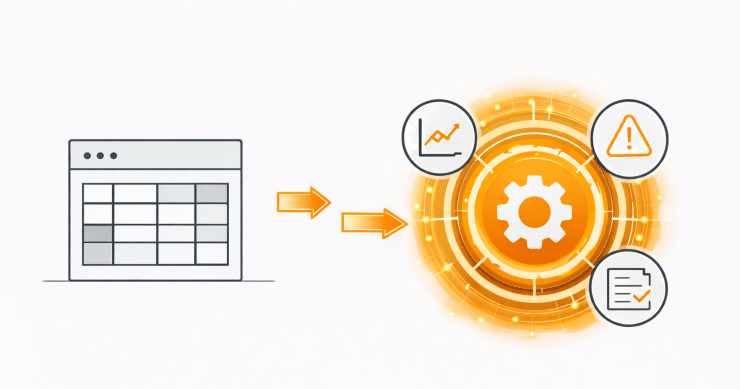
Today’s threat landscape demands more. With risks evolving hourly, static registers create blind spots between updates. Enter AI-powered versions: intelligent systems that ingest live data from SIEM tools, control tests, and external feeds to maintain a continuously current inventory. This shift transforms GRC from reactive housekeeping to proactive strategy, without losing the core discipline of structured risk tracking.
How Risk Registers Work
A risk register is the central record organizations use to track identified risks. It usually includes the risk description, source, likelihood, impact, owner, mitigation plan, status, and review date.
In a traditional process, teams identify a risk, enter it into the register, score it, assign ownership, and update it over time as conditions change. The register helps create consistency and gives leadership a structured view of what needs attention.
The weakness is that many registers still depend on manual upkeep. When updates are delayed, scores grow stale, and the register becomes more of a snapshot than a live view. That is why newer risk registers are shifting from static documentation toward continuous, connected risk monitoring.
Pain Points of Traditional Risk Registers
Conventional risk registers rely heavily on manual effort.
- Teams spend hours manually entering risks identified during assessments, often duplicating work across siloed departments.
- Scores and priorities stagnate between review cycles, missing emerging threats like new vulnerabilities or regulatory changes.
- Mapping risks to business impact feels subjective, with limited evidence to back qualitative judgments.
- Scaling across business units or subsidiaries means endless copy-pasting, leading to inconsistencies and version control nightmares.
- Remediation tracking turns into a game of email ping-pong, with no automated visibility into progress or ownership.
These issues compound in complex environments, where quarterly updates barely scratch the surface of ongoing exposure.
How AI Changes the Game
AI-powered risk registers ingest data continuously from assessments, evidence libraries, integrations, and compliance frameworks.
They start by surfacing potential risks: analyzing historical data, control gaps, and external feeds to generate items that might otherwise go unnoticed. Dynamic scoring kicks in next, calculating priorities as new information flows in.
Business context integration elevates this further: AI translates technical findings into organizational language, quantifying impacts on revenue, operations, or reputation. Multi-entity support organizes risks by business unit, location, or asset group, while built-in workflows assign remediation tasks with real-time status updates.
Benefits of AI-Powered GRC
Only a few advanced GRC platforms offer true AI-powered risk registers today. Teams using them save many hours of manual work, spending less time on data entry and more on real strategy.
- Spots risks 3x faster with live updates from security tools
- Shows business impact in dollars for easy executive updates
- Handles subsidiaries automatically during growth or M&A
- Creates remediation tickets that track progress automatically
- Proves every decision to auditors with clear evidence trails
These tools also find risks Excel misses, like hidden API issues. Smart teams get 4x return on investment in year one. They’ll soon be essential as regulations tighten.
Anatomy of an Automated Risk Register
Modern AI risk management frameworks blend LLMs with rules-based engines for precision.
Data ingestion pulls from a variety of integrations. AI processes this into risk objects. Scoring engines apply quantitative formulas updated by machine learning on your historical data [Forrester Wave: GRC 2025].
Output layers feed executive dashboards, remediation tickets, and compliance reports, with full audit trails.
Feature Face-Off
| Aspect | Traditional Register | AI-Powered Register |
| Risk ID | Manual brainstorming | AI pattern detection from thousands of data points |
| Scoring | Static quarterly math | Continuous ML recalcs with evidence |
| Impact | Gut-feel notes | Quantified ties to revenue/ops/reputation |
| Scale | Excel hell across teams | Native multi-entity inheritance |
| Maintenance | Manual refresh cycles | Always-on with immutable logs |
| Reporting | Pivot-table exports | AI-narrated dashboards + drill-downs |
Lessons from the McKinsey Lilli Breach
In March 2026, McKinsey’s internal AI platform Lilli (used by 40,000 consultants) was breached in under 2 hours. An autonomous AI agent exploited 22 unauthenticated APIs and a SQL injection flaw to extract 46.5 million chat messages, 728,000 confidential files, and 95 editable system prompts. This exposed strategy documents, M&A plans, and client data. Attackers gained full read/write control over Lilli’s core behavior.
Traditional risk registers offered zero visibility into these risks, leaving McKinsey blind until researchers went public.
The incident reveals three practical control gaps that modern AI risk registers close automatically:
1. Organizations need full visibility into their AI footprint. Teams use ChatGPT, Claude, internal copilots, and custom models—but no one tracks what sensitive data flows where or which third-party APIs access it. AI registers create a live inventory of every tool and connection.
2. AI creates single points of failure. Lilli combined user prompts, company documents, and model logic in one vulnerable environment. Modern registers enforce strict separation between these layers—a breach at the front door can’t access back-room data.
3. AI behavior changes silently. Approved use cases drift daily through new data sources, model updates, or prompt tweaks. Quarterly audits miss this completely. AI registers run continuous health checks, flagging drift before it creates compliance issues.
McKinsey’s breach proves these controls aren’t theoretical necessities. They’re what prevent AI from becoming a compliance liability instead of a strategic advantage. Platforms like Centraleyes deliver all three capabilities natively.
Regulatory Drivers
Recent regulations accelerate the shift from static to AI-powered registers. The EU AI Act (effective Aug 2026) mandates continuous high-risk AI system monitoring, explicitly calling out “dynamic risk inventories” over periodic reports. NIST AI RMF 2.0 (Jan 2026 update) emphasizes real-time control-effectiveness testing, which manual Excel updates can’t provide. DORA (Jan 2026) requires financial firms to link operational resilience risks to live third-party feeds.
Busting Common Misconceptions
“AI replaces risk experts.”
This is false. AI handles 80% of grunt work like data entry and stale scoring, freeing experts for high-judgment calls such as geopolitical weighting or novel supply chain scenarios. 92% of AI GRC users report becoming more strategic, not redundant.
This misconception ignores modern deployment realities. Cloud SaaS deploys in weeks with no servers needed. Mid-market firms achieve value 3x faster than on-prem legacy systems. Start with 100 risks and scale as confidence grows.
“AI creates a data security nightmare.”
Enterprise platforms meet SOC 2 Type II, ISO 27001, and FedRAMP standards. AI processes only anonymized patterns; raw PII never touches models. Zero data exposure incidents have occurred across top vendors since 2023.
How Centraleyes Helps Organizations with AI-Powered Risk Management
As risk registers become more dynamic, the value of the platform behind them becomes much more important. It is no longer enough to have a place to log risks. Teams need a system that helps them keep risk visible, connected, and usable across the wider GRC program.
Centraleyes is built to help organizations bring risk, compliance, evidence, and ongoing change into one working environment. That matters because a modern risk register does not operate in isolation. It depends on context from assessments, controls, business processes, ownership, and supporting documentation.
For teams moving away from static spreadsheets or disconnected workflows, Centraleyes offers a more practical model. It helps turn the register into part of an active AI risk management process rather than a record that gets revisited only during reviews or audits. Risks can be understood in relation to the broader environment, tracked more consistently, and connected more clearly to the work happening around them.
That broader structure is especially useful for organizations managing complexity across multiple entities, frameworks, or stakeholder groups. Instead of treating risk tracking as a separate exercise, Centraleyes supports a more connected approach, where risk visibility becomes part of everyday governance and decision-making.
FAQs
1. How do I move my Excel spreadsheet without losing data?
Super common worry. Just export to CSV, map the columns, and bulk upload. Run both systems side-by-side in your first quarter to double-check.
2. Can AI risk registers integrate with our SIEM or vulnerability management tools?
Yes. Practitioners live in tool sprawl. Top platforms connect via API to Splunk, Qualys, or Tenable, pulling vulnerabilities as live risks. dd
3. What happens to risk scoring when we acquire a new subsidiary or divest assets?
Entity changes break manual registers. AI systems use inheritance: parent risks cascade to new subs with regional tweaks (CCPA for US entities). Divestitures? Bulk archive with audit trail. Multi-entity views aggregate roll-ups—execs see consolidated exposure, managers drill to their scope. Onboarding a sub takes hours, not weeks of spreadsheet surgery.
4. How does AI change the overall approach to risk management?
Traditional methods focus on periodic manual reviews of known risks. AI shifts to continuous, data-driven monitoring that automatically identifies emerging threats, updates priorities in real-time, and connects risks to business outcomes.
5. When does AI add the most value over manual registers?
AI shines in dynamic environments. It eliminates version control chaos and surfaces patterns (like supply chain weaknesses) that humans miss during quarterly updates.
6. What core risk management principle stays the same?
Ownership and accountability. AI generates insights and evidence, but humans must still set risk appetite, approve mitigations, and make final calls on qualitative judgments like market shifts or vendor relationships.
7. How does AI fit into broader GRC strategy?
AI risk registers become the central hub, pulling from compliance, audit, and security tools to create unified risk views. This breaks silos, giving executives one source of truth instead of competing spreadsheet reports.
8. What’s the biggest risk management mindset shift?
Move from reactive firefighting to proactive prediction. AI doesn’t just track what happened. It forecasts what could happen based on live signals.
The post AI-Powered Risk Registers vs. Traditional Risk Management: What’s the Difference? appeared first on Centraleyes.
*** This is a Security Bloggers Network syndicated blog from Centraleyes authored by Rebecca Kappel. Read the original post at: https://www.centraleyes.com/ai-powered-risk-registers-vs-traditional-risk-management/
如有侵权请联系:admin#unsafe.sh