嗯,用户让我帮忙总结一下这篇文章的内容,控制在一百个字以内,而且不需要用“文章内容总结”或者“这篇文章”这样的开头。直接写描述就行。 首先,我需要通读整篇文章,抓住主要信息。文章讲的是CPUID网站被黑,导致用户下载了恶意软件。这些软件包括CPU-Z、HWMonitor等,被植入了恶意DLL,用来连接C2服务器并执行恶意代码。攻击者还复用了之前的恶意软件配置和RAT工具,结果被Kaspersky检测到。 接下来,我要提炼关键点:CPUID网站被黑的时间和日期、受影响的软件、恶意DLL的作用、攻击者重复使用旧工具导致被检测、受害者分布情况以及Kaspersky的检测方法。 然后,控制在100字以内。可能需要合并一些信息,比如受害者分布在哪些国家可以简化为“全球多个国家”。 最后,确保语言简洁明了,不使用复杂的术语。直接描述事件经过和结果即可。 </think> 2026年4月9日至10日,CPUID网站被黑,用户下载系统管理软件时植入恶意DLL(CRYPTBASE.dll),用于连接C2服务器并执行恶意代码。攻击者复用此前攻击中的配置和RAT工具(STX RAT),导致行为被Kaspersky检测。超150名受害者遍布全球多个国家。 2026-4-10 16:26:38 Author: securelist.com(查看原文) 阅读量:54 收藏
Introduction
On April 9, 2026, the website cpuid[.]com, hosting installers for popular system administration software CPU-Z, HWMonitor (HWMonitor Pro) and Perfmonitor 2, was compromised. We observed that starting from approximately April 9, 15:00 UTC, until about April 10, 10:00 UTC, the legitimate download URLs for installers of that software have been replaced with URLS to the following malicious websites:
- cahayailmukreatif.web[.]id;
- pub-45c2577dbd174292a02137c18e7b1b5a.r2[.]dev;
- transitopalermo[.]com;
- vatrobran[.]hr.
We provided the complete list of hashes of files that we observed to have been downloaded from these websites, in the IoCs section.
Attack chain
We observed the attackers deploy malicious distributions of various popular system administration software published on the cpuid[.]com website. Below is a list of this software:
- CPU-Z (version 2.19)
- HWMonitor Pro (version 1.57)
- HWMonitor (version 1.63)
- PerfMonitor (version 2.04)
The trojanized software was distributed both as ZIP archives and as standalone installers for aforementioned products. These files contain a legitimate signed executable for the corresponding product and a malicious DLL which is named “CRYPTBASE.dll” to leverage the DLL Sideloading technique.
The malicious DLL is responsible for C2 connection and further payload execution. Prior to this, it also performs a set of anti-sandbox checks and, if all the checks have passed, it connects to the C2 server. The interesting part here is that the attackers reused both the C2 address and the connection configuration from the March 2026 campaign where the attackers hosted a fake FileZilla (an open-source FTP client) site distributing malicious downloads. The configuration embedded in the DLL is presented further. The “referrer” field in the configuration equals “cpz” which tends to be a shorthand for “CPU-Z”.
{ "hello": { "tag":"tbs", "referrer":"cpz", "callback":"hxxps://welcome.supp0v3[.]com/d/callback } } |
This loader also contains a huge array of MAC addresses (represented as strings) that later form the next stage payload by converting hexadecimal symbols in MAC addresses to their byte values. After a set of auxiliary loaders, the execution chain results in a sophisticated RAT.
Copy-pasted malicious implants
The final stage RAT is not new though. The adversary decided to reuse the so-called “STX RAT” reported by Esentire , thus making one more mistake. We noted that the final stage is fully detected by the YARA rules provided in the eSentire article.As can be observed, attackers put an effort to compromise the popular software website, but failed to avoid detection with known indicators of compromise.
Victimology
Based on our telemetry, we have identified more than 150 victims, the majority of whom are individuals. However, several organizations from various sectors, including retail, manufacturing, consulting, telecommunications and agriculture, were also affected with most infections in Brazil, Russia and China.
Recommendations
While the watering hole attack occurred in a short timeframe of less than 24 hours, it is important to check whether your organization may be affected. The best way to do this is examine DNS logs for the malicious websites from which the trojanized installers have been downloaded. It is also paramount to examine filesystems to check for traces of the malicious archives and executable files related to this attack.
Detection by Kaspersky products
Kaspersky Endpoint Detection and Response Expert effectively detects the behavior of the described malicious activity at each stage. This section presents possible detection scenarios.
During the loading of the cryptbase.dll library, the cryptbase_dll_loaded_from_wrong_location rule is triggered, designed to detect the loading of unsigned libraries located outside the system directory. In this case, the library is located in the same directory as the executable file and is loaded during its execution.
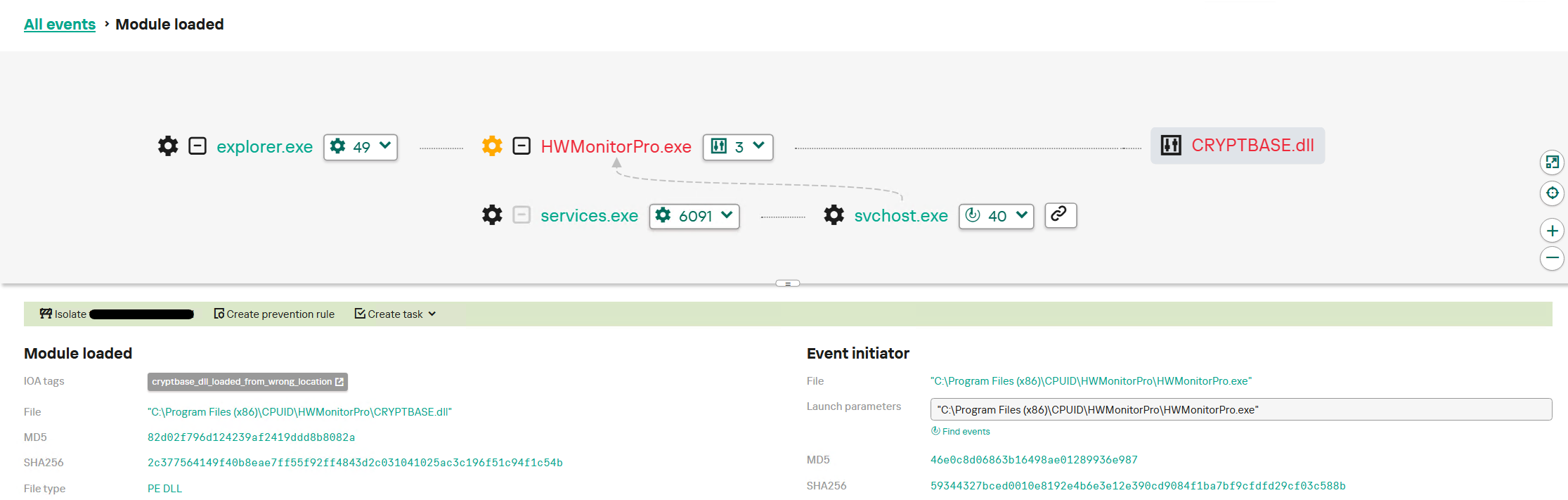
Loading of unsigned module
During the creation of a PowerShell child process and redirection of its output to a pipe for writing the payload, several rules are triggered for AMSI and process started event types, which track pipe usage and execution of suspicious commands:
suspicious_powershell_command_invocation_obtained_via_pipe_amsi
suspicious_powershell_cmdline_general_obfuscation_amsi
suspicious_powershell_command_invocation_obtained_via_pipe
suspicious_powershell_cmdline_general_obfuscation
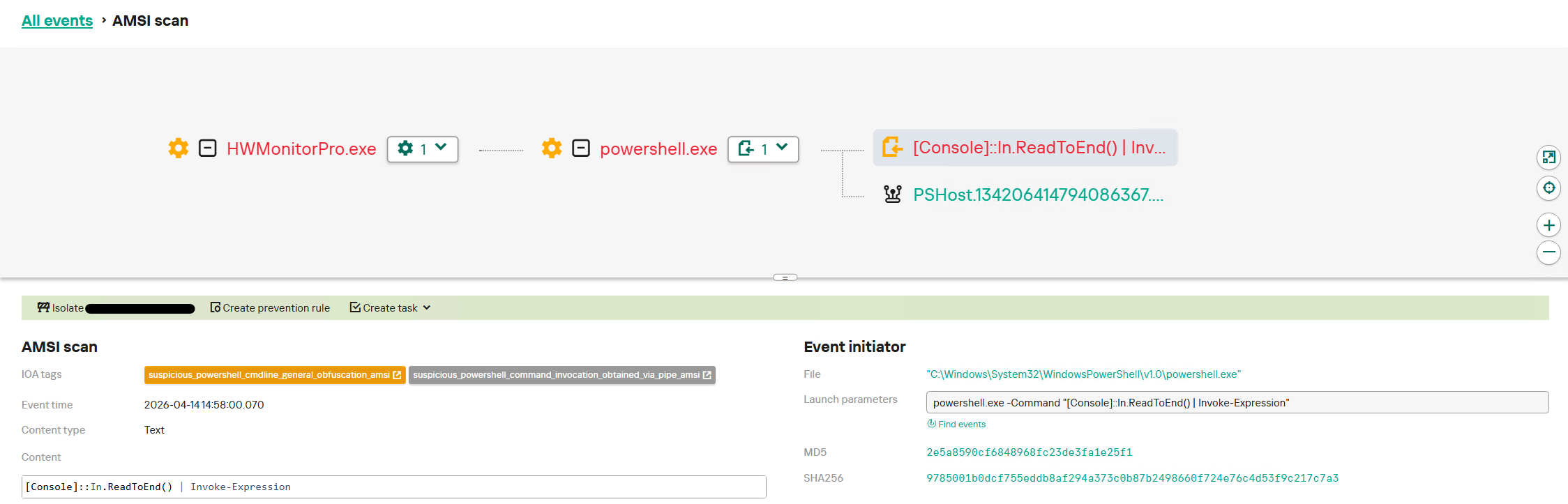
Child process creation
Attempts to access web browser data are detected by several rules, for example credentials_from_web_browsers, which tracks suspicious access to files storing user secrets.
For comprehensive analysis of the described malicious activity, Kaspersky Cloud Sandbox, part of Kaspersky Threat Analysis, can be used, providing detailed information about the behavior of malicious files under investigation. In particular, this tool allows identifying indicators of compromise based on behavioral analysis.
The figure below shows the Kaspersky Threat Analysis interface demonstrating dynamic analysis results for one of the STX RAT samples:
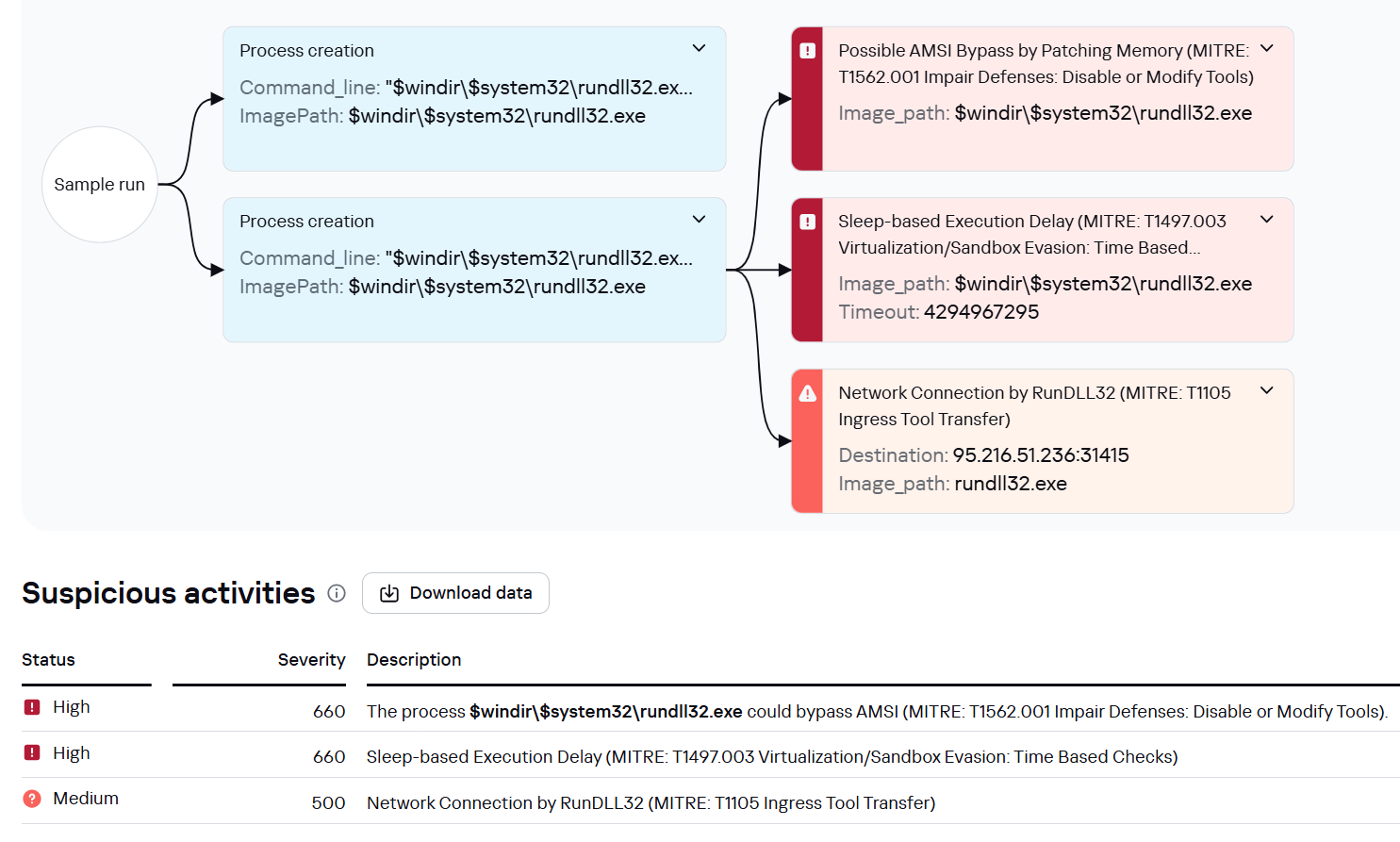
Malicious sample detonation in Kaspersky Cloud Sandbox
Based on dynamic analysis results, the analyzed sample was found to perform the following malicious actions:
- modifies AMSI to bypass antivirus protection (AMSI patching);
- establishes network connection with C2 server;
- introduces time delay for deferred payload execution.
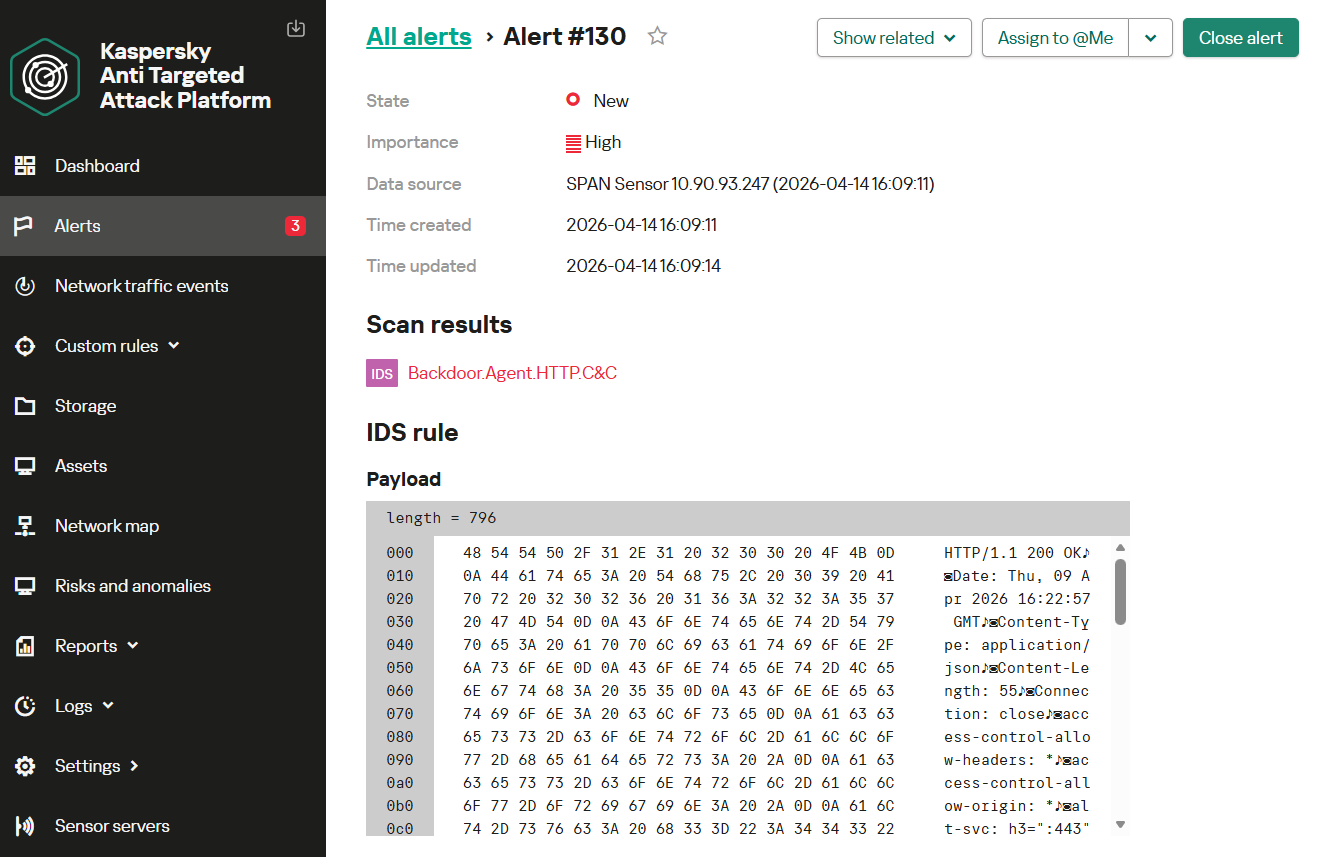
Network traffic monitoring to identify characteristic anomalies also remains a reliable way to detect such attacks. Malicious activity in traffic can be detected using Kaspersky Anti Targeted Attack (KATA) with NDR module
Below is the KATA NDR interface with an alert about detection of loader C2 communication via HTTP protocol. In this case, the Backdoor.Agent.HTTP.C&C rule was triggered, which detects network communication characteristic of this campaign.
Conclusion
Compared to other recently occurred watering hole and supply chain attacks, such as the Notepad++ supply chain attack, the attack on the cpuid.com website was orchestrated quite poorly. The gravest mistake attackers made was to reuse the same infection chain involving STX RAT, and the same domain names for C2 communication, from the previous attack related to fake FileZilla installers. The overall malware development/deployment and operational security capabilities of the threat actor behind this attack is quite low, which, in turn, made it possible to detect the watering hole compromise as soon as it started.
Indicators of Compromise
Hashes of downloaded malicious files
d0568eaa55f495fd756fa205997ae8d93588d2a2 cpu-z_2.19-en.zip
02a53d660332c25af623bbb7df57c2aad1b0b91b hwinfo_monitor_setup.exe
9253111b359c610b5f95ef33c2d1c06795ab01e9 HWMonitorPro_1.57_Setup.exe
2f717a77780b8f6b2d853dc4df5ed2b90a3a349a hwmonitor-pro_1.57.zip
7c615ce495ac5be1b64604a7c145347adbcd900c hwmonitor_1.63.zip
c417c3a4b094646d06a06103639a5c9faabc9ba4 hwmonitor_1.63.zip
8351a43a0c0455e4b0793d841fe12625f072f9b4 PerfMonitor2_Setup.exe
6a71656c289201f742787f48398056fcd2aa7274 perfmonitor-2_2.04.zip
Hashes of malicious DLLs
24bbfcfea0c79f640a4eec99ffdae3ccd315786 CRYPTBASE.dll
c65e515b9c9655c651c939b94574cf39b40a8be2 CRYPTBASE.dll.bin
3041a4e2bc5ccefbfd2222a9e23614fb79d6db63 CRYPTBASE.dll
4e3195399a9135247e55781ad13226c6b0e86c0d CRYPTBASE.dll
4597f546a622ae55e0775cbcc416b3f1dfd096ce CRYPTBASE.dll
a06955d253711385eaa6f5af76fa9fa47bdeb1e9 CRYPTBASE.dll
6b49823483889bc1ad152a1be52d1385c4e0affb CRYPTBASE.dll
3041a4e2bc5ccefbfd2222a9e23614fb79d6db63 CRYPTBASE.dll
c65e515b9c9655c651c939b94574cf39b40a8be2 CRYPTBASE.dll
4f3d8c47239bd1585488ce431d931457f101104c CRYPTBASE.dll
ba19e03ca03785e89010672d7e273ac343e4699a CRYPTBASE.dll
e2464454017cd02a8bc6744596c384cf91cdd67e CRYPTBASE.dll CRYPTBASE.dll
URLs
hxxps://welcome.supp0v3[.]com
hxxps://cahayailmukreatif.web[.]id/sw-content/template/hwmonitor/hwinfo_monitor_setup.exe
hxxps://pub-45c2577dbd174292a02137c18e7b1b5a.r2[.]dev/perfmonitor/perfmonitor-2_2.04.zip
hxxps://pub-45c2577dbd174292a02137c18e7b1b5a.r2[.]dev/perfmonitor/PerfMonitor2_Setup.exe
hxxps://pub-45c2577dbd174292a02137c18e7b1b5a.r2[.]dev/hwmonitor-pro/hwmonitor-pro_1.57.zip
hxxps://pub-45c2577dbd174292a02137c18e7b1b5a.r2[.]dev/hwmonitor_1.63.zip
hxxps://pub-45c2577dbd174292a02137c18e7b1b5a.r2[.]dev/hwmonitor/hwinfo_monitor_setup.exe
hxxps://pub-45c2577dbd174292a02137c18e7b1b5a.r2[.]dev/cpu-z_2.19-en.zip
hxxps://pub-45c2577dbd174292a02137c18e7b1b5a.r2[.]dev/hwmonitor-pro/hwmonitorpro_1.57_setup.exe
hxxps://transitopalermo[.]com/config/hwmonitor/hwmonitor_1.63.zip
hxxps://transitopalermo[.]com/config/hwmonitor-pro/hwmonitorpro_1.57_setup.exe
hxxps://transitopalermo[.]com/config/hwmonitor/HWiNFO_Monitor_Setup.exe
hxxps://vatrobran[.]hr/en-GB/info/hwmonitor/hwmonitor_1.63.zip
hxxps://vatrobran[.]hr/en-GB/info/cpu-z/cpu-z_2.19-en.zip
hxxps://vatrobran[.]hr/en-gb/info/hwmonitor/hwinfo_monitor_setup.exe
hxxps://vatrobran[.]hr/en-GB/info/hwmonitor-pro/HWMonitorPro_1.57_Setup.exe
如有侵权请联系:admin#unsafe.sh