2026-04-10
6 min read

Cloudflare’s global network and backbone in 2026.
Cloudflare's network recently passed a major milestone: we crossed 500 terabits per second (Tbps) of external capacity.
When we say 500 Tbps, we mean total provisioned external interconnection capacity: the sum of every port facing a transit provider, private peering partner, Internet exchange, or Cloudflare Network Interconnect (CNI) port across all 330+ cities. This is not peak traffic. On any given day, our peak utilization is a fraction of that number. (The rest is our DDoS budget.)
It’s a long way from where we started. In 2010, we launched from a small office above a nail salon in Palo Alto, with a single transit provider and a reverse proxy you could set up by changing two nameservers.
The early days of transit and peering
Our first transit provider was nLayer Communications, a network most people now know as GTT. nLayer gave us our first capacity and our first hands-on company experience in peering relationships and the careful balance between cost and performance.
From there, we grew city by city: Chicago, Ashburn, San Jose, Amsterdam, Tokyo. Each new data center meant negotiating colocation contracts, pulling fiber, racking servers, and establishing peering through Internet exchanges. The Internet isn't actually a cloud, of course. It is a collection of specific rooms full of cables, and we spent years learning the nuances of every one of them.
Not every city was a straightforward deployment, having to deal with missing hardware, customs strikes, and even dental floss. In a single month in 2018, we opened up in 31 cities in 24 days: from Kathmandu and Baghdad to Reykjavík and Chișinău. When we opened our 127th data center in Macau, we were protecting 7 million Internet properties. Today, with data centers in 330+ cities, we protect more than 20% of the web.
When the network became the security layer
As our footprint grew, customers asked for more than just website caching. They needed to protect employees, replace aging Multiprotocol Label Switching (MPLS) circuits, and secure entire enterprise networks. Instead of traditional appliances, we built systems to establish secure tunnels to private subnets and advertise enterprise IP space directly from our global network via BGP.
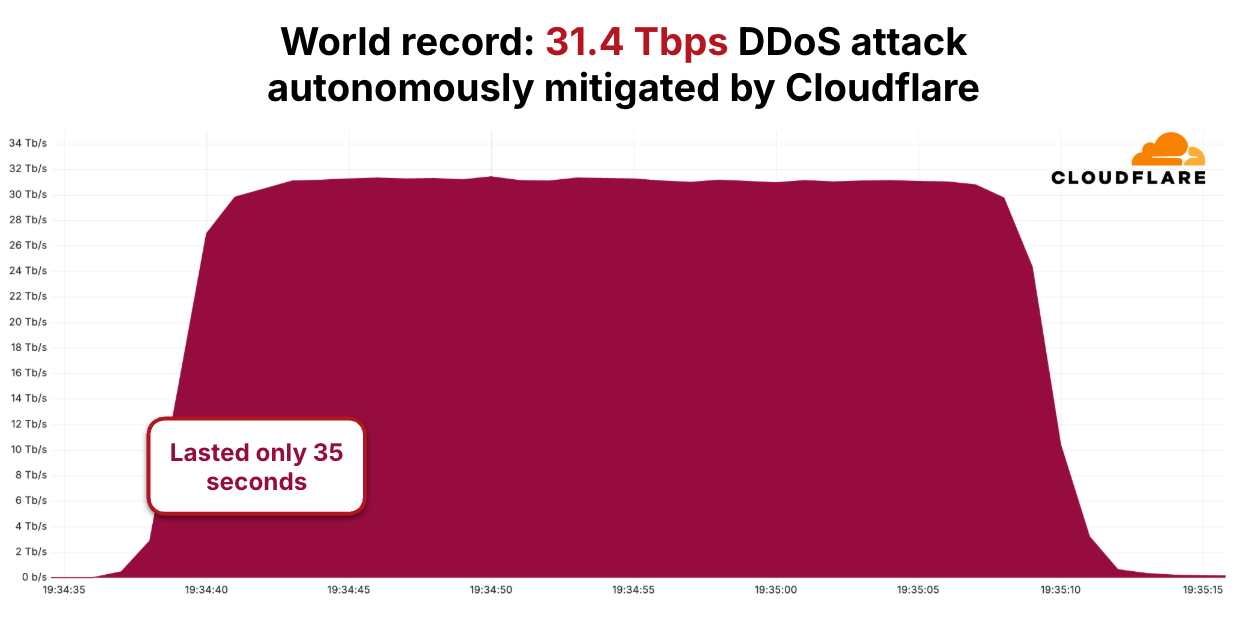
The scale of threats grew in parallel. In 2025, we mitigated a 31.4 Tbps DDoS attack lasting 35 seconds. The source was the Aisuru-Kimwolf botnet, including many infected Android TVs. It was one of over 5,000 attacks we blocked that day. No engineer was paged.

A decade ago, an attack of that magnitude would have required nation-state resources to counter. Today, our network handles it in seconds without human intervention. That is what operating at a 500 Tbps scale requires: moving the intelligence to every server in our network so the network can defend itself.
How our network responds to an attack
Here is what actually happens when an attack hits our network. Packets arrive at the network interface card (NIC) and immediately enter an eXpress Data Path (XDP) program chain managed by xdpd, running in driver mode. Among the first programs in that chain is l4drop, which evaluates each packet against mitigation rules in extended Berkeley Packet Filter (eBPF). Those rules are generated by dosd, our denial of service daemon, which runs on every server in our fleet. Each dosd instance samples incoming traffic, builds a table of the heaviest hitters it sees, and broadcasts that table to every other instance in the colo. The result is a shared colo-wide view of traffic, and because every server works from the same data, they reach the same mitigation decision.

When dosd detects an attack pattern, the resulting rule is applied locally via l4drop and propagates globally via Quicksilver, our distributed key-value (KV) store, reaching every server in every data center within seconds. Only after surviving l4drop do packets reach Unimog, our Layer 4 (L4) load balancer, which distributes them across healthy servers in the data center. For Magic Transit customers routing enterprise network traffic through our edge, flowtrackd adds a further layer of stateful TCP inspection, tracking connection state and dropping packets that don't belong to legitimate flows.
The 31.4 Tbps attack we mitigated followed exactly this path. No traffic was backhauled to a centralized scrubbing center. No human intervened. Every server in the targeted data centers independently recognized the attack and began dropping malicious packets at line rate, before those packets consumed a single CPU cycle of application processing. The software is only half the story: none of it works if the ports aren't there to absorb the traffic in the first place.
A distributed developer platform
Running code on every server in our network was a natural consequence of controlling the full stack. If we already ran eBPF programs on every machine to drop attack traffic, we could run customer application code there too. That insight became Workers, and later KV and Durable Objects.
Our developer platform runs in every city we operate in, not in a handful of cloud regions. In 2025, we added Containers to Workers, so heavier workloads can run at the edge too. V8 isolates and custom filesystem layers minimize cold starts. Your code runs where your users are, on the same servers that drop attack traffic at line rate via l4drop. Attack traffic is dropped before it reaches the network stack. Your application never sees it.
Forward-looking protocols: IPv6, RPKI, ASPA
We were early adopters of IPv6 and Resource Public Key Infrastructure (RPKI). BGP hijacks cause real outages and security breaches. RPKI allows us to drop invalid routes from peers, ensuring traffic goes where it is supposed to. We sign Route Origin Authorizations (ROAs) for our prefixes and enforce Route Origin Validation on ingress. We reject RPKI-invalid routes, even when that occasionally breaks reachability to networks with misconfigured ROAs.
Autonomous System Provider Authorization (ASPA) is next. RPKI validates who owns a prefix. ASPA validates the path it took to get here. RPKI is a passport check at the destination, confirming the right owner, while ASPA is a flight manifest check: it verifies every network the traffic passed through. A route leak is like a passenger who boarded in the wrong city; RPKI would not catch it, but ASPA will.
Current ecosystem adoption for ASPA looks like RPKI did in 2015. We were one of the first networks to deploy RPKI at scale, and today, 867,000 prefixes in the global routing table have valid RPKI certificates, up from near zero a decade ago. At our scale, the protocols we choose have real consequences for the broader Internet. We push for adoption early because waiting means more hijacks and more leaks in the meantime.
AI agents and the evolving Internet
AI has changed what it means to have a presence on the web. For most of the Internet’s history, traffic was human-generated, by people clicking links in browsers. Today, AI crawlers, model training pipelines, and autonomous agents now account for more than 4% of all HTML requests across our network, comparable to Googlebot itself. "User action" crawling, where an AI visits a page because a human asked it a question, grew over 15x in 2025 alone.
AI crawlers behave differently than browsers at the infrastructure level. Browsers load a page and stop. Crawlers instead fetch every linked resource at maximum throughput with no pause between requests. At our scale, distinguishing legitimate AI crawling from actual attacks is a real engineering problem. Our detection systems use a combination of verified bot IP ranges, TLS fingerprinting, behavioral analysis, and robots.txt compliance signals to make that distinction, and to give site owners the data they need to decide which crawlers to allow.
At the TLS layer, for example, a legitimate browser presents a ClientHello with a predictable set of cipher suites, extensions, and ordering that matches its declared User-Agent. A crawler spoofing that User-Agent but using a stripped-down TLS library will present a different fingerprint, and that mismatch is one of the signals our systems use to classify the request before it reaches the origin.
Help us build the next 500 Tbps
What started above a nail salon in Palo Alto is now a 500 Tbps network in 330+ cities across 125+ countries, where every server runs our developer platform and security services, not just cache. That is sixteen years of architectural decisions compounding, and we owe it to the 13,000+ networks and partners who peer with us. We are not done.
If you are a network operator, peer with us. Our peering policy and interconnection details are on PeeringDB. If you are interested in embedding Cloudflare infrastructure directly within your network, reach out to our team at [email protected], to join the Edge Partner Program.
Cloudflare's connectivity cloud protects entire corporate networks, helps customers build Internet-scale applications efficiently, accelerates any website or Internet application, wards off DDoS attacks, keeps hackers at bay, and can help you on your journey to Zero Trust.
Visit 1.1.1.1 from any device to get started with our free app that makes your Internet faster and safer.
To learn more about our mission to help build a better Internet, start here. If you're looking for a new career direction, check out our open positions.