好的,我现在需要帮用户总结一篇关于恶意软件LucidRook的文章,控制在100字以内。首先,我要通读整篇文章,抓住关键点。 文章提到LucidRook是一种基于Lua的恶意软件,用于鱼叉式网络钓鱼攻击,目标是台湾的非政府组织和大学。由Cisco Talos研究人员发现,归因于威胁组织UAT-10362。攻击手段包括带有密码保护存档的钓鱼邮件,使用LNK快捷方式和EXE文件作为感染链。 恶意软件采用模块化设计,内置Lua环境,允许动态更新功能并隐藏痕迹。此外,数据收集后通过加密和FTP外泄。研究人员还发现了相关工具LucidKnight,利用Gmail进行数据外泄。 总结时要涵盖恶意软件名称、攻击目标、攻击手段、技术特点以及数据外泄方式。确保内容简洁明了,不超过100字。 </think> 一种名为LucidRook的新Lua恶意软件被用于针对台湾非政府组织和大学的鱼叉式网络钓鱼攻击。该恶意软件由威胁组织UAT-10362开发,通过伪装政府文件或使用虚假杀毒软件进行传播。其模块化设计和Lua环境使其能够动态更新功能并隐藏痕迹。攻击者利用加密和FTP外泄收集的数据,并开发了相关工具如LucidKnight进行侦察活动。 2026-4-9 22:16:27 Author: www.bleepingcomputer.com(查看原文) 阅读量:14 收藏

A new Lua-based malware, called LucidRook, is being used in spear-phishing campaigns targeting non-governmental organizations and universities in Taiwan.
Cisco Talos researchers attribute the malware to a threat group tracked internally as UAT-10362, who they describe as a capable adversary "with mature operational tradecraft."
LucidRook was observed in attacks in October 2025 that relied on phishing emails carrying password-protected archives.

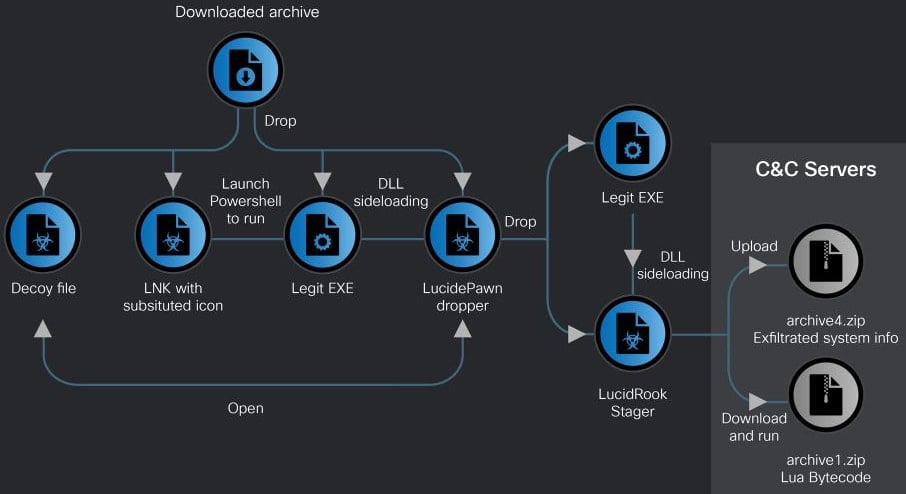
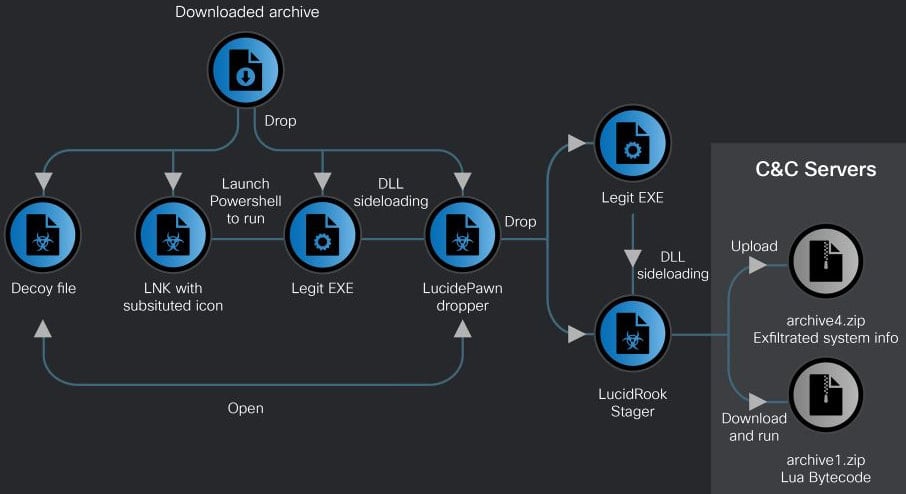
The researchers identified two infection chains, one using an LNK shortcut file that ultimately delivered a malware dropper called LucidPawn, and an EXE-based chain that leveraged a fake antivirus executable impersonating Trend Micro Worry-Free Business Security Services.
The LNK-based attack employs decoy documents, such as government letters crafted to appear as if they originate from the Taiwanese government, to divert the user's attention.
Source: Cisco Talos
Cisco Talos observed that LucidPawn decrypts and deploys a legitimate executable renamed to mimic Microsoft Edge, along with a malicious DLL (DismCore.dll) for sideloading LucidRook.
LucidRook is notable for its modular design and built-in Lua execution environment, which allows it to retrieve and execute second-stage payloads as Lua bytecode.
This approach enables operators to update functionality without modifying the core malware, while also limiting forensic visibility. This stealth is further increased by extensive obfuscation of the code.
“Embedding the Lua interpreter effectively turns the native DLL into a stable execution platform while allowing the threat actor to update or tailor behavior for each target or campaigns by updating the Lua bytecode payload with a lighter and more flexible development process,” Cisco Talos explains.
“This approach also improves operational security, since the Lua stage can be hosted only briefly and removed from C2 after delivery, and it can hinder post-incident reconstruction when defenders recover only the loader without the externally delivered Lua payload.”
Talos also notes that the binary is heavily obfuscated across embedded strings, file extensions, internal identifiers, and C2 addresses, complicating any reverse-engineering efforts.
During its execution, LucidRook performs system reconnaissance, collecting information such as user and computer names, installed applications, and running processes.
The data is encrypted using RSA, stored in password-protected archives, and exfiltrated to attacker-controlled infrastructure via FTP.
While examining LucidRook, Talos researchers identified a related tool named “LucidKnight,” which is likely used for reconnaissance.
One notable characteristic of LucidKnight is its abuse of Gmail GMTP to exfiltrate collected data, suggesting that UAT-10362 maintains a flexible toolkit to meet varying operational needs.
Cisco Talos concludes with medium confidence that the LucidRook attacks are part of a targeted intrusion campaign. However, they were unable to capture a decryptable Lua bytecode fetched by LucidRook, so the specific actions taken post-infection aren’t known.

Automated Pentesting Covers Only 1 of 6 Surfaces.
Automated pentesting proves the path exists. BAS proves whether your controls stop it. Most teams run one without the other.
This whitepaper maps six validation surfaces, shows where coverage ends, and provides practitioners with three diagnostic questions for any tool evaluation.
如有侵权请联系:admin#unsafe.sh