
嗯,用户让我帮忙总结一篇文章的内容,控制在一百个字以内,而且不需要特定的开头。首先,我需要仔细阅读这篇文章,抓住主要信息。 文章讲的是一个国际执法行动,联合私营公司,破坏了APT28的FrostArmada活动。APT28又叫Fancy Bear,和俄罗斯军方有关。他们通过劫持MikroTik和TP-Link路由器的本地流量,窃取微软账户凭证。 攻击者主要针对SOHO路由器,篡改DNS设置,将流量导向他们控制的VPS服务器。这样他们就能拦截认证流量,窃取微软登录信息和OAuth令牌。高峰期感染了18,000台设备,涉及120个国家。 微软和Black Lotus Labs合作追踪恶意活动,并在FBI、司法部和波兰政府的支持下关闭了攻击基础设施。 总结的时候要注意字数限制,所以要简洁明了。可能需要提到APT28、攻击手段、影响范围以及国际合作等方面。 最后确保语言流畅自然,不使用复杂的术语,让用户容易理解。 </think> 国际执法机构与私营企业合作破坏了俄罗斯网络间谍组织APT28的FrostArmada活动。该活动通过劫持MikroTik和TP-Link路由器的本地流量窃取微软账户凭证。攻击者篡改DNS设置将流量导向恶意服务器,在高峰期感染18,000台设备并影响120个国家。 2026-4-7 16:0:26 Author: www.bleepingcomputer.com(查看原文) 阅读量:22 收藏

An international operation from law enforcement authorities in partnership with private companies has disrupted FrostArmada, an APT28 campaign hijacking local traffic from MikroTik and TP-Link routers to steal Microsoft account credentials.
The Russian threat group APT28, also tracked as Fancy Bear, Sofacy, Forest Blizzard, Strontium, Storm-2754, and Sednit, has been linked to Russia's General Staff Main Intelligence Directorate (GRU) 85th Main Special Service Center (GTsSS) military unit 26165.
In the FrostArmada attacks, the hackers compromised mainly small office/home office (SOHO) routers and altered the domain name system (DNS) settings to point to virtual private servers (VPS) under their control, which acted as DNS resolvers.

This allowed APT28 to intercept authentication traffic to targeted domains and steal Microsoft logins and OAuth tokens.
At its peak in December 2025, FrostArmada infected 18,000 devices across 120 countries, primarily targeting government agencies, law enforcement, IT and hosting providers, and organizations operating their own servers.
Microsoft, whose services were targeted by this campaign, worked together with Black Lotus Labs (BLL), Lumen's threat research and operations division, to map the malicious activity and identify victims.
With support from the FBI, the U.S. Department of Justice, and the Polish government, the offending infrastructure has been taken offline.
FrostArmada activity
The attackers targeted internet-exposed routers, primarily MikroTik and TP-Link, as well as some firewall products from Nethesis and older Fortinet models.
Once compromised, the devices communicated with the attackers’ infrastructure and received DNS configuration changes that redirected traffic to malicious VPS nodes.
The new DNS settings were automatically pushed to internal devices via the Dynamic Host Configuration Protocol (DHCP).
When clients queried authentication-related domains the threat actor targeted, the DNS server returned the attacker’s IP instead of the real one, redirecting victims to an adversary-in-the-middle (AitM) proxy.
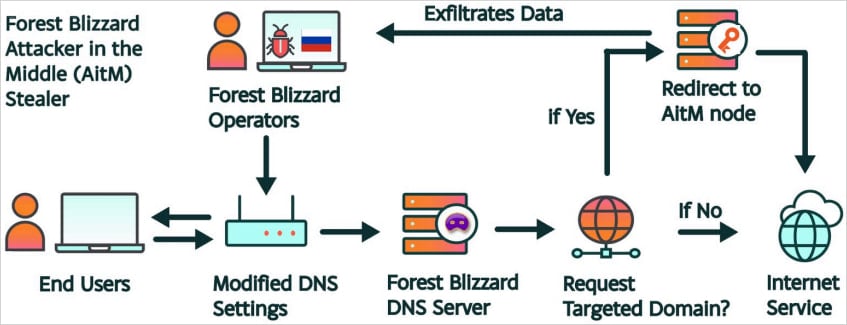
Source: Black Lotus Labs
The only visible sign of fraud for the victim would have been a warning for an invalid TLS certificate, which could have easily been dismissed. However, ignoring the alert gave the threat actor access to the victim's unencrypted internet communication.
“The actor essentially ran a proxy service as the AitM that the end user was directed to via DNS,” Lumen's Black Lotus Labs researchers explain.
“The only sign of this attack would be a pop-up warning about connecting to an untrusted source because of the 'break and inspect' configuration.”
“If warnings were present and ignored or clicked through, the actor proxied requests to the legitimate services, collecting the data at the midpoint and collecting data associated with the targeted account by passing the valid OAuth token.”
In some cases, though, the hackers spoofed DNS responses for certain domains, thus forcing affected endpoints to connect to the attack infrastructures, Microsoft says in a report today.
Lumen reports that FrostArmada operated in two distinct clusters, one called the 'Expansion team' dedicated to device compromise and botnet growth, and the second handling the AiTM and credential collection operations.
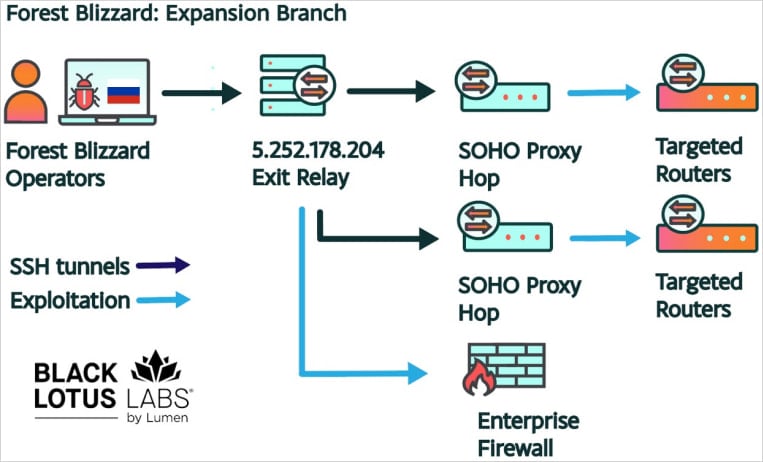
Source: Black Lotus Labs
The researchers report that FrostArmada activity increased sharply following an August 2025 report from the National Cyber Security Centre (NCSC) in the UK describing a Forest Blizzard toolset that targeted Microsoft account credentials and tokens.
Microsoft confirmed that APT28 carried out AitM attacks against domains associated with the Microsoft 365 service, as subdomains for Microsoft Outlook on the web have also been targeted.
Additionally, the company observed this activity on servers belonging to three government organizations in Africa that were not hosted on Microsoft infrastructure. In those attacks, "Forest Blizzard intercepted DNS requests and conducted follow-on collection."
Black Lotus Labs also observed the threat actor targeting entities with on-premise email servers and "a small number of government organizations" in North Africa, Central America, and Southeast Asia.
The researchers note that "there was also a connection to a national identity platform in one European country."
In a report today, the UK agency says that the AitM activity impacted both browser sessions and desktop applications, and the DNS hijacking is believed to have been opportunistic in nature to build a large pool of potential targets and then filtering those of interest.
Black Lotus Labs has published a small set of indicators of compromise for the VPS servers used during the FrostArmada campaign:
| IP address | First Seen | Last Seen |
|---|---|---|
| 64.120.31[.]96 | May 19, 2025 | March 31, 2026 |
| 79.141.160[.]78 | July 19, 2025 | March 31, 2026 |
| 23.106.120[.]119 | July 19, 2025 | March 31, 2026 |
| 79.141.173[.]211 | July 19, 2025 | March 31, 2026 |
| 185.117.89[.]32 | September 9, 2025 | September 9, 2025 |
| 185.237.166[.]55 | December 30, 2025 | December 30, 2025 |
The researchers note that defenders should implement certificate pinning for corporate devices (laptops, mobile phones) controlled via an MDM solution, which would generate an error when the attacker tries to intercept and analyze traffic on their VPS infrastructure.
Another recommendation is to minimize the attack surface through patching, limiting exposure on the public web, and removing all end-of-life equipment.
Microsoft and the NCSC also provide a list of IoCs and protection guidance to help defenders identify and prevent DNS hijacking attacks.

Automated Pentesting Covers Only 1 of 6 Surfaces.
Automated pentesting proves the path exists. BAS proves whether your controls stop it. Most teams run one without the other.
This whitepaper maps six validation surfaces, shows where coverage ends, and provides practitioners with three diagnostic questions for any tool evaluation.
如有侵权请联系:admin#unsafe.sh