By Diana Brown
- Cisco Talos has recently observed an increase in activity that is leveraging notification pipelines in popular collaboration platforms to deliver spam and phishing emails.
- These emails are transmitted using the legitimate mail delivery infrastructure associated with GitHub and Jira, minimizing the likelihood that they will be blocked in transit to potential victims.
- By taking advantage of the built-in notification functionality available within these platforms, adversaries can more effectively circumvent email security and monitoring solutions and facilitate more effective delivery to potential victims.
- In most cases, these campaigns have been associated with phishing and credential harvesting activity, which is often a precursor to additional attacks once credentials have been compromised and/or initial access has been achieved.
- During one campaign conducted on Feb. 17, 2026, approximately 2.89% of the emails observed being sent from GitHub were likely associated with this abuse activity.
Platform abuse, social engineering, and SaaS notification hijacking
Recent telemetry indicates an increase in threat actors leveraging the automated notification infrastructure of legitimate Software-as-a-Service (SaaS) platforms to facilitate social engineering campaigns. By embedding malicious lures within system-generated commit notifications, attackers bypass traditional reputation-based email security filters. This Platform-as-a-Proxy (PaaP) technique exploits the implicit trust organizations place in traffic originating from verified SaaS providers, effectively weaponizing legitimate infrastructure to bypass standard email authentication protocols. Talos' analysis explores how attackers abuse the notification pipelines of platforms like GitHub and Atlassian to facilitate credential harvesting and social engineering.
The PaaP model
The core of this campaign relies on the abuse of SaaS features to generate emails. Because the emails are dispatched from the platform's own infrastructure, they satisfy all standard authentication requirements (SPF, DKIM, and DMARC), effectively neutralizing the primary gatekeepers of modern email security. By decoupling the malicious intent from the technical infrastructure, attackers successfully deliver phishing content with a "seal of approval" that few security gateways are configured to challenge.
Anatomy of GitHub campaign: Abusing automated notification pipelines
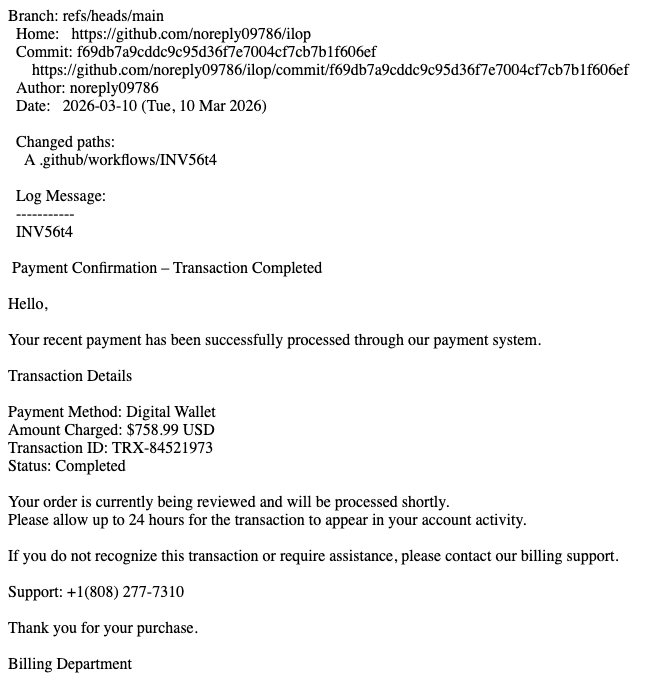
The GitHub vector is a pure "notification pipeline" abuse mechanism. Attackers create repositories and push commits with payloads embedded in the commit messages. The User Interface Mechanism has two fields for text input: one is a mandatory summary, a single limited line, where the user provides a high-level overview of the change. Attackers weaponize this field to craft the initial social engineering hook, ensuring the malicious lure is the most prominent element of the resulting automated notification. The second field is an optional, extended description that allows for multi-line, detailed explanations. Attackers abuse this to place the primary scam content, such as fake billing details or fraudulent support numbers.

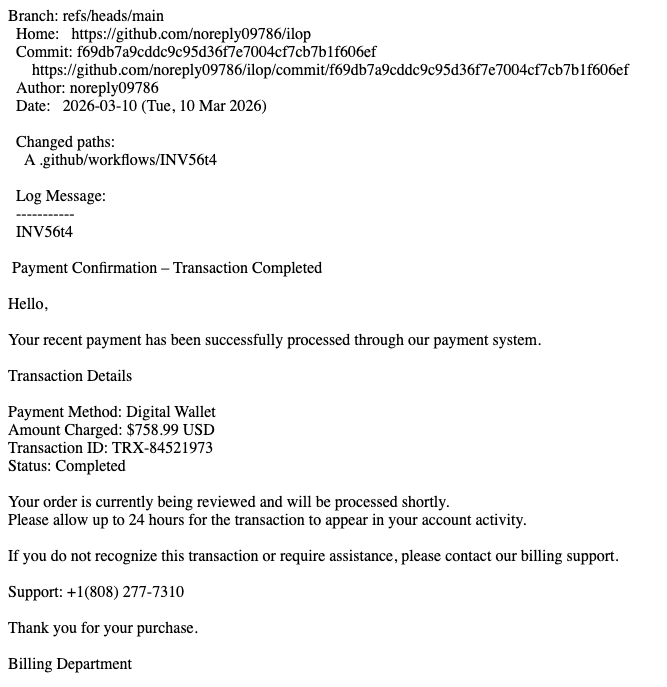
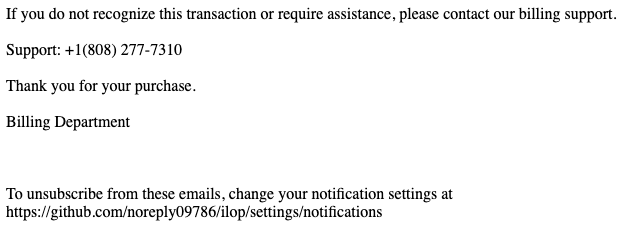
By pushing a commit, the attacker triggers an automatic email notification. GitHub’s system is configured to notify collaborators of repository activity. Because the content is generated by the platform’s own system, it avoidssecurity flags. In this example, we can see the details of the commit followed by the scam message. At the bottom of the email, we have the mention of the subscription, buried at the very bottom of the page.
The chain of Received headers shows the message entering the system from “out-28[.]smtp[.]github[.]com” (IP “192[.]30[.]252[.]211”). This is a known legitimate and verified GitHub SMTP server.

The email contains a DKIM-Signature with “d=github[.]com”. This signature was successfully verified by the receiving server (“esa1[.]hc6633-79[.]iphmx[.]com”), proving that the email was sent by an authorized GitHub system and was not tampered with in transit. Telemetry collected over a five-day observation period indicates that 1.20% of the total traffic originating from “noreply[@]github[.]com” contained the "invoice" lure in the subject line. On the peak day of Feb. 17, 2026, this volume spiked to approximately 2.89% of the daily sample set.
Abusing workflow and invitation logic (Jira)
The Jira vector does not rely on a notification pipeline in the traditional sense. Jira notifications are expected in corporate environments. An email from Atlassian is rarely blocked, as it is often critical for internal project management and IT operations. The abuse here is not a "pipeline" of activity, but an abuse of the collaborative invitation feature.
Attackers do not have access to modify the underlying HTML/CSS templates of Atlassian’s emails. Instead, they abuse the data fields that the platform injects into those templates. When an attacker creates a Jira Service Management project, they are given several fields to configure. When the platform triggers an automated “Customer Invite” or “Service Desk” notification, it automatically wraps the attacker’s input — such as a fraudulent project name or a deceptive welcome message — within its own cryptographically signed, trusted email template. By utilizing a trusted delivery pipeline, the attacker successfully obscures the origin and intent of the malicious.
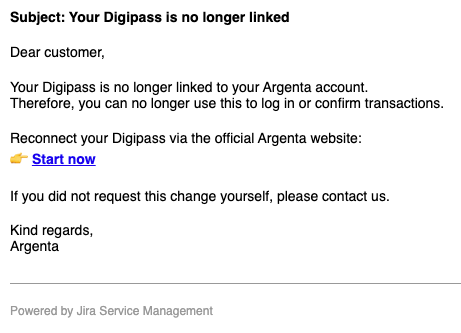
In this example, the attacker sets the "Project Name" to "Argenta." When the platform sends an automated invite, the email subject and body dynamically pull the project name. The recipient sees "Argenta" as the sender or the subject, which the platform has verified as the project name.
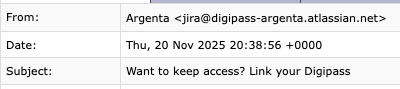
The attacker placed their malicious lure subject into the "Welcome Message" or "Project Description" field. They use the "Invite Customers" feature and input the victim's email address. Atlassian’s backend then generates the email. Because the system is designed to be a "Service Desk," the email is formatted to look like a professional, automated system alert. At the bottom of the phishing email, we can see the branding footer that Jira automatically appends to email notifications.
Strategic implications
The trust paradox is now the primary driver of successful phishing and scamming. GitHub is abused primarily for its high developer reputation, where attackers rely on the platform’s status as an official source of automated alerts. In contrast, Jira is abused for its business-critical integration; because it is a trusted enterprise tool, attackers use it to mimic internal IT and helpdesk alerts, which employees are pre-conditioned to treat as urgent and legitimate. In both cases, attackers are using the platform's own reputation to launder their malicious content.
How do we fundamentally change the trust model?
Defending against PaaP attacks requires moving from the binary “trusted vs. untrusted” approach. Because attackers weaponize the platform’s own infrastructure to bypass authentication protocols (SPF/DKIM/DMARC), the gateway is effectively blind to the malicious intent. Defenders should transition to a Zero-Trust architecture that treats SaaS notifications as untrusted traffic until verified against platform-level telemetry. Moving beyond the limitations of the email gateway and adopt a fundamental paradigm shift: transitioning from reactive, signature-based filtering toward a proactive, API-driven model architecture that validates intent before a notification ever reaches the user.
Identity and instance-level verification: We must move from "global domain trust" to "instance-level authorization." Security teams should restrict notification acceptance to specific sender addresses or IP ranges associated with their organization’s verified SaaS instances. Furthermore, by implementing Identity-Contextualization, notifications must be cross-referenced against the organization's internal SaaS directory. If a notification originates from an external or unverified account — even one hosted on a trusted platform like GitHub — it should be automatically quarantined. Verification is no longer about the server sending the email; it is about the identity of the user triggering the action.
Upstream API-level monitoring: The most effective way to disrupt PaaP campaigns is to detect them before the notification is ever sent. Attackers must perform "precursor activities" within the platform — such as creating repositories, configuring project names, or mass-inviting users — to set the stage for their cyber-attack. By ingesting metadata from SaaS APIs (e.g., GitHub or Atlassian audit logs) into a SIEM/SOAR environment, security teams can identify these anomalous events in real-time. Detecting a "Project Creation" event that deviates from established naming conventions, originating from a country where the receiving organization has no employees or occurs outside of business hours allows for the preemptive suspension of the malicious account, neutralizing the threat at the source. Instead of waiting for a phishing email to arrive in an inbox, defenders are watching the attacker’s movements inside the platform as they set up the attack.
Semantic intent and behavioral profiling: We must replace simple keyword matching with Business Logic Profiling. Every sanctioned SaaS tool has a functional "Communication Baseline." GitHub is for code collaboration; Jira is for project management. By defining these baselines, security teams can detect "semantic discontinuity," when the content of a notification (e.g., urgent financial billing) is incongruent with the platform's primary utility. Any notification that deviates from the expected functional profile should trigger an automated "Suspicious" banner or be routed for manual review, regardless of its technical validity.
Mitigating cognitive automation fatigue: PaaP attacks exploit "automation fatigue," where users are conditioned to trust system-generated alerts. To break this cycle, organizations can introduce intentional friction. For high-risk SaaS interactions, such as new project invitations or requests for sensitive data, security policies should mandate out-of-band verification. By requiring a platform-native verification code or forcing the user to navigate directly to the official portal rather than clicking a link, we remove the "reflexive trust" that attackers rely on. This ensures that the platform’s "seal of approval" is validated by a deliberate human action.
Automated takedown orchestration: Finally, the cost of attack must be increased. Security teams should integrate automated workflows that report malicious repositories or projects directly to the provider’s Trust andSafety teams. By accelerating the detection-to-takedown lifecycle, we force adversaries to constantly churn their infrastructure, making the PaaP model technically and economically unsustainable.
By adopting this framework, the security posture evolves from "Is this email authenticated?" to "Is this platform activity authorized and consistent with our business logic?" This shift effectively strips the trusted status that attackers exploit, forcing them to operate within an environment where their actions are monitored, profiled, and verified at every stage of the pipeline.
Acknowledgements
Special thanks to the Talos Email Security Research Team — Dev Shah, Lucimara Borges, Bruno Antonino, Eden Avivi, Marina Barsegyan, Barbara Turino Jones, Doaa Osman, Yosuke Okazaki, and Said Toure — for their collaborative effort in identifying and mitigating these platform abuse vectors.
Indicators of compromise (IOCs)
IOCs for this threat can be found on our GitHub repository here.