嗯,用户让我帮忙总结一篇文章,控制在100字以内,而且不需要特定的开头。首先,我需要通读整篇文章,抓住主要观点。 文章主要讲的是企业安全运营中心(SOC)每天处理大量安全警报,但手动处理效率低下,导致很多警报未被调查。这不仅造成了资源浪费,还导致分析师压力大、离职率高。然后文章介绍了D3 Morpheus AI这个平台,它通过自动化处理警报,让分析师可以专注于更有价值的工作,比如威胁狩猎和战略咨询。 接下来,我需要把这些信息浓缩到100字以内。要确保涵盖问题、解决方案和结果。可能的结构是:问题现状、AI解决方案、带来的好处。 还要注意用词简洁准确。比如“每天4400多个警报”、“手动处理耗时”、“AI自动处理”、“释放时间用于战略工作”等。 最后检查字数是否符合要求,并确保没有使用任何限制性的开头语句。 </think> 企业每天面临大量安全警报,手动处理效率低下,导致多数警报未被调查。D3 Morpheus AI通过自动化处理所有警报,释放分析师时间用于威胁狩猎和战略咨询等高价值工作。 2026-4-2 21:58:49 Author: securityboulevard.com(查看原文) 阅读量:3 收藏
The average enterprise SOC receives over 4,400 security alerts per day. Each one takes approximately 70 minutes to investigate manually. Run the math and you’ll find your team would need 5,231 analyst-hours per day to cover every alert. No organization staffs to that level. The result: two-thirds of alerts are never investigated, and 61% of SOC teams have ignored alerts later confirmed as genuine compromise.
This is a structural failure. And it’s destroying your best people.
The Triage Assembly Line Is Breaking Your Team
When analysts know they’re leaving threats on the table, stress compounds. Industry data confirms 71% of SOC analysts report burnout, and 64% are actively considering leaving the field within 12 months. With 4.8 million unfilled cybersecurity positions globally, every departure creates a hole that takes months to fill, at a cost exceeding $150,000 per replacement.
The cruel irony: organizations invest in hiring skilled analysts, then assign them to repetitive triage work that a purpose-built system could handle faster and more consistently. The talent shortage is a leverage problem.
What Changes When Autonomous Triage Absorbs the Volume
D3 Morpheus AI is an AI-autonomous Security Orchestration, Automation and Response (SOAR) platform that processes 100% of incoming alerts with L2-quality depth in under two minutes each. It absorbs the exhausting, repetitive triage work so analysts can redirect 3+ hours per day toward work that actually reduces organizational risk.
The platform is built on ten integrated capabilities that work as a unified system:
Purpose-Built Cybersecurity LLM
24 months of development by 60 specialists, including red teamers, data scientists, AI engineers, and SOC analysts. Purpose-built to understand attack propagation at a foundational level.
Attack Path Discovery
Multi-dimensional correlation: vertical (North-South) deep inspection into the alert’s origin tool + horizontal (East-West) correlation across the full security stack. L2-quality investigation in under 2 minutes.
Contextual Playbook Generation
Generates bespoke playbooks at runtime per incident. No static playbook authoring, versioning, or emergency updates when new attack variants appear.
Self-Healing Integrations
Detects API drift, schema changes, and detection output shifts across 800+ integrations. Generates corrective code autonomously. No more broken connectors during a shift.
AI Adaptive Tasking
Suggests investigative tasks on the fly based on alert data, user feedback, and completed task results. Grounded in full case context, proactively surfacing tasks without waiting to be asked.
AI SOP
Natural-language playbooks combining API calls, data processing, and AI agent tasks. Uses the Claude agent SDK with human-in-the-loop oversight for continuous quality improvement.
Customer-Expandable LLM
Customize the LLM for your environment, threat landscape, and SOC procedures. Full transparency: every reasoning step is reviewable, editable, and overridable by the analyst.
Built-In SOAR + Tool Consolidation
Full SOAR engine alongside autonomous AI. Run static and autonomous models side by side. Consolidates SOAR, case management, and AI tooling into one platform. Predictable pricing: no per-token fees.
The Analyst’s New Role: From Ticket Processor to Strategic Advisor
When Morpheus AI handles autonomous triage, each analyst recovers 3+ hours per day. For a 10-person team, that’s 7,800 hours per year of strategic capacity. Here’s where that time goes:
- AI Auditor: Review Morpheus AI’s investigation reports, validate triage decisions, and refine the Customer-Expandable LLM. Every correction makes the model smarter.
- Threat Hunter: Proactively search for threats no alert has triggered. Use Attack Path Discovery insights to identify dormant attack paths before adversaries exploit them.
- Detection Engineer: Build and refine detection rules, tune alert fidelity. AI Adaptive Tasking surfaces exactly which alert types generate false positives.
- Strategic Security Advisor: Participate in architecture reviews, risk assessments, and executive briefings. Translate operational SOC data into security strategy.
The cross-industry pattern holds: Every field that adopted AI-driven automation (radiology, financial trading, manufacturing, legal discovery) followed the same trajectory. Repetitive tasks were absorbed by machines. Human roles shifted toward judgment, oversight, and strategy. Net employment grew, not shrank. The WEF projects 85 million jobs displaced but 97 million new roles created globally.
Implementation: Start Static, Go Autonomous
Morpheus AI’s Built-In SOAR engine means you don’t face an all-or-nothing transition. Deploy alongside existing workflows. Enable autonomous triage on high-volume alert categories first. Let analysts audit results through AI SOP, building trust in the system’s reasoning. Expand autonomy on your timeline as confidence grows. Predictable pricing without token fees ensures budget certainty as coverage scales.
The Question Has Changed
The question is no longer “Will AI replace our analysts?” It is: “What will our analysts accomplish when they are no longer drowning in alerts?”
Organizations that invest in AI-autonomous platforms today give their security teams the leverage to do the work that actually reduces risk: threat hunting, detection engineering, architecture review, and strategic security advisory.
The analysts who feared being replaced will instead become the most valuable people in the building.
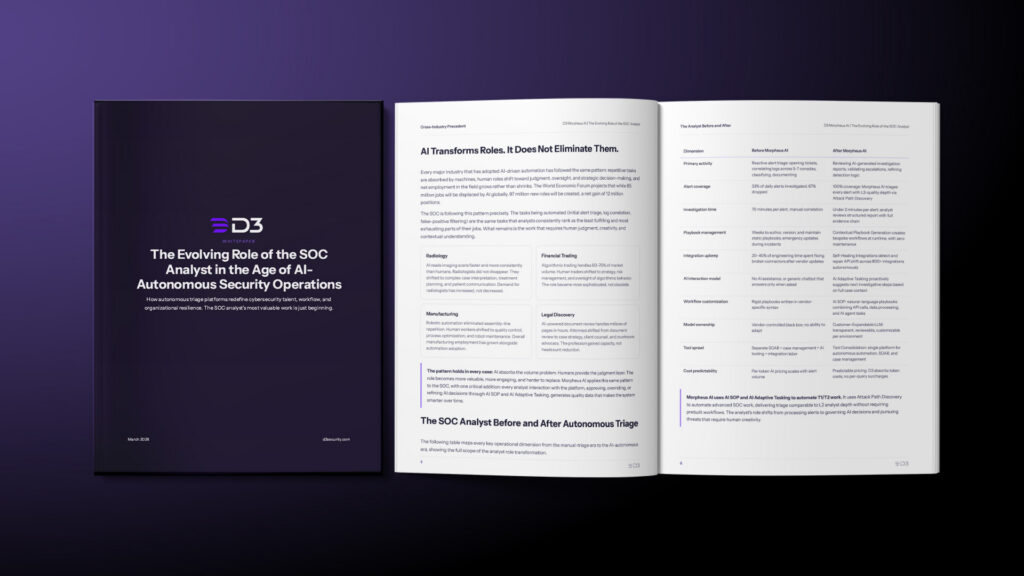
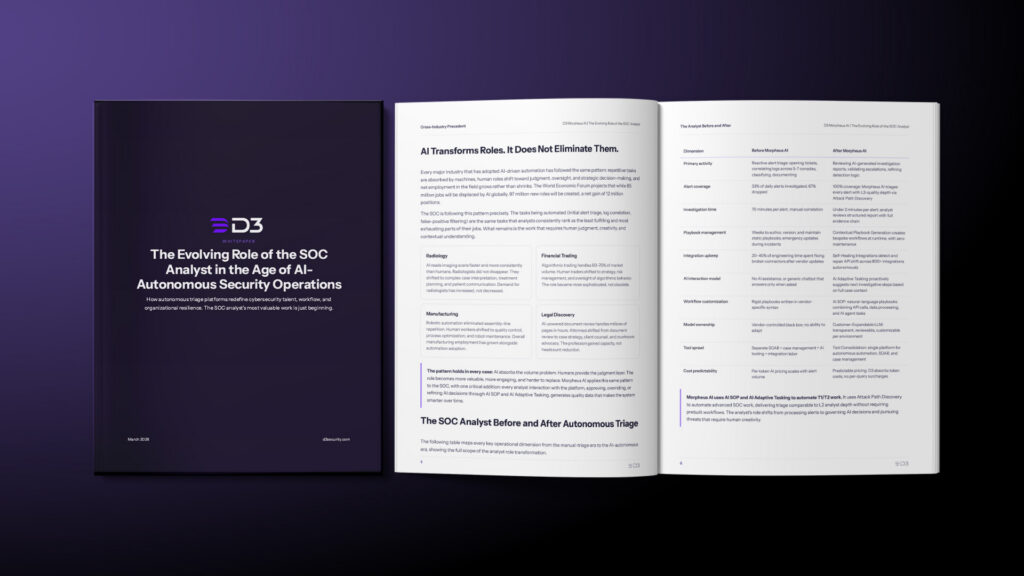
Go Deeper: This post is based on our whitepaper, The Evolving Role of the SOC Analyst in the Age of AI-Driven Autonomous Security Operations, which covers the full before-and-after transformation in detail, including implementation sequencing, the cross-industry precedent for AI role evolution, and how recovered analyst hours translate into strategic capacity. Read the full whitepaper →
The post The SOC Analyst Was Never Meant to Be a Ticket Processor. Autonomous Triage Proves It. appeared first on D3 Security.
*** This is a Security Bloggers Network syndicated blog from D3 Security authored by Shriram Sharma. Read the original post at: https://d3security.com/blog/soc-analyst-role-autonomous-triage/
如有侵权请联系:admin#unsafe.sh