5 Questions That Expose Whether an “Agentic SOC” Actually Works in Production
好的,我现在需要帮用户总结一篇文章,控制在100字以内。用户的要求是直接写文章描述,不需要特定的开头。首先,我得通读整篇文章,抓住主要内容。
文章主要讨论了“agentic SOC”在2026年RSA大会上的流行情况,以及它背后的技术架构。文中提到多个厂商采用了这个术语,但买家对其含义和实际效果有疑问。接着,文章解释了agentic SOC的定义,即使用多个专门的AI代理来协调工作,不同于传统的SOAR或统一智能架构。
然后,文章列出了五个关键问题来评估这种架构在实际生产中的表现,涉及审计追踪、延迟、错误传播、API变化和定价模式。最后,文章介绍了D3 Security的解决方案Morpheus AI,强调其单模型架构的优势。
总结时要涵盖agentic SOC的定义、其重要性、评估问题以及D3 Security的方法。同时要控制在100字以内,语言简洁明了。
</think>
文章探讨了“agentic SOC”概念及其在企业安全运营中的应用与挑战。通过分析多代理架构与统一智能模型的区别,揭示了其在实际生产环境中的优势与局限,并提出了评估其性能的关键问题。最终介绍了D3 Security的Morpheus AI解决方案及其在提升效率和降低成本方面的优势。
2026-4-2 18:32:55
Author: securityboulevard.com(查看原文)
阅读量:8
收藏
At RSA Conference 2026, “agentic SOC” was everywhere. Google Security Operations. Cisco. Dropzone AI. Stellar Cyber. ReliaQuest. Every major vendor adopted the label — and most buyers walked away with a genuine question: what does this actually mean, and does it matter?
It matters a lot. The architecture behind the label determines how your SOC performs at 4,000 alerts per day, under a breach-level spike, on a Sunday night when your senior analysts are off. This post breaks down what the agentic label means, why it emerged, and the five questions that separate architectures that work in production from ones that work in demos.
67% Enterprise alerts go uninvestigated daily
4 min Median attacker breakout time (CrowdStrike 2025)
An agentic SOC deploys multiple specialized AI agents — each scoped to a discrete function like detection, threat intel enrichment, correlation, or response — that coordinate autonomously through agent-to-agent protocols or shared memory. It is not the same as an AI-augmented SOAR (where a general-purpose LLM is bolted onto legacy static playbooks), and it is not the same as a Unified Intelligence architecture (where a single purpose-built model handles the full investigation without any handoffs).
The distinction matters because these three architectures have completely different production failure modes. When vendors use “agentic SOC” to describe any AI-assisted security operations, buyers lose the vocabulary to compare them accurately.
The architecture test: Ask any vendor claiming an “agentic SOC”: Does your platform route investigation work through multiple coordinated agents with discrete scopes? Or does a single unified model perform the full investigation in one inference pass? That answer determines which set of trade-offs you live with in production.
Why the Agentic Frame Makes Intuitive Sense
The agentic approach emerged as a genuine response to real crises: enterprise SOCs receiving 4,400+ daily alerts that static SOAR playbooks couldn’t handle at scale, a global workforce shortage making manual investigation structurally impossible, and a recognition that the SOAR ceiling — where playbooks top out at 30–40% coverage regardless of investment — could not be raised by adding more playbooks.
Specialization, parallelism, and modular replaceability are real architectural advantages. A detection agent trained narrowly may process alerts faster than a generalist model. Parallel execution across agents can increase throughput. These are legitimate arguments for the model. The problem is what happens when those agents need to cooperate under production load — and what happens when vendor APIs change.
The 5 Questions That Expose Production Performance
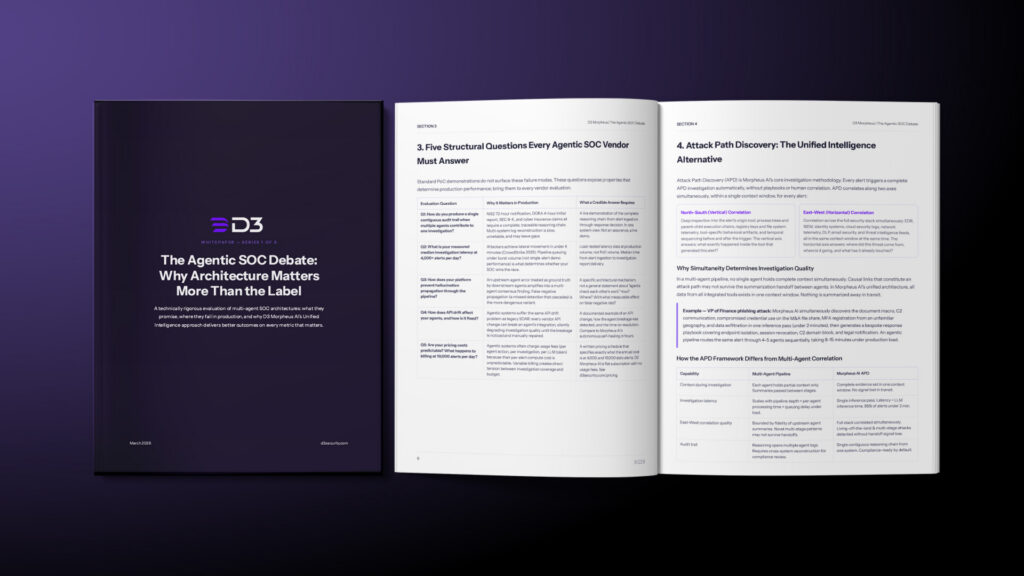
Question 1: How do you produce a single contiguous audit trail when multiple agents contributed to one investigation?
NIS2 requires a 72-hour detailed notification. DORA requires an initial ICT incident report in 4 hours. The SEC gives you 4 business days for an 8-K materiality determination. When your investigation reasoning spans 5 separate agent logs — each with its own system clock, its own context store, its own logging format — reconstructing a complete, regulator-ready audit trail under those timelines is a compliance exposure, not a process improvement. Ask to see it demonstrated live.
Question 2: What is your measured median investigation latency at 4,000+ alerts per day — not single-alert demo performance?
Attackers achieve lateral movement in under 4 minutes at the median. A 5-agent investigation pipeline under production alert volume introduces queuing delay at every handoff. The number you see in a demo — one alert, no queue pressure — is not the number you’ll see when 183 alerts arrive per hour during a breach. Ask for load-tested latency data, not demo performance.
Question 3: How does your platform prevent an upstream agent error from becoming a downstream consensus finding?
In a single-model system, a hallucinated output is reviewed by a human analyst who can see the error. In a multi-agent pipeline, that error is passed to the next agent as factual context — where it’s amplified, not caught. By the time the investigation report reaches your analyst, it presents as four agents’ worth of mutually reinforcing detail built on a single upstream mistake. Ask for the specific architectural mechanism that prevents this, not a general assurance.
Question 4: When a vendor API changes, how is the agent integration break detected — and how long does repair take?
This is the question that reveals whether the vendor has solved the problem SOAR couldn’t — or just reproduced it in a new form. Legacy SOAR platforms failed at scale partly because every vendor API update broke integrations silently, consuming engineering capacity that should have gone toward detection engineering. A 50-tool stack with 4–6 updates per tool per year means integration disruptions every 6 weeks on average. Agentic systems with per-agent static connectors inherit this problem directly. Ask for a documented example of an API drift event, how it was detected, and the measured time-to-restored-functionality.
Question 5: What is your exact pricing at 4,000 daily alerts? At 10,000? Put it in writing.
Multi-agent vendors often charge usage-based fees — per agent action, per investigation, or per LLM token — because their per-alert compute cost is structurally unpredictable. These vendors sometimes issue broad, undirected queries to the LLM at each pipeline stage because they don’t know precisely what context each agent needs. They cannot predict the per-alert cost in advance, and they pass that unpredictability to customers. A breach incident that spikes your alert volume will spike your costs at the worst possible time. Ask for a written pricing schedule at realistic production volumes.
What D3 Security Built Instead
D3 Security started building its answer in 2022 — two years before “agentic SOC” became a marketing category. The core question was: what does a world-class L2 analyst actually do when investigating an alert, and can that be fully automated within a single model?
The result is Morpheus AI‘s Attack Path Discovery (APD) framework — a single purpose-built cybersecurity LLM that correlates vertically into alert origin tools and horizontally across the full security stack simultaneously, in one inference pass, with no inter-agent handoffs. The same framework extends beyond alert triage to threat intelligence environmental hunting (ingest a feed, APD runs the indicators across your whole environment automatically), vulnerability response planning (ingest scanner findings, APD produces context-aware response playbooks), and proactive threat hunting.
On API drift: Morpheus AI’s Self-Healing Integrations continuously monitor all 800+ connected tools. When a vendor API changes, the system detects the drift in minutes, analyzes the semantic meaning of the change, regenerates the connector code autonomously, and restores full operation in hours. No engineering tickets. No visibility gaps. This is a structural advantage over both legacy SOAR and every multi-agent system that relies on per-agent static connectors.
On pricing: Morpheus AI is a flat subscription with no per-alert, per-token, or per-investigation charges. D3 absorbs all LLM compute costs internally. The APD framework uses precise contextual queries — the model determines what data is actually needed before querying — which controls token consumption and makes flat pricing viable at any alert volume. See d3security.com/pricing for current rates.
In production, this delivers: 95% of alerts triaged in under 2 minutes, a 99.86% alert reduction at one MSSP deployment (from 144,000 monthly alerts requiring human attention to 200), and an 80% reduction in mean time to respond across production environments.
The Architecture Comparison at a Glance
When evaluating AI SOC platforms, ask whether the architecture is:
Multi-agent (agentic): Multiple coordinated agents with discrete scopes, connected by message-passing. Genuine advantages in narrow domains. Structural challenges with coordination latency, context fragmentation, API drift per agent, and fragmented audit trails in enterprise SOC production environments.
AI-augmented SOAR: LLM chat interface on a legacy static playbook engine. Real quality-of-life improvements for playbook authors. The underlying SOAR architecture — and its SOAR architect dependency — is unchanged.
Unified Intelligence (Morpheus AI): Single purpose-built cybersecurity LLM. Complete investigation in one inference pass. Self-Healing Integrations. Flat subscription pricing. Extended use cases (threat intel hunting, vulnerability response) native to the APD framework.
Read the Full Whitepaper Series: The Agentic SOC Debate