好的,我现在需要帮用户总结一篇文章,控制在100字以内。用户的要求很明确,不需要特定的开头,直接写文章描述。首先,我得仔细阅读文章内容,抓住主要观点。 文章主要讨论了SOC(安全运营中心)架构的问题,特别是工具泛滥导致的效率低下和成本高昂。作者提到大多数组织正在整合安全工具,但这种整合并没有解决根本问题,比如依赖单一的SOAR架构师、静态响应流程、以及频繁的集成中断。 接下来,文章介绍了D3 Morpheus AI平台,它通过整合AI分类、自动化响应和案例管理功能,解决了这些问题。具体来说,该平台能够自动进行深入调查、生成动态响应工作流,并自我修复集成问题。这些功能显著减少了人工干预和维护负担。 然后是数据部分,展示了该平台在实际应用中的效果,比如大幅减少需要人工审查的警报数量和节省成本。最后,作者建议评估现有架构是否仍然依赖传统方法,并推荐使用Morpheus AI来替代现有的工具。 总结时要抓住关键点:SOC工具泛滥的问题、Morpheus AI的功能及其带来的好处。同时要确保语言简洁明了,在100字以内准确传达主要内容。 </think> 文章指出安全运营中心(SOC)面临的主要威胁是其复杂架构和工具泛滥问题。大多数组织正在尝试通过整合工具来简化 SOC 运营,但这种方法未能解决根本性问题。D3 Morpheus AI 通过整合 AI 分类、自动化响应和案例管理功能,消除对静态 playbook 和手动集成维护的依赖,并实现自我修复连接,显著提升效率并降低成本。 2026-4-2 19:33:47 Author: securityboulevard.com(查看原文) 阅读量:5 收藏
The biggest threat to your SOC is the architecture you built to stop attackers.
Every CISO we talk to says the same thing: “We’re consolidating.” Gartner confirms it: 75% of organizations are pursuing vendor consolidation, up from 29% in 2020. The instinct is right. The average SOC manages 83 tools from nearly 30 vendors. That’s not a security strategy. It’s technical debt with an incident response plan.
But here’s where most consolidation efforts go wrong: they treat tool sprawl as the disease instead of the symptom.
Fewer Tools, Same Failures
Merging dashboards and collapsing vendor contracts feels productive. You save 30–40% on licensing. Your architecture diagram gets cleaner. But the five structural failures that actually cause SOC dysfunction remain untouched:
Your SOAR architect (the one person who understands 200+ static playbooks) is a single point of failure earning $150K–$250K/year. Your playbooks can’t adapt: a phishing workflow runs identical steps whether the target is an intern or the CFO. Your integrations break silently, with 50+ tools shipping updates quarterly, you’re facing 200–300 disruptions per year that create the exact blind spots attackers exploit. And 67% of your alerts go completely uninvestigated.
Consolidating into another SOAR doesn’t fix this. Bolting a chatbot onto your existing one doesn’t either.
Three Product Categories That Should Be One
Most SOCs are paying separately for three product categories that should never have been separate:
AI triage tools like DropZone, 7AI, and Prophet Security classify alerts as benign or suspicious. Useful at L1, but when they flag something, a human analyst still does the actual investigation.
SOAR platforms like Tines, Torq, and Palo Alto XSOAR automate pre-defined response workflows. They depend on architects, accumulate playbook sprawl, and apply static logic to dynamic threats.
Case management tools force analysts to context-switch between investigation and documentation, copying evidence, updating tickets, maintaining audit trails manually.
Three license costs. Three integration engineering efforts. Three vendor relationships. And the seams between them are where investigations fall apart.
What Replaces All Three
D3 Morpheus AI collapses these categories into a single platform through an architecture that eliminates the dependencies creating the sprawl.
Attack Path Discovery traces threats vertically through origin tools and horizontally across your entire stack (EDR, SIEM, identity, cloud, network), building complete attack timelines in under two minutes. This delivers autonomous L2-depth investigation on every alert, not alert classification.
Contextual Playbook Generation produces response workflows at runtime from live evidence: alert data, cross-stack correlation, environmental context, and SOC preferences. No SOAR architect required. No playbook library to maintain.
Self-Healing Integrations monitor 800+ tool connections continuously. When APIs break, schemas change, or authentication fails, Morpheus detects drift within 15 minutes and regenerates connectors autonomously. Total repair time: under 45 minutes versus 10 days manual.
The Numbers From Production
These aren’t lab benchmarks:
- 144,000 → 200: Monthly alerts requiring human review at a large MSSP
- 99.86% alert noise eliminated with full L2 investigation depth
- $0.27 per AI-triaged alert vs. $2.50 for human analyst triage
- 7,800 hours recovered annually in a 10-person SOC
- 80% reduction in mean time to respond
At $2.50 per analyst-triaged alert, 144,000 monthly alerts cost $360,000 in human triage. At $0.27, that’s $38,880, an 89% reduction. No AI triage point product matches this because none eliminates the downstream investigation work.
The Question You Should Be Asking
The consolidation conversation shouldn’t start with “how many tools can we cut?” It should start with “does our architecture still require a SOAR architect, static playbooks, and manual integration maintenance?”
If the answer is yes, you haven’t consolidated. You’ve rearranged.
Evaluate Morpheus AI
Ask these questions of any platform claiming to consolidate your SOC:
- Does it investigate at L2 depth, or just classify alerts at L1?
- Does it generate playbooks from live evidence, or require architects to build static ones?
- Does it heal its own integrations, or add to your maintenance burden?
- Does it replace your SOAR, AI triage, and case management, or sit alongside them?
Ready to see Morpheus AI investigate your actual alerts? Request a proof-of-value →
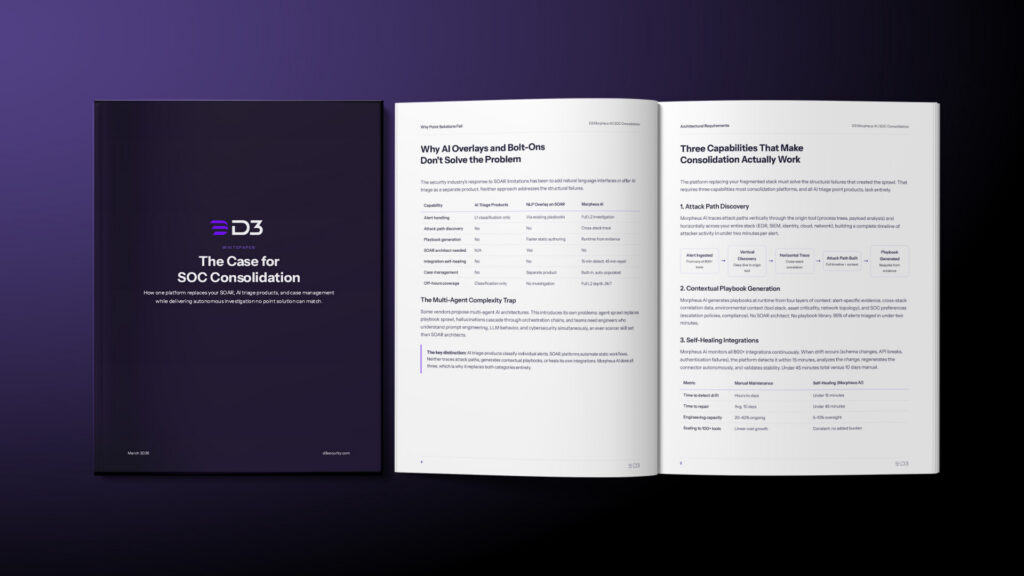
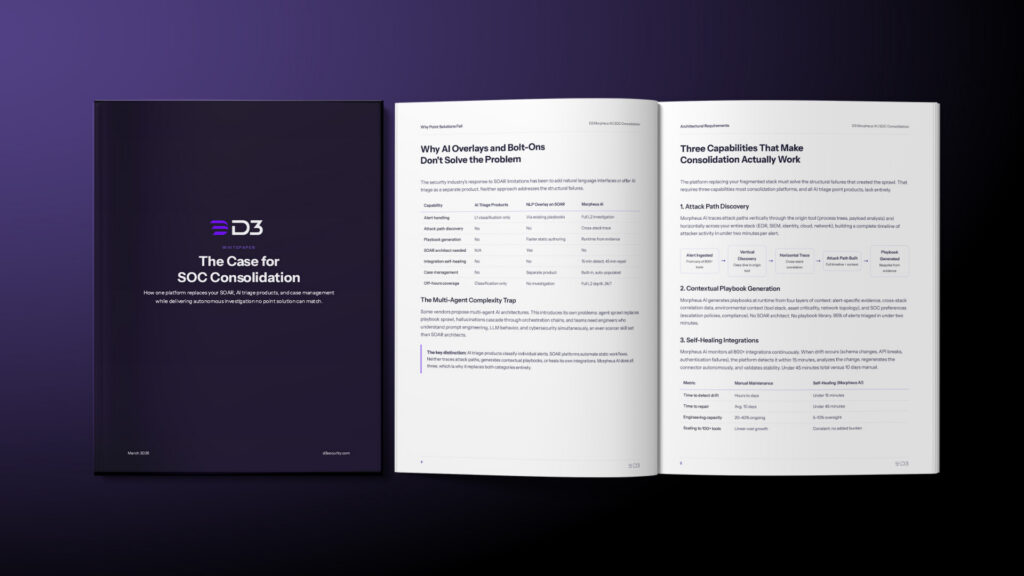
Go deeper: The full cost analysis, architecture breakdown, and five structural failures behind SOC sprawl are covered in The Case for SOC Consolidation whitepaper.
The post The $250K Single Point of Failure Hiding in Every SOC appeared first on D3 Security.
*** This is a Security Bloggers Network syndicated blog from D3 Security authored by Shriram Sharma. Read the original post at: https://d3security.com/blog/soar-is-a-legacy-system/
如有侵权请联系:admin#unsafe.sh