好的,我现在需要帮用户总结一篇文章,控制在100字以内。用户的要求是直接写文章描述,不需要特定的开头。首先,我得通读整篇文章,抓住主要观点。 文章主要讨论SIEM系统在安全事件管理中的作用,以及存在的“调查缺口”问题。SIEM生成大量警报,但大部分未被调查,因为团队资源有限。文章指出,AI智能层可以填补这一缺口,通过自动关联事件、优先排序和推荐响应措施来提高效率。 接下来,我需要将这些要点浓缩到100字以内。重点包括:SIEM生成警报多、调查不足、AI的作用和优势。确保语言简洁明了。 最后,检查字数是否符合要求,并确保信息准确传达。 </think> 文章指出安全信息和事件管理系统(SIEM)虽然能有效收集日志并生成警报,但67%的警报未被调查。问题在于团队缺乏资源应对海量警报。引入AI智能层可自动关联事件、优先排序并推荐响应措施,从而缩短调查时间并提升效率。 2026-4-1 18:42:4 Author: securityboulevard.com(查看原文) 阅读量:7 收藏
The SIEM Investigation Gap: A Real Problem
Your security information and event management system works exactly as designed. It collects logs. It applies rules. It generates alerts.
But here’s the gap: 67% of security alerts go uninvestigated because security teams simply don’t have the bandwidth to triage, investigate, and respond to every alert their SIEM generates.
That number isn’t a failure of your tools. It’s a failure of scale. Your SIEM can generate thousands of alerts per day. Your team cannot investigate thousands of incidents per day.
The average investigation takes 70 minutes. Manual. Repetitive. Consuming expertise that could be applied to actual threats.
This is the investigation gap. And it’s where most breaches happen. You detect them, but you don’t have time to investigate them.
The SIEM Does What It Was Built to Do
Before we talk about solutions, let’s be clear: your SIEM isn’t the problem.
SIEMs were built to do one thing well: collect events from everywhere, normalize them, and surface them in a queryable way. They’re phenomenal at it. Organizations with mature SIEMs have visibility into their infrastructure that was unimaginable 15 years ago.
But SIEMs were not designed to investigate. They were not designed to reason about attack chains. They were not designed to ask “Is this noise, or is this the first step of a sophisticated attack?”
Those are intelligence problems, not data collection problems.
The Missing Layer: Investigation Intelligence
The gap between “detection” and “investigation” is where an AI intelligence layer lives.
An AI intelligence layer sits above your SIEM and answers the questions your SIEM cannot:
- What is the attack story? Is this isolated noise, or part of a coordinated attack?
- Which alerts matter? Which ones should your team investigate first?
- What happened next? What are the likely next steps in the attack?
- What should we do? What are the recommended response actions?
An AI intelligence layer doesn’t replace your SIEM. It understands your SIEM. It reads your alerts as a security analyst would: with context, with domain knowledge, with an understanding of how attackers work.
Three Categories of AI SOC Approaches
When evaluating tools that claim to bridge this gap, you’ll encounter three different approaches:
| Approach | What It Does | The Trade-Off |
|---|---|---|
| Alert Noise Reduction | Filters alerts, applies ML-based baselining to reduce false positives | Treats the symptom, not the cause. You miss fewer alerts, but you still must investigate each one manually |
| Natural Language Overlay | Uses LLMs to rewrite alerts in human language, provide context | Better storytelling, but doesn’t change investigation time or accuracy |
| AI Intelligence Layer | Reasons about attack chains, prioritizes by risk, recommends response actions, discovers attack paths | Requires deep security domain knowledge. Most vendors can’t do this credibly. |
The first two feel helpful. The third actually changes the business metrics: investigation time, response time, and analyst coverage.
How Attack Path Discovery Changes the Math
Let’s use a real attack scenario: Business Email Compromise (BEC) detection.
Your SIEM detects:
- Unusual email forwarding rule created
- Email from external sender with PayPal logo in subject
- Large file transfer to external cloud storage
- Login from new location at 2 AM
In most organizations, these are four separate alerts. Your analyst must connect them manually, looking at timestamps, checking user context, building a narrative.
Without AI Intelligence Layer: Analyst spends 60–90 minutes correlating events across multiple dashboards. Risk of missed context. Risk of analyst fatigue leading to dismissal as false positives.
With Attack Path Discovery: The AI layer automatically correlates these events, identifies them as a cohesive attack chain, assigns them a single incident number, assigns a risk score, and recommends containment actions in under 2 minutes.
That’s the difference between reactive response (after damage) and proactive containment (during the attack).
What to Look For in an AI Intelligence Layer
Not all AI security tools are created equal. When evaluating an AI intelligence layer, use this checklist:
- Attack path reasoning: Does it connect disparate alerts into coherent attack stories?
- Risk-based prioritization: Does it prioritize high-risk incidents over high-volume ones?
- Integrated response recommendations: Does it recommend specific, actionable containment steps?
- SIEM integration: Does it work with your existing SIEM without requiring replacement?
- Domain expertise: Are the team’s security researchers building this, or is it generic LLM output?
- Explainability: Can it explain why it flagged an incident? Can analysts understand and trust the logic?
- Behavioral learning: Does it understand your environment beyond generic threat rules?
- Analyst workflow integration: Does it reduce manual work, or just add another dashboard to monitor?
Generic AI wrapped around generic threat intelligence won’t solve this problem. You need an intelligence layer built by security people, for security people.
The Outcome
An effective AI intelligence layer does one thing: it gives your team time back.
Instead of spending 70 minutes manually investigating four related alerts, your team spends 10 minutes validating an automated incident narrative and approving a containment recommendation. Instead of investigating 10% of alerts, you can investigate 80%. Instead of finding attacks after the fact, you can contain them during the attack.
Your SIEM will always be there. It will always collect logs and generate alerts. But it doesn’t have to be the last step in your detection pipeline.
The question isn’t whether you need to replace your SIEM. The question is whether you can afford another year of uninvestigated alerts.
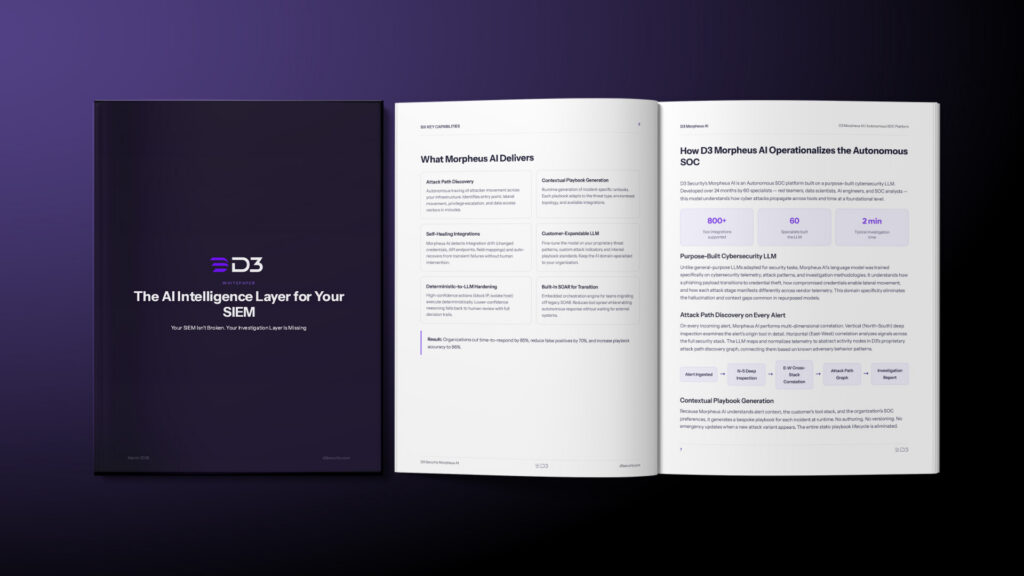
Download our latest whitepaper: The AI Intelligence Layer for Your SIEM to learn how D3 Morpheus AI bridges the investigation gap
The post The AI Intelligence Layer for SIEM, Explained: What It Does, Why It Matters, and How to Evaluate One appeared first on D3 Security.
*** This is a Security Bloggers Network syndicated blog from D3 Security authored by Shriram Sharma. Read the original post at: https://d3security.com/blog/ai-intelligence-layer-siem/
如有侵权请联系:admin#unsafe.sh