嗯,用户希望我用中文总结一篇文章,控制在100字以内,而且不需要特定的开头。我先快速浏览一下文章内容。 文章主要讲的是网络安全中的AI应用,特别是专门设计的LLM(大语言模型)如何解决传统AI在安全分析中的不足。传统AI如GPT-4虽然强大,但无法有效处理攻击链和跨工具关联。而专门设计的LLM能更好地处理这些任务,减少误报,提高效率。 接下来,我需要提取关键点:专门设计的LLM的优势、传统AI的局限性、以及实际应用案例(比如D3 Morpheus AI)。然后把这些信息浓缩到100字以内。 要注意用简洁的语言表达清楚,避免使用复杂的术语,让读者容易理解。同时确保涵盖主要观点:问题、解决方案、效果。 最后检查一下字数,确保不超过限制。这样用户就能快速抓住文章的核心内容了。 </think> 文章讨论了网络安全中AI的应用,指出通用AI模型在处理安全威胁时存在局限性。专门设计的网络安全LLM通过针对性训练,在攻击链追踪、跨工具关联和减少误报方面表现更优。D3 Morpheus AI作为实例展示了其在自主调查和动态响应中的优势。 2026-3-27 18:51:51 Author: securityboulevard.com(查看原文) 阅读量:4 收藏
The average SOC analyst spends 70 minutes investigating a single alert. Your security stack generates thousands daily. And 40% of those alerts? Never investigated at all.
The cybersecurity industry has spent the last two years bolting general-purpose AI onto this problem. ChatGPT-style models wrapped in security dashboards. Generic LLMs with clever prompt engineering. The result: faster summaries of the same overwhelming noise.
That approach has hit a wall. Here’s why purpose-built cybersecurity LLMs represent the architectural shift that actually solves it.
The Numbers That Should Keep CISOs Awake
ISC2’s 2025 Cybersecurity Workforce Study counts 4.8 million unfilled cybersecurity positions globally. The Tines 2025 Voice of the SOC Analyst report found 71% of working SOC analysts report burnout. SANS 2025 data shows 70% of analysts with five years or less experience leave within three years.
Meanwhile, the AI cybersecurity market hit $30.9 billion in 2025 (Mordor Intelligence) and 42% of security leaders are already piloting AI agents in their SOCs (Gartner, October 2025).
The money is flowing in. But is it flowing toward the right architecture?
General-Purpose LLMs: Smart, But Not Security-Smart
Models like GPT-4, Claude, and Gemini are remarkable general reasoning engines. They can summarize a phishing alert. They can explain a CVE. But they cannot do what a SOC investigation actually requires.
| Capability | Purpose-Built Cybersecurity LLM | General-Purpose LLM + Security Prompt |
|---|---|---|
| Attack Propagation | Traces causal chains across the full kill chain. A phishing email leading to credential theft, lateral movement, and cloud workload alerts is seen as one attack chain. | Treats each alert as an isolated text input. Cannot connect events across tools. |
| Cross-Stack Correlation | Multi-dimensional (vertical + horizontal) correlation across 28+ tools simultaneously: email, endpoint, identity, cloud, and network. | Single-alert summarization with limited correlation capability. |
| Hallucination Risk | Reduced through domain-specific training. Measurably higher precision on security-specific outputs (IOCs, ATT&CK mappings). | Higher risk of confident errors. A hallucinated MITRE ATT&CK mapping or fabricated IOC misdirects the entire response. |
| Playbook Generation | Generates contextual playbooks at runtime based on alert context and tool stack. No static authoring required. | Assists with static playbook creation but cannot generate autonomously. |
| Integration Handling | Self-healing: auto-detects API drift and generates corrective code. | Manual maintenance required when vendor APIs change. |
Gartner’s February 2026 cybersecurity trends report warns of “agent washing,” their term for vendors rebranding existing products with AI labels without genuine agentic capability. Of thousands of claimed agentic AI vendors, only about 130 offer real capability.
What “Purpose-Built” Actually Means
Cisco’s Foundation AI team provided independent validation of the purpose-built approach in April 2025. Their Foundation-sec-8b model (8 billion parameters, trained on curated cybersecurity data) outperforms general-purpose models nearly 10x its size on core security benchmarks.
The principle: domain-specific training data produces domain-specific accuracy.
A purpose-built cybersecurity LLM is trained from the ground up on security telemetry, attack patterns, threat intelligence, incident investigation records, and adversary behavior frameworks. It doesn’t need to be prompted to think like a security analyst. It was trained to think like one.
How D3 Morpheus AI Puts This Into Practice
D3 Security’s Morpheus AI is an Autonomous SOC platform built on a purpose-built cybersecurity LLM developed over 24 months by 60 specialists. Here’s what that architecture enables in production:
Attack Path Discovery on every alert. Morpheus AI maps telemetry to D3’s proprietary attack path graph, connecting events based on adversary behavior patterns. Investigation reports with step-by-step reasoning, delivered in minutes.
Contextual Playbook Generation at runtime. Because the model understands alert context and the customer’s tool stack, it generates a bespoke playbook for each incident. No static authoring. No versioning bottleneck. No emergency updates when a new attack variant appears.
Self-Healing Integrations across 800+ tools. When APIs drift or schemas change, Morpheus AI detects the change and generates corrective code. This addresses the #1 cause of silent SOAR failures.
Human-in-the-loop by design. D3’s AI SOP captures every analyst approval and override, creating continuous improvement loops. Morpheus AI includes a full SOAR engine alongside its autonomous capabilities. Run both simultaneously, transition on your own timeline.
Predictable pricing. D3 absorbs token costs. Flat-rate pricing with no per-alert or per-token fees.
The Honest Caveat
No Autonomous SOC platform operates without human oversight. “Autonomous” describes the investigation model, not the governance model. Purpose-built models reduce hallucination but don’t eliminate it. Organizations that adopt these platforms expecting to fire their SOC team will be disappointed and exposed.
The right question isn’t “can AI replace analysts?” It’s “can a purpose-built LLM give analysts the capacity to actually investigate every alert?”
What to Ask Vendors
When evaluating cybersecurity AI, these questions separate real capability from agent washing:
- Was the model trained on cybersecurity data, or is it a fine-tuned general-purpose model?
- Can it investigate alerts across your entire security stack simultaneously?
- Does it generate playbooks at runtime, or require static playbook authoring?
- How does it handle integration drift when vendor APIs change?
- Can analysts see, review, and override every step of the AI’s reasoning?
- Does the pricing include token or usage-based fees?
Frequently Asked Questions
What is a purpose-built cybersecurity LLM?
A purpose-built cybersecurity LLM is a large language model trained from the ground up on curated cybersecurity data including security telemetry, attack patterns, threat intelligence, incident investigation records, and adversary behavior frameworks. Unlike general-purpose AI models adapted for security, a purpose-built cybersecurity LLM understands how attacks propagate across tools, how to correlate signals across the full security stack, and how to reason about threats with domain-specific accuracy.
How is a purpose-built cybersecurity LLM different from using ChatGPT or GPT-4 for security?
General-purpose models like GPT-4 are trained on broad internet data. They can summarize security alerts but cannot trace attack propagation chains, correlate signals across 28+ security tools simultaneously, or avoid hallucinating indicators of compromise. Cisco’s Foundation-sec-8b demonstrated that an 8-billion parameter model trained on cybersecurity data outperforms general-purpose models nearly 10x its size on security benchmarks.
Why does cybersecurity need a domain-specific AI model?
The cybersecurity industry faces 4.8 million unfilled positions (ISC2, 2025), 71% analyst burnout (Tines, 2025), and 40% of alerts going uninvestigated. General-purpose AI produces faster alert summaries but cannot perform the multi-dimensional investigation that SOC operations require. Domain-specific models trained on security data deliver measurably higher accuracy in threat detection, forensic investigation, and attack analysis.
What is an AI SOC platform?
An AI SOC platform uses artificial intelligence to automate and augment Security Operations Center (SOC) functions including alert triage, investigation, threat detection, and incident response. The most advanced AI SOC platforms use purpose-built cybersecurity LLMs to perform autonomous investigation with human oversight, rather than relying on general-purpose AI with security prompts.
How does D3 Morpheus AI use a purpose-built cybersecurity LLM?
D3 Security’s Morpheus AI is an Autonomous SOC platform built on a purpose-built cybersecurity LLM developed over 24 months by 60 specialists. The LLM powers attack path discovery on every alert, contextual playbook generation at runtime, and self-healing integrations across 800+ tools. The model is customer-expandable, fully explainable, and operates with human-in-the-loop oversight.
What is the difference between SOAR and an Autonomous SOC?
SOAR (Security Orchestration, Automation and Response) platforms use static, pre-authored playbooks to automate repetitive tasks. An Autonomous SOC platform uses AI-driven investigation to dynamically triage alerts, generate contextual response playbooks at runtime, and correlate threats across the full security stack. The most effective platforms, like Morpheus AI, include both a full SOAR engine and autonomous AI capabilities.
Next Steps
Evaluate Morpheus AI against your actual alert data. The platform’s value is measurable: investigation time, false positive reduction, analyst hours recovered.
Visit d3security.com/morpheus to schedule a demonstration.
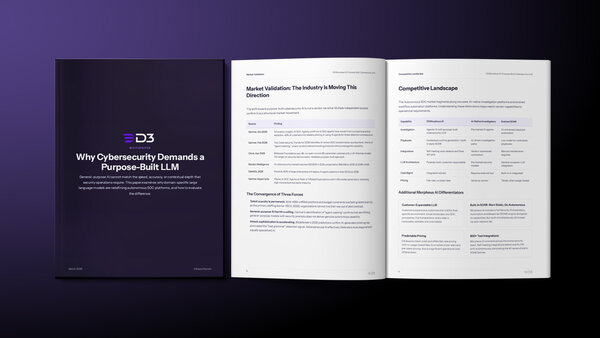
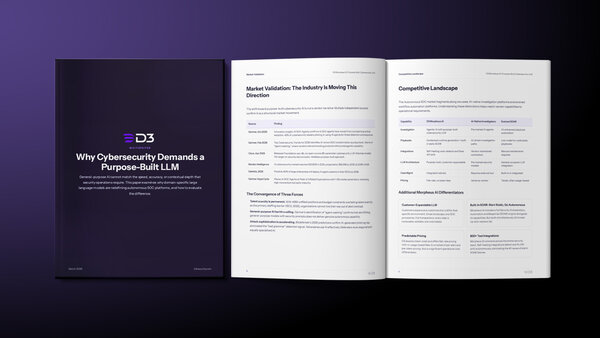
Read the Full Resource: Why Cybersecurity Demands a Purpose-Built LLM
The complete technical case for purpose-built cybersecurity LLMs: training architecture, benchmark data, and how Morpheus AI applies it to autonomous SOC operations.
D3 Security is a cybersecurity company founded in 2012 and headquartered in Vancouver, Canada. Morpheus AI is an Autonomous SOC platform combining a purpose-built cybersecurity LLM, AI-driven alert triage, contextual playbook generation, self-healing integrations across 800+ tools, a full SOAR engine, and integrated case management, with predictable, flat-rate pricing.
d3security.com | 1-800-608-0081 | [email protected]
The post GPT Can’t Trace an Attack Chain. A Purpose-Built Cybersecurity LLM Can. appeared first on D3 Security.
*** This is a Security Bloggers Network syndicated blog from D3 Security authored by Shriram Sharma. Read the original post at: https://d3security.com/blog/purpose-built-cybersecurity-llm-vs-general-ai/
如有侵权请联系:admin#unsafe.sh