好的,我现在需要帮用户总结这篇文章的内容,控制在100字以内。首先,我得仔细阅读文章,理解它的主要观点。 文章讨论了AI对中小企业(SMBs)、 MSP(管理服务提供商)和软件供应商的影响。作者认为,AI降低了执行成本,但并未减少问责制的需求。SMBs仍然倾向于外包IT问题给MSP,因为他们不想自己承担这些责任。 接下来,AI对MSP的影响是提高了效率,使他们能够更有效地处理重复性工作,支持更多客户。而软件供应商则面临更大的挑战,因为AI加速了产品开发速度,新公司更容易进入市场,这对传统大公司来说是个威胁。 总结一下,文章的核心是AI如何影响这三个层面:SMBs继续依赖MSP,MSP变得更高效,软件供应商需要快速适应AI以保持竞争力。因此,在总结时需要涵盖这些要点,并且控制在100字以内。 现在我要把这些点浓缩成一句话:AI降低了执行成本但未减少问责需求。中小企业仍依赖MSP处理IT问题;MSP通过AI提升效率;软件供应商则面临更快的产品开发和新竞争者的挑战。 </think> AI降低了执行成本但未减少问责需求。中小企业仍依赖MSP处理IT问题;MSP通过AI提升效率;软件供应商则面临更快的产品开发和新竞争者的挑战。 2026-3-27 13:0:0 Author: raffy.ch(查看原文) 阅读量:32 收藏

“AI lowers execution cost, not accountability. SMBs outsource accountability.”
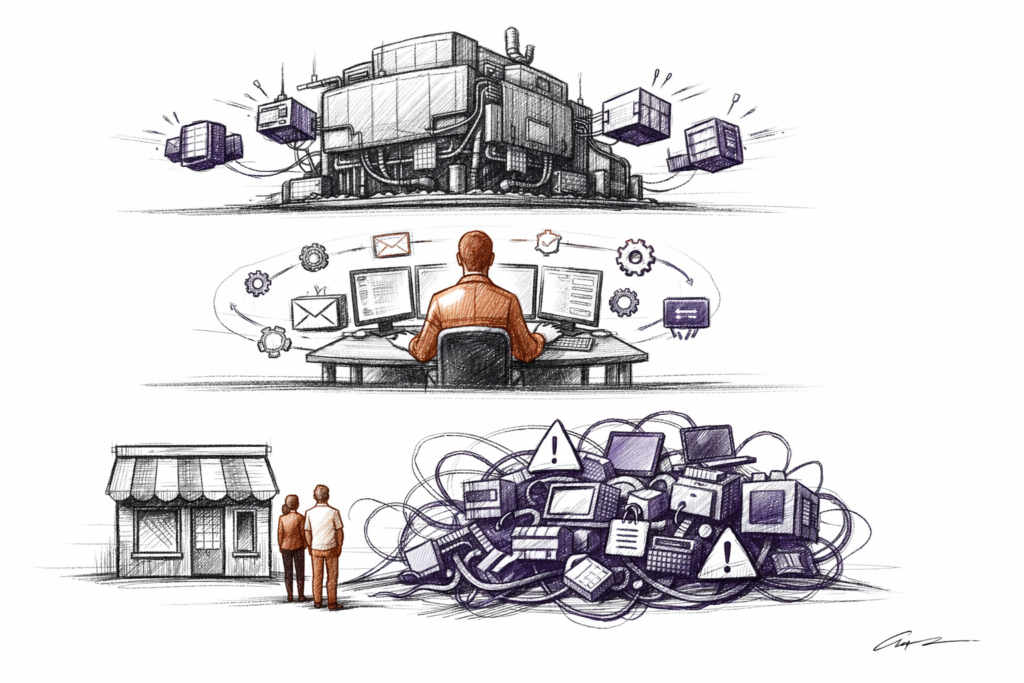
It will affect SMB customers, the MSPs serving them, and the software vendors selling into the channel. Those are three different layers, and the impact on each one is different.
SMBs Still Do Not Want To Own the Problem
One concern is that AI makes knowledge cheaper and tooling easier, so SMBs may decide to manage more of their own IT.
I do not think that is the main outcome.
Most SMBs do not hire an MSP because they cannot access software or information. They hire an MSP because they do not want to own the problem. They want someone else to choose the tools, deploy them, keep them running, support users, stay current, and deal with issues when something breaks.
AI may make parts of IT easier. It does not remove the need for responsibility. That is why I think AI is unlikely to reduce the need for MSPs in any dramatic way.
MSPs Get More Leverage
Inside the MSP, the impact is more direct.
A lot of the work is repetitive: triage, ticket handling, investigation, internal knowledge lookup, and workflow coordination across too many systems. AI can improve all of that.
That does not mean the MSP becomes irrelevant. It means the MSP becomes more efficient.
A smaller team may be able to support more customers, resolve more issues, and operate with fewer manual steps. In security especially, where talent is scarce, that matters a lot. The near-term effect of AI on MSPs is not disintermediation. It is better leverage, better scale, and a different labor model.
MSP Software Vendors Face the Real Reset
The most interesting pressure may land on the MSP software vendors.
The issue is not whether they can add AI features. They all will. The real issue is whether they can get on the AI coding wagon fast enough and turn that into much faster product development.
AI-native development practices will increase the amount of software the market can produce. More gets built. Iteration cycles get shorter. Focused startups can come in faster. And incumbents lose some of the advantage that came from simply being large, embedded platforms.
That is where the moving-fast disadvantage shows up.
Big vendors carry legacy code, older architectures, complex customer requirements, and years of accumulated product sprawl. It is much harder for them to become truly AI-first development organizations than it is for a newer company starting fresh. There is a big difference between developers occasionally using AI and a company rebuilding product, engineering, testing, and delivery around AI-assisted speed.
If incumbents make that shift well, they will benefit enormously. If they do not, AI will not just improve their products. It will make newer competitors much more dangerous.
What Changes From Here
My current view is simple.
AI is probably a tailwind for MSP demand. It is clearly a lever for MSP efficiency. But it may be most disruptive to the software vendors serving the market, because it changes the speed of product development and lowers the barrier for new entrants.
MSPs are not going away. But the basis of competition is changing.
No comments yet.
如有侵权请联系:admin#unsafe.sh