
嗯,用户让我总结一篇文章的内容,控制在一百个字以内,而且不需要用“文章内容总结”或者“这篇文章”这样的开头。直接写描述即可。好的,我先看看文章讲的是什么。 文章主要讲的是一个叫做VoidStealer的信息窃取恶意软件,它使用了一种新的方法绕过了Chrome浏览器的ABE(应用绑定加密)机制。这种方法利用硬件断点直接从浏览器内存中提取v20_master_key,而不需要提升权限或注入代码。Gen Digital的报告指出,这是第一次在野外观察到使用这种机制的信息窃取软件。 那我需要把这些关键点浓缩到100字以内。首先,提到VoidStealer,然后是绕过ABE的方法,用硬件断点提取主密钥,以及这是首次被发现的情况。 可能的结构是:VoidStealer利用硬件断点绕过Chrome的ABE机制,从内存中提取v20_master_key进行解密。Gen Digital报告称这是首个在野使用该技术的信息窃取软件。 检查一下字数是否合适。大约是50多字,符合要求。看起来没问题。 </think> VoidStealer利用硬件断点绕过Chrome的ABE机制,从内存中提取v20_master_key进行解密。Gen Digital报告称这是首个在野使用该技术的信息窃取软件。 2026-3-22 14:45:17 Author: www.bleepingcomputer.com(查看原文) 阅读量:27 收藏

An information stealer called VoidStealer uses a new approach to bypass Chrome’s Application-Bound Encryption (ABE) and extract the master key for decrypting sensitive data stored in the browser.
The novel method is stealthier and relies on hardware breakpoints to extract the v20_master_key, used for both encryption and decryption, directly from the browser's memory, without requiring privilege escalation or code injection.
A report from Gen Digital, the parent company behind the Norton, Avast, AVG, and Avira brands, notes that this is the first case of an infostealer observed in the wild to use such a mechanism.
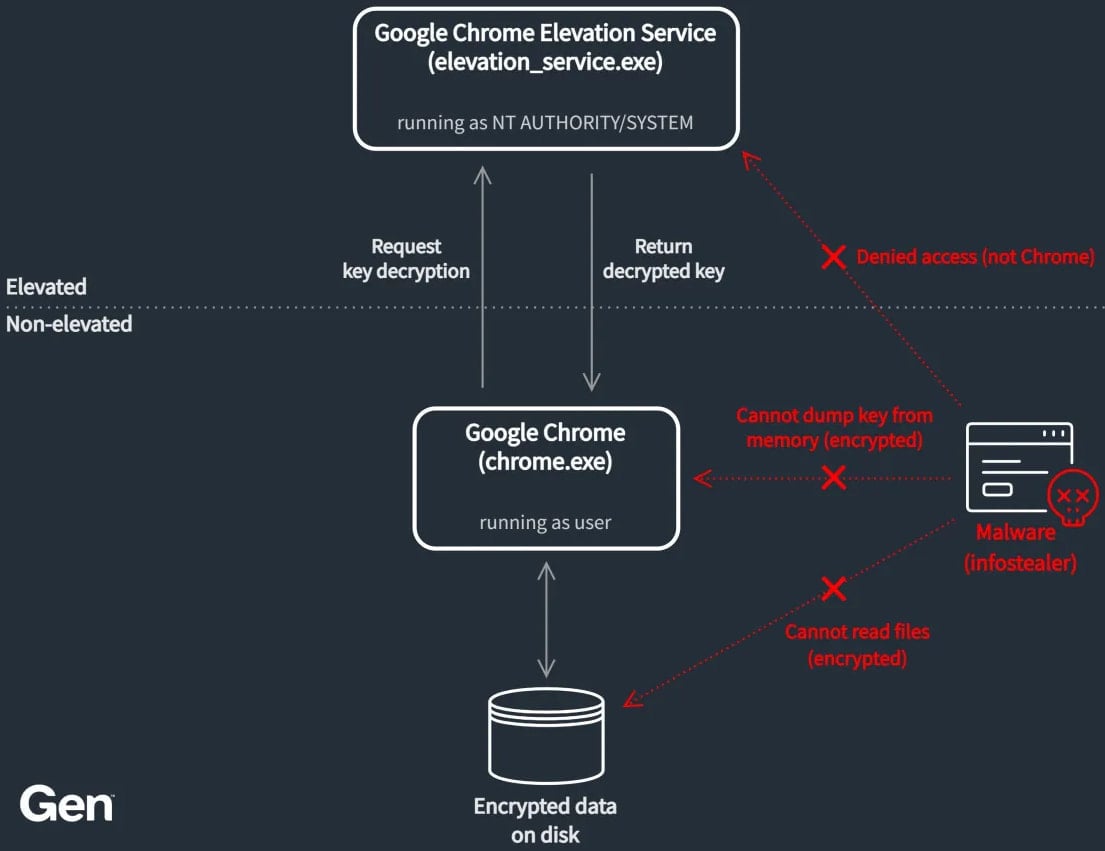
Google introduced ABE in Chrome 127, released in June 2024, as a new protection mechanism for cookies and other sensitive browser data. It ensures that the master key remains encrypted on disk and cannot be recovered through normal user-level access.
Decrypting the key requires the Google Chrome Elevation Service, which runs as SYSTEM, to validate the requesting process.
Source: Gen Digital
However, this system has been bypassed by multiple infostealer malware families and has even been demonstrated in open-source tools. Although Google implemented fixes and improvements to block these bypasses, new malware versions reportedly continued to succeed using other methods.
“VoidStealer is the first infostealer observed in the wild adopting a novel debugger-based Application-Bound Encryption (ABE) bypass technique that leverages hardware breakpoints to extract the v20_master_key directly from browser memory,” says Vojtěch Krejsa, threat researcher at Gen Digital.
VoidStealer is a malware-as-a-service (MaaS) platform advertised on dark web forums since at least mid-December 2025. The malware introduced the new ABE bypass mechanism in version 2.0.
.webp)
Source: Gen Digital
Stealing the master key
VoidStealer's trick to extract the master key is to target a short moment when Chrome’s v20_master_key is briefly present in memory in plaintext state during decryption operations.
Specifically, VoidStealer starts a suspended and hidden browser process, attaches it as a debugger, and waits for the target browser DLL (chrome.dll or msedge.dll) to load.
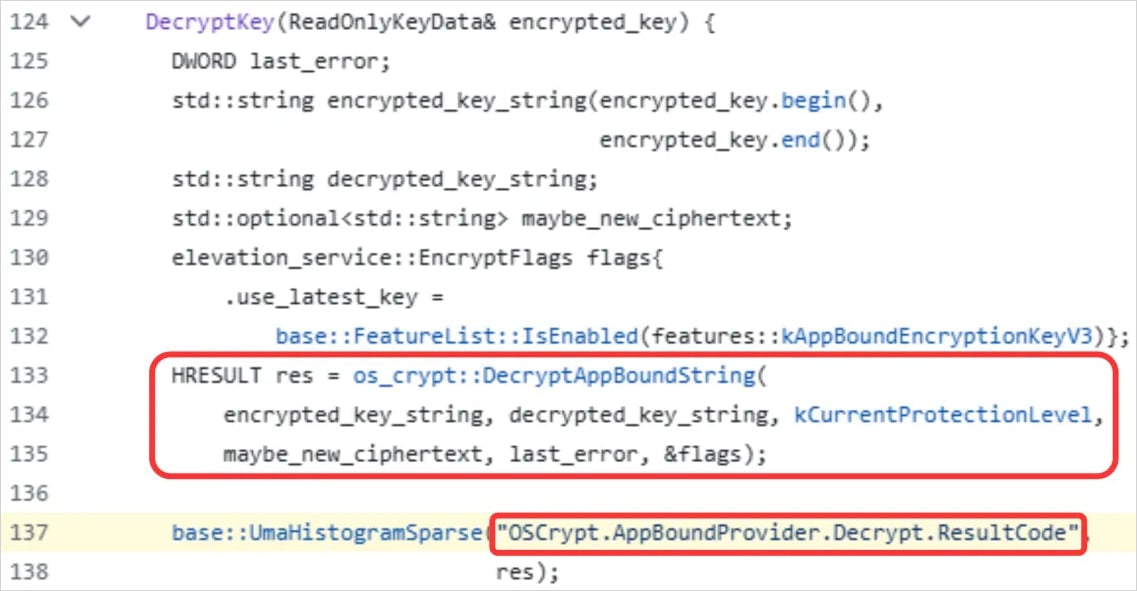
When loaded, it scans the DLL for a specific string and the LEA instruction that references it, using that instruction's address as the hardware breakpoint target.
Source: Gen Digital
Next, it sets that breakpoint across existing and newly created browser threads, waits for it to trigger during startup while the browser is decrypting protected data, then reads the register holding a pointer to the plaintext v20_master_key and extracts it with ‘ReadProcessMemory.’
Gen Digital explains that the ideal time for the malware to do this is during browser startup, when the application loads ABE-protected cookies early, forcing the decryption of the master key.
The researchers explained that VoidStealer likely did not invent this technique but rather adopted it from the open-source project ‘ElevationKatz,’ part of the ChromeKatz cookie-dumping toolset that demonstrates weaknesses in Chrome.
Although there are some differences in the code, the implementation appears to be based on ElevationKatz, which has been available for more than a year.
BleepingComputer has contacted Google with a request for a comment on this bypass method being used by threat actors, but a reply was not available by publishing time.

Red Report 2026: Why Ransomware Encryption Dropped 38%
Malware is getting smarter. The Red Report 2026 reveals how new threats use math to detect sandboxes and hide in plain sight.
Download our analysis of 1.1 million malicious samples to uncover the top 10 techniques and see if your security stack is blinded.
如有侵权请联系:admin#unsafe.sh