
好的,我现在需要帮用户总结一篇文章的内容,控制在100字以内。用户的要求很明确,不需要特定的开头,直接写描述即可。 首先,我得快速浏览文章内容。这篇文章主要讲的是纽约将废弃地改造成社区花园的例子,引出软件安全会议Chainguard Assemble 2026的主题。会议讨论了在AI和自动化环境下如何改进软件安全,强调了预先构建安全系统的重要性,而不是事后修补。 接下来,我需要提取关键点:会议地点、参与者数量、演讲主题、关键观点如预先构建安全系统、自动化工具的作用、信任机制的变化等。 然后,我得把这些信息浓缩到100字以内,确保涵盖主要主题和结论。同时要保持语言简洁明了,避免使用复杂的术语。 最后,检查一下是否符合用户的所有要求:字数控制、直接描述内容、没有特定开头。确认无误后就可以提交了。 </think> 纽约将废弃地改造成社区花园的例子启发了一场关于软件安全的会议 Chainguard Assemble 2026。会议探讨了在 AI 和自动化驱动下如何改进软件安全,强调预先构建安全系统而非事后修补,并讨论了信任机制、非人类身份治理及自动化工具的重要性。 2026-3-20 15:0:15 Author: securityboulevard.com(查看原文) 阅读量:5 收藏
New York knows how to turn rough ground into something human-friendly. For example, the Liz Christy Garden began in 1973 as the city’s first community garden, carved out of an overgrown vacant lot on the Lower East Side. They went from a wild and chaotic space to a human-friendly park that New Yorkers still enjoy today. That felt like a good backdrop for an event where security-minded professionals could have a conversation centered on taking messy, fast-moving software systems and building them into something durable, governed, and worth trusting. About 400 like-minded practitioners did exactly that at Chainguard Assemble 2026.
Throughout the event, held at The Glass House, attendees had the chance to see 38 speakers, including a closing session with Colin Jost, discuss the path forward for security in a world of rapidly evolving, AI-powered threats. Across keynotes, lightning talks, and other sessions, the same message kept surfacing from different angles: patching after the fact is no longer a strategy, and security teams cannot afford to be the last human checkpoint in a pipeline shaped by AI, automation, and sprawling dependencies.
Here are just a few of the highlights from Chainguard's second annual event.
The opening Product Keynote by Dan Lorenc, founder of Chainguard, began with a woodworking story that contrasted hand tools with power tools. Hand tools are slower and more familiar. Power tools are faster, louder, and more dangerous when things go wrong. Dan said this is where we are all at with AI and software development: we can now move much faster, but at greater risk of causing damage.
The industry has already entered a world where automation is not optional, and AI is not confined to autocomplete. CVE discovery and remediation that once took weeks can now happen in minutes. Agentic pentesting is compressing what used to be month-long cycles. That speed is real, and the attackers are using it too. The consequence is that "scan and patch" security no longer holds up as a primary operating model. By the time you find the issue downstream, the system has already moved on.
Dan used that argument to frame Chainguard Factory 2.0. This lets them build everything from source and control dependencies tightly, reconcile the active state against a desired state, and let agents handle the repetitive, high-volume coordination work while keeping trust anchored in cryptographic authenticity in a transparent process. Tens of thousands of dependency updates, hundreds of thousands of artifacts, and versioning edge cases across upstream projects that do not agree with each other. This is how they managed to build 7 new offerings, including OS dependencies and AI agent skills.
Software production now looks more like an automated factory than a bespoke workshop. Security has to be embedded in the factory design, not bolted on later.
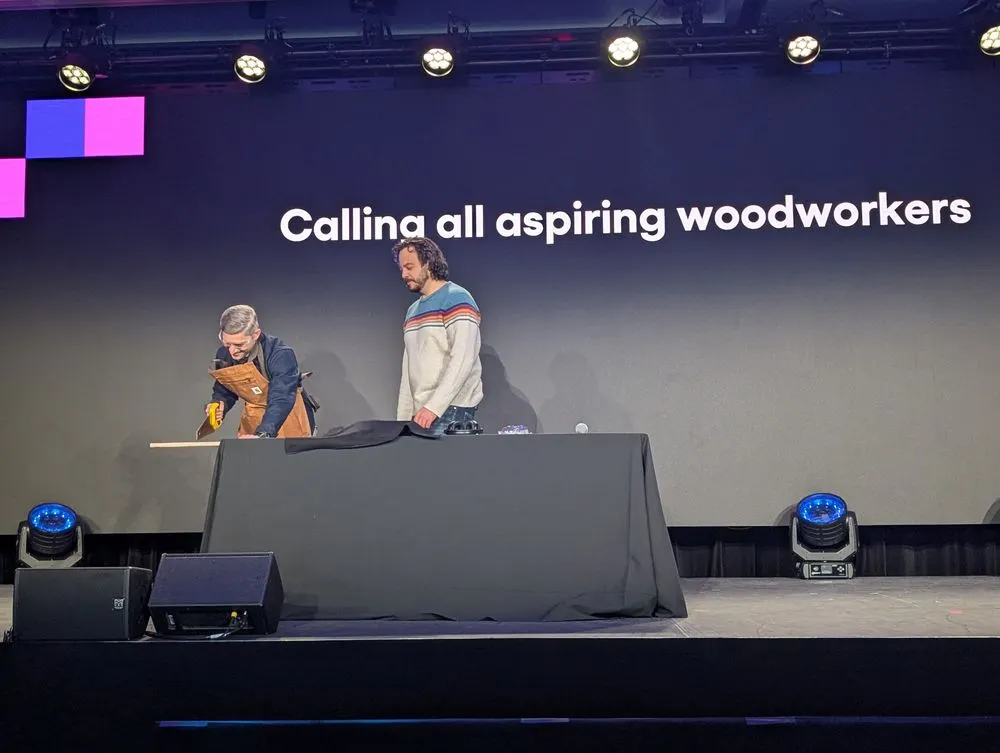
Caption: Dan Lorenc and a volunteer sawing wood
Golden Images As An Operating Model
In the joint session from Molly Soja, Lead Security Engineer at KKR, and Ayesha Bhutto, Sr Technical Success Manager at Chainguard, called "Why Golden Images Still Matter," they presented a practical reminder that mature programs still need stable foundations. Golden images can sound old-fashioned, but this talk grounded the conversation in the realities of consistency, compliance, and rollout strategy.
They explained that golden images are not just about hardening a base container, but about gaining predictability at scale. You get this by creating a standard layer where security, compliance readiness, and developer expectations can align. That matters even more in large environments where drift accumulates quietly, DIY image factories become distractions, and every exception adds operational drag. Molly told stories from her time at KKR and made the case for treating the work as a phased program instead of a grand migration. She said to start with a proof of value and choose services that reflect the real environment, and focus on reducing complexity.
Teams want velocity, but they also want sane defaults, audit readiness, and fewer surprise regressions.
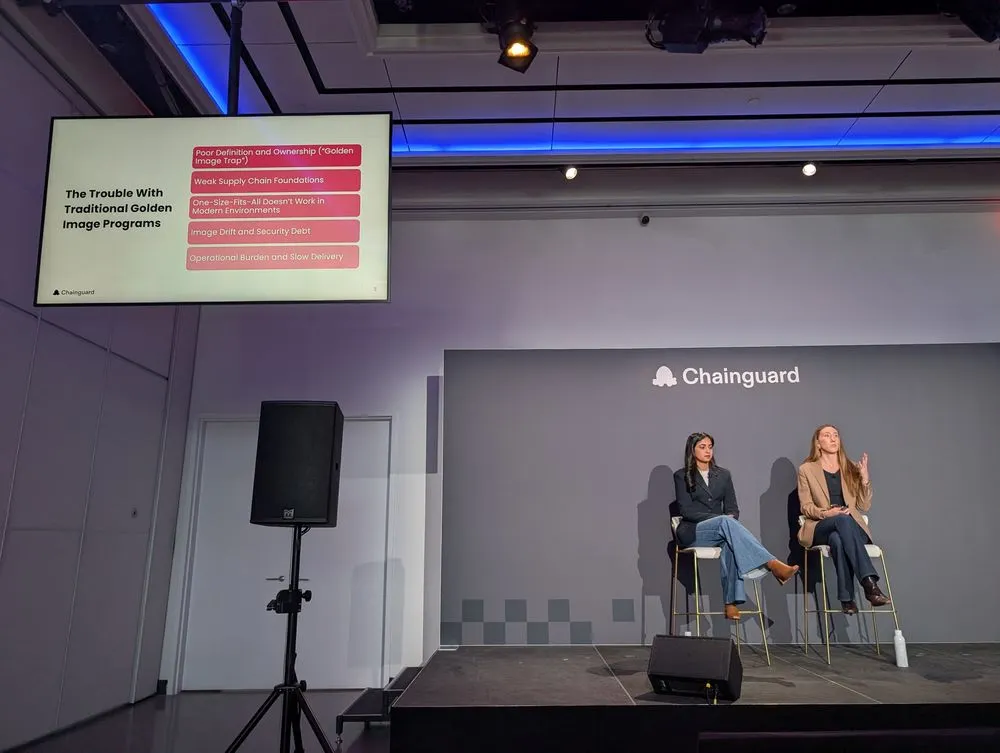
Ayesha Bhutto and Molly Soja
Developer Speed Needs A Support Model
In the session from Brandon Heard, Technical Leader at PeopleTec, called "Developer Productivity Without Compromise," he told us his job is to let developers go as fast as they want, as often as they want, without making security a tax on delivery. He stressed that the details matter.
His approach rested on one blessed runtime, security built into development workflows, and migration treated as a supported program rather than a mandate. The rollout mechanics were concrete, involving taking a full inventory of existing images, piloting non-critical services, and automating through CI and templates. He supported the developers themselves by publishing example commits and holding office hours. This is not what typically happens in his experience; normally, platform or security teams announce a standard and assume adoption will follow. Brandon showed that adoption is a product problem as much as a technical one.
The before-and-after comparison gave the story weight. Images dropped from roughly 600 MB to 120 MB. High CVEs dropped from 12 to 2. SBOMs became a default output instead of an afterthought. There is an operational lesson here that secure defaults only scale when accompanied by documentation, migration patterns, and support channels that respect how engineering teams actually work.
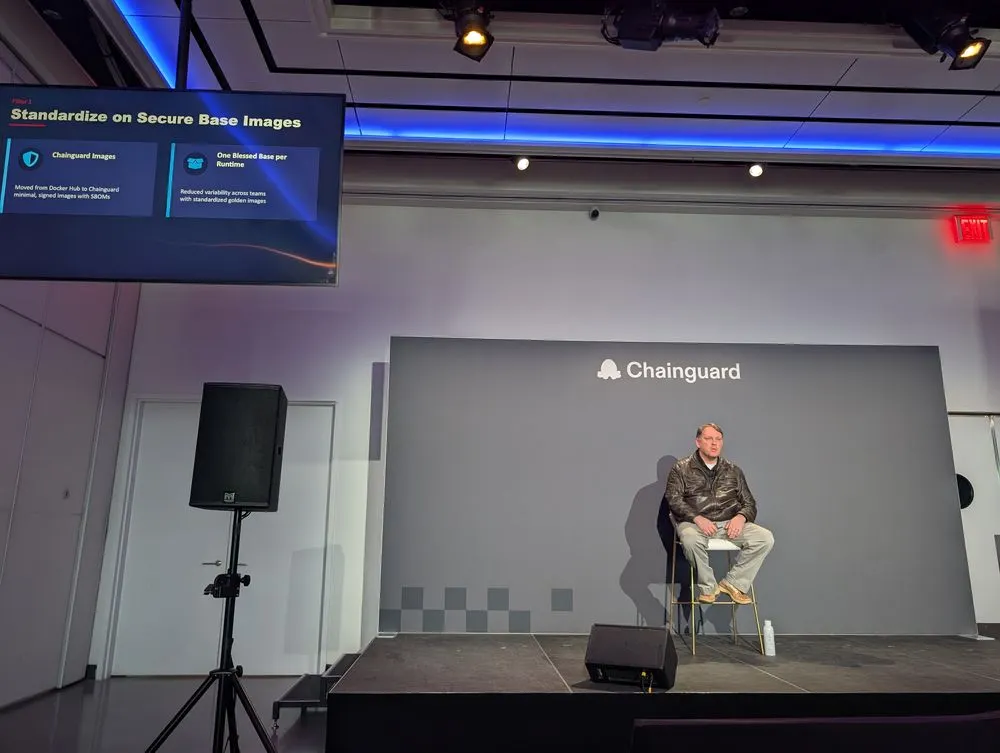
Brandon Heard
Compliance At Lunar Velocity
In his session, "Securing the Next Moon Age: Automated Compliance Powers the Next Giant Leap," Collin Estes, CIO at MRI Technologies working at NASA, presented the most compelling high-stakes, real-risk example of the day. The context was NASA missions, flight readiness, and systems where the question "is it safe to fly?" is literal.
Collin described a stack of platform, compliance, and supply chain problems that will sound familiar outside aerospace: multiple cloud environments, bespoke platforms, complex data flows, inherited controls, and the challenge of continuous authorization across hundreds of controls and overlays. They needed to address compliance and delivery simultaneously. The platform they developed absorbed much of the control burden. GitOps, identity federation, brokered services, and hardened container supply chains became a force multiplier for both operations and auditability.
He described the shift toward continuously delivering trust rather than chasing a "point-in-time clean state." A zero-CVE pull today says little about tomorrow unless the surrounding system keeps reconciling, updating, and proving what changed. When a software factory model reaches a mission-critical environment, compliance stops being paperwork and becomes part of the operating substrate.
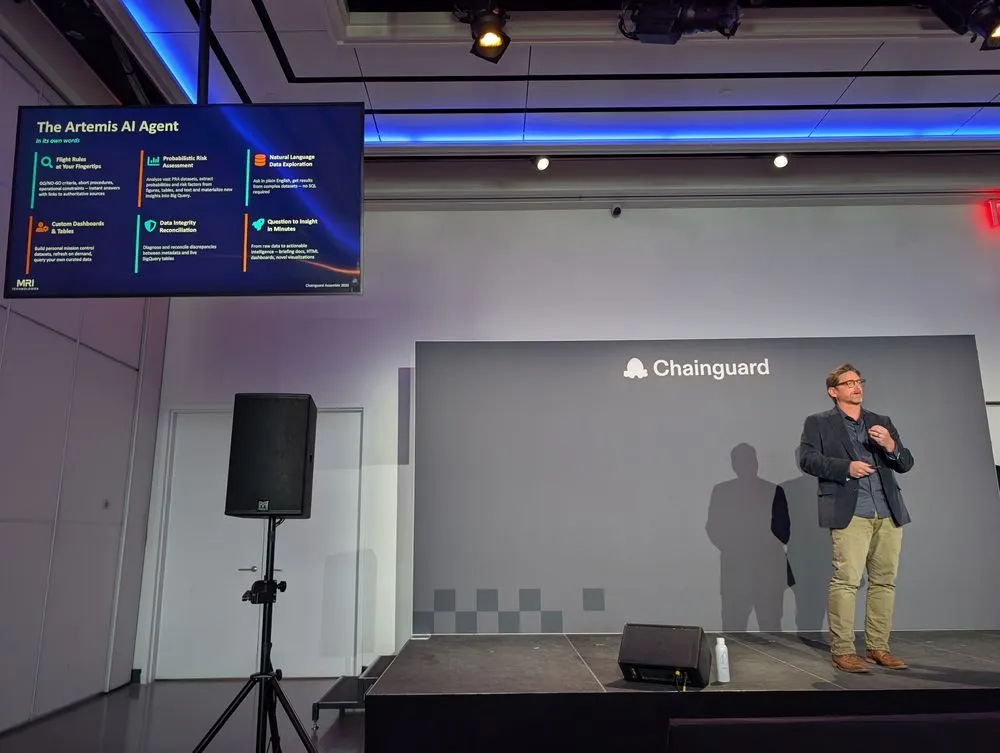
Collin Estes
Security Is Moving Upstream Because Timelines Have Changed
AI assistance, dependency churn, malicious package discovery, and faster release expectations have all shortened the window between creation and consequence. That does not just create more work for security teams. It changes where security work belongs. When the cycle compresses, downstream review becomes a bottleneck, and bottlenecks get bypassed.
Many talks focused on source builds, policy enforcement at package boundaries, hardened actions, and secure defaults in developer tooling. The goal is no longer to catch bad outcomes late. It is to constrain what can enter the system in the first place.
Trust Is Becoming A Property Of Systems, Not Vendors
Another pattern across the event was a shift from brand trust to process trust. Several sessions touched on this from different angles, including cryptographic authenticity, trusted package sources, reconciliation loops, and audit trails for agents. Teams need verifiable control over how software is built, updated, and promoted.
AI increases output faster than it increases confidence. If more code, more automation, and more decisions are flowing through the pipeline, then "trust us" is not enough. Systems have to show their work, preserve provenance, and make validation a first-class function.
Operational Maturity Now Includes Non-Human Identities
Modern governance has to account for agents, prompts, skills, actions, and machine-driven workflows as real participants in the supply chain. This was never presented as science fiction at Assemble. It was discussed as the current operational reality. Teams are already pulling external skills, running agentic workflows, and handing meaningful tasks to systems that can move much faster than manual reviewers.
We are seeing a rapid shift in how we need to think about governance models. Identity risk is no longer only about employees and service accounts. Secret sprawl is no longer only a developer hygiene problem. Non-human identities with inherited permissions and agent behavior need to be managed with the same seriousness as runtime images and dependency graphs.
Assembling A More Secure, AI-Powered Future
Assemble 2026 featured many product announcements, but that was not the main takeaway from the many hallway conversations. Everything at the event pointed to the reality that security teams cannot keep acting as if software is still produced by small groups moving at human review speed. The tools and way we work have changed. As AI agents and assistants get more powerful, the risks are less forgiving, and the output volume is already beyond what manual processes can govern.
Automation alone is not the answer, and no single tool can make us secure. But we need automation inside systems designed for trust, delivering reproducible updates, policy-backed repositories, and auditable agent behavior. We must think about reducing variance in how we build before it becomes real risk. That is relevant whether you are building for financial services, federal environments, commercial SaaS, or missions that end in splashdown.
Security maturity in 2026 is less about scanning harder and more about deciding where trust is manufactured. For teams dealing with identity risk, secrets sprawl, and the growing governance burden around non-human actors, that factory mindset looks less like a nice architectural pattern and more like the cost of keeping up.
*** This is a Security Bloggers Network syndicated blog from GitGuardian Blog - Take Control of Your Secrets Security authored by Dwayne McDaniel. Read the original post at: https://blog.gitguardian.com/chainguard-assemble-2026/
如有侵权请联系:admin#unsafe.sh