好的,我现在需要帮用户总结一篇文章的内容,控制在100字以内。首先,我得仔细阅读文章,理解其主要观点。文章主要讲的是微软报告中提到的网络攻击者如何利用生成式AI工具进行各种恶意活动,比如侦察、钓鱼、基础设施开发、恶意软件创建等。AI帮助他们提高攻击速度,扩大规模,并降低技术门槛。 接下来,我需要确定用户的需求。用户希望用中文总结,并且不需要特定的开头,直接描述内容即可。同时,字数限制在100字以内,所以要简洁明了。 然后,我要提取关键信息:微软报告、AI在攻击中的应用、具体任务如钓鱼邮件、恶意软件开发、数据处理等。还要提到攻击者如何绕过安全措施使用AI。 最后,组织语言,确保涵盖所有要点,并且符合字数限制。可能的结构是先点明主题,再列举具体应用和影响。 </think> 微软报告指出,网络攻击者正利用生成式AI工具加速攻击、扩大恶意活动规模并降低技术门槛。AI被用于钓鱼邮件编写、恶意软件开发、数据处理等任务,并帮助攻击者绕过安全措施。 2026-3-7 15:31:17 Author: www.bleepingcomputer.com(查看原文) 阅读量:19 收藏

Microsoft says threat actors are increasingly using artificial intelligence in their operations to accelerate attacks, scale malicious activity, and lower technical barriers across all aspects of a cyberattack.
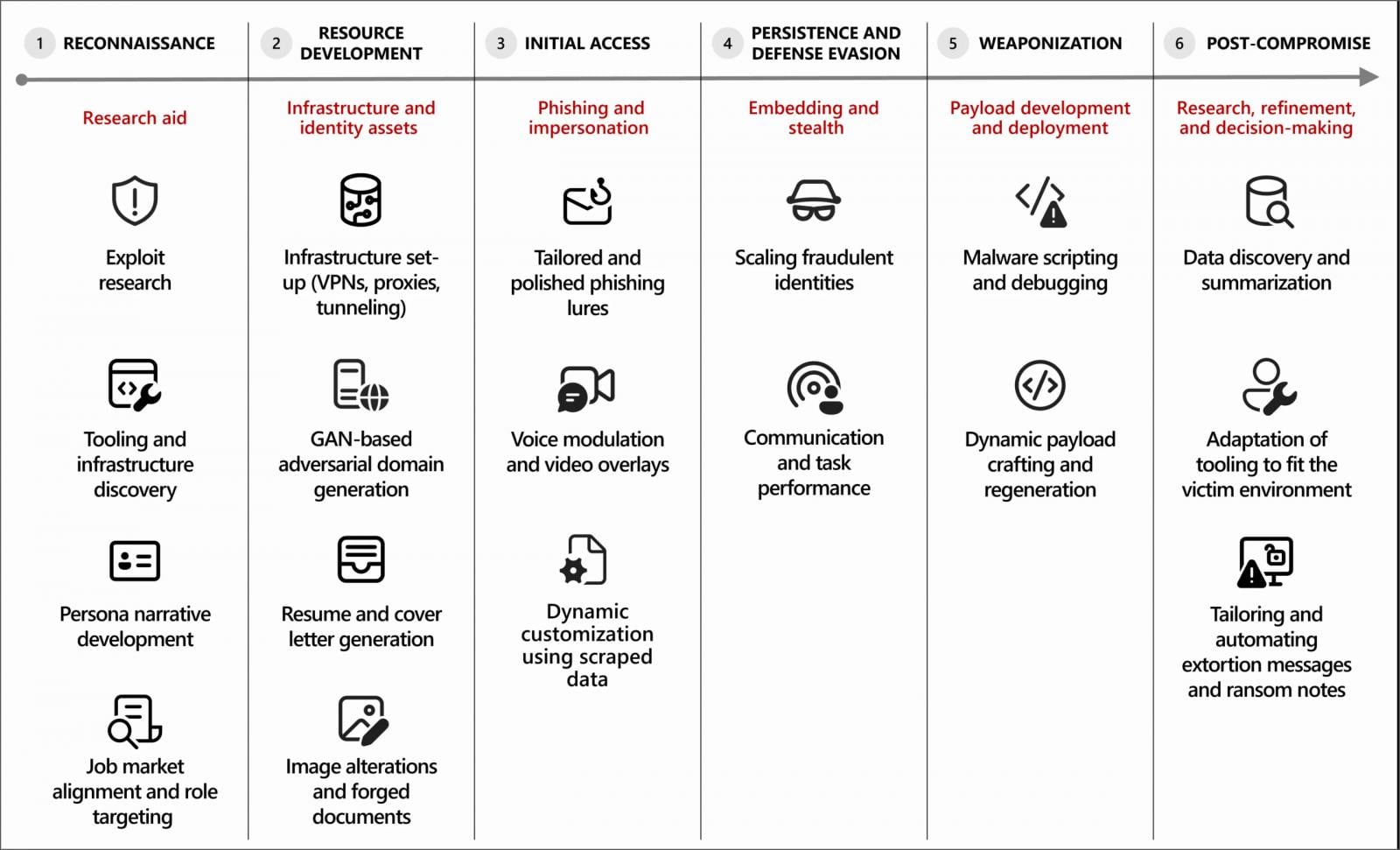
According to a new Microsoft Threat Intelligence report, attackers are using generative AI tools for a wide range of tasks, including reconnaissance, phishing, infrastructure development, malware creation, and post-compromise activity.
In many cases, AI is used to draft phishing emails, translate content, summarize stolen data, debug malware, and assist with scripting or infrastructure configuration.
"Microsoft Threat Intelligence has observed that most malicious use of AI today centers on using language models for producing text, code, or media. Threat actors use generative AI to draft phishing lures, translate content, summarize stolen data, generate or debug malware, and scaffold scripts or infrastructure," warns Microsoft.
"For these uses, AI functions as a force multiplier that reduces technical friction and accelerates execution, while human operators retain control over objectives, targeting, and deployment decisions."
Source: Microsoft
AI used to power cyberattacks
Microsoft has observed multiple threat groups incorporating AI into their cyberattacks, including North Korean actors tracked as Jasper Sleet (Storm-0287) and Coral Sleet (Storm-1877), who use the technology as part of remote IT worker schemes.
In these operations, AI tools help generate realistic identities, resumes, and communications to gain employment at Western companies and maintain access once hired.
Jasper Sleet leverages generative AI platforms to streamline the development of fraudulent digital personas. For example, Jasper Sleet actors have prompted AI platforms to generate culturally appropriate name lists and email address formats to match specific identity profiles. For example, threat actors might use the following types of prompts to leverage AI in this scenario:
Example prompt 1: “Create a list of 100 Greek names.”
Example prompt 2: “Create a list of email address formats using the name Jane Doe.“
Jasper Sleet also uses generative AI to review job postings for software development and IT-related roles on professional platforms, prompting the tools to extract and summarize required skills. These outputs are then used to tailor fake identities to specific roles.
❖ Microsoft Threat Intelligence
The report also describes how AI is being used to assist with malware development and infrastructure creation, with threat actors using AI coding tools to generate and refine malicious code, troubleshoot errors, or port malware components to different programming languages.
Some malware experiments show signs of AI-enabled malware that dynamically generate scripts or modify behavior at runtime.
Microsoft also observed Coral Sleet using AI to quickly generate fake company sites, provision infrastructure, and test and troubleshoot their deployments.
When AI safeguards attempt to prevent the use of AI in these tasks, Microsoft says threat actors are using jailbreaking techniques to trick LLMs into generating malicious code or content.
In addition to generative AI use, Microsoft researchers have begun to see threat actors experiment with agentic AI to perform tasks autonomously and adapt to results.
However, Microsoft says AI is currently used primarily for decision-making rather than for autonomous attacks.
Because many IT worker campaigns rely on the abuse of legitimate access, Microsoft advises organizations to treat these schemes and similar activity as insider risks.
Furthermore, as these AI-powered attacks mirror conventional cyberattacks, defenders should focus on detecting abnormal credential use, hardening identity systems against phishing, and securing AI systems that may become targets in future attacks.
Microsoft is not alone in seeing threat actors increasingly using artificial intelligence to power attacks and lower barriers to entry.
Google recently reported that threat actors are abusing Gemini AI across all stages of cyberattacks, mirroring what Amazon observed in this campaign.
Amazon and the Cyber and Ramen security blog also recently reported on a threat actor using multiple generative AI services as part of a campaign that breached more than 600 FortiGate firewalls.
Red Report 2026: Why Ransomware Encryption Dropped 38%
Malware is getting smarter. The Red Report 2026 reveals how new threats use math to detect sandboxes and hide in plain sight.
Download our analysis of 1.1 million malicious samples to uncover the top 10 techniques and see if your security stack is blinded.
如有侵权请联系:admin#unsafe.sh