
好的,我现在需要帮用户总结一篇文章的内容,控制在100字以内。首先,我得仔细阅读文章,理解其主要观点。 文章主要讨论了SOC(安全运营中心)工具过多的问题。平均每个SOC管理83个工具,来自近30个供应商。这些工具大多无法协同工作,导致SOC花费大量时间管理基础设施而不是防御威胁。高管们认为复杂性是最大的障碍。 接下来,文章提到整合趋势:75%的组织正在积极减少安全供应商数量,高于2020年的29%。整合的原因包括人才短缺、预算压力和监管要求。整合后,ROI提高了四倍,威胁检测和缓解速度也加快了。 SOAR平台被寄予厚望,但实际效果不佳,因为集成不稳定和静态剧本的问题。D3 Morpheus提出了一种新的架构,通过统一平台整合SOAR、XDR、案例管理和AI驱动的调查,减少复杂性。 最后,文章强调Morpheus的优势:自愈合集成、AI驱动的分类、治理缓解和透明度。这使得SOC更高效、更少依赖人工维护。 总结时要涵盖主要问题、整合趋势、SOAR的问题以及Morpheus的解决方案。控制在100字以内,直接描述内容。 </think> 文章指出安全运营中心(SOC)面临工具过多且难以协同工作的挑战,并强调了整合和简化的重要性。通过引入D3 Morpheus平台,实现统一管理和自愈合集成,提升效率并降低复杂性。 2026-3-5 22:55:37 Author: securityboulevard.com(查看原文) 阅读量:7 收藏
The average SOC manages 83 security tools from nearly 30 vendors. If that number surprises you, you’ve probably never had to onboard a new Tier 1 analyst and watch them try to navigate the labyrinth of consoles, dashboards, and alert streams that constitute modern security operations.
The uncomfortable truth is that most of those tools are not designed to work together. Every additional tool adds another alert stream, another data format, another integration to maintain, and another vendor contract to negotiate. The result is a SOC that spends more time managing its own infrastructure than defending the organization.
And the data bears this out. 52% of executives say complexity is the single biggest impediment to their security operations.
The consolidation wave is here
According to Gartner, 75% of organizations are actively pursuing security vendor consolidation, up from just 29% in 2020. That’s not incremental growth; it’s a fundamental shift in how CISOs think about building their security architecture.
The drivers are converging from every direction. The global cybersecurity workforce gap hit 4.8 million professionals in 2024, a 19% increase year-over-year. Budget pressure is mounting, with 37% of organizations facing security budget cuts last year. And regulators are demanding more comprehensive audit trails that are nearly impossible to produce when your data lives in 30 different platforms.
Consolidation works. IBM research shows organizations with consolidated security platforms generate four times greater ROI (101% versus 28% for fragmented environments). They identify threats 72 days faster and mitigate them 84 days sooner. Gartner estimates consolidated platforms deliver a 15–25% reduction in overall security spend within 12 to 24 months.
Cutting complexity, not cutting corners.
The SOAR problem nobody talks about
SOAR platforms were supposed to be the answer. Connect all your tools, automate the repetitive work, let analysts focus on real threats. The vision was right. The execution has been painful.
D3 Security President Gordon Benoit calls it “the Achilles heel of SOAR”: brittle integrations and static playbooks that break the moment your environment changes. An EDR vendor updates their API schema. An identity platform rotates its authentication format. Suddenly, playbooks fail silently, alerts pile up, and your senior engineers, the ones you hired to hunt threats, are debugging Python scripts.
This is the “integration drift tax”, the hidden, recurring cost of maintaining the web of connections that makes SOAR work. The more you automate, the more maintenance you create. It’s a treadmill, and most organizations are running faster just to stay in place.
And the playbooks themselves? They’re static logic applied to dynamic threats. When adversaries shift tactics, your pre-built workflows don’t adapt. They just miss things, until a human notices and manually updates the logic. By then, the window of exposure may have been open for weeks.
A different architecture: D3 Morpheus
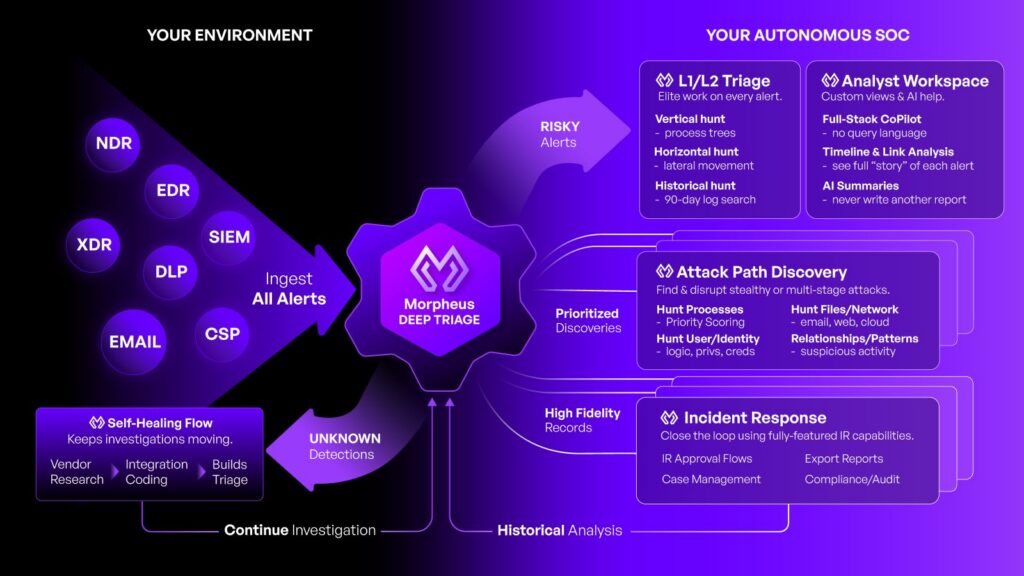
Morpheus doesn’t layer AI on top of a traditional SOAR platform. It replaces the paradigm entirely with what D3 calls an Autonomous SOC Platform, a single environment that unifies SOAR orchestration, XDR-style correlation, case management, and AI-driven investigation.
Here’s how it works in practice:
Alert ingestion. Morpheus connects to your entire security stack through 800+ bidirectional integrations across EDR, SIEM, XDR, identity, email, cloud, and network. It ingests alerts, not raw logs, which means it works with your existing detection investments and complements them.
AI-driven triage via Attack Path Discovery. This is where Morpheus diverges from every “AI-enhanced SOAR” on the market. Attack Path Discovery goes beyond enriching alerts with contextual data. It maps the relationships between users, assets, and processes to trace the full trajectory of a potential attack. It identifies lateral movement and privilege escalation patterns that rule-based detection misses. The system is roughly 70–80% deterministic framework and 20–30% LLM. The framework constrains the AI into verifiable, step-by-step investigation, preventing unconstrained generation. The result: 95% of alerts triaged in under two minutes, with customers reporting 99%+ alert reduction.
Governed remediation. When Morpheus confirms a threat, it executes response through policy-governed workflows with configurable approval gates. High-impact actions like disabling accounts or isolating servers require human sign-off. Routine containment runs automatically. The playbooks themselves aren’t static templates; they’re generated contextually in response to each specific incident.
Integrated case management. Investigations live in a single workspace with full evidence chain of custody, automated timelines, and the complete audit trail from AI triage through remediation. One platform handles everything that used to require switching between a SOAR console and a separate case management tool.
Self-healing integrations. This is the capability that directly attacks SOAR’s Achilles heel. When APIs drift, schemas change, or detection outputs shift, Morpheus detects the change and generates corrective code autonomously. Alerts keep flowing. Analysts don’t babysit broken connectors. The integration drift tax drops to near zero.
The GRC advantage
For CISOs reporting to boards and navigating regulatory audits, Morpheus’s transparency is a strategic asset. Every automated decision comes with a complete log of the logic applied: the evidence considered, the reasoning chain, the actions taken, and the alternatives evaluated. When compliance teams audit, they see the full thought process on every alert.
As Benoit puts it: for any person purchasing an AI product, auditability is extremely important. In an era where regulators are increasingly scrutinizing automated decision-making, having an AI system that can explain itself is table stakes.
The path forward
The organizations that consolidate now are building the unified data and operational foundation that these advances require. The consolidation path with Morpheus is deliberately non-disruptive. Your EDR stays. Your SIEM stays. Your identity platform stays. What changes is the operational layer, the place where alerts become investigations, investigations become cases, and cases become resolved incidents. You manage that entire workflow in one platform.
Your SOC doesn’t need more tools. It needs fewer, better-connected, AI-driven ones. And it needs them to heal themselves when the environment inevitably changes.
That’s what Morpheus was built to do.
To learn more about how D3 Morpheus can consolidate your security operations, visit d3security.com/morpheus or request a demo.
The post Your SOC Doesn’t Need More Tools. It Needs Fewer. appeared first on D3 Security.
*** This is a Security Bloggers Network syndicated blog from D3 Security authored by Shriram Sharma. Read the original post at: https://d3security.com/blog/soc-consolidation-fewer-tools/
如有侵权请联系:admin#unsafe.sh