好的,我现在需要帮用户总结一篇文章的内容,控制在100字以内。首先,我得仔细阅读文章,抓住主要观点。 文章主要讲的是企业架构的变化和安全问题。过去架构比较简单,现在变得复杂,数据分散在AI平台、边缘应用、微服务等地方。这导致了安全盲点。 接着,文章介绍了Salt公司的两个新产品:Databricks连接器和Netlify收集器。Databricks连接器用于监控AI行为层,发现隐藏的服务器和潜在风险。Netlify收集器则用于捕捉边缘流量,确保即使不经过中心网关也能被监控。 最后,文章强调了全面可见性的重要性,认为安全必须覆盖所有层面,从核心到边缘。 现在我要把这些要点浓缩到100字以内。重点包括架构变化、安全盲点、新产品功能以及全面可见性的必要性。 可能会这样组织:企业架构变得复杂,数据分散导致安全盲点。Salt推出两个工具监控AI和边缘流量,实现全面可见性以应对API安全挑战。 检查字数是否合适,并确保没有使用开头的固定句式。 </think> 企业架构日益复杂化,数据分散在AI平台、边缘应用及微服务中,形成安全盲点。Salt推出Databricks连接器和Netlify收集器,监控AI行为与边缘流量,实现全面API攻击面可见性。 2026-1-22 14:31:16 Author: securityboulevard.com(查看原文) 阅读量:0 收藏
If you look at an enterprise architecture diagram from five years ago, it looks relatively tidy. You had a data center, maybe a cloud provider, and a few gateways. Today, that diagram looks like a constellation.
Data is living in AI platforms like Databricks. Frontend applications are pushed to the edge on Netlify. Logic is scattered across microservices, serverless functions, and legacy IIS servers.
For security teams, this fragmentation creates a massive headache: Blind Spots.
At Salt, our mission has always been to provide the most complete view of your API attack surface. Today, we are taking a massive step forward in that mission with two major releases that might seem different on the surface but solve the exact same problem: The Salt Databricks Connector and the Salt Netlify Collector.
1. Shining a Light on the “Agentic AI Action Layer” (Where CNAPP Goes Dark)
We talk a lot about “Shadow API,” but “Shadow AI” is becoming an even bigger risk. Your data science teams are moving fast, building AI agents and Model Context Protocol (MCP) servers directly inside platforms like Databricks to crunch massive datasets.
The problem? Traditional security tools don’t look inside the behavior of the data lake.
- A CNAPP (Cloud Native Application Protection Platform) will assess your Databricks cluster and report whether the VM is patched and whether the storage bucket is encrypted.
- But it cannot tell you that an AI agent running on that cluster just queried a User Database and sent the results to a third-party Slackbot.
The Salt Difference: Complete Visibility. Our new Databricks Connector is specifically designed to secure the Agentic AI Action Layer within Databricks. We don’t just scan the “box”; we look at the “traffic.” It discovers:
- Hidden MCP Servers: The specific “tools” your AI agents use to fetch data.
- Agentic Workflows: Which internal APIs are being queried by autonomous agents?
- Governance Gaps: Is that internal research bot inadvertently exposing PII?
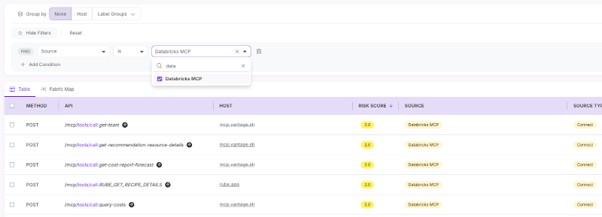
We prioritized Ease of Use above all else. You connect the integration, and Salt automatically populates your Unified Inventory with these AI assets, letting you govern them alongside your standard REST and GraphQL APIs, all within minutes.
2. Securing the Modern Edge (Before it Hits the Gateway)
On the other side of the stack, developers are moving to composable architectures. Platforms like Netlify have revolutionized how we build and deploy web apps, pushing content and logic closer to the user.
But “decoupled” often means “unmonitored.” In a Netlify architecture, traffic often hits the edge and executes logic without ever passing through your centralized corporate API Gateway. If your security relies on that gateway, you are blind.
We built the Salt Netlify Collector to close this gap. It allows us to capture traffic directly from the modern, decoupled frontend stack with the same fidelity as a traditional load balancer.
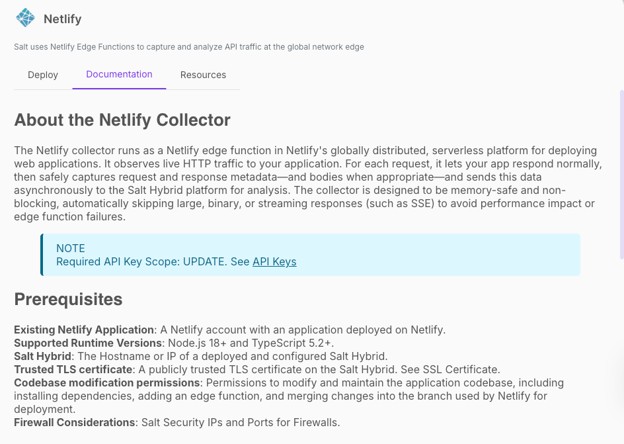
The Speed of Innovation. This release isn’t just about Netlify; it’s a proof point for our agility. The modern web changes fast. Developers will adopt a new edge platform tomorrow. Because Salt is built on a flexible, agnostic architecture, we can rapidly build and deploy new collectors for these platforms to meet customer requirements. We ensure that your security program moves as fast as your developers, never forcing them to slow down innovation just to stay compliant.
The Power of “And”
Security vendors often ask you to choose: Do you want to secure your Cloud? Your Code? Your AI?
We believe you need to secure everything. Whether it’s an AI agent querying a database in Databricks or a customer hitting a static site on Netlify, it’s all part of your API Fabric. And with Salt, you can finally see it all in one place.
The era of fragmented security is over. You cannot govern what you cannot see, and you cannot secure what you cannot reach. It’s time to demand universal visibility, from the agentic core to the composable edge.
If you want to learn more about Salt and how we can help you, please contact us, schedule a demo, or visit our website. You can also get a free API Attack Surface Assessment from Salt Security’s research team and learn what attackers already know.
*** This is a Security Bloggers Network syndicated blog from Salt Security blog authored by Eric Schwake. Read the original post at: https://salt.security/blog/from-the-data-lake-to-the-edge-why-universal-visibility-is-the-future-of-api-security
如有侵权请联系:admin#unsafe.sh