嗯,用户让我用中文帮他总结一下这篇文章的内容,控制在一百个字以内,而且不需要以“文章内容总结”或“这篇文章等”这样的开头,直接写文章描述即可。首先,我需要仔细阅读这篇文章,理解其主要内容和重点。 这篇文章的标题是“威胁警告:利用2026年1月美国在委内瑞拉行动的诈骗活动”。看起来是关于网络犯罪分子如何利用美国在委内瑞拉的军事行动进行诈骗活动的分析报告。执行摘要部分提到,在美国对委内瑞拉采取军事行动后,网络犯罪分子迅速注册了许多可疑域名,用于各种恶意活动。 接下来,文章详细分析了这些域名的数量、注册商、国家分布以及使用的顶级域名类型。数据显示,GoDaddy.com是最常用的注册商,其次是NameCheap等。注册国家主要集中在美国内地、冰岛等。顶级域名主要是.com,其次是.org和.net。 然后是关键词分析部分,关键词包括“venezuela”、“oil”、“maduro”等,显示出这些诈骗活动主要围绕委内瑞拉的政治、石油资源以及前总统马杜罗展开。此外,文章还提到了时间线和威胁分析,从军事行动前到行动后几天内,诈骗活动如何演变。 最后是整体建议和缓解措施,建议跟踪危机关键词,并采取预测监控解决方案来打击欺诈基础设施。 现在需要将这些信息浓缩到100字以内。重点应放在网络犯罪分子如何利用美国在委内瑞拉的行动进行诈骗活动,包括大量可疑域名的注册、关键词分析以及涉及的行业如能源和加密货币。 所以总结应该是:网络犯罪分子利用2026年1月美国在委内瑞拉的军事行动进行诈骗活动,在此期间注册了大量可疑域名,并使用关键词如“venezuela”、“oil”、“maduro”,涉及能源和加密货币等行业。 </think> 网络犯罪分子利用2026年1月美国在委内瑞拉的军事行动进行诈骗活动,在此期间注册了大量可疑域名,并使用关键词如“venezuela”、“oil”、“maduro”,涉及能源和加密货币等行业。 2026-1-22 12:2:26 Author: bfore.ai(查看原文) 阅读量:49 收藏
Threat Advisory: Scam Activity Leveraging U.S. Actions in Venezuela in January 2026

Executive Summary: Scam Activity Leveraging U.S. Actions in Venezuela in January 2026
Date: January 2026
Source: PreCrime™ Labs
PreCrime™ Labs, the threat research division of BforeAI, has identified a high concentration of suspicious scam-related activity linked to the U.S. government’s recent activity in Venezuela. While the internet remains somewhat divided on the potential outcomes of the developing situation in Venezuela, cybercriminals are running their own agendas, taking all sides, and launching malicious infrastructure aimed at victimizing interested and invested parties using various themes. In the days since the January 2 U.S. military operation to capture Venezuela’s now-deposed president, Nicolas Maduro, there has been a great deal of registration activity. However, it is also important to note that, due to ongoing U.S. operations targeting alleged drug boats in coastal waters around Venezuela, significant staging activity in anticipation of some sort of event was occuring. So far, the majority of the malicious campaigns related to the Venezuela affair are focused on merchandise and shops, with a few others targeting other industries, such as real estate, energy, and cryptocurrency industries.
Note: Over 60% of the observed suspicious domains were either for sale, under construction, or in parked state as of the publication of this report.

Emerging Tech Gartner® Report
Get complimentary access to the Gartner report, Emerging Tech: Tech Innovators in Preemptive Cybersecurity
When the PreCrime Labs team investigated new domains related to the Venezuela matter and registered from December 1- January 12, 2026, a total of 829 domains were determined to be suspicious. An even more recent surge in domain registrations, primarily in January 2026, dominates the dataset. Approximately 546 domains were registered in the time period between January 3-5, 2026 alone. This represents a significant spike in activity compared to the December 2025 period leading up to the January 2 military action in which 110 related domains were registered over the entire month.
Registrars: GoDaddy.com, LLC was the most commonly-used registrar in this registration cluster, accounting for 322 of the registrations. NameCheap, Inc. was the second most popular registrar with 134 registrations. Other prominent registrars include Ionos SE, SquareSpace Domains, LLC, and Tucows Domains, Inc.
Registration by country: In terms of registration by country, the United States has had the most so far, with 84 registrations. Iceland is the second most common registrant country with 56 entries. Other prominent countries include Spain, Austria, and Czech Republic.
Most-used top level domains (TLD): The majority of suspicious domains were registered with the “.com” TLD (580), followed by “.org” (83) and “.net” (31). Fewer, yet notable, usage was observed for “.xyz” (22) and “.info” (19).
|
Keyword |
Count |
Keyword |
Count |
|---|---|---|---|
|
venezuela |
45 |
oil |
8 |
|
maduro |
16 |
venezuelaoilwatch |
6 |
|
venezia |
11 |
captureofmaduro |
5 |
|
makevenezuelagreatagain |
8 |
trump |
6 |
|
venezuelanreparations |
5 |
huntvenezuela |
5 |
Timeline and Threat Analysis
Day 0: Prior to the incident
In the lead-up to the January 2 military action, long-standing domains started appearing around the conflict giving the predictive indicators of potential future attacks. This reflects intentional narrative priming, establishing moral justification of any claimed action in the future. Domains such as “venezuela-war”, “warinvenezuela”, and “venezualandrugboats” were registered in the days spanning December 17-23, 2025, right after a series of U.S. strikes on alleged drug-smuggling boats in the eastern Pacific took place.

Claims emerged alleging that U.S. forces had captured President Nicolás Maduro and his wife, positioning the action as a counter-narcotics operation rather than a conventional military strike. These claims spread rapidly, despite limited verifiable confirmation at the time. Since these incidents unfolded, several of these “live tracking” websites have emerged, claiming to provide timely updates. Sites like these should be regarded with suspicion and treated with extreme caution.

As events unfolded, several merchandise stores emerged on the same day offering discounts and inviting people to celebrate the imprisonment using “harsh” terms. However, this divided the internet, while some websites reflected celebratory narratives, others emerged calling for Maduro to be freed.
Visuals and reports began circulating showing some Venezuelans allegedly celebrating the removal of leadership, with crowds cheering, statues being defaced, and symbolic acts of relief. These images became a dominant emotional driver, leading to the emergence of more online shops and websites claiming to sell merchandise and “parked” domains around releasing Maduro from prison. On this day, we also observed registrations of domains such as “makevenezuelagreatagain”.


Maduro’s first public statement occurred on Jan 5, 2026 in Manhattan federal court during his first appearance, in which he wished journalists a Happy New Year, pleaded not guilty, and said that rather than being arrested he had been “kidnapped.” In this same appearance, Maduro asserted he is still the rightful president of Venezuela, and described himself as a “prisoner of war.” Maduro’s wife, Cilia Flores, also pleaded not guilty.
January 5 also saw a surge in activity around merchandise stores and listings for buying and selling real estate in Venezuela. Simultaneously, there was a noticeable rise in domains linked to energy companies, employment, and oil and mineral sectors, signaling a narrative shift toward Venezuela’s natural reserves and the growing external interest in them.
Days 4-5: January 6-7, 2026
Even as the immediate shock of the overnight capture of Maduro subsides, parallel counter-narratives begin to emphasize the idea of Maduro’s “abduction.” Websites related to mining services began to surface, alongside meme-driven content and domains referencing a proposed new viceroy of Venezuela. With the assumption that new opportunities will present themselves in coming months, additional seculative domains appeared discussing new rights and even banking institutions, although many of these remain under construction.
January 5 also saw a surge in activity around merchandise stores and listings for buying and selling real estate in Venezuela. Simultaneously, there was a noticeable rise in domains linked to energy companies, employment, and oil and mineral sectors, signaling a narrative shift toward Venezuela’s natural reserves and the growing external interest in them.

Day 6-onward: January 8-12, 2026
Media coverage reflected uncertainty surrounding Venezuela’s political transition and concerns over lingering power structures. Following Trump’s declaration as the immediate acting president of Venezuela, a fresh wave of domains appeared, many still under construction.

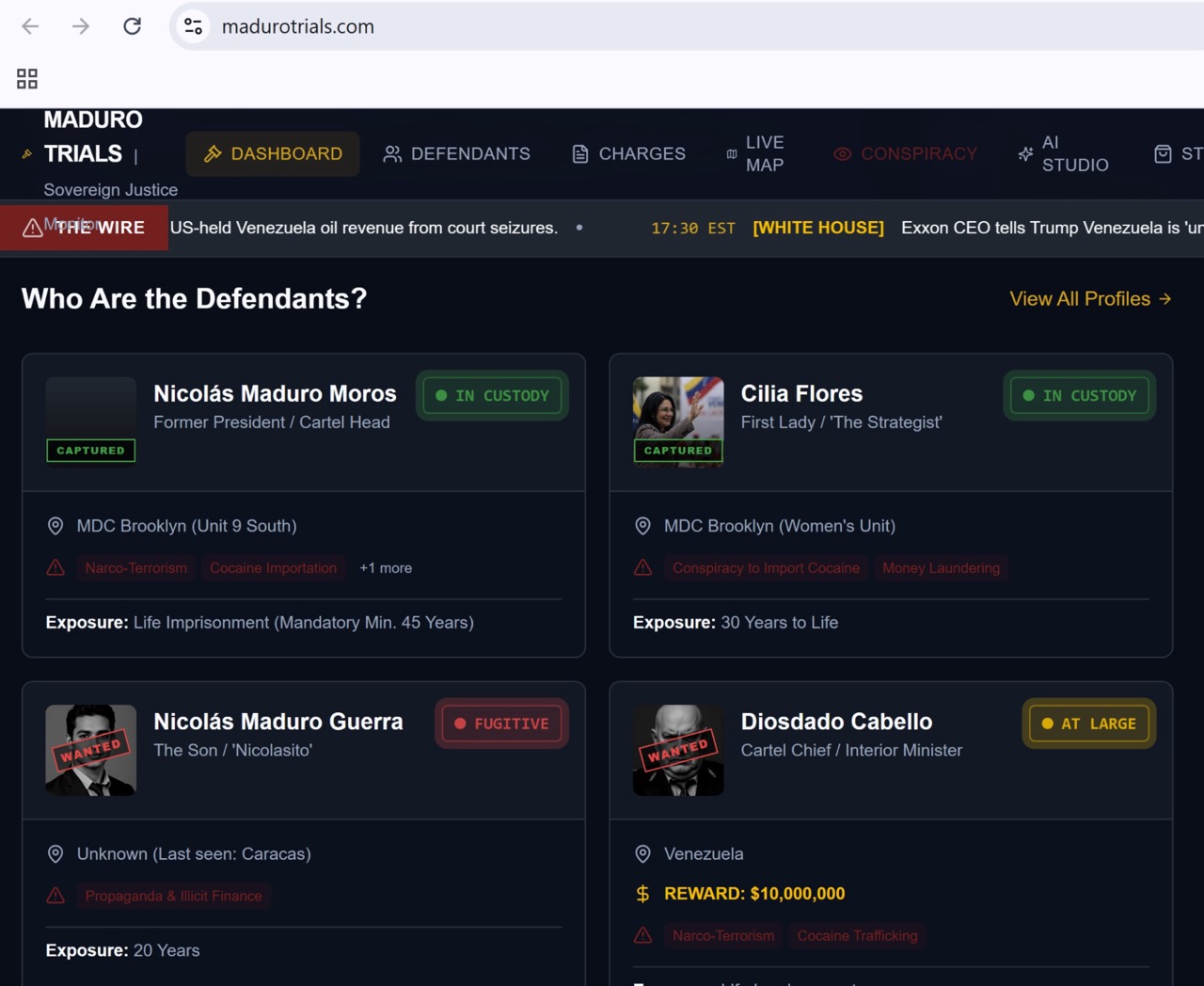
A Notable Meme-coin Campaign
We observed a set of domains that, at first, appeared to be blending political satire with meme-coin marketing by leveraging controversy, outrage, and recognition to drive attention and speculative buying. In the example given below, the “most wanted” framing suggests provocation as an engagement strategy. Since crisis conditions reduce critical evaluation and increase impulsive engagement, we have repeatedly observed these types of campaigns launching during or immediately after high-profile geopolitical events, indicating that criminals find this tactic to be successful.

Along with this, the “madurocoin community” branding creates an illusion of legitimacy, even with a very small member count. The perception of belonging to an early insider group significantly boosts engagement and opportunistic behavior. Community admins can pin posts, set tone, and repeatedly promote:
- contract addresses
- “most wanted” language
- conflict escalation claims

“Madurocoin” Campaign Observations:
- Adversaries exploit geopolitical crises (e.g., leadership capture claims, war narratives, drug-trafficking framing, etc.) to push emotionally charged, low-verification content that spreads faster than facts.
- Meme coins tied to real-world political figures leverage outrage, satire, and urgency to drive speculative buying and potential exit scams leading to financial losses and normalization of violence and extremism.
- Fraudulent or suspicious sites are being broadcasted on social media, where narratives spread faster to wider audiences. Similar misleading content was seen on Instagram. This leads to false legitimacy through community branding and increased trust in malicious links and CTAs (calls to action).
- Once attention peaks, threat actors pivot to monetization, fake donations, airdrops, legal aid, or fraudulent shops.
Overall Takeaways and Mitigation:
- Track crisis keywords paired with: “aid,” “support,” “registration,” “exclusive,” and “urgent”
- Threat monitors and other public-facing agencies should proactively warn the general public about fake NGOs, legal help, and airdrops by coordinating with fraud detection and threat monitoring tools.
- Deploy brand and persona impersonation detection with special focus on certain news items, like official government statements, trials, etc., as they can be followed with targeted activity leveraging these events.
- Where possible, implement predictive monitoring solutions that can disrupt or take down fraudulent infrastructure before it launches.
Explore our latest PreCrime™ Labs report:
Suspicious Domain Activity in Lead up to 2026 FIFA World Cup Tournament
Phishing Campaign Imitating U.S. Department of Education G5
Ready to see BforeAI in action?
Get a personalized demo
Talk to one of our experts and deploy in minutes.
No implementation needed. Works right out of the box!
如有侵权请联系:admin#unsafe.sh