read file error: read notes: is a directory 2025-9-30 10:43:8 Author: payatu.com(查看原文) 阅读量:25 收藏
🎯Goal of This Blog
Understand the foundational components that make up modern Industrial Control Systems (ICS)—from traditional devices like sensors, actuators, PLCs, RTUs HMIs, SCADA to Industry 4.0 elements like PLM and IIOT systems. We’ll explore their functions, how they interact, how they can be abused by attackers, and how to protect them effectively.
🧩 Why Should You Care About ICS Components?
Trying to secure an ICS environment without understanding its parts is like trying to repair an engine blindfolded. ICS components define the physical and digital boundaries of an OT system, and attackers often exploit the weak links—devices assumed to be invisible or safe.
In the OT stack, understanding how PLCs, RTUs, HMIs, SCADA, and modern IIoT components interoperate is the foundation of both visibility and security.
(Suggested Infographic: Layered ICS ecosystem showing OT as the umbrella → ICS → SCADA/DCS → PLC/RTU → Sensors/Actuators, with data/control flow arrows. Highlight attacker entry points.)
🏗️ Understanding the OT–ICS Hierarchy in Action
Imagine a water treatment plant:
- Level 0: Sensors measure turbidity; actuators open/close valves.
- Level 1: PLCs process sensor input and adjust flow.
- Level 2: HMIs visualise flow rate and alarms.
- Level 3: SCADA aggregates multiple plant data points and remotely alerts engineers.
- Level 4: Historian and PLM log events, trends, and maintenance history.
Now imagine an attacker changes a sensor reading to show clean water when it’s not. The PLC doesn’t react, the actuator remains closed, and contaminated water is released.
⚙️ Meet the ICS Components
1. Programmable Logic Controllers (PLCs)
Think of PLCs as the industrial brain. They receive input from sensors, execute pre-programmed instructions, and then send output signals to devices such as motors, pumps, or valves. They are extremely reliable and built to operate nonstop in noisy, hot, or dusty environments. In short, PLC is a rugged industrial computer that executes control logic.
Real-Life Scenario: Mixing valves in a dairy plant adjust proportions based on PLC logic.

Security Incident: Stuxnet (2010) modified Siemens S7 PLC logic to destroy centrifuges while faking output.
Typical Weaknesses: Hardcoded credentials, unprotected ladder logic uploads, and firmware backdoors.
🔓 Attacker View: Gaining access to an EWS can allow logic tampering in PLCs, changing thresholds, and disabling safety interlocks.
2. Remote Terminal Units (RTUs)

RTUs act like walkie-talkies between sensors in the field and the central control room. They’re used when assets are spread out—such as power lines or oil pipelines—and send updates about the environment back to HQs while also receiving commands. RTU is a field-deployed unit used for telemetry and remote control, especially in SCADA setups.
Real-Life Scenario: Oil pipeline RTUs track pressure and control isolation valves remotely.
Security Incident: In the Oldsmar Water Hack (2021), an exposed HMI behind a remote RTU interface was accessed to adjust sodium hydroxide levels.
🔓 Attacker View: RTUs with exposed services (e.g., Telnet, SNMP) can act as gateways into SCADA networks.
3. Human Machine Interfaces (HMIs)
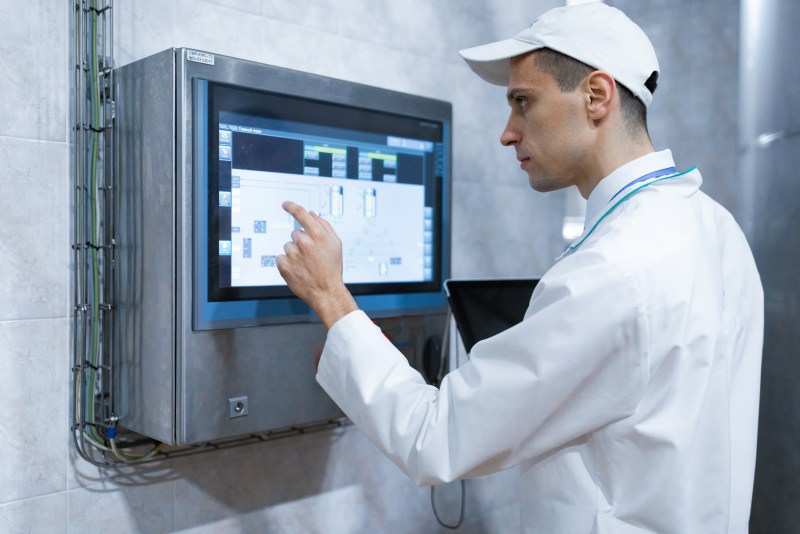
HMIs are like dashboards that let operators monitor and control machines. From visualising temperature trends to acknowledging alarms or tweaking machine settings, HMIs are where people interact with the industrial system. In short, HMI is an Operator-facing dashboard for viewing system status, alarms, and manual overrides.
Real-Life Scenario: A beverage bottling line operator uses an HMI to stop the line when the bottle counts do not match.

Security Incident: Ukraine 2015 blackout—HMI stations were hijacked to cut power and prevent operator visibility.
🔓 Attacker View: A backdoored or unpatched HMI is a perfect access point to manipulate or mislead human operators.
4. Supervisory Control and Data Acquisition (SCADA)

SCADA is like the air traffic control tower for industrial sites. It brings together data from multiple field locations into a single location, allowing operators to view, analyse, and send control signals across long distances.
Role: Provides supervisory control and centralised monitoring of geographically dispersed assets.
Real-Life Scenario: National water utility uses SCADA to oversee dozens of treatment plants from a single dashboard.
Common Vulnerabilities: Weak segmentation, shared remote access passwords, and a lack of protocol encryption.
Expanded Threat Surface: Based on research from Mastering SCADA, SCADA systems face multiple additional threats, including: – Insider misuse of shared admin accounts – Unpatched legacy systems (e.g., Windows 7-based HMIs) – Weak remote access control without MFA – USB-based malware delivery
🔓 Attacker View: Access to SCADA means access to a global view, disrupt alarms, override controls, and pivot to connected sites.

5. Distributed Control Systems (DCS)
A DCS is like a team of mini-brains working together across a plant to manage specific parts of the process. It’s commonly used in places like refineries or chemical plants where local control is better than centralised command. DCS Controls complex industrial processes with localised controllers within a facility
Real-Life Scenario: A refinery uses DCS to regulate heat exchanges, compressors, and chemical mix ratios.

Security Concern: DCS networks often operate flat; compromise of one subsystem can ripple across.
🔓 Attacker View: DCS systems usually trust internal traffic. Abusing native protocols or engineering tools often leads to total plant control.

6. Sensors and Actuators
Sensors are like the eyes and ears of the system—they collect information (like temperature or flow). Actuators are like hands—they respond to commands by turning valves or starting motors. These are the interface between the physical and digital world.
Role: Sensors gather physical data (e.g., flow, temp). Actuators convert digital commands into physical actions (open valve, run pump).
Real-Life Scenario: Conveyor belt motor activated when the load cell sensor’s weight exceeds the threshold.

Security Risk: False sensor data or actuator command injection can cause physical damage.
🔓 Attacker View: Manipulating field IO can cause kinetic consequences—burned motors, overflows, process hazards.
7. Engineering Workstations (EWS)
An engineering workstation is the control room’s toolbox. Engineers use it to write code for PLCs, update settings, troubleshoot faults, and push updates to industrial devices.
Role: Used by engineers to program and upload logic to PLCs, configure networked devices, or update firmware.
Real-Life Scenario: Maintenance engineer changes PID loop parameters after motor instability.
Security Concern: Dual-homed EWS (connected to IT + OT) are juicy targets for phishing + lateral movement.
🔓 Attacker View: Compromising EWS grants full write access to PLCs. Bonus: they often store plain-text credentials.
8. Industry 4.0 Assets
These are the modern smart systems—things like PLM (Product Lifecycle Management) platforms, AI-based quality checks, mobile interfaces, and cloud-connected sensors that help optimise industrial operations in real time.
Role: Modern smart factory tools like PLM, AI inspection, mobile HMIs, MQTT brokers, and predictive analytics platforms.
Real-Life Scenario: Smart camera detects defects → Data to PLM → Feedback to PLC for calibration.
Security Concern: These systems introduce API, MQTT, and cloud attack surfaces that are often unmanaged by OT.
🔓 Attacker View: An Insecure MQTT broker or mobile app can expose control commands to unauthorised users.
🧭 Deployable OT Labs for Practical Learning
To truly understand the inner workings of industrial control systems, theory alone is not enough — hands-on experience is crucial. Thankfully, several free, deployable OT/ICS labs allow security professionals and enthusiasts to experiment safely with PLCs, SCADA systems, HMIs, and connected sensors and actuators. Open-source projects like OpenPLC, ICSsVirtualForCiberSec, LabShock, and Fortiphyd/GRFICSv2 enable users to set up fully virtualised environments in VMs or Docker, replicating real-world OT networks without the risk of disrupting production systems. While OpenPLC, ICSsVirtualForCiberSec, and LabShock focus on PLC programming, SCADA integration, and end-to-end OT network simulation, GRFICSv2 adds a modern “Graphics 2.0” layer, simulating chemical processes and providing rich visualisation of remote IO devices. These labs provide a practical platform for writing ladder logic, visualising control flows, simulating sensor-actuator interactions, and exploring how cyber attacks can affect system behaviour. By working through these simulators, teams can gain a concrete understanding of OT components, learn to identify potential attack vectors, and practice mitigation strategies — all in a safe, cost-free environment, from a compromised device to causing physical disruption. Below is a curated list of free, deployable OT/ICS labs that readers can explore to gain practical experience:
| Lab / Repository | Focus | GitHub Link |
|---|---|---|
| OpenPLC | PLC simulation and ladder logic programming | https://github.com/thiagoralves/OpenPLC_v3 |
| ICSsVirtualForCiberSec | PLC and RTU simulation supports IEC 104, Modbus, S7Comm | https://github.com/sfl0r3nz05/ICSsVirtualForCiberSec |
| LabShock | Rapidly deployable ICS lab with SCADA, PLC, and EWS | https://github.com/zakharb/labshock |
| LiuYuancheng PLC & RTU Simulator | PLC and HMI-based railway control, OT-cyber attack scenarios | https://github.com/LiuYuancheng/PLC_and_RTU_Simulator |
| Railway_Control-OT-Cyber-Attack | PLC and HMI based railway control, OT-cyber attack scenarios | https://github.com/LiuYuancheng/Railway_Control-OT-Cyber-Attack |
| Fortiphyd/GRFICSv2 | Modern “Graphics 2.0” ICS lab, chemical process simulation with remote IO devices | https://github.com/Fortiphyd/GRFICSv2 |
🧯 Key Takeaways
- ICS components form the digital-physical bridge of industry.
- Each layer (sensor to SCADA) has unique vulnerabilities.
- Industry 4.0 increases surface area—security must follow the data.
- Real-world incidents, such as Stuxnet and the 2015 Ukraine attack, demonstrate the damage that compromised ICS components can cause.
- SCADA-specific threats range from physical sabotage to USB malware to protocol exploitation—defenders must anticipate both traditional and hybrid attacks.
🔜 Next in Blog 4
The Purdue Model – Demystified. We’ll walk level-by-level through Purdue Levels 0–5, explain zones and conduits, and show how attackers traverse boundaries.
Stay tuned!
如有侵权请联系:admin#unsafe.sh