
Executive SummaryKubernetes operators are coded to drastically reduce operational 2026-9-29 10:0:48 Author: unit42.paloaltonetworks.com(查看原文) 阅读量:26 收藏
Executive Summary
Kubernetes operators are coded to drastically reduce operational toil by acting as automated site reliability engineers. However, their reliance on highly privileged service accounts introduces a severe, often overlooked security weak spot.
To quantify and combat threats aiming to take advantage of this weak spot, we have released OperTraitor, an open-source, large language model (LLM)-powered analysis engine. OperTraitor ingests raw role-based access control (RBAC) configurations directly from locally installed operators and the OperatorHub catalog. Upon doing so, it calculates the difference between an operator's documented functionality and its actual granted privileges.
In using this tool, we discovered problems lingering in default registries like OperatorHub (e.g., abandoned, overly permissive software components). To ensure smooth deployments, developers frequently grant these Kubernetes operators broad, wildcard RBAC permissions, unintentionally transforming trusted components into silent backdoors.
OperTraitor empowers defenders by generating a normalized risk score to help visualize the potential impact of third-party operators. Defenders can then effectively downscope the operators’ underlying service accounts before they can be exploited.
This article analyzes the shifting threat landscape as the industry transitions toward AI-driven agentic operators, a development that will turn these passive RBAC misconfigurations into active threat vectors.
- We detail the real-world impact of these excessive permissions through two case studies:
- Using our tool, we identified a High-severity vulnerability (CVE-2026-6389, CVSS 8.8) in IBM's Turbonomic platform
- OperTraitor also flagged an overly privileged configuration that included cluster-wide access to secrets and various actions on RBAC resources
- We examine the complex trade-offs vendors face between operational flexibility and strict security
- We demonstrate how to hunt for and mitigate similar risks in your own environment using OperTraitor
Palo Alto Networks customers are better protected from the threats discussed in this article through the following products:
The Unit 42 AI Security Assessment and Unit 42 Frontier AI Defense service can help identify and mitigate complex AI-enabled risks.
If you think you might have been compromised or have an urgent matter, contact the Unit 42 Incident Response team.
Kubernetes Automation Mechanisms
Before we can secure Kubernetes infrastructure, we must understand its foundational automation mechanisms. When we discuss Kubernetes operators, we refer to two core components working in tandem, a custom resource definition (CRD) and a controller:
- CRD: A user-defined extension of the Kubernetes API that allows engineers to treat specific business logic (like a database cluster or a firewall policy) as a native Kubernetes object.
- Controller: A non-terminating control loop that continuously monitors the actual state of these custom resources and reconciles them against the desired state defined in the configuration files. To execute this reconciliation loop, the controller requires a Kubernetes service account bound to specific Roles or ClusterRoles.
If a threat actor compromises an operator, the scope of the compromise is entirely defined by its RBAC permissions. An overly privileged operator functions as a silent backdoor ripe for exploitation, regardless of whether the compromise stems from a container image supply chain attack, a dependency vulnerability or the hijacking of its underlying node.
The Amplification of Risk: AI and the Agentic Era
While the fundamental issue is RBAC, the stakes are rising. The industry is currently shifting toward agentic operators, which are autonomous systems that manage clusters using LLMs and AI reasoning.
When we introduce AI into this ecosystem, excessive permissions become a much more serious weakness. We can observe this compounding risk in three emerging operational patterns:
- LLM-enhanced logic: Operators that enhance standard remediation with LLM calls (e.g., K8sGPT)
- If these inherit broad RBAC, they effectively become autonomous entities capable of reading sensitive data across unintended namespaces. These autonomous entities fall under two categories:
- External agent bridges
- Full agent runtimes
- If these inherit broad RBAC, they effectively become autonomous entities capable of reading sensitive data across unintended namespaces. These autonomous entities fall under two categories:
- External agent bridges: Operators serving as conduits for external agents (e.g., via Model Context Protocol)
- An overly privileged operator can grant an external AI unchecked control over cluster resources
- Full agent runtimes: Operators designed to manage AI agent lifecycles natively within the cluster
- The agents' unpredictable capabilities can impact the approach to infrastructure management
Regardless of whether an operator uses an LLM or traditional deterministic logic, the defensive mandate remains the same: Secure the service account.
Auditing the Ecosystem: The Operator Lifecycle Weak Spot
To understand the true scale of these RBAC misconfigurations across the ecosystem and empower the community to audit them, we built OperTraitor. We designed this automated pipeline to perform the following:
- Collect data based on OperatorHub and locally installed operators
- Extract their raw YAML manifests
- Feed their RBAC configurations into an LLM configured for threat analysis
The engine compares the permissions an operator actually possesses against its stated documentation. It then assigns a risk score from 1–10 based on the difference between required and granted privileges.
Figure 1 illustrates OperTraitor's high-level architecture.
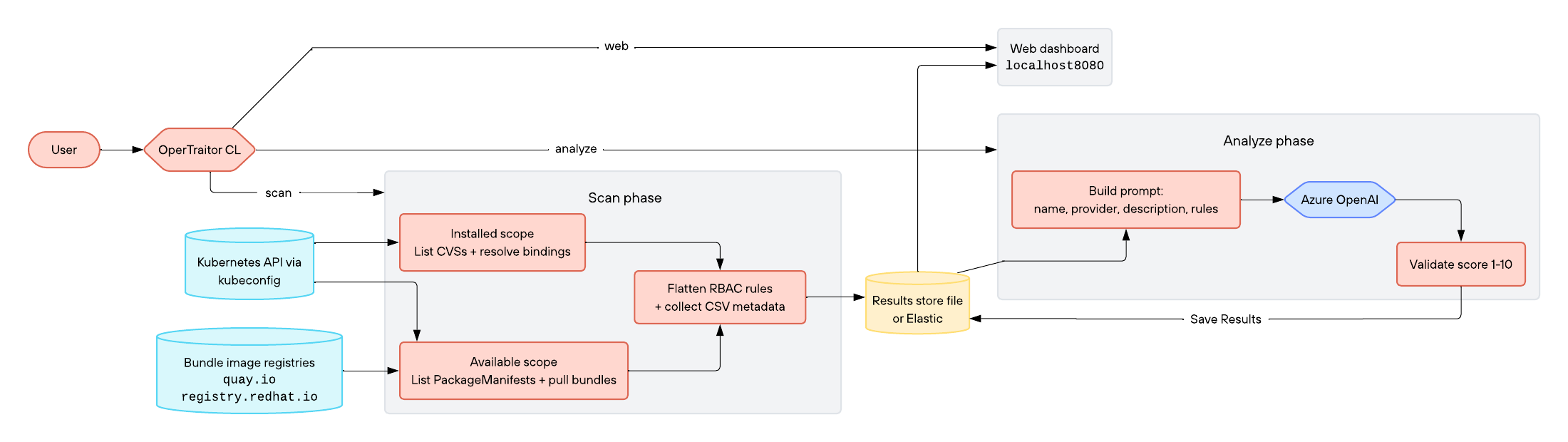
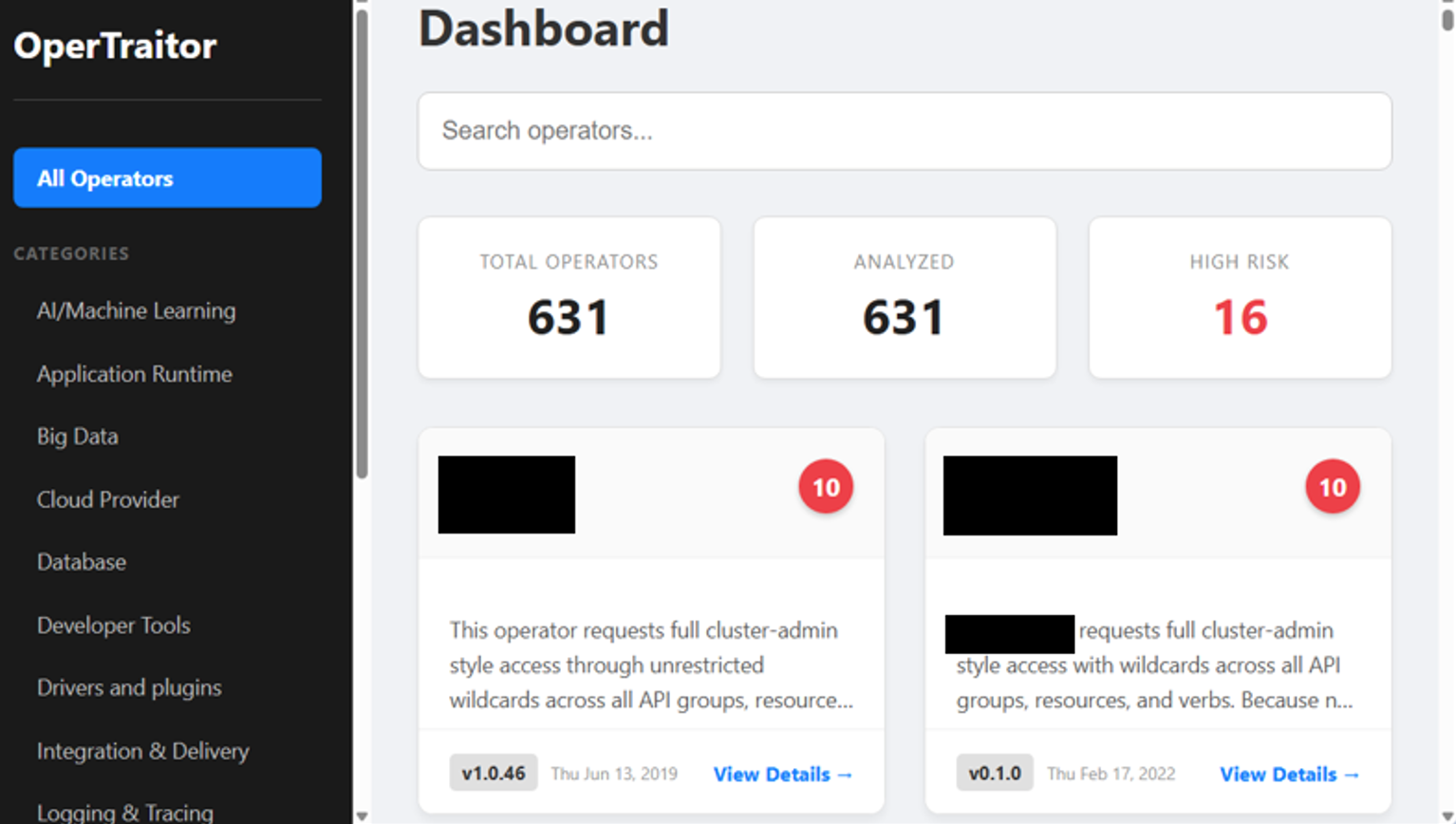
Figure 2 displays a screenshot of the OperTraitor user interface, showing the total number of high-risk operators alongside the post-analysis scores of two specific operators.
During this process, we uncovered a significant supply chain weakness. OperatorHub is filled with abandoned, overly permissive software components. Many vendors publish new, secure versions of their operators exclusively through Helm charts, their GitHub repositories or ArtifactHub. However, their older, vulnerable versions remain easily accessible through the Operator Lifecycle Manager (OLM).
OLM has historically been the gold standard of the open-source community and the default in OpenShift environments. As a result, users routinely deploy outdated operators in a few simple clicks, often without realizing it. Vendors are largely not prioritizing the maintenance or deprecation of their legacy components on OperatorHub, presenting a significant attack vector.
The Tip of the Iceberg
The RBAC misconfigurations we discovered are not isolated incidents. During our research, we identified multiple other operators (slightly over 5%) that request excessive privileges, including implicit paths to cluster admin access.
Unfortunately, many of the operator owners we contacted did not respond to our responsible disclosure attempts. In many cases, this lack of engagement simply indicates that the operator is no longer actively maintained.
While we will not cover those specific cases in this article, the reality highlights a critical takeaway that security teams must be vigilant. We strongly encourage treating every component sourced from OperatorHub with caution, independently verifying both its RBAC requirements and its active maintenance status before deployment.
To illustrate the real-world impact of these excessive permissions, we detail two specific case studies below.
Case Study 1: Excessive Secret Access (Prometurbo Operator - IBM)
When initially scanning OperatorHub, OperTraitor flagged the Prometurbo operator for using wildcards. Recognizing that the version on OperatorHub was severely outdated (v8.6.0, from 2022), we analyzed the recent version available via IBM’s GitHub repository (v8.17.6) to see if the posture had changed.
OperTraitor identified a critical RBAC violation. Instead of restricting access to its own namespace, the operator's service account was bound to a ClusterRole. This ClusterRole contained an explicit rule granting get, list and watch verbs on the secrets resource within the core API group (represented by apiGroups: [""])
Unless an operator functions explicitly as a centralized secrets manager, it rarely requires cluster-wide read access to Secret resources. Typically, an operator only needs access to specific secrets within its localized namespace.
Possessing explicit, cluster-wide read access to all secrets, the Prometurbo operator effectively became a single point of failure. If compromised, an attacker could immediately dump administrative service account tokens, database credentials, API keys and TLS certificates from completely unrelated namespaces. This could turn a localized breach into a total environment compromise.
Upon identifying this setting, we initiated a responsible disclosure process with IBM. The vendor responded promptly and collaboratively, quickly identifying the root cause and issuing a patch in a subsequent release that properly scoped the operator's RBAC permissions to align with the principle of least privilege (PoLP).
Due to the importance and impact of the vulnerability, IBM published a formal security bulletin and assigned a CVE (CVE-2026-6389) with a High CVSS score (8.8/10).
Disclosure Timeline:
- Nov. 5, 2025: Vulnerability reported to IBM via the Vulnerability Disclosure Program
- Feb. 3, 2026: IBM confirmed the issue is resolved
- April 24, 2026: IBM published a security bulletin with CVE-2026-6389
Case Study 2: The Trade-Off Between Security and User Experience (UX) (Datadog Operator)
In the case of the Datadog operator, OperTraitor flagged an overly privileged configuration that included cluster-wide access to secrets and various actions (verbs) on RBAC resources (ClusterRoles and ClusterRoleBindings).
Upon our disclosure, Datadog representatives shared a detailed explanation of the reasoning behind granting these broad permissions. They noted that the names of the secrets the operator needs to access are based on user-defined values, making them impossible to predict or explicitly define before deployment. Given Datadog’s architecture, this is a valid point that highlights the complex trade-off vendors face between delivering strict security and a seamless user experience.
Datadog recognized the importance of transparency for end users assessing cluster risk. They opted to add a detailed explanation of their RBAC settings and documented applied mitigations, allowing security teams to make informed risk-acceptance decisions.
Mitigation: Securing the Non-Human Identity
Securing the operator ecosystem requires a shift in how security teams evaluate and monitor Kubernetes infrastructure. We recommend implementing the following defensive strategies:
- Verify the source and avoid default registries: Do not implicitly trust versions available on OLM or OperatorHub. Always verify the vendor's official documentation and deploy operators via their maintained Helm charts, ArtifactHub or official GitHub repositories to ensure you are installing the most recent, patched version.
- Enforce namespace-scoped operators: Whenever architecturally possible, restrict operators to the specific namespaces they manage. Avoid deploying cluster-scoped operators (ClusterRoles and ClusterRoleBindings) unless absolutely necessary, strictly limiting the area of impact in a potential compromise.
- Continuously audit and downscope RBAC: Always validate vendor-provided YAML manifests. Assess the RBAC posture for critical production environments. There are useful open-source tools to support this task, including OperTraitor.
- Monitor service account behavior: Enable and actively monitor Kubernetes Audit Logs. Baseline the normal behavior of your operator service accounts and alert on anomalous activity. An example of anomalous activity could be an operator suddenly attempting to list secrets in an unrelated namespace or querying the API server from an unexpected IP address.
- Establish guardrails for AI agents: If you are experimenting with LLM enhanced operators or agentic frameworks, enforce strict network policies:
- Ensure these pods cannot reach the public internet or unauthorized internal endpoints
- Strictly limit the context and permissions passed to the underlying LLMs
Conclusion
The convenience of Kubernetes operators comes with a hidden cost: the rapid proliferation of highly privileged, non-human identities within our clusters. Our research indicates a widespread violation of the PoLP across the Kubernetes ecosystem.
Whether driven by the difficulty of scoping permissions for dynamic environments or simply by a developer’s misconfiguration, operators are frequently granted access that far exceeds their operational requirements. This problem is exacerbated by the prevalence of outdated, abandoned components in registries like OperatorHub, creating a massive attack surface.
The shift to agentic operators will worsen the risks this presents. An overly privileged operator today is the autonomous, uncontrolled agent of tomorrow.
As we stand on the threshold of the agentic era, the way we manage Kubernetes is undergoing a fundamental change. AI-driven automation holds incredible promise for reducing operational overhead, but it requires a rock-solid foundation of identity and access management to ensure a secure environment.
We can not afford to treat non-human identities as an afterthought. Security teams must scrutinize operator permissions with the same rigor they apply to human administrators. By improving the RBAC hygiene of our clusters today, we can safely embrace the autonomous operations of the future without betraying our security posture.
Palo Alto Networks Protection and Mitigation
Palo Alto Networks customers are better protected from the threats discussed above through the following products:
- Cortex Cloud can help protect cloud posture and runtime operations against identity-driven threats by pairing static permission baselines with deep behavioral context. By embedding the functional identity baselines discussed in this research into our detection engine for both cloud VM compute and serverless agents, Cortex Cloud adds a vital layer of operational context, enabling security teams to filter out noisy false positives and decisively catch threat actors attempting to masquerade, alter configurations, or execute anomalous operations in the environment.
The Unit 42 AI Security Assessment and Unit 42 Frontier AI Defense service can help identify and mitigate complex AI-enabled risks.
If you think you may have been compromised or have an urgent matter, get in touch with the Unit 42 Incident Response team or call:
- North America: Toll Free: +1 (866) 486-4842 (866.4.UNIT42)
- UK: +44.20.3743.3660
- Europe and Middle East: +31.20.299.3130
- Asia: +65.6983.8730
- Japan: +81.50.1790.0200
- Australia: +61.2.4062.7950
- India: 000 800 050 45107
- South Korea: +82.080.467.8774
Palo Alto Networks has shared these findings with our fellow Cyber Threat Alliance (CTA) members. CTA members use this intelligence to rapidly deploy protections to their customers and to systematically disrupt malicious cyber actors. Learn more about the Cyber Threat Alliance.
Additional Resources
如有侵权请联系:admin#unsafe.sh