
好的,我现在需要帮用户总结一篇文章,控制在100字以内。用户的要求很明确,直接写文章描述,不需要特定的开头。首先,我得通读整篇文章,抓住主要内容。 文章主要讲的是班加罗尔作为印度的科技中心,面临日益严重的网络安全威胁。原因包括2023年的DPDP法案加强了合规要求,CERT-In的6小时报告规则增加了压力。此外,跨国公司的全球能力中心(GCCs)成为攻击目标,因为这些中心拥有进入全球网络的特权访问权限。云环境的扩展和影子IT也增加了攻击面。人才短缺和高流动率导致安全团队难以应对威胁。 Seceon的解决方案是使用统一的AI驱动安全平台,帮助公司应对合规、人才和复杂环境的问题。文章强调了班加罗尔在全球网络安全中的重要性,并指出企业必须采用先进平台来应对威胁。 接下来,我需要将这些要点浓缩到100字以内。重点包括班加罗尔的地位、面临的威胁、原因以及Seceon的解决方案。同时要保持语言简洁明了。 可能的结构是:班加罗尔作为科技中心面临网络安全威胁,原因包括法规、攻击目标、云扩展和人才问题。Seceon提供AI平台帮助应对挑战。 现在检查字数是否在限制内,并确保涵盖所有关键点。 </think> 班加罗尔作为印度科技中心面临日益严峻的网络安全威胁。跨国公司因处理大量敏感数据成为网络攻击目标。新法规如DPDP法案和CERT-In规则增加了合规压力。同时,全球能力中心(GCCs)成为攻击入口点,云环境扩展和影子IT扩大了攻击面。人才短缺加剧了安全挑战。Seceon等AI驱动的安全平台成为关键解决方案,帮助企业在复杂环境中实现合规与防护。 2025-12-29 14:3:1 Author: securityboulevard.com(查看原文) 阅读量:3 收藏
Bangalore is the beating heart of India’s technology landscape, a global hub where innovation, data, and enterprise operations converge at unprecedented scale. But a new report highlights a stark reality: as digital acceleration skyrockets, so do the cyber risks facing the multinational organizations (MNCs) operating here. With the DPDP Act 2023 reshaping compliance expectations and attackers increasingly targeting Global Capability Centers (GCCs) as gateways into Fortune 500 networks, Bangalore-based operations now sit at the center of a high-stakes cybersecurity storm.
This analysis breaks down the threats shaping the 2024-2025 landscape and examines why unified, AI-driven security platforms like Seceon’s are becoming mission-critical for enterprises navigating India’s rapidly evolving regulatory and risk environment.
What’s Happening and Why It’s a Warning Sign for Global Enterprises
Bangalore’s MNC ecosystem handles global codebases, R&D, sensitive financial operations, and enormous volumes of personal data, making these hubs extremely attractive to APT groups and cybercriminals.
Several forces have collided:
1. A Regulatory Shockwave: DPDP Act 2023 and CERT-In’s 6-hour Rule
- The DPDP Act introduces GDPR-level obligations with fines up to ₹250 crore per instance.
- CERT-In mandates an extremely tight 6-hour incident reporting timeline.
Why it’s a warning:
Most organizations lack real-time visibility or automated evidence collection, making compliance almost impossible without modernized security operations.
2. “GCC as a Gateway” Attacks Are Rising
Bangalore GCCs hold privileged access to global networks.
A breach here can enable attackers to pivot into parent company environments across continents.
Why it’s dangerous:
A ransomware attack or credential compromise in Bangalore can cripple systems in the U.S., Europe, and APAC within minutes.
3. The Talent Paradox: Skill Abundance, SOC Churn
Bangalore has massive tech talent, but security teams suffer:
- extreme attrition
- alert fatigue
- knowledge drain every 12–18 months
Why it matters:
Junior analysts drowning in noise are more likely to miss subtle but devastating threats.
4. Cloud Sprawl and Shadow IT Are Expanding Attack Surfaces
Multi-cloud adoption (AWS, Azure, GCP) has exploded alongside legacy on-prem systems.
The risk:
Misconfigurations, unmanaged APIs, and hidden Shadow IT resources create blind spots attackers exploit long before detection.
Why This Matters for Enterprises, MSPs, and Global Operators
Even if you are not headquartered in Bangalore, the implications are global.
Key lessons for infrastructure operators, GCC leaders, MSPs, and CISOs:
- Threat vectors are evolving. Attacks now span network, cloud, identity, APIs, OT, and developer pipelines.
- Siloed security tools are failing. Fragmented data means no single view of cross-environment threats.
- Compliance pressure has become operational pressure.
DPDP plus CERT-In reporting timelines require automated, real-time detection. - Talent shortages demand automation.
Modern SOCs must rely on AI to scale, not manual human correlation.
For global enterprises relying on Bangalore operations, cybersecurity is no longer a back-office concern. It is a board-level continuity risk.
Fragmented tools, spreadsheets, and overworked SOC teams cannot defend a high-velocity, high-risk ecosystem. Seceon’s unified aiSIEM + aiXDR + SOAR platform directly addresses the triple challenge of regulatory pressure, hybrid complexity, and talent shortages.
Here’s how:
1. Streamlined Compliance for DPDP Act and CERT-In
Challenge:
Strict fines and 6-hour reporting make manual incident response impossible.
Seceon Advantage:
- Centralized logging across hybrid infrastructure
- Automated evidence gathering
- Real-time threat validation
- SOAR-driven rapid reporting
This enables MNCs to meet India’s new compliance demands without increasing operational burden.
2. AI as a Force Multiplier for High-Churn SOC Teams
Challenge:
Alert fatigue plus attrition equals missed threats.
Seceon Advantage:
- AI or ML reduces noise by up to 90 percent
- Converts thousands of alerts into a few high-fidelity incidents
- Helps junior analysts operate at expert level
Organizations maintain resilience even as teams shift or scale.
3. Unified Visibility Across Hybrid Cloud and Shadow IT
Challenge:
Data and identities are scattered across Bangalore on-prem systems and global cloud regions.
Seceon Advantage:
- aiXDR correlates data across AWS, Azure, GCP, endpoints, and on-prem
- Identifies cross-cloud lateral movement
- Eliminates blind spots from Shadow IT and unmanaged resources
MNCs gain the single, correlated security view they have been missing.
4. Automated Response for 24/7 Global Operations
Challenge:
Ransomware and credential compromises propagate faster than humans can respond.
Seceon Advantage:
- SOAR executes sub-second containment
- Blocks malicious users, isolates endpoints, stops encryption
- Ensures uptime for global service delivery
This capability is essential for GCCs supporting multiple time zones.
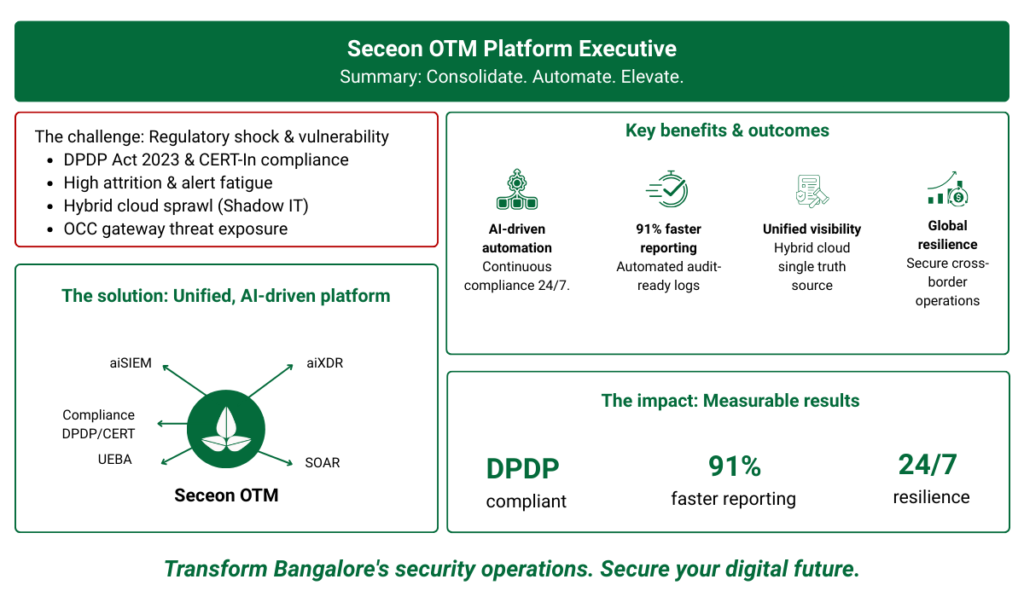
Bangalore is India’s innovation engine, but also a prime target for global adversaries.
As DPDP enforcement intensifies, cloud ecosystems expand, and attackers exploit GCCs as entry points to global networks, cybersecurity becomes existential for MNCs operating here.
The question isn’t if Bangalore operations will be tested. It is when.
And when that moment comes, fragmented tools and manual workflows will not hold the line.
Unified, AI-powered platforms like Seceon’s are now the new standard for resilience, enabling MNCs to stay compliant, secure, and globally connected in a rapidly evolving threat landscape.

The post Bangalore MNCs Under Cyber Siege: Why India’s Silicon Valley Faces a New Era of Risk and How Unified Security Platforms Are Becoming Essential appeared first on Seceon Inc.
*** This is a Security Bloggers Network syndicated blog from Seceon Inc authored by Aditya Kumar. Read the original post at: https://seceon.com/bangalore-mncs-under-cyber-siege-why-indias-silicon-valley-faces-a-new-era-of-risk-and-how-unified-security-platforms-are-becoming-essential/
如有侵权请联系:admin#unsafe.sh