
嗯,用户让我总结一下这篇文章的内容,控制在100个字以内,而且不需要用“文章内容总结”这样的开头。首先,我需要快速浏览一下文章,抓住主要观点。 文章主要讲的是零信任AI安全模型在2026年的应用。传统基于边界的网络安全已经过时了,现在组织大多采用混合云和远程办公,所以需要更灵活的安全策略。零信任模型的核心是“永远不信任,总是验证”,结合AI来检测和响应威胁。 文中还提到了一些统计数据,比如95%的成功率针对没有零信任控制的组织,以及实施后的显著效果,比如76%的漏洞减少。此外,文章还讨论了为什么需要零信任AI安全的原因,包括数字转型、远程工作、第三方风险等。 关键原则包括明确验证、最小权限访问、假设已被入侵以及AI增强的情报。技术组件有身份管理、网络分割、端点安全等。Seceon的优势在于统一平台、快速部署和高检测率。 总结下来,我需要把这些要点浓缩到100字以内。要涵盖零信任AI安全的定义、核心原则、技术组件以及带来的好处。 </think> Zero Trust AI Security combines zero trust architecture with AI to protect organizations in distributed environments. It verifies every access request, applies least privilege, assumes breach mentality, and leverages AI for threat detection. Key components include identity management, network segmentation, endpoint security, and cloud protection. Organizations implementing this model saw 76% fewer breaches and faster response times. 2025-12-22 10:49:7 Author: securityboulevard.com(查看原文) 阅读量:1 收藏
The traditional perimeter-based security model has become obsolete in today’s distributed digital environment. With 82% of organizations now operating in hybrid or multi-cloud infrastructures and remote work becoming the standard, the concept of a secure network boundary no longer exists. Zero Trust AI Security represents the evolution of cybersecurity strategy-combining the principles of zero trust architecture with artificial intelligence to create adaptive, intelligent security frameworks that protect organizations in 2026’s complex threat landscape.
Understanding Zero Trust AI Security
Zero Trust AI Security integrates two transformative approaches to cybersecurity: the zero trust security model and artificial intelligence-driven threat detection and response. This combination creates a dynamic security posture that continuously validates, monitors, and adapts to emerging threats.
The foundational principle of zero trust is simple yet powerful: “Never trust, always verify.” Unlike traditional security models that assume internal network traffic is trustworthy, zero trust treats every access request as potentially hostile, regardless of origin. When enhanced with artificial intelligence, this model becomes exponentially more effective, utilizing machine learning algorithms to identify patterns, predict threats, and automate responses at speeds impossible for human security teams.
In 2026, organizations implementing Zero Trust AI Security reported 76% fewer successful breaches and reduced incident response times from days to minutes, demonstrating the tangible business value of this approach.
The Critical Need for Zero Trust AI Security in 2026
The cybersecurity landscape continues to evolve at an unprecedented pace, requiring organizations to fundamentally rethink their security strategies:
Current Threat Statistics
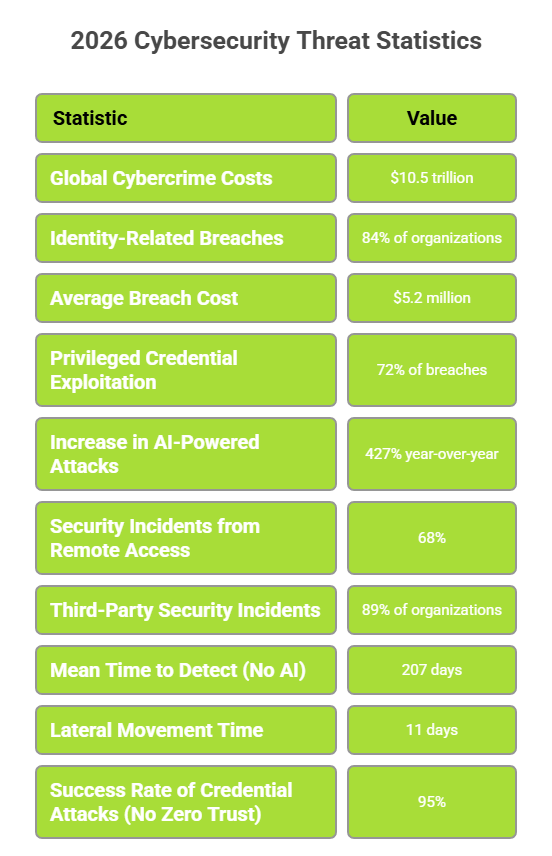
Understanding the magnitude of today’s security challenges provides context for why Zero Trust AI Security has become essential:
- $10.5 trillion: Global annual cybercrime costs in 2026
- 84% of organizations experienced identity-related breaches in 2025
- Average breach cost: $5.2 million, with costs 38% higher for organizations without zero trust implementation
- 72% of breaches involve the exploitation of privileged credentials
- AI-powered attacks have increased by 427% year-over-year
- Remote work vulnerabilities: 68% of security incidents originate from remote access points
- Supply chain compromises: 89% of organizations experienced third-party security incidents
- Mean time to detect: 207 days for organizations without AI-enhanced security
- Lateral movement: Attackers spend an average of 11 days moving through networks before detection
95% success rate: Credential-based attacks against organizations lacking zero trust controls
Business Imperatives Driving Zero Trust Adoption
Digital Transformation Requirements: Cloud migration, SaaS application adoption, and hybrid infrastructure models eliminate traditional network boundaries, making perimeter-based security ineffective.
Regulatory Compliance: Frameworks, including GDPR, HIPAA, PCI-DSS, SOC 2, and the new Federal Zero Trust Architecture mandate require organizations to implement zero trust principles and demonstrate continuous verification capabilities.
Remote Workforce Security: With 58% of employees working in hybrid or fully remote environments, organizations must secure access from any location while maintaining productivity and user experience.
Third-Party Risk Management: Modern business operations rely on extensive partner ecosystems, requiring granular access controls and continuous monitoring of third-party connections.Insider Threat Mitigation: Malicious and negligent insider actions account for 34% of security incidents, costing organizations an average of $16.2 million per incident.
Core Principles of Zero Trust AI Security
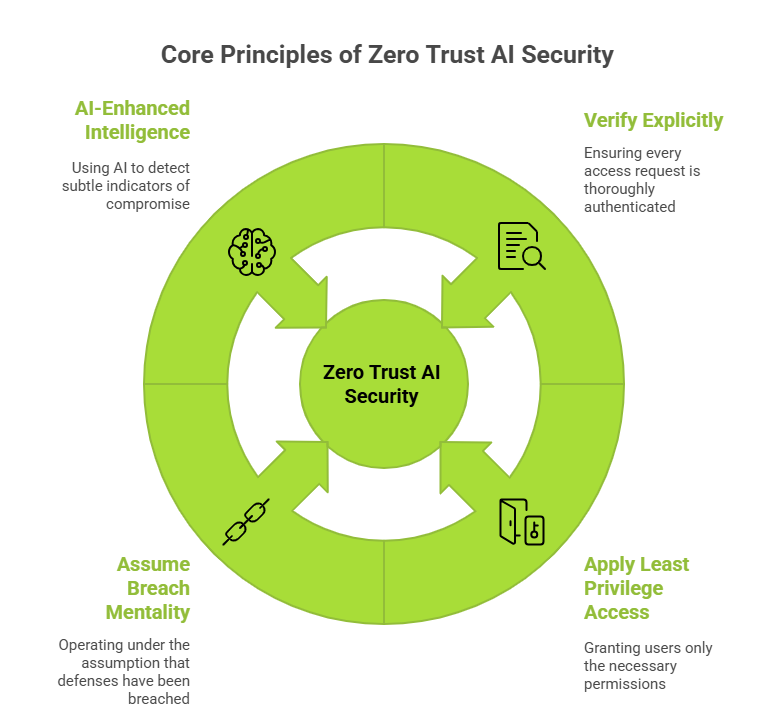
Effective implementation of Zero Trust AI Security requires understanding and applying fundamental principles that form the foundation of this security model:
1. Verify Explicitly
Every access request undergoes comprehensive authentication and authorization processes utilizing multiple data points:
- Multi-factor authentication (MFA) requires multiple verification methods
- Contextual analysis evaluating user location, device health, time of access, and behavior patterns
- Risk-based authentication, adjusting security requirements based on real-time threat intelligence
- Continuous validation reassessing trust throughout the session duration
- Identity and access management (IAM) integration ensures centralized policy enforcement
2. Apply Least Privilege Access
Organizations implement granular access controls that provide users with only the minimum permissions required for their specific roles:
- Just-in-time (JIT) access provisioning temporary elevated permissions when needed
- Role-based access control (RBAC) defines permissions based on job functions
- Attribute-based access control (ABAC) utilizing contextual attributes for dynamic authorization
- Privileged access management (PAM) secures and monitors administrative credentials
- Microsegmentation divides networks into isolated zones with specific access requirements
3. Assume Breach Mentality
Security architectures operate under the assumption that threats have already penetrated defenses, requiring continuous monitoring and rapid response:
- Lateral movement prevention restricting internal network traversal
- Network segmentation isolates critical assets and limits the blast radius
- Continuous monitoring, analyzing all network traffic and user activities
- Automated threat response immediately contains suspicious activities
- Forensic capabilities, maintaining detailed logs for incident investigation
4. AI-Enhanced Intelligence
Artificial intelligence amplifies zero trust effectiveness by processing vast datasets and identifying subtle indicators of compromise:
- Behavioral analytics establishes normal patterns and detects anomalies
- Predictive threat modeling forecasting potential attack vectors
- Automated policy enforcement dynamically adjusts security controls
- Real-time risk scoring continuously evaluates access request legitimacy
Machine learning algorithms are improving detection accuracy through continuous learning
Key Components of Zero Trust AI Security Architecture
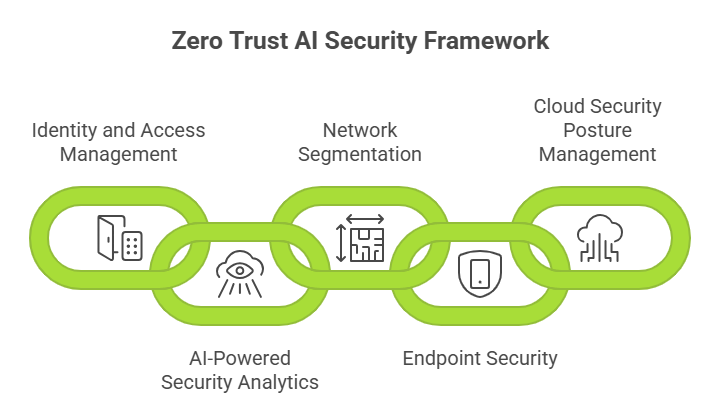
Implementing comprehensive Zero Trust AI Security requires integrating multiple technology components into a cohesive security framework:
Identity and Access Management (IAM)
Modern IAM solutions serve as the foundation of zero trust, managing digital identities and controlling access across all systems:
- Centralized identity governance and administration
- Single sign-on (SSO) with adaptive authentication
- Multi-factor authentication supporting biometric, hardware token, and behavioral factors
- Identity federation for partner and customer access
- Automated provisioning and deprovisioning workflows
AI-Powered Security Analytics
Artificial intelligence processes security data at scale, identifying threats that traditional systems miss:
- User and entity behavior analytics (UEBA) detects anomalous activities
- Advanced threat detection utilizing machine learning models
- Automated incident prioritization based on risk severity
- Predictive analytics forecasting security incidents
- Natural language processing analyzing threat intelligence feeds
Network Segmentation and Microsegmentation
Dividing networks into smaller, isolated segments limits attacker movement and contains potential breaches:
- Software-defined perimeter (SDP) creates dynamic access boundaries
- Application-level segmentation protects individual workloads
- East-west traffic inspection monitoring lateral movement attempts
- Zero trust network access (ZTNA) is replacing traditional VPNs
- Cloud workload protection for containerized and serverless environments
Endpoint Security and Detection
Comprehensive endpoint protection ensures device security regardless of location:
- Endpoint detection and response (EDR) monitoring device activities
- Mobile device management (MDM) enforces security policies
- Device health attestation verifying security posture before access
- Application whitelisting prevents unauthorized software execution
- Data loss prevention (DLP) protects sensitive information
Cloud Security Posture Management
Organizations require specialized tools for securing cloud infrastructure and services:
- Cloud access security broker (CASB) monitoring SaaS application usage
- Cloud security posture management (CSPM) identifies misconfigurations
- Cloud workload protection platform (CWPP) securing virtual machines and containers
- API security ensures secure application programming interface usage
Infrastructure as code (IaC) scanning and detecting security issues in deployment templates
The Seceon Advantage in Zero Trust AI Security
Organizations evaluating Zero Trust AI Security solutions require platforms that combine comprehensive functionality, ease of deployment, and proven effectiveness. Seceon’s aiSIEM platform delivers enterprise-grade zero trust capabilities enhanced by advanced artificial intelligence.
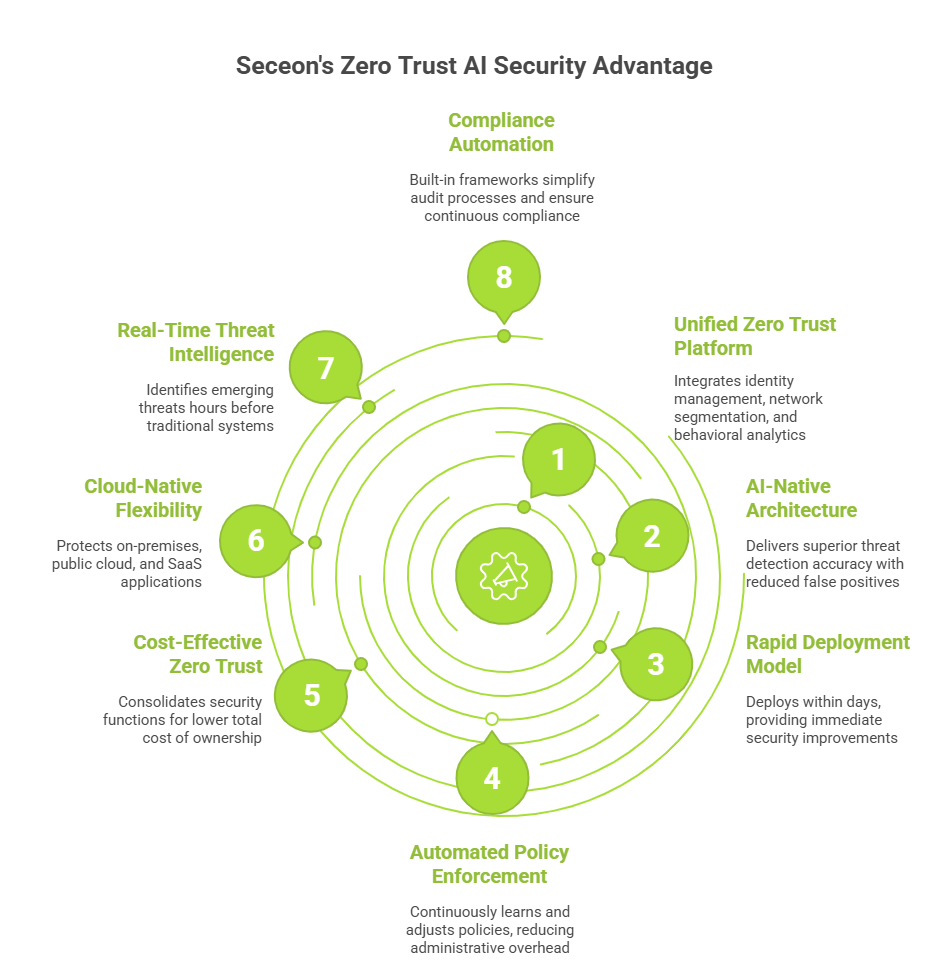
Seceon’s Differentiated Capabilities
Unified Zero Trust Platform: Seceon integrates identity management, network segmentation, behavioral analytics, and automated response in a single, cohesive solution. Organizations eliminate the complexity and cost of managing multiple disparate security tools.
AI-Native Architecture: Built from inception with artificial intelligence at its core, Seceon’s platform delivers superior threat detection accuracy exceeding 99.3% while reducing false positives by 92% compared to traditional SIEM solutions.
Rapid Deployment Model: Unlike complex zero trust implementations requiring 12-18 months, Seceon deploys within days, providing immediate security improvements. Organizations achieve full operational capability within 30-60 days.
Automated Policy Enforcement: Seceon’s AI continuously learns organizational patterns and automatically suggests or implements policy adjustments, reducing administrative overhead by 67%.
Cost-Effective Zero Trust: By consolidating multiple security functions, Seceon delivers comprehensive zero trust protection at 60% lower total cost of ownership compared to building equivalent capabilities with point solutions.
Cloud-Native Flexibility: Designed for modern hybrid and multi-cloud environments, Seceon seamlessly protects on-premises infrastructure, public cloud workloads, and SaaS applications through a unified policy framework.
Real-Time Threat Intelligence: Seceon integrates global threat intelligence feeds with proprietary AI analysis, identifying emerging threats an average of 47 hours before traditional signature-based systems.Compliance Automation: Built-in compliance frameworks for GDPR, HIPAA, PCI-DSS, SOC 2, and zero trust architecture mandates simplify audit processes and ensure continuous compliance.
Measuring Zero Trust AI Security Success
Organizations must establish clear metrics to evaluate Zero Trust AI Security effectiveness and demonstrate return on investment:
Security Effectiveness Metrics
- Breach Prevention Rate: Percentage of attack attempts successfully blocked (target: 98%+)
- Mean Time to Detect (MTTD): Average time to identify security incidents (benchmark: under 15 minutes)
- Mean Time to Respond (MTTR): Average time to contain and remediate threats (target: under 30 minutes)
- False Positive Reduction: Decrease in non-actionable security alerts (goal: 85%+ reduction)
- Lateral Movement Prevention: Percentage of internal propagation attempts blocked (target: 95%+)
Operational Efficiency Metrics
- Authentication Success Rate: Percentage of legitimate access requests approved without friction (goal: 99%+)
- Administrative Overhead: Time spent on access management tasks (target: 70% reduction)
- Policy Violation Rate: Frequency of access policy violations (benchmark: under 2%)
- Automation Coverage: Percentage of security incidents handled automatically (goal: 80%+)
- User Satisfaction: Employee feedback on the security process’s impact on productivity
Business Impact Metrics
- Risk Reduction: Quantified decrease in organizational cyber risk exposure
- Compliance Achievement: Successful audit outcomes and regulatory requirement fulfillment
- Incident Cost Avoidance: Financial impact of prevented security breaches
- Insurance Premium Reduction: Cyber insurance cost savings from improved security posture
- Return on Investment: Total security benefits compared to implementation and operational costs (average ROI: 285%)
Best Practices for Zero Trust AI Security Success
Organizations implementing Zero Trust AI Security should follow proven practices to maximize effectiveness and minimize implementation challenges:
Executive Sponsorship: Secure C-level commitment and adequate budget allocation. Zero trust represents a strategic initiative requiring organizational transformation beyond technology deployment.
User-Centric Design: Balance security requirements with user experience. Implementations causing excessive friction result in shadow IT and workarounds that undermine security objectives.
Incremental Implementation: Adopt a phased approach focusing on highest-risk areas first. Organizations attempting comprehensive overnight transitions typically experience implementation failures and user resistance.
Continuous Education: Invest in ongoing security awareness training. Zero trust effectiveness depends on user understanding and cooperation with new access procedures.
Regular Assessment: Conduct quarterly reviews of access policies, detection rules, and security effectiveness. Threat landscapes evolve continuously, requiring corresponding security adjustments.
Integration Planning: Ensure zero trust solutions integrate seamlessly with existing security infrastructure. Siloed implementations create visibility gaps and increase operational complexity.
Performance Monitoring: Establish comprehensive metrics tracking both security effectiveness and operational impact. Data-driven insights enable continuous improvement and demonstrate business value.
Schedule Your Zero Trust AI Security Assessment
Organizations cannot afford to delay zero-trust implementation. Each day without comprehensive zero trust controls increases exposure to credential theft, lateral movement attacks, and data breaches that average $5.2 million in costs.
Complimentary Security Consultation
Seceon’s zero trust specialists provide comprehensive evaluations helping organizations understand their current security posture and develop strategic implementation roadmaps. Our assessment includes:
- Current architecture analysis identifying security gaps and improvement opportunities
- Zero trust readiness evaluation across identity, network, and endpoint domains
- Risk prioritization based on business impact and threat exposure
- Customized implementation roadmap with phased deployment plan
- ROI projection demonstrating expected cost savings and risk reduction
- Live platform demonstration showing zero trust capabilities in action
Proven Results from 3,200+ Organizations
Organizations across healthcare, financial services, manufacturing, retail, and government sectors trust Seceon for Zero Trust AI Security. Customers report:
- 76% reduction in successful breach attempts
- 89% decrease in mean time to detect threats
- 67% reduction in security administrative overhead
- 98.9% user authentication success rates
$3.2 million average annual savings from prevented incidents

Conclusion: Strategic Investment in Zero Trust AI Security
The cybersecurity paradigm has fundamentally shifted. Perimeter-based security models cannot protect organizations operating in distributed, cloud-centric environments with remote workforces and extensive partner ecosystems. Zero Trust AI Security provides the comprehensive, adaptive protection modern enterprises require.
Organizations implementing zero trust architectures enhanced with artificial intelligence achieve measurably superior security outcomes-experiencing 76% fewer successful breaches while reducing operational costs through automation and intelligent policy enforcement. With average breach costs exceeding $5.2 million and regulatory penalties reaching eight figures, the business case for zero trust implementation is compelling.
When evaluating Zero Trust AI Security solutions, prioritize platforms offering unified architecture, AI-native design, rapid deployment capabilities, and proven effectiveness. Seceon delivers enterprise-grade zero trust protection accessible to organizations of all sizes, combining advanced technology with operational simplicity.
Your organization’s security resilience, regulatory compliance, and competitive positioning depend on implementing modern security architectures designed for today’s threat landscape. Zero Trust AI Security represents the foundation for secure digital operations in 2026 and beyond.

The post Zero Trust AI Security: The Comprehensive Guide to Next-Generation Cybersecurity in 2026 appeared first on Seceon Inc.
*** This is a Security Bloggers Network syndicated blog from Seceon Inc authored by Anand Prasad. Read the original post at: https://seceon.com/zero-trust-ai-security-the-comprehensive-guide-to-next-generation-cybersecurity-in-2026/
如有侵权请联系:admin#unsafe.sh