
文章探讨了云服务提供商在FedRAMP框架下需遵守的审计日志保留规定。要求包括热存储(90天)和冷存储(更长时间),涉及用户访问、安全事件等日志类型,并需符合NARA等标准。数据安全与合规性是关键考量。 2025-12-20 00:30:50 Author: securityboulevard.com(查看原文) 阅读量:1 收藏
Every cloud service provider that seeks an authorization to operate with the federal government using the FedRAMP framework has to undergo and pass an audit.
Beyond passing the audit, the CSP needs to keep and maintain proof of not just their external audit, but also internal audits, continuous monitoring results, and more. All of this logging serves as proof that the CSP is able to monitor their security at different scopes and scales, as well as proof of security, proof of monitoring, and proof of response to detected risks and breaches.
All of these logs add up. The image of boxes upon boxes of paperwork isn’t far from the truth, as much as it’s all digital these days. Logs need to be retained and properly stored, but they also need to be archived or purged at appropriate intervals as well.
The more information you retain, the harder it can be to comb through it for the most relevant information, and critically, the more it can reveal if the log storage itself is breached. Even beyond that, extensive logs can become a legal liability if they’re retained beyond the limits.
What does FedRAMP say about retaining logs? How long do they need to be stored? Are there rules about storing those logs? Let’s examine the rules and requirements CSPs have to adhere to for FedRAMP compliance.
What Are Audit Logs?
When you think of a FedRAMP audit, you think of the once-every-three-years high-stakes review where a 3PAO comes through and evaluates your security implementation from top to bottom. The reports and logs of this process are audit logs.
However, there are also many other logs generated by parts of your monitoring and assessments, from dedicated internal audits to general continuous monitoring records. All of these data logs can be considered audit logs as well.
Logs of user access, logs of breaches, logs of data changes; these are all logs meant for the purposes of auditing. They all need to be stored appropriately, retained for a relevant length of time, and discarded when they’re no longer applicable.
A business can be penalized for not storing auditing logs long enough, but it can also face repercussions for storing too much for too long. Excess data is a liability.
Hot Storage and Cold Storage for Audit Logs
Another critical piece of information to know before discussing records retention is the types of storage that are relevant for retention. You’ll usually see this referred to as online storage and offline storage, or more frequently, as hot storage and cold storage.
For all levels of FedRAMP, log retention (as well as other data retention) has policies that refer to two phases. Generally, it will look something like:
“Central log retention: 30-day online; 12-month cold storage.”
The first phase is hot storage, while the second is cold. This is a concept for all kinds of data storage, including things like backups and reference data, and is not unique to FedRAMP.
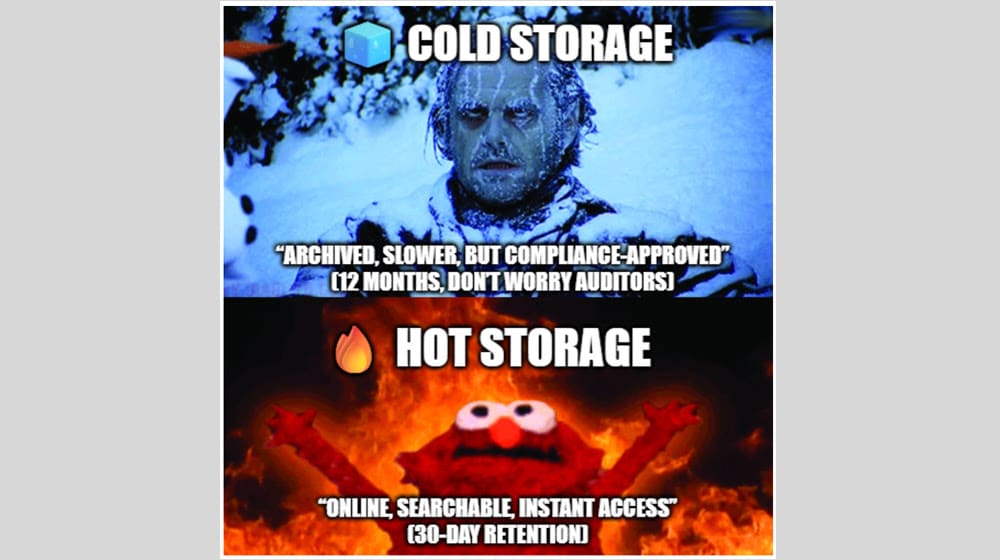
To draw a metaphor, hot storage would be like having a spreadsheet of data printed out and available on your desk; cold storage would be filing it away in a records room. Hot storage is readily accessible. Cold storage is still accessible, but with a delay.
Digitally speaking, hot storage generally means stored in an easily-accessible online location, such as in a trust center or a central server for the CSP. Cold storage means the data can be moved to slower and less accessible devices. It still needs to be accessible, so it can’t be deleted or filed away somewhere out of reach, but it doesn’t need to be available online. It can be filed away on magnetic tape storage, optical storage, or other media, for example.
Securing Logs at Rest and In Transit
As you might expect, data as sensitive as audit logs needs to be stored in a secure location. Inaccessibility isn’t enough on its own. Additionally, when logs are transferred to storage, moved from hot to cold storage, or accessed in an auditing process, the data needs to be secured while in transit as well.
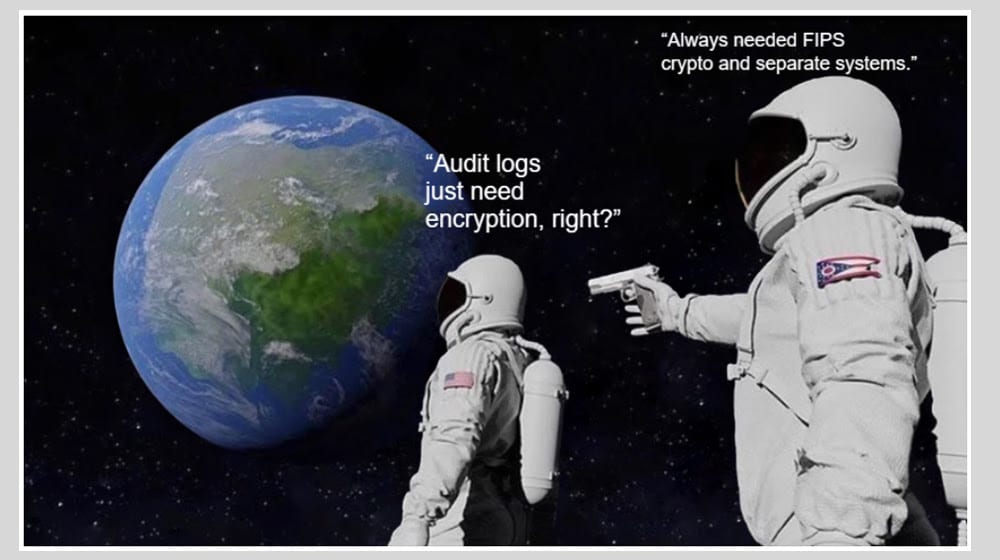
Different impact levels for FedRAMP require different levels of security for that data.
- Low and Moderate: Audit data and auditing tools must be protected from unauthorized access, modification, and deletion, and relevant stakeholders must be notified upon detection of unauthorized access, modification, or deletion of that information.
- High: The same as above, but with more controls. Store audit records at least weekly in a repository that is part of a physically different system or component than the one being audited. Additionally, implement cryptographic mechanisms to protect the integrity of audit information and audit tools. This requires the use of cryptography that must be compliant with Federal requirements to use FIPS-validated or NSA-approved cryptography.
As with most examples of securing data at rest in FedRAMP, the government does not mandate a specific cryptographic algorithm, but rather one of the algorithms that has been approved for use. Using too-high encryption serves little real benefit and is not recommended.
How Long Should Audit Logs Be Stored?
The discussion of records retention is a tricky one.
Here’s what FedRAMP has to say for different impact levels.
Li-SaaS:
“Retain audit records for [a time period in compliance with M-21-31] to provide support for after-the-fact investigations of incidents and to meet regulatory and organizational information retention requirements.”
Low: The same as Li-SaaS, with additional requirements.
“The service provider retains audit records on-line for at least ninety days and further preserves audit records off-line for a period that is in accordance with NARA requirements.”
“The service provider must support Agency requirements to comply with M-21-31.”
Moderate: The same as Low.
High: The same as Moderate and Low.
So, at minimum, records need to be stored in hot storage for at least 90 days, and in cold storage for longer. This brings up several other sources of authority, however. NARA, M-21-31, and regulatory rules are all in play.
What does NARA have to say about audit log retention?
NARA is the National Archives, and they’re the organization that sets many of the record retention rules across the federal government.
When it comes to CSPs adhering to FedRAMP rules, NARA maintains the GRS, or General Records Schedules. This is a set of standardized record-keeping requirements for different classes of records and different categories of entities.
NARA’s GRS section 3.0 is for Technology records, and 3.2 is for Information Systems Security Records.
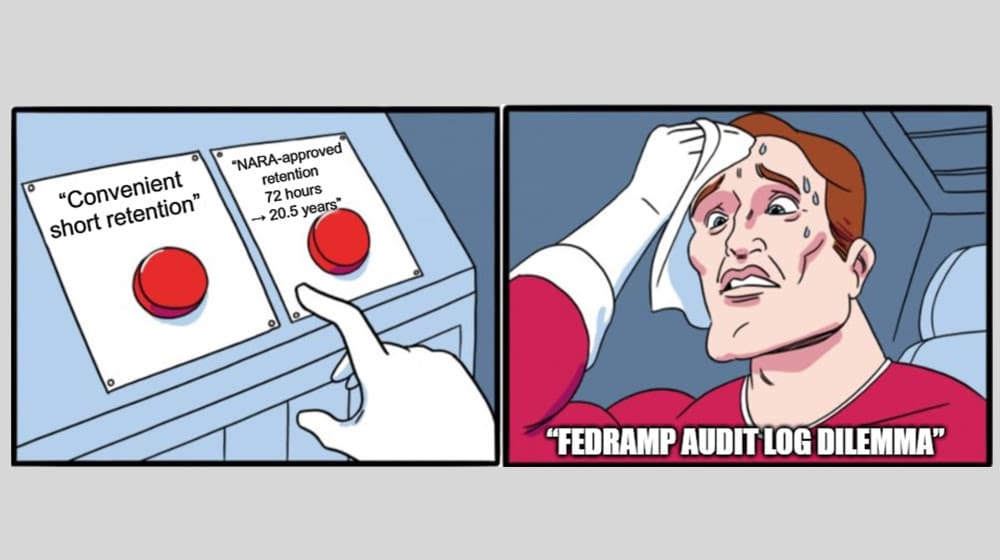
Within this schedule, you’ll find several pieces of guidance for different kinds of information security records, ranging from system security plans to narrative reports and more. The shortest of these is 72 hours, while the longest is 20.5 years (specifically for certain PKI administrative records).
NARA also refers to M-21-31 for further guidance.
What is M-21-31 and what does it say?
OMB Memo M-21-31 is the memo titled Improving the Federal Government’s Investigative and Remediation Capabilities Related to Cybersecurity Incidents. It was published in 2021 in the wake of the massive SolarWinds event.
This memo established new guidelines for the retention, storage, and destruction of records relating to cybersecurity across a four-tiered staged roll-out that followed a two-year timeline to achieve full compliance.
In addition to establishing the timelines for records retention, this memo also included standardization for data included in records, including the specific formats for timestamps, rules for validating log information, and more. It’s quite a comprehensive memo.
There’s a wrench in the works here, though: CSPs may not need to care. FedRAMP consulted with the OMB directly and, quote:
“…assessed that M-21-31 does not apply directly to CSP offerings (unless that CSP is a government system); however, FedRAMP authorized CSOs must comply with M-21-31 by supporting agency implementations within the cloud offering. These requirements are reflected in the FedRAMP Rev. 5 baselines (specifically AC-4 (4), AU-11, and SI-4 (10)).”
AC-4.4 is simply the control mandating the enforcement of information flow control. AU-11 is the reference above, guiding CSPs to look to NARA. SI-4.10 is the requirement that encrypted traffic is visible to system monitoring tools and mechanisms.
While in general, M-21-31 expands records retention, often to one year of hot storage and an additional 18 months of cold storage, FedRAMP says to largely ignore this and instead support what your sponsoring agency requires.
All of this also points to one further source of authority: regulatory requirements.
What are regulatory requirements for audit log retention?
CSPs in different sectors will have different regulatory environments to examine. The type of information you handle will also inform the duration of log retention. Healthcare information, governed by HIPAA, mandates six years for health data. SOX has seven years for financial records. Federal grants are often for three years.
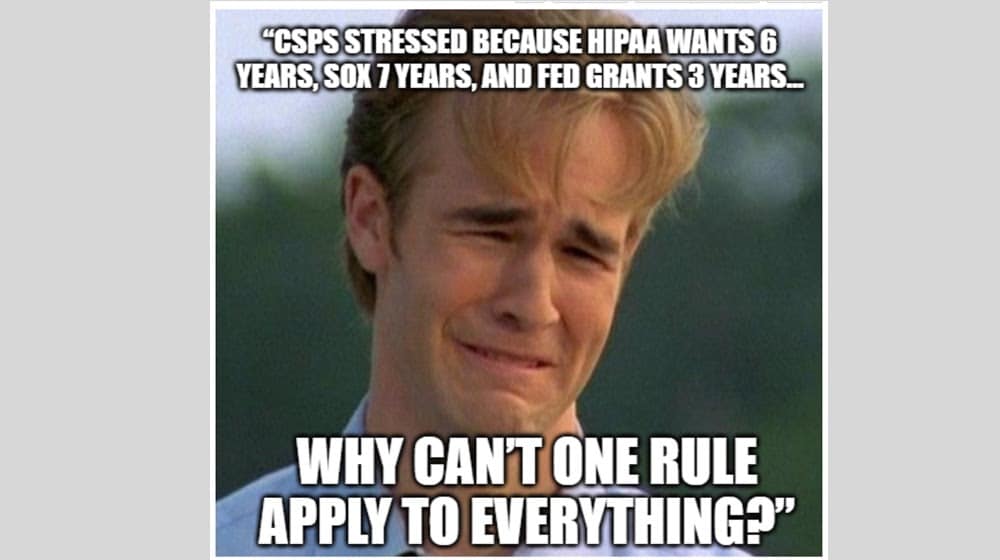
Essentially, the federal government doesn’t want to have to figure out what all of the different regulatory frameworks say and what rules they enforce, and also doesn’t want to tell CSPs to do one thing while other laws say to do something else. This is why the FedRAMP requirements largely refer to other sources of authority rather than specifying anything other than a bare minimum.
You’ll likely want to talk to an experienced compliance officer or a 3PAO that frequently works with your industry for more specific information. Rather than potentially provide incorrect information here, we instead encourage you to reach out with specific questions and ask us directly.
Is Any of This Changing in 2026 with FedRAMP 20x?
Yes and no.
As you’ve likely heard by now, FedRAMP is making a serious, concerted effort to streamline and speed up the process of authorization. The removal of the JAB process, the enhanced allowance for machine-readable data, the sped-up auditing process, and the 20x pilot program are all part of these efforts.
Big changes are coming to FedRAMP, and it’s hard to predict where each system will change as the pilots develop.
So far, nothing has changed with regard to record retention rules themselves. You still have to capture audit logs, you still have to retain them according to everything we’ve said above, and you still need to destroy them when applicable.
One possible change, however, comes in where your records are stored. Previously, you would store your records locally, and a lot of them would be uploaded to FedRAMP themselves. However, FedRAMP’s growth and goal of streamlining their systems mean they’ve determined that keeping track of all of this data themselves is unnecessary.
Instead, they’re experimenting with allowing CSPs to host their data on Trust Centers. A Trust Center is a secure and authorized system or repository for this data that can be validated and accessed both by the CSP and by FedRAMP and auditors as necessary. For now, this is a small pilot experiment, and there’s no timeline for it rolling out to a broader audience, but if it works out, it may change how your audit logs are stored.
How Ignyte Can Help
How can we help you with records retention and audit logging? Several ways.
First, as a FedRAMP-recognized 3PAO, we’re deeply experienced with sorting out all of the rules and regulations you need to comply with for a FedRAMP authorization. We can serve as consultants to help you figure out what you need to be doing, or as a 3PAO to perform the audits and give you the records you’ll need to keep.
Second, the Ignyte Assurance Platform was designed from the ground up to help with the implementation of frameworks like FedRAMP, CMMC, and ISO 27001. While the platform itself is not a trust center, it can help you track and monitor your logs, their locations, their ages, and when they need to be updated, turned over to cold storage, or removed according to your regulations.

Beyond that, you can keep an eye here on our blog or subscribe to our Reckless Compliance podcast for discussions on the current and future state of security, frameworks like FedRAMP and the evolution of 20x, and more. 2026 is looking to be a year where many of the rules change, and staying ahead of the game will ensure you’re well-positioned as FedRAMP continues to evolve.
*** This is a Security Bloggers Network syndicated blog from Ignyte authored by Dan Page. Read the original post at: https://www.ignyteplatform.com/blog/fedramp/fedramp-audit-log-retention/
如有侵权请联系:admin#unsafe.sh