
文章强调了根因分析(RCA)在网络安全中的重要性。通过深入调查攻击背后的真正失败点,组织能够优化安全控制、减少停机时间并提升整体韧性。RCA帮助从战术应急转向战略改进,有效预防重复攻击和系统性风险。 2025-12-12 06:12:32 Author: securityboulevard.com(查看原文) 阅读量:8 收藏
Security incidents don’t fail because of a lack of tools; they fail because of a lack of insight. In an environment where every minute of downtime equals revenue loss, customer impact, and regulatory risk, root cause analysis has become a decisive factor in how effectively organizations execute incident response and stabilize operations. The difference between rapid recovery and prolonged disruption often lies in how deeply teams investigate the true failure point behind an attack, whether that failure originated from a missed vulnerability in a vapt audit, a misconfigured identity control, an unmonitored cloud API, or a breakdown in security process enforcement. Without this depth of investigation, remediation remains reactive, attackers retain reusable entry paths, and organizations unknowingly accept repeat exposure under the illusion of recovery.
The Strategic Role of Root Cause Analysis in Modern Incident Response
Traditional incident handling focuses on rapid containment: isolating infected systems, blocking malicious IPs, and disabling compromised credentials. While necessary, these actions alone do not explain:
- Why did the attack succeed?
- Which control failed?
- Was the exposure known or unknown?
- Could this path be reused tomorrow?
Root cause analysis transforms incident response from a tactical firefight into a strategic security improvement function.
By tracing every compromise to its original failure point, process, people, or technology, security leaders gain evidence-backed visibility into systemic weaknesses, not just attack artifacts.
This enables:
- Precise remediation instead of blanket patching
- Defensive control re-architecture
- Long-term reduction in attack recurrence
How Root Cause Analysis Strengthens Incident Response?
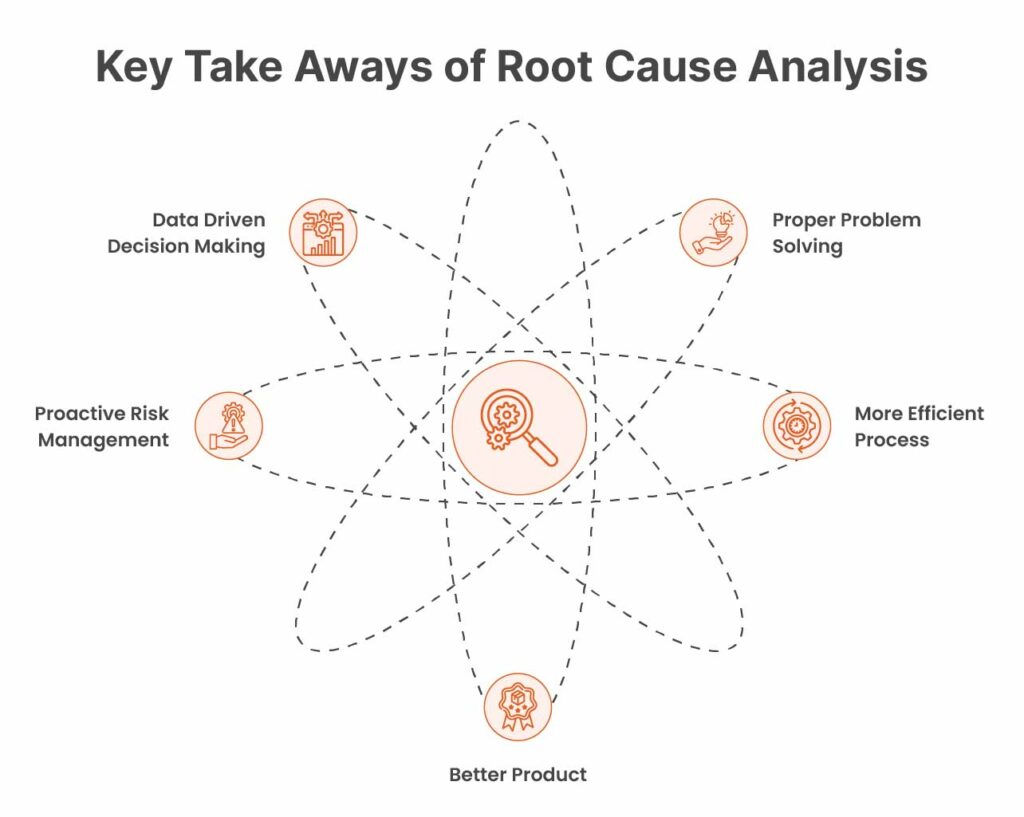
Root cause analysis transforms incident response from a reactive function into a continuously improving security discipline.
- Eliminating Recurrence Through Control Validation
Every security incident exposes a failed or bypassed control—whether it is an EDR blind spot, IAM misconfiguration, inadequate network segmentation, or weak patch governance. Root-level investigation identifies:
- Which security control failed?
- Why did it fail under real-world attack pressure?
- Whether the failure was architectural, procedural, or visibility-related
This directly strengthens incident response maturity, transforming it from tactical recovery into strategic hardening. Organizations that apply this rigor consistently witness a sharp decline in repeated attack patterns.
- Reducing Mean Time to Contain and Recover (MTTC & MTTR)
When security teams understand systemic failure points, they build faster response logic for future incidents:
- Known misconfiguration paths can be auto-remediated through SOAR
- High-risk assets receive pre-emptive isolation policies
- High-failure controls gain layered compensating mechanisms
As a result:
- Detection becomes faster
- Triage becomes more accurate
- Recovery becomes predictable
This directly translates into lower downtime, reduced service disruption, and improved business continuity metrics.
- Converting Security Logs into Engineering Intelligence
Security logs are often treated as forensic artifacts. Root-level security analysis transforms them into engineering feedback loops:
- Authentication failures map weak trust boundaries
- Privilege escalation traces reveal IAM design weaknesses
- Repeated malware families expose patching blind spots
Instead of remaining isolated spike events, attack telemetry becomes a blueprint for control redesign. This significantly improves response precision in future real-world attacks.

Why Organizations That Skip Root Level Analysis Stay Vulnerable?
When organizations skip root-level investigation, they don’t just miss insights; they systematically leave themselves exposed to repeated compromise.
They Patch The Same Weaknesses Repeatedly
Without root-level investigation, security teams focus on closing the visible vulnerability rather than fixing the underlying control failure. This results in the same misconfigurations, identity weaknesses, or architectural gaps being exploited again and again—often through slightly modified attack techniques. Over time, this creates a false sense of progress while the real security exposure remains unchanged.
They Suffer Recurring Incidents Disguised as “New Attacks”
In the absence of root cause analysis, similar attack patterns appear to be unrelated incidents. Adversaries simply reuse proven entry points with new malware variants or phishing lures. This leads to alert fatigue, poor incident prioritization, and degraded SOC effectiveness, as teams are constantly reacting to what seems like fresh threats but are actually recycled failures.
They Experience Unpredictable Downtime Cycles
When the true failure chain behind each incident is not mapped, outages occur without warning and recovery timelines remain inconsistent. Systems that were assumed to be secured repeatedly fail under pressure, making downtime patterns impossible to predict. This unpredictability disrupts business operations, impacts SLAs, and weakens customer confidence.
They Struggle With Cyber Insurance and Regulatory Deep-Dive Assessments
Modern cyber insurers and regulators demand evidence of preventive remediation, not just rapid containment. Organizations that cannot demonstrate documented root-level findings, control redesign, and long-term risk reduction are classified as high-risk. This leads to higher premiums, policy exclusions, failed renewals, and adverse regulatory outcomes.
In Contrast: Structural Cyber Resilience Through Root Cause Analysis
- They Eliminate Attack Conditions, Not Just Attack Indicators
Organizations that operationalize root cause analysis across incident response and VAPT audit programs remove the systemic conditions that enable exploitation. Instead of blocking a single malicious IP or patching one exposed service, they redesign trust boundaries, eliminate excessive privileges, and close entire attack paths—making repeated compromise structurally impossible.
- They Achieve Predictable Downtime and Measurable Risk Reduction
With every incident feeding engineering and governance improvements, downtime becomes predictable and progressively reduces. Security controls improve with each investigation, leading to fewer business disruptions, stronger audit outcomes, and a steadily increasing cyber maturity score.
Join our weekly newsletter and stay updated
How Kratikal Can Help You with Root Cause Analysis?
At Kratikal, we help organizations go beyond surface-level incident resolution by conducting a comprehensive Root Cause Analysis that pinpoints exactly how and why a security incident occurred. Our experts reconstruct the complete attack timeline, analyze exploited vulnerabilities, and identify gaps across technology, processes, and controls. Through detailed, evidence-backed insights and tailored remediation strategies, we empower businesses to eliminate recurring issues, strengthen their security architecture, and enhance overall cyber resilience. With Kratikal’s RCA approach, integrated seamlessly with our VAPT and incident response services, organizations gain the clarity and confidence needed to prevent future breaches and build a stronger security posture.
FAQs
- What are the 5 P’s of Root Cause Analysis?
The five P’s, parts, position, paper, people, and paradigms, form a solid framework. Even though software gathered the data in this case, the methodology itself is robust and delivers strong results with or without digital tools.
- What is the RCA methodology?
RCA (Root Cause Analysis) is a systematic and structured methodology used to uncover the underlying reasons behind problems rather than focusing on surface-level symptoms. It leverages techniques such as the 5 Whys and Fishbone Diagrams to identify true failure points. The goal is to implement lasting solutions, prevent recurrence, and enhance overall operations. The process typically involves defining the problem, gathering relevant data, identifying root causes, and implementing corrective actions to eliminate them effectively.
The post How Root Cause Analysis Improves Incident Response and Reduces Downtime? appeared first on Kratikal Blogs.
*** This is a Security Bloggers Network syndicated blog from Kratikal Blogs authored by Shikha Dhingra. Read the original post at: https://kratikal.com/blog/how-root-cause-analysis-improves-incident-response-and-reduces-downtime/
如有侵权请联系:admin#unsafe.sh