
好的,我现在需要帮用户总结一篇文章的内容,控制在100个字以内。用户已经给出了文章的详细内容,所以我得先通读一遍,理解主要信息。 文章讲的是朝鲜的IT招募者如何利用AI和深度伪造技术,诱骗开发者出租身份,从而为政权赚取收入。他们通过冒充合法工程师,使用代理人的电脑进行恶意活动,并通过GitHub等平台发布招聘信息。 接下来,我需要提取关键点:朝鲜的IT招募者、AI和深度伪造、诱骗开发者、出租身份、赚取收入。然后用简洁的语言把这些点连贯起来。 还要注意不要超过100个字,并且直接描述内容,不需要开头语。所以最终的总结应该涵盖这些要点,同时保持简洁明了。 </think> 朝鲜IT招募者利用AI和深度伪造技术诱骗开发者出租身份,以赚取收入。他们冒充合法工程师,使用代理人的电脑进行恶意活动,并通过GitHub等平台发布招聘信息。 2025-12-2 15:0:27 Author: www.bleepingcomputer.com(查看原文) 阅读量:1 收藏

In an unprecedented intelligence operation, security researchers exposed how North Korean IT recruiters target and lure developers into renting their identities for revenue generation.
Famous Chollima (also known as WageMole), part of North Korea’s state-sponsored Lazarus group, is known for social-engineering campaigns to infiltrate Western companies for espionage and revenue generation for the regime.
They managed to trick recruiters and secure jobs at Fortune 500 companies by leveraging stolen identities and a lot of AI, including deep fake videos, and avoiding appearing on camera during interviews.
Another method is to recruit legitimate engineers and convince them to act as a figurehead in DPRK agents’ operation to get a remote job at a targeted company.
The frontman would have to be the face of the agents in the interaction with the company during interviews and would receive a percentage of the salary, between 20% and 35% for the duration of the contract.
To get a larger sum, the compromised engineer would have to let DPRK agents use their computer.
This is to hide the North Korean’s location and their traces, since they would use the computer and the engineer as a proxy for malicious activities.
Mauro Eldritch, a hacker and threat intelligence specialist at BCA LTD, says that the compromised engineer takes all the risk as they rented their identity and will be the only one responsible for any damage done.
Spamming GitHub repositories
Eldritch is familiar with Famous Chollima’s recruiting tactics while leading the Quetzal Team, the Web3 Threats Research Team at digital financial services company Bitso.
He documented several encounters with DPRK agents looking for gullible engineers or developers ready to make some quick money [1, 2, 3, 4, 5, 6].
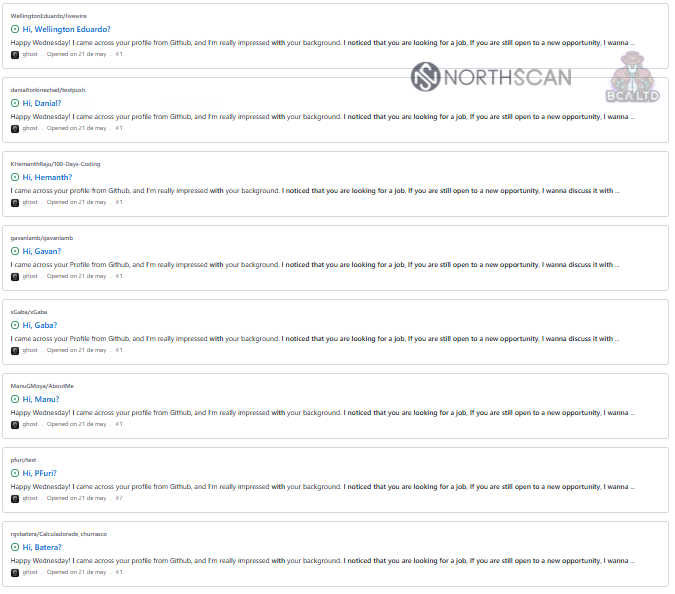
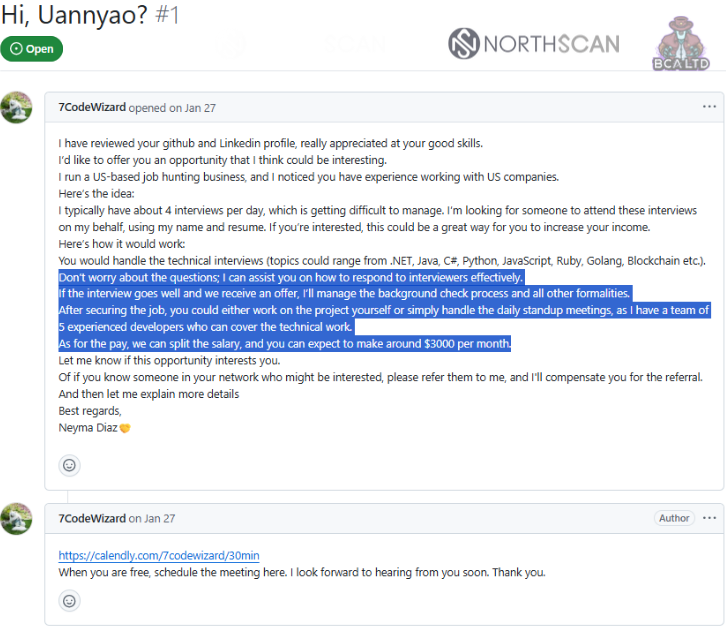
Recently, he found multiple accounts on GitHub that were spamming repositories with a recruitment announcement for individuals who would attend technical interviews (.NET, Java, C#, Python, JavaScript, Ruby, Golang, Blockchain) under a provided fake identity.
source: Mauro Eldritch and Heiner García
The candidate would not have to be proficient in the technical areas, as the recruiter would assist “to respond to interviewers effectively.”
To make the offer more attractive, the DPRK agent set the financial expectation to “around $3000 per month.”
source: Mauro Eldritch and Heiner García
Eldritch accepted the challenge and developed a plan with Heiner García from the NorthScan threat intelligence initiative for uncovering North Korean IT worker infiltration.
The two researchers used sandbox services from ANY.RUN, a company that provides solutions for interactive malware analysis and threat intelligence, to set up a simulated laptop farm honeypot that could record the activity in real time for later analysis of the tactics and tools used in the operation.
García assumed the role of the rookie engineer responding to the recruitment offer. He posed as a previously contacted individual, a developer named Andy Jones, based in the United States.
The researchers created a new GitHub profile that mimicked Jones’ down to the public repositories and associated details.
Following multiple interactions with the DPRK agent to obtain information about the operation, the North Korean recruiter asked for 24/7 remote access to Eldritch’s laptop over AnyDesk for “remote work.”
Slowly, the agent disclosed that he needed the ID, full name, visa status, and address to apply to interviews as Andy Jones.
For acting as a frontman in the interviews, Eldritch’s persona would receive 20% of the salary, or “10% for only using my information and laptop whilst he conducts the interviews himself.”
The DPRK agent also asked for the social security number, for background checks, and explained that all accounts need to be verified on KYC-compliant platforms.
Remoting in via Astrill VPN
After setting up the sandboxed ANY.RUN environment, based in Germany, and tunneled the connection through a residential proxy to appear US-based, the researchers were ready to let the “recruiter” connect remotely to their “laptop.”
The researchers had full control over the environment and could prevent the threat actor from browsing while keeping the remote connection active, and crash the machine at will, to deny malicious activity against any third party.
After connecting to the researchers’ machine remotely, the threat actor started to check the hardware on the system, set Google Chrome as the default browser, and verified the location of the station.
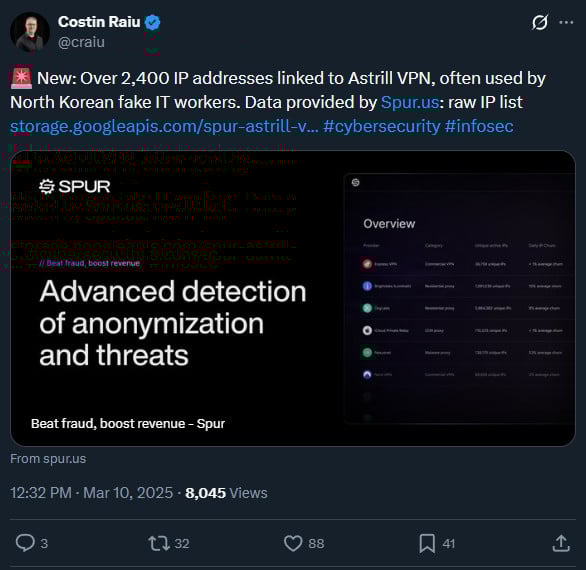
The researchers noticed that the remote connection came through Astrill VPN, a popular service among North Korean fake IT workers.
source: Costin Raiu
Tools and tricks of the trade
The two researchers tried to stall the North Korean’s activity as much as possible, pushing his patience to the limit by crashing the machine and removing all the progress, or by delaying their reply to messages.
They even blamed all the technical “mishaps” on a network misconfiguration or the agent’s use of a VPN connection.
In one instance, the researchers trapped the DPRK agent in a login and CAPTCHA loop where he spent almost an hour trying to escape.
However, all these actions led to obtaining more information about the operation, the individuals involved, potential partners from different countries, and the tools and tricks used.
The researchers observed multiple AI-powered extensions like AIApply, Simplify Copilot, Final Round AI, and Saved Prompts that helped the threat actor autofill job applications and create resumes, save ChatGPT LLM prompts, and for getting real-time replies during interviews.
Apart from this, the threat actor also revealed OTP authentication extensions, the use Google Remote Desktop, and routine system reconnaissance tactics.
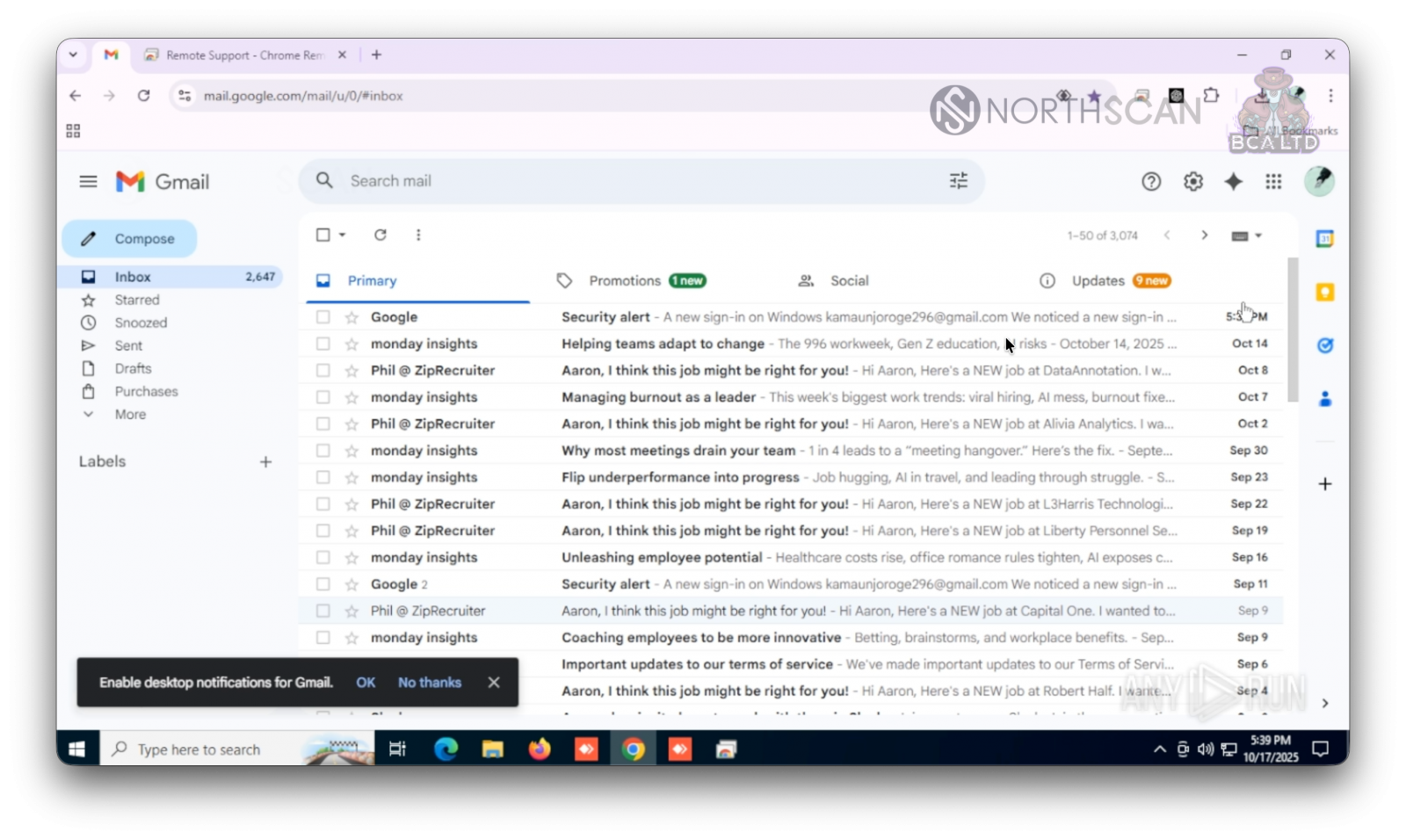
At one point, the fake recruiter logged into his Google account and activated the synchronization option, which loaded in the browser all the preferences associated with the profile, and gave access to his email inbox.
source: Mauro Eldritch and Heiner García
García and Eldritch could see multiple subscriptions to job-seeking platforms, installed the browser extensions, and Slack workspaces and partial chats.
“He spoke regularly with an individual named Zeeshan Jamshed who in an initial conversation stated that he would be out for Eid, the Muslim festivity,” the researchers say in a report shared with BleepingComputer.
According to the report, the Famous Chollima team involved in this operation consisted of six members, who used the names Mateo, Julián, Aaron, Jesús, Sebastián, and Alfredo.
However, it should be mentioned that there are multiple North Korean teams engaged in Famous Chollima operations, some of them having ten members, and they compete with each other, poaching potential victims, as Eldritch and García also point out in the report.
The information collected from the interaction with the North Korean threat actor could serve defenders across both small and large enterprises as an early warning of a potential infiltration attempt.
The data could help them anticipate the group’s behaviors, disrupt workflows, and improve detection beyond standard malware IoC matching.

Break down IAM silos like Bitpanda, KnowBe4, and PathAI
Broken IAM isn't just an IT problem - the impact ripples across your whole business.
This practical guide covers why traditional IAM practices fail to keep up with modern demands, examples of what "good" IAM looks like, and a simple checklist for building a scalable strategy.
如有侵权请联系:admin#unsafe.sh