Creating a Linux Application Using VSCodium, Cline, OpenRouter, and Claude
文章描述了在Linux系统上使用VSCodium、Cline、OpenRouter和Claude创建一个图形化屏幕捕捉应用的过程。该应用支持方形区域选择、1:1比例捕捉、PNG格式输出、预览功能以及暗模式,默认保存位置和自动命名等功能,并采用C++与Qt框架实现。 2025-11-4 00:49:1 Author: taosecurity.blogspot.com(查看原文) 阅读量:64 收藏

Creating a Linux Application Using VSCodium, Cline, OpenRouter, and Claude

In March I created a Windows Application Using Visual Studio Code, Cline, OpenRouter, and Claude. This was a program that created square screen captures. The user doesn't need to manually ensure the dimensions are a square. The program makes the window grow and shrink while keeping the length equal to the height.


In June I created an equivalent program on Linux using VSCodium, Cline, OpenRouter, and Claude.

I provided this prompt, which I derived from the last project.

== 

Create a graphical Linux application to take screen captures with the following features:


Square Region Selection: Enforces a 1:1 aspect ratio during region selection


1:1 Aspect Ratio: Ensures all captures are perfectly square


PNG Output: Saves high-quality images in PNG format


Preview: Shows the captured image before saving


Dark Mode by Default: Toggle to light theme if desired


Square Interface: The application window itself uses a square ratio


Default Save Location: Set a preferred folder for saving captures


Automatic File Naming: Uses format "BejCap-YYYYMMDD###" for organized file management

I prefer C++ with Qt. 

For shortcuts use Ctrl+S to Save the current image and Esc to Cancel region selection (when in region selection mode). 

I do not want to capture to clipboard.

== 

I also supplied these guidelines:

Always test the project at the end to ensure it doesn't contain errors.


Don't create placeholder code unless you plan to expand on it later.


Code from A to Z rather than just small parts that don't fulfill the user's needs.


Keep project files between 300-500 lines where possible.


Don't duplicate code. Build upon existing implementations.

== 

I had to install the following to enable the program development:
 

sudo apt install build-essential cmake qtbase5-dev qt5-qmake qtbase5-dev-tools 

The development seemed much faster than my last project, and the result works very well.


Popular posts from this blog

Zeek in Action Videos

Image

This is a quick note to point blog readers to my Zeek in Action YouTube video series for the Zeek network security monitoring project .  Each video addresses a topic that I think might be of interest to people trying to understand their network using Zeek and adjacent tools and approaches, like Suricata, Wireshark, and so on.  I am especially pleased with Video 6 on monitoring wireless networks . It took me several weeks to research material for this video. I had to buy new hardware and experiment with a Linux distro that I had not used before -- Parrot .  Please like and subscribe, and let me know if there is a topic you think might make a good video.

MITRE ATT&CK Tactics Are Not Tactics

Image

Just what are "tactics"? Introduction MITRE ATT&CK  is a great resource, but something about it has bothered me since I first heard about it several years ago. It's a minor point, but I wanted to document it in case it confuses anyone else. The MITRE ATT&CK Design and Philosophy document from March 2020 says the following: At a high-level, ATT&CK is a behavioral model that consists of the following core components: • Tactics, denoting short-term, tactical adversary goals during an attack; • Techniques, describing the means by which adversaries achieve tactical goals; • Sub-techniques, describing more specific means by which adversaries achieve tactical goals at a lower level than techniques; and • Documented adversary usage of techniques, their procedures, and other metadata. My concern is with MITRE's definition of "tactics" as "short-term, tactical adversary goals during an attack," which is oddly recursive. The key word in the tacti...

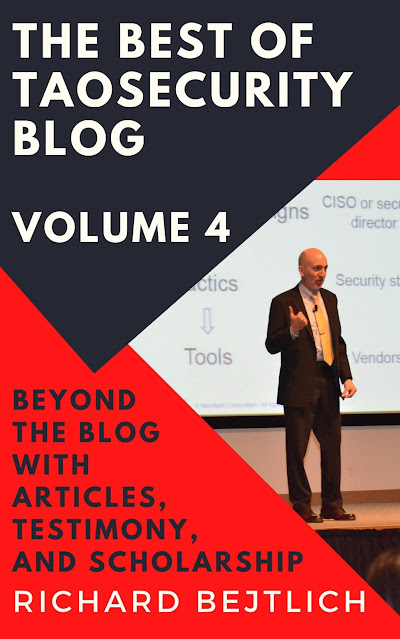
New Book! The Best of TaoSecurity Blog, Volume 4

Image

  I've completed the TaoSecurity Blog book series . The new book is  The Best of TaoSecurity Blog, Volume 4: Beyond the Blog with Articles, Testimony, and Scholarship .  It's available now for Kindle , and I'm working on the print edition.  I'm running a 50% off promo on Volumes 1-3 on Kindle through midnight 20 April. Take advantage before the prices go back up. I described the new title thus: Go beyond TaoSecurity Blog with this new volume from author Richard Bejtlich. In the first three volumes of the series, Mr. Bejtlich selected and republished the very best entries from 18 years of writing and over 18 million blog views, along with commentaries and additional material.  In this title, Mr. Bejtlich collects material that has not been published elsewhere, including articles that are no longer available or are stored in assorted digital or physical archives. Volume 4 offers early white papers that Mr. Bejtlich wrote as a network defender, either for technica...


文章来源: https://taosecurity.blogspot.com/2025/11/creating-linux-application-using.html
如有侵权请联系:admin#unsafe.sh